
METHOD NOTES 10- What Material Resistance Reveals
Resistance creates the need for judgment. Observation reveals how that judgment develops.
Materials do not always follow intention.
Paper tears. Paint spreads. Adhesives fail. Structures collapse. Surfaces resist pressure. Weight changes balance. Some choices can be revised easily; others leave visible and partly irreversible consequences.
These events are often treated as technical problems to eliminate as quickly as possible.
Within CCH, they can serve another function.
Material resistance creates situations in which learners must observe what happened, interpret physical feedback, compare alternatives, regulate frustration, revise a strategy, and decide what to do next.
The central question is therefore not:
How can every difficulty be removed?
It is:
What becomes visible when a learner encounters resistance and must respond without a predetermined answer?
CCH does not assume that difficulty automatically produces growth. Resistance can support development only when the challenge remains manageable, the environment feels sufficiently safe, and appropriate support is available.
Under these conditions, material constraints can create meaningful opportunities to exercise judgment, adaptation, persistence, and self-regulation.
Materials Create Real Conditions
A creative idea may initially appear unlimited.
Once that idea enters physical reality, it must respond to actual conditions:
weight
scale
surface
flexibility
absorption
tension
drying time
structural stability
compatibility between materials
These conditions do not merely interrupt the idea. They help shape it.
Material Engagement Theory proposes that thinking cannot always be understood as an internal plan that is simply transferred into an object. Human thought develops through interaction among perception, bodily action, tools, materials, and the environment.
From this perspective, making is not the final execution of thinking.
It is part of thinking itself.
A learner may not fully understand why a cardboard structure needs a wider base until the structure begins to tilt. The material response produces information that verbal instruction alone may not provide.
The process becomes:
intention → action → material response → observation → decision → revision
Each stage changes what the learner knows about the problem.
Constraint Is Different from Restriction
A restriction closes possibility without developmental purpose.
A meaningful constraint gives the learner something real to work with.
For example:
limited structural strength requires reinforcement
drying time requires waiting and sequencing
incompatible surfaces require another joining method
limited material quantity requires prioritization
an unstable composition requires redistribution
an irreversible mark requires adaptation
The value lies neither in making the task artificially difficult nor in celebrating frustration.
The value lies in creating a situation where decisions have consequences.
Studio practice becomes cognitively significant because learners must coordinate attention, working memory, inhibition, flexibility, planning, and self-regulation while pursuing a meaningful goal. Executive-function research commonly identifies working memory, inhibitory control, and cognitive flexibility as core processes supporting goal-directed behavior, with planning and problem-solving emerging through their coordination.
Material constraints make these processes observable in action.
Resistance Requires Decision-Making
When a material does not behave as expected, the learner must decide how to interpret the situation.
Possible questions include:
Is the problem caused by the material or the method?
Should the original plan be preserved or changed?
Is reinforcement possible?
Would another material work better?
Does the problem require technical support?
Can the unexpected result become part of the work?
Is the current direction still worth continuing?
These are not purely artistic decisions.
They involve comparison, consequence, uncertainty, and responsibility.
A learner may need to remember the original intention, inhibit an impulsive response, examine evidence, generate alternatives, and shift strategy. Cognitive flexibility is specifically concerned with adapting thinking and behavior when contextual demands change.
Within CCH, material resistance is therefore interpreted as a potential decision-making environment.
The material does not tell the learner exactly what to do.
It provides evidence that requires interpretation.
What Creative Resistance Can Support
Creative resistance may create opportunities to practice:
sustained attention
frustration tolerance
problem identification
cognitive flexibility
reality-based judgment
revision
persistence
appropriate help-seeking
acceptance of partial irreversibility
recognition of meaningful closure
The wording matters.
CCH does not claim:
Resistance teaches resilience automatically.
The more accurate position is:
Resistance creates an opportunity to practice adaptation, judgment, and recovery.
Whether that opportunity becomes developmentally useful depends on several conditions:
the difficulty is within a manageable range
the learner understands enough of the problem to respond
emotional distress does not exceed current regulatory capacity
adult support does not replace the learner’s responsibility
enough time is available for observation and revision
the task remains meaningful to the learner
Stress can impair working memory and cognitive flexibility, particularly when demands become excessive.
The educational goal is therefore not maximum difficulty.
It is productive resistance: enough challenge to require thought, with enough support to keep thought active.
Productive Resistance and Overload
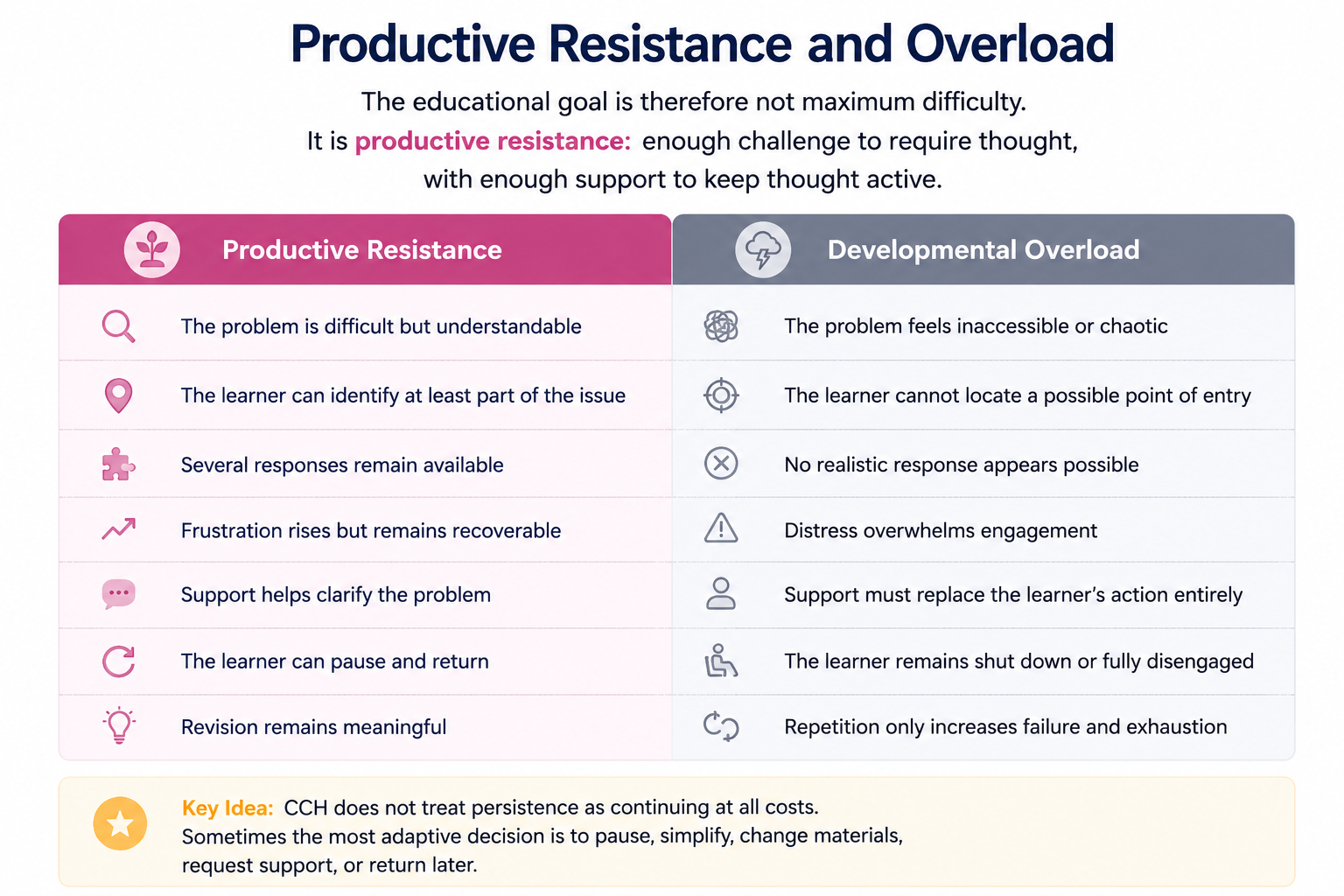
CCH does not treat persistence as continuing at all costs.
Sometimes the most adaptive decision is to pause, simplify, change materials, request support, or return later.
The developmental question is not whether the learner endured indefinitely.
It is whether the learner developed a more informed response to the situation.
Failure Becomes Information
In conventional product-centered instruction, failure may be interpreted mainly as deviation from the expected result.
Within CCH, failure can also be read as feedback.
A failed connection may reveal:
insufficient surface area
incompatible materials
poor weight distribution
inadequate drying time
an unrealistic structural expectation
A learner who can identify the source of failure has moved beyond the general conclusion:
“It doesn’t work.”
Toward a more specific conclusion:
“The upper section is heavier than the base can support.”
This shift matters because precise observation supports precise revision.
Executive functions allow individuals to resist immediate responses, maintain relevant information, and adapt to novel challenges.
Material failure makes those processes necessary in a concrete, visible situation.
Revision Is Evidence of Thinking
Revision is sometimes interpreted as correcting a mistake.
Within CCH, revision is broader.
It may include:
changing scale
replacing a material
reinforcing a structure
reorganizing sequence
reinterpreting an unexpected result
simplifying an overcomplicated plan
preserving a visible trace of failure
abandoning one direction for a more viable one
Revision shows that the learner is using new evidence to reconsider an earlier decision.
This is closely related to cognitive flexibility: the capacity to shift perspective or strategy in response to changing demands.
A finished artwork may conceal how much revision occurred.
Observation helps reveal whether the learner:
noticed the need for change
accepted material evidence
generated an alternative
requested support appropriately
maintained ownership of the final decision
Help-Seeking Under Constraint
Material problems often create moments when assistance becomes necessary.
CCH does not treat all help-seeking as dependence.
It examines the form of the request.
Compare:
“Can you do this for me?”
with:
“The tape keeps lifting from this surface. Is there another way to connect it?”
The second request identifies the problem while preserving responsibility for the solution.
Appropriate help-seeking can indicate:
awareness of current limits
problem identification
strategic use of available support
continued ownership
readiness to learn a technical procedure
The goal is not complete independence from assistance.
It is the ability to use assistance without surrendering judgment.
Observation Is Different from Evaluation
Evaluation and observation serve different functions.
Evaluation usually asks:
Did the work meet a standard?
Was the intended outcome achieved?
How successful is the final result?
How does this performance compare with an expectation?
Observation asks:
How did the learner enter the problem?
What did the learner notice?
How were alternatives compared?
What happened after resistance appeared?
When was help requested?
How did the learner recover?
Did the strategy change when the evidence changed?
What pattern appears across time?
Harvard Project Zero’s Studio Thinking framework identifies habits such as observing, reflecting, envisioning, engaging and persisting, and stretching and exploring—forms of thinking that occur during studio practice and cannot always be inferred from the finished object.
Observation therefore expands the evidence base.
It does not replace artistic evaluation in every context. Technical assessment may still be appropriate when a specific skill is being taught.
CCH uses observation because its developmental questions extend beyond visual quality.
What CCH Observes When Materials Resist
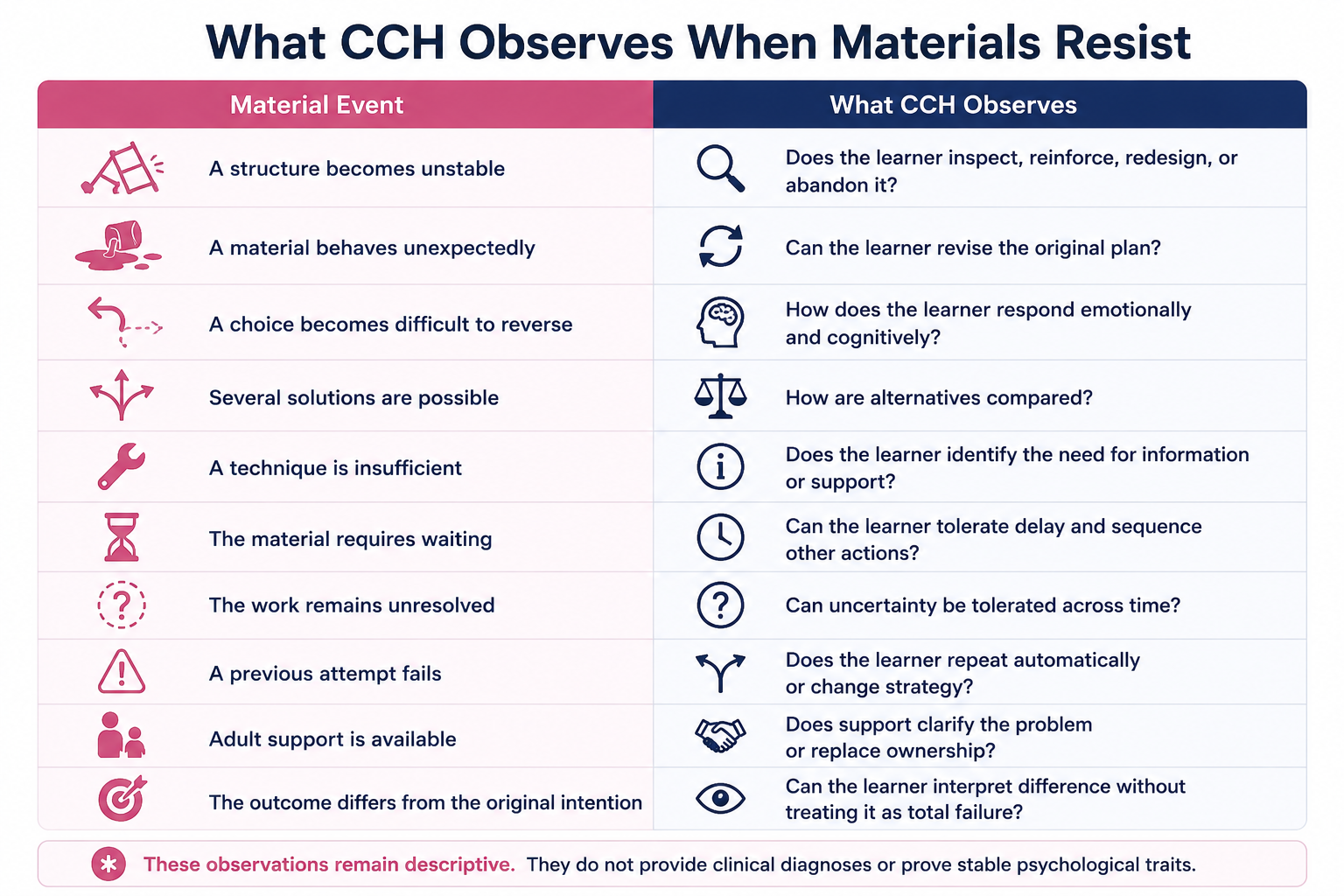
These observations remain descriptive.
They do not provide clinical diagnoses or prove stable psychological traits.
Observation Without Premature Judgment
A single difficult moment should not define a learner.
For example:
“The learner lacks persistence.”
is a broad interpretation.
A more grounded observation would be:
“After the first structure collapsed, the learner moved away from the work and requested that the adult rebuild it. After a focused question about the base, the learner returned and added two supports independently.”
The second statement records sequence, support, and response.
CCH distinguishes among:
Observable event — what occurred
Interpretation — what the event may suggest
Recurring pattern — what appears across multiple sessions
Developmental change — how that pattern shifts over time
This distinction reduces premature labeling and strengthens documentation.
Studio Thinking similarly emphasizes making learner thinking visible through observation of process, reflection, and work over time rather than relying only on generalized impressions.
The Same Behavior Can Mean Different Things
Hesitation may indicate:
careful observation
fear of failure
uncertainty about materials
waiting for adult approval
strategic planning
emotional overload
Persistence may indicate:
meaningful engagement
inflexible repetition
fear of stopping
productive determination
dependence on adult encouragement
Fast completion may indicate:
strong planning
impulsivity
technical familiarity
low engagement
an efficient and appropriate solution
Observation requires context.
CCH therefore avoids interpreting behavior through a single fixed category.
The question is not only what happened, but also:
under what conditions
after which prompt
with what level of support
in response to which material event
whether the pattern repeated
whether it changed over time
From Material Event to Developmental Evidence
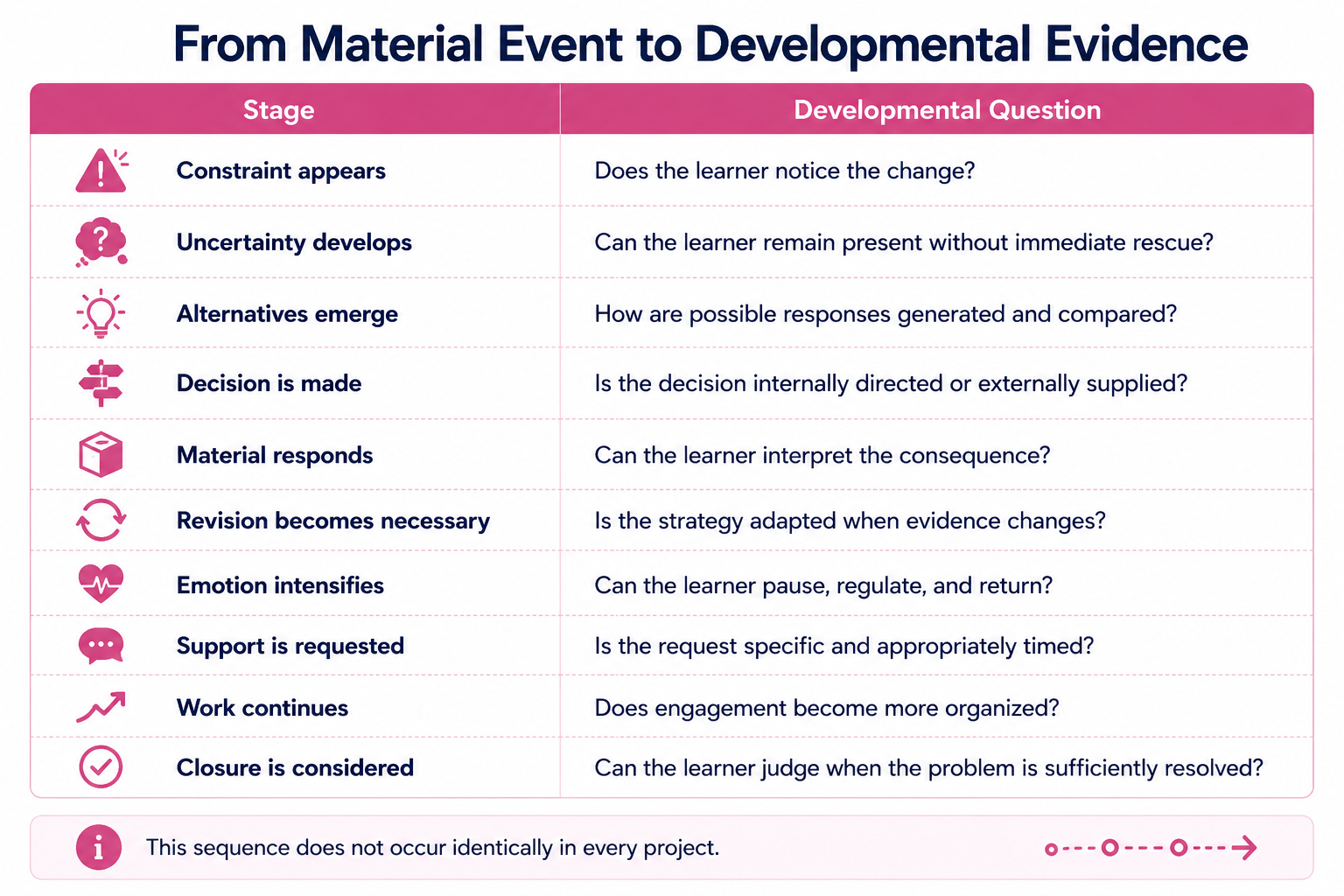
This sequence does not occur identically in every project.
It provides a framework for understanding how physical constraints can make cognitive and regulatory processes more visible.
Why Observation Matters More Than Quick Correction
Immediate correction may produce a cleaner result.
It may also remove the opportunity to see:
whether the learner detects the problem
how uncertainty is tolerated
which alternatives are generated
whether evidence changes the strategy
how help is requested
whether recovery occurs
CCH does not avoid intervention at all costs.
It delays unnecessary intervention long enough to understand what the learner can currently do.
The adult may intervene when:
safety is involved
the problem is technically inaccessible
emotional distress has exceeded a productive range
the learner lacks the necessary information
repeated effort is no longer producing meaningful learning
The aim is calibrated support.
Enough intervention to preserve engagement.
Enough space to preserve judgment.
Materials Reveal More Than Skill
A learner’s handling of materials can reveal technical familiarity.
It may also reveal how the learner approaches:
uncertainty
physical consequence
delay
irreversibility
competing possibilities
frustration
support
closure
Material Engagement Theory argues that materials are not passive objects standing outside cognition; they participate in how action and thought are organized.
For CCH, this means the material encounter itself becomes educational evidence.
The artwork records the visible outcome.
The process reveals how the learner negotiated reality while producing it.
Evidence Accumulates Across Time
One collapsed structure does not demonstrate low resilience.
One successful revision does not prove stable cognitive flexibility.
CCH looks for recurring changes such as:
noticing material problems earlier
describing problems more precisely
trying alternatives before requesting rescue
making more deliberate choices
recovering more quickly after failure
accepting partial irreversibility
using support more strategically
revising without abandoning the entire work
recognizing closure with greater independence
Longitudinal observation is important because development appears through patterns, not isolated performances.
Project Zero’s student-work documentation similarly illustrates how decisions, artistic voice, observation, and development can be traced across stages and over time.
What This Method Note Does Not Claim
CCH does not claim that:
all material difficulty is educational
frustration should be prolonged indefinitely
learners should solve every problem alone
failure automatically produces resilience
studio observation provides clinical assessment
one project proves cognitive development
material practice transfers automatically to every area of life
Research on far transfer from cognitive training remains contested; improvement in one context does not guarantee broad generalized effects.
The more defensible CCH claim is:
Studio practice repeatedly creates meaningful situations in which learners must observe, decide, adapt, seek support, regulate, and revise.
These processes can be documented educationally.
Stronger causal claims require validated measures, formal research design, comparison conditions, and independent review.
Key Takeaway
Material resistance creates the need for judgment. Observation reveals how learners interpret consequences, compare alternatives, seek support, revise decisions, recover from frustration, and continue under uncertainty.
Within CCH, resistance is neither an enemy to eliminate nor a hardship to glorify.
It is a condition that can make thinking visible.
Materials create real constraints.
Decision-making converts those constraints into action.
Observation helps us understand how that decision-making develops over time.
References
Diamond, A. “Executive Functions.” Annual Review of Psychology. Core executive functions include working memory, inhibitory control, and cognitive flexibility.
Diamond, A., & Lee, K. “Interventions Shown to Aid Executive Function Development in Children.”
Dajani, D. R., & Uddin, L. Q. “Demystifying Cognitive Flexibility.”
Hohl, K., et al. “Measuring Cognitive Flexibility.”
Malafouris, L. “Mind and Material Engagement.”
Malafouris, L. “Between Brains, Bodies and Things.”
Malafouris, L. “Mark Making and Human Becoming.”
Shields, G. S., et al. “The Effects of Acute Stress on Core Executive Functions.”
Harvard Project Zero. Eight Studio Habits of Mind.
Harvard Project Zero. Studio Thinking: The Real Benefits of Visual Arts Education.
Harvard Project Zero. Student Work Examples.