
ADULT STUDIO CASE 01-Re-entering Creativity After Years of Evaluation
Breaking the Traditional Image of Art
Creative re-entry often begins by questioning what adults have learned to recognize as “real art.”
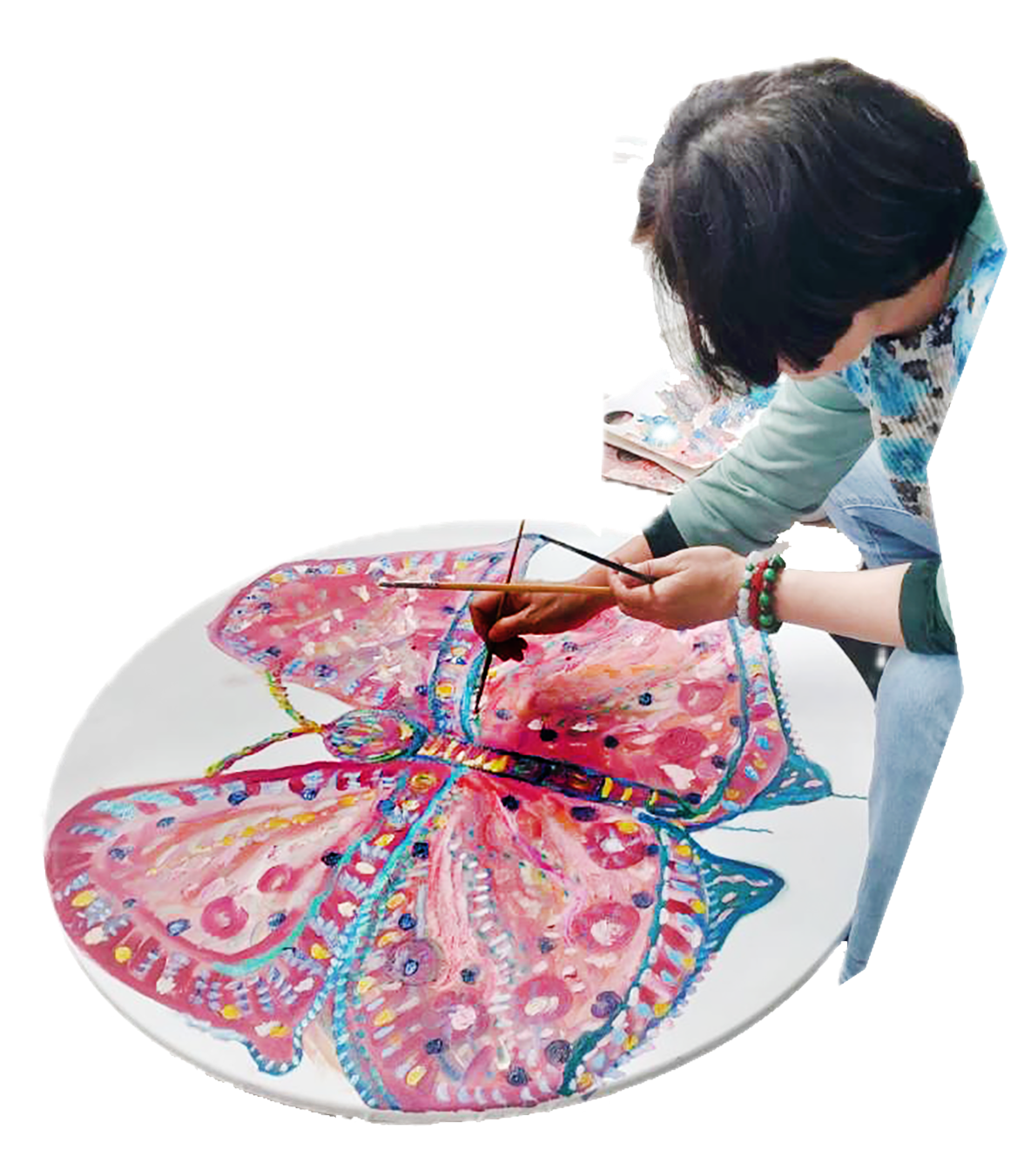
Many adults enter the studio carrying an established image of what art should look like.
Art should demonstrate technical skill.
A successful painting should be refined.
Drawing should resemble its subject.
Abstract art should still appear intentional and sophisticated.
A capable adult should already know what to do.
These assumptions may come from school assessment, professional culture, museum conventions, social comparison, or years of receiving praise for correctness and criticism for visible mistakes.
As a result, returning to creativity is rarely only a matter of learning how to use paint.
The deeper challenge is often psychological:
Can an adult begin making before knowing whether the result will look accomplished, mature, or recognizably artistic?
Within CCH adult studio practice, creative re-entry begins by loosening inherited expectations and rebuilding a direct relationship with perception, choice, and material response.
Evaluation Changes the Creative Starting Point
Adults often approach painting as though the work is already being assessed.
Before the first mark appears, they may ask:
Will this look professional?
Does this resemble real art?
Is this too simple?
What if the colors become unattractive?
What is the correct way to begin?
Will other people understand it?
What if the work looks childish?
This evaluative stance shifts attention away from the present material encounter and toward an imagined future judgment.
The canvas becomes less a space for investigation and more a test of ability.
Research distinguishes perfectionistic striving from perfectionistic concern. High concern over mistakes, self-doubt, and external standards can restrict experimentation, while recent creativity research has found negative associations between perfectionism and originality in divergent-thinking tasks. These findings do not mean that high standards are inherently harmful; they indicate that rigid self-evaluation can interfere with exploratory thought.
For adult studio practice, the issue is therefore not whether standards should disappear.
It is whether evaluation arrives so early that experimentation never has time to begin.
The Traditional Image of Art
Many adults have learned to recognize artistic legitimacy through a narrow group of visible signals:
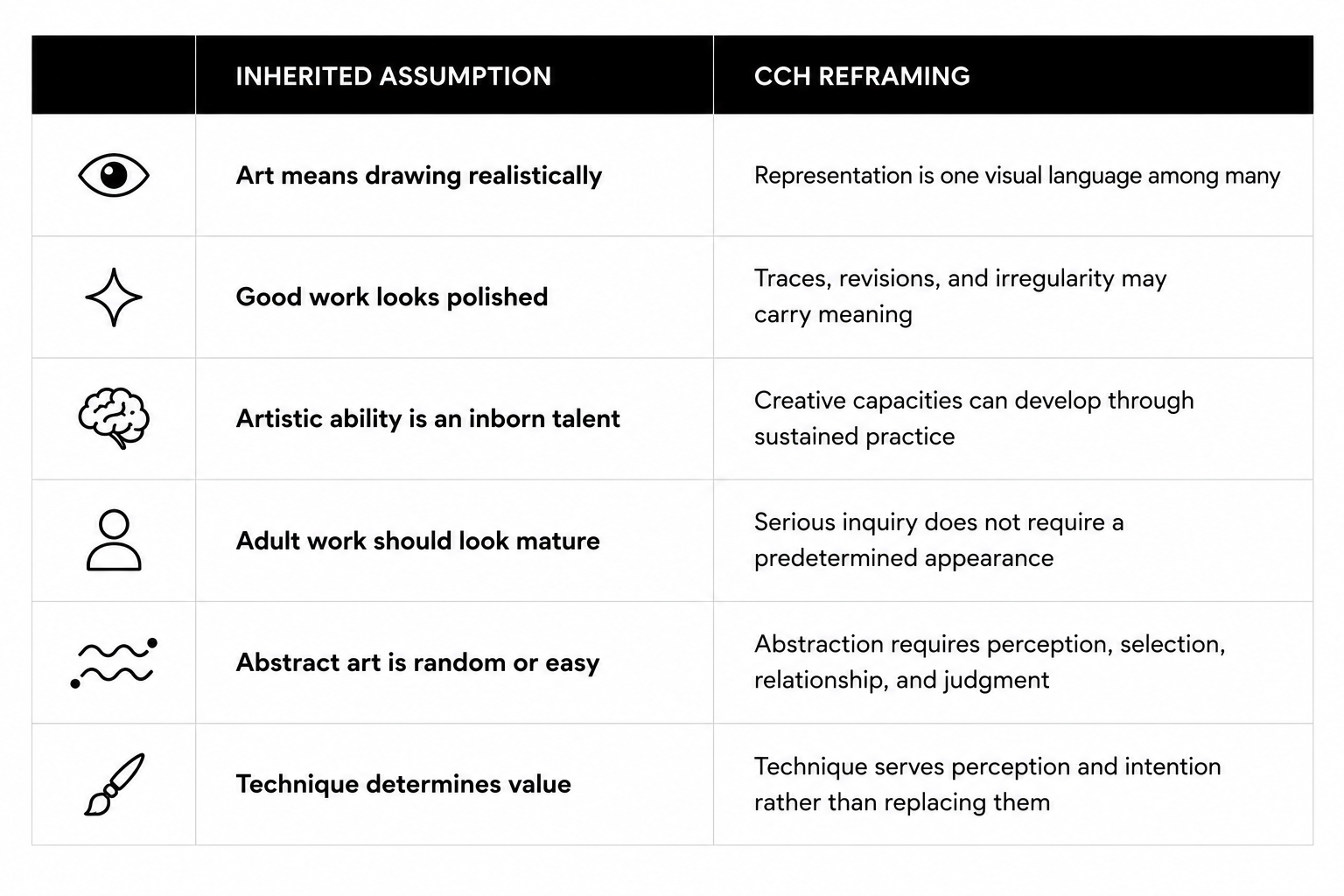
These assumptions are not entirely false. Realistic drawing requires skill. Refinement can strengthen a work. Technical knowledge expands what an artist can do.
The problem appears when one tradition becomes the definition of art itself.
A learner who believes that creativity is an innate and fixed ability may interpret early difficulty as evidence that they are simply “not artistic.” Research on creative mindsets distinguishes fixed beliefs—creativity as an inborn trait—from growth-oriented beliefs that creative capacities can change through learning and practice. Growth creative mindsets have been associated with stronger creative motivation and thinking, although mindset is only one influence among many.
CCH therefore does not begin by asking adults to prove artistic talent.
It asks them to notice what their inherited definition of talent has prevented them from trying.
From Producing Art to Entering a Process
The first developmental shift is subtle:
From “I need to make something that looks like art”
toward “I need to notice what I am seeing, choosing, and doing.”
This changes the function of the first mark.
The first mark no longer needs to establish the final composition. It can test viscosity, pressure, scale, contrast, movement, or surface response.
The adult begins to gather information:
How does this paint move?
What happens when the surface remains visible?
Which color changes the spatial balance?
What occurs when one layer covers another?
Does this accidental edge need correction?
What does the work now require?
The process becomes less about executing a fully formed image and more about allowing perception to develop through action.
Embodied and material-engagement theories support the broader proposition that cognition is shaped through bodily action and interaction with objects and environments. Malafouris argues that materials belong inside the “cognitive equation,” rather than functioning only as passive surfaces onto which finished ideas are transferred.
From this perspective, painting is not simply the physical delivery of an idea conceived in advance.
The idea continues to change because the material responds.
Material Encounter Interrupts Evaluation
Materials can interrupt the adult’s habitual reliance on verbal judgment.
Paint spreads before it can be fully controlled.
A scraped surface exposes earlier layers.
Water produces edges that cannot be precisely predicted.
Collage changes the scale and direction of the composition.
A color that appeared wrong may create a necessary contrast.
These events redirect the learner from abstract self-judgment toward observable evidence.
Instead of asking:
“Am I good at this?”
the learner may begin asking:
“What happened when I added this layer?”
This movement matters because the second question can be investigated.
It creates a practical next step.
The creative process is not one moment of inspiration but a sequence of thoughts and actions in which ideas are generated, tested, selected, transformed, and refined. Research on visual-art creation similarly describes creative production as a multistage process rather than a direct path from idea to completed object.
CCH uses material encounters to keep that process open long enough for new judgment to develop.
Abstract Work Is Not the Absence of Judgment
Adults who are unfamiliar with abstraction may interpret it in one of two ways:
as something intellectually inaccessible, or
as something anyone can produce without thought.
Both interpretations overlook the decisions abstraction requires.
An abstract painting may involve close attention to:
proportion
rhythm
visual weight
density
interval
repetition
edge quality
transparency
spatial tension
material history
The absence of realistic representation does not eliminate judgment.
It transfers judgment toward relationships within the work.
An abstract image may therefore provide an especially useful context for adults who are accustomed to asking whether a drawing is “correct.” Without a fixed external model, the learner must build criteria through perception.
The question changes from:
“Does this look like the object?”
to:
“What is happening among these forms, surfaces, and colors?”
What CCH Observes
CCH does not evaluate creative re-entry only through the final painting.
Observation may focus on whether the adult:
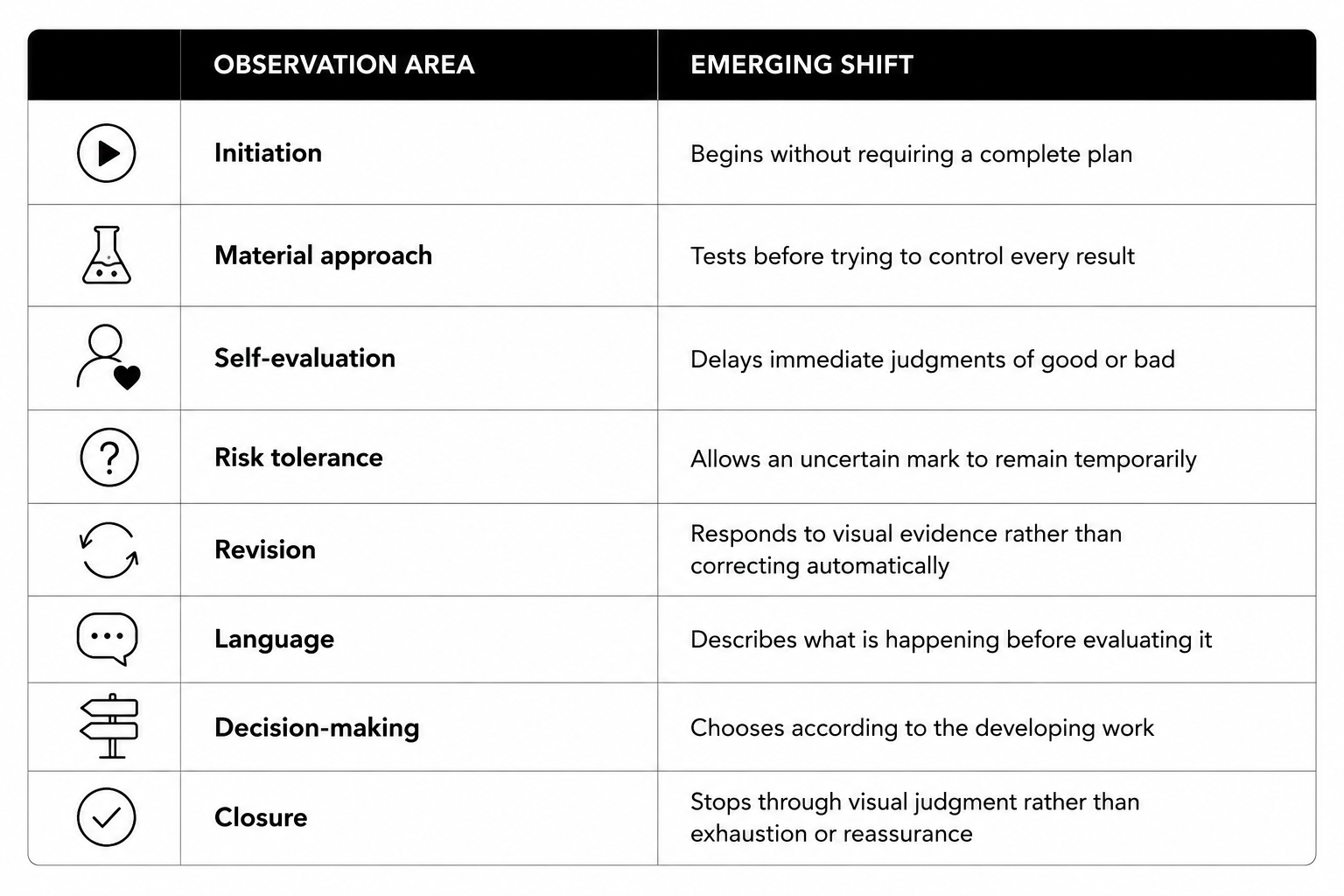
These are educational and studio-based observations. They are not psychological diagnoses or proof that a stable internal transformation has occurred.
The relevant evidence is the pattern that develops across repeated encounters.
Psychological Breakthrough Without Forced Expression
A psychological breakthrough in the studio does not require dramatic disclosure.
The adult does not need to explain trauma, reveal private memories, or turn every painting into autobiography.
Breakthrough may appear in a smaller and more precise form:
making the first mark without prolonged reassurance
allowing an unresolved area to remain
noticing beauty in an unintended trace
changing direction without interpreting revision as failure
trusting a visual decision before receiving approval
accepting that a serious work can begin through play
The breakthrough lies in changing the person’s relationship to uncertainty and evaluation.
It is not necessary for the artwork to look radically different.
The process of arriving there may already have changed.
Re-entering Creativity
Creative re-entry does not mean returning to a supposedly natural state untouched by education or culture.
Adults bring history, taste, skill, ambition, and prior knowledge into the studio. These do not need to be erased.
The task is to reorganize their role.
Technique becomes available without becoming the sole measure of legitimacy.
Standards can guide later refinement without controlling the first stage of exploration.
Knowledge of art history can deepen perception without requiring imitation.
Maturity can appear through attention and judgment rather than through a prescribed visual style.
The adult gradually moves from:
“I need to produce something that qualifies as art.”
toward:
“I am learning to observe how I perceive, choose, and respond through materials.”
That transition creates a new creative entrance.
Key Takeaway
Adults often return to creativity carrying inherited assumptions about talent, realism, refinement, and artistic legitimacy. CCH uses painting and material exploration to delay premature evaluation, make perception active, and rebuild trust in personal visual judgment.
The purpose is not to reject traditional art.
It is to expand the adult’s understanding of where artistic practice can begin.
Evidence Boundary
This case framework describes recurring educational concerns relevant to adult studio practice. It does not claim that artmaking automatically resolves perfectionism, anxiety, or other psychological conditions. Clinical conclusions would require appropriate assessment, validated measures, and qualified mental-health practice.
References
Botella, M., et al. “What Are the Stages of the Creative Process? What Visual Art Students Are Saying.” Frontiers in Psychology, 2018.
Goulet-Pelletier, J.-C., et al. “Investigating the Negative Link Between Perfectionism and the Generation of Original Ideas.” 2025.
He, W., et al. “From Growth and Fixed Creative Mindsets to Creative Thinking.” 2024.
Malafouris, L. How Things Shape the Mind: A Theory of Material Engagement. MIT Press.
Noë, A. Action in Perception. MIT Press.