
ADULT STUDIO CASE 02- From Control to Material Responsiveness
The Psychological Difficulty of Beginning
The first mark is often psychological before it is technical.
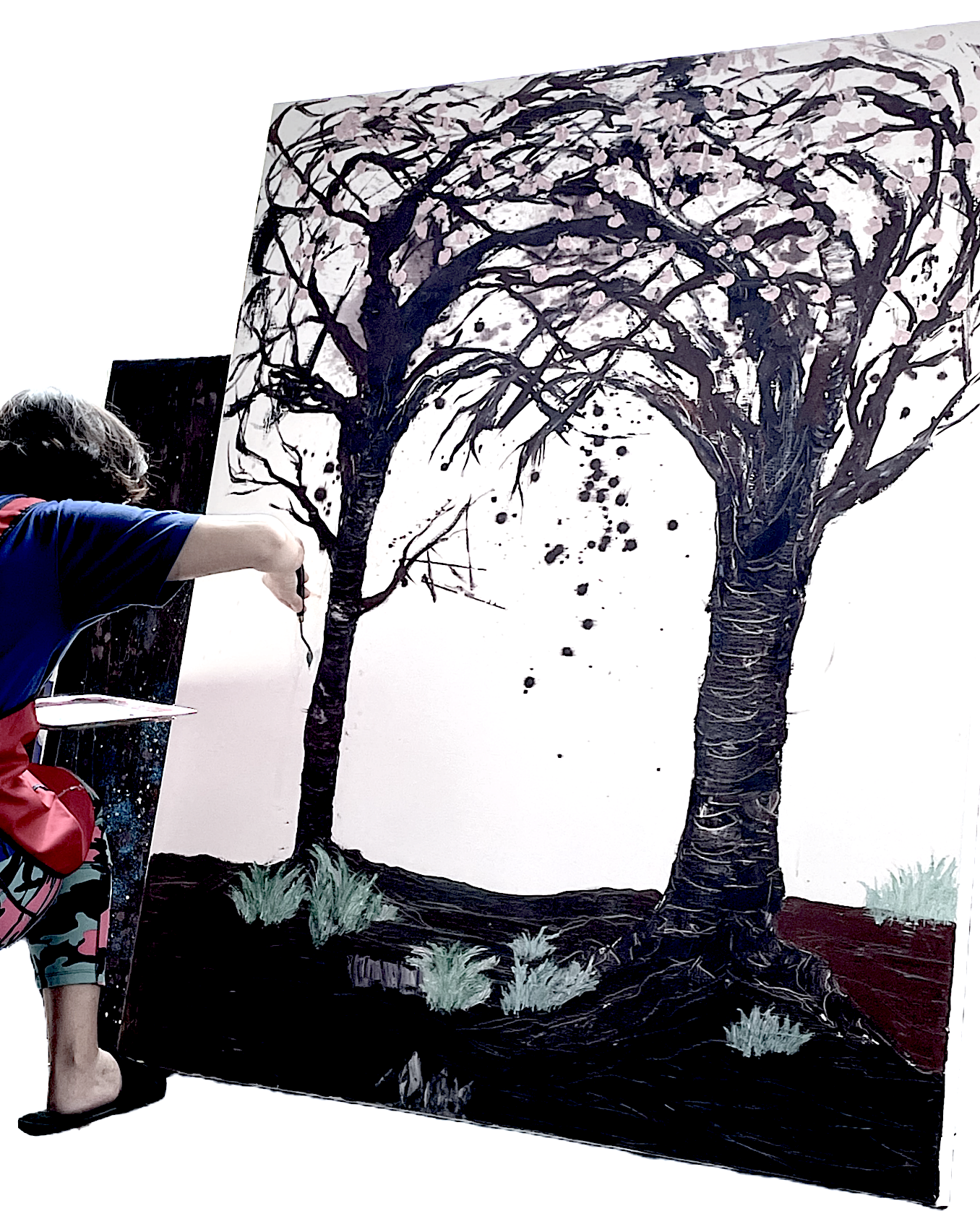
Many adults do not enter the studio with an absence of ideas.
They enter with too many conditions.
The work should look intentional.
The first mark should lead somewhere.
The composition should make sense.
The material should remain under control.
The result should justify the time spent making it.
Before the brush touches the surface, the adult may already be imagining failure, correction, explanation, and evaluation.
This is why beginning can feel disproportionately difficult.
The technical action may be simple: choose a tool, load the brush, make a mark.
The psychological action is more demanding:
Can I begin before I know what the work will become?
Within CCH adult studio practice, hesitation at the beginning is not interpreted automatically as a lack of creativity or technical ability. It may reflect the pressure to predict, control, and evaluate an outcome before enough material evidence exists.
The purpose is not to eliminate all uncertainty.
It is to help the adult move from controlling an imagined result toward responding to what the materials make visible.
Beginning Under Evaluation
Adults frequently approach a blank surface as though it were already being judged.
The absence of marks creates unlimited possibility, but it also removes external guidance. There is no existing image to correct, no material event to interpret, and no obvious next step.
This can produce questions such as:
Where should I begin?
What if the first mark ruins the surface?
What is the correct composition?
Should I plan the whole image first?
What if the result looks amateur?
What if I cannot recover from a poor decision?
How will I know whether the work is successful?
These questions often appear technical, but many are anticipatory evaluations.
The adult is not only deciding what to do. They are attempting to avoid a future state in which the work feels uncontrolled, unsuccessful, or exposed.
Research treats intolerance of uncertainty as a tendency to respond negatively to ambiguous or unpredictable conditions. It has been associated with worry and anxiety, although these findings should not be used to diagnose ordinary studio hesitation.
In the studio, uncertainty is unavoidable because the work does not fully exist yet.
The difficulty of beginning may therefore emerge from a conflict:
The adult wants material evidence before acting, but material evidence can appear only after action begins.
The Blank Surface Is Not Empty
A blank surface may appear neutral.
Psychologically, it can carry accumulated expectations:
years of school-based correction
comparison with skilled artists
beliefs about talent
professional habits of planning
fear of wasting materials
pressure to produce something presentable
memories of being told that one “cannot draw”
The surface may therefore feel less like an open field and more like a test.
Perfectionism is multidimensional. High standards alone do not necessarily prevent creativity, while concerns over mistakes, doubts about action, and harsh self-evaluation can interfere with exploratory thinking. Recent research has found a negative association between perfectionistic concerns and originality in divergent-thinking tasks, while distinguishing these concerns from adaptive striving for excellence.
This distinction is important for CCH.
The goal is not to ask adults to stop caring about quality.
It is to prevent standards from becoming active so early that no exploratory process can occur.
The First Mark Changes the Problem
Before the first mark, the adult is responding mainly to imagined possibilities.
After the first mark, the surface begins to provide actual information.
The mark may reveal:
the transparency of the paint
the scale of the gesture
the absorbency of the surface
an unexpected edge
a spatial imbalance
a color relationship
a direction that was not previously visible
The problem changes from:
“What should the whole painting become?”
to:
“What is happening here, and what might I do next?”
This shift is central.
A complete answer is no longer required. The adult needs only enough information to make the next responsive decision.
Material Engagement Theory describes cognition as distributed across brain, body, action, objects, and environment. From this perspective, materials are not passive recipients of a fully formed idea; their behavior participates in how thought develops.
The first mark therefore does more than begin the image.
It creates the conditions for further thinking.
From Prediction to Response
Control-based practice often follows this sequence:
predict → execute → compare → correct
Material-responsive practice may follow another sequence:
act → observe → interpret → adjust
The difference is not the absence of intention.
It is the willingness to let new evidence change the intention.
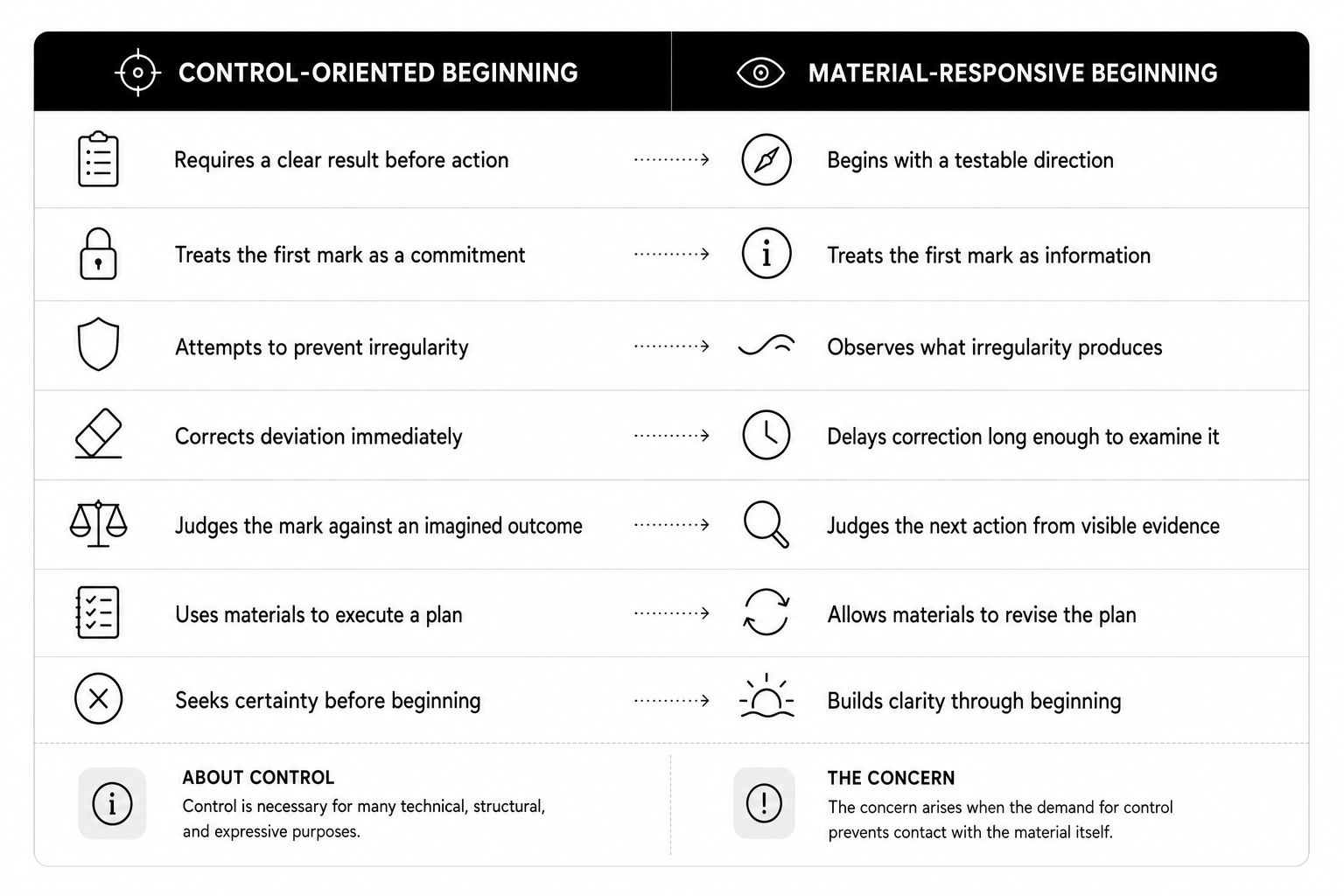
CCH does not position control as inherently negative.
Control is necessary for many technical, structural, and expressive purposes.
The concern arises when the demand for control prevents contact with the material itself.
The Material Residue Field Case
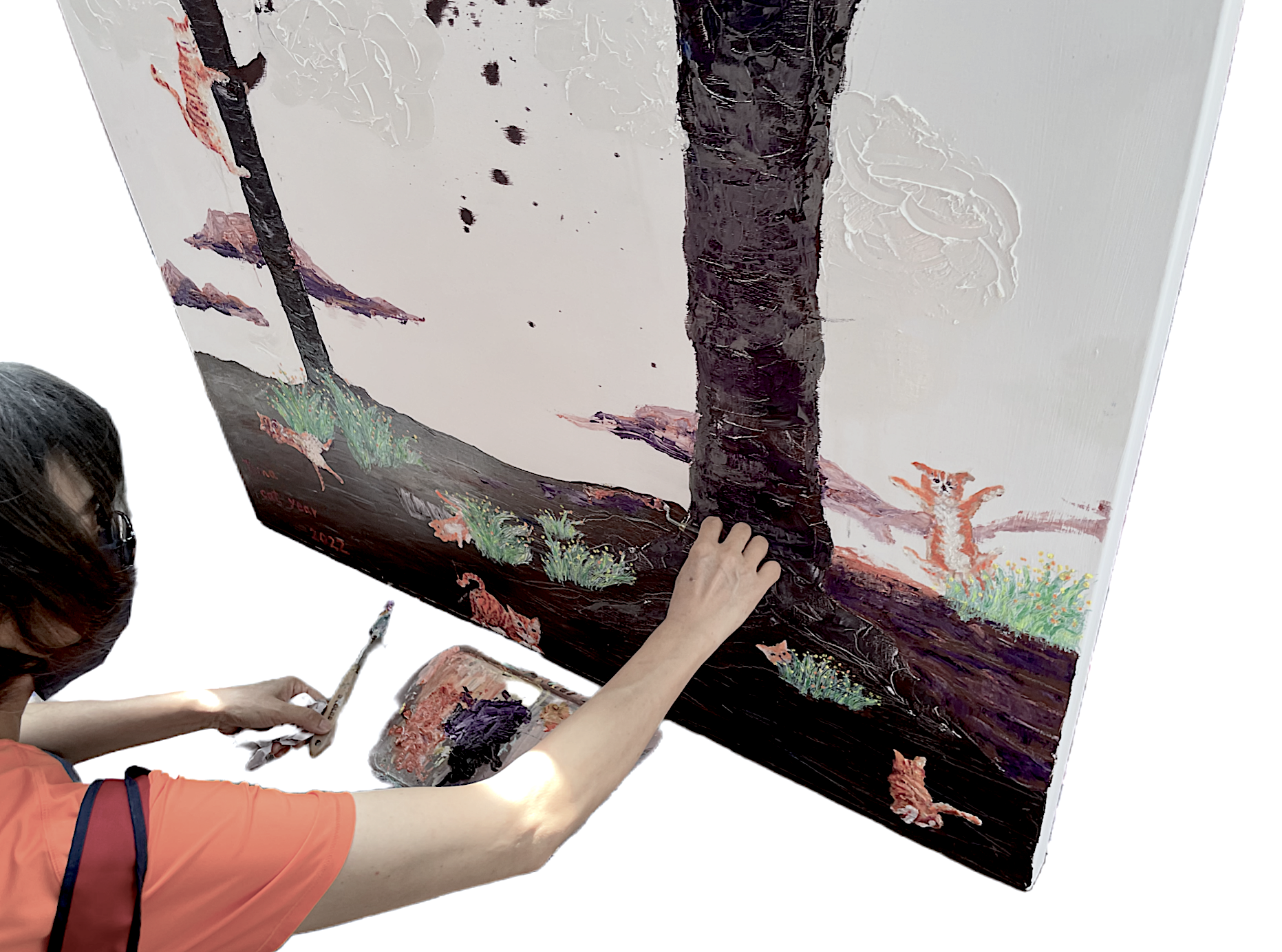
In the Material Residue Field case, the adult entered the painting process with a strong tendency to anticipate appearance and organize the work toward a controlled result.
The initial difficulty was not a lack of artistic knowledge.
It was the pressure to decide too much before the materials had generated enough visual evidence.
The working process gradually introduced:
layered paint
residue
transfer
partial erasure
overlapping surfaces
traces of earlier actions
unplanned relationships between marks
These material events interrupted the expectation that every action should remain clean, deliberate, and immediately interpretable.
Rather than correcting each irregularity, the adult was encouraged to observe:
Which traces remained visually active?
Which areas carried unexpected depth?
Where did an earlier layer alter the meaning of a later one?
Which residue should remain?
What did the surface now suggest?
The shift was not from intention to randomness.
It was from controlling the image in advance to making decisions in conversation with the developing work.
Residue as Information
Residue is often treated as unwanted remainder.
In painting, it may include:
dried edges
transferred pigment
scraped areas
visible underlayers
uneven opacity
fragments from earlier decisions
stains produced by pressure or removal
A control-oriented response may attempt to conceal these traces.
A material-responsive response first asks what they contribute.
Residue can reveal time.
It can show that the image developed through several states rather than appearing as a single polished decision.
It may create depth, friction, interruption, or contradiction.
This does not mean that every accidental mark should be preserved.
The developmental task is to postpone automatic correction long enough for perception to become active.
The adult learns to distinguish between an unwanted error and an unexpected visual resource.
Why Adults Want to Know the Result
The desire to predict the final image often serves several functions.
It may help the adult:
reduce uncertainty
protect self-image
avoid wasting time
prevent embarrassment
maintain a sense of competence
compare progress against a clear target
avoid making an irreversible choice
These motivations are understandable, particularly for adults whose professional lives reward planning, efficiency, and error prevention.
Studio practice asks for a different relationship with control.
The adult may need to act before all relevant information is available.
They must then update the plan as new evidence appears.
This does not oppose professional competence. It exercises a form of adaptive judgment that rigid execution cannot provide.
Creative Anxiety and Self-Efficacy
Anxiety can alter how people interpret creative demands, especially when they expect evaluation or doubt their ability to produce an acceptable result. Research on creative self-efficacy suggests that confidence in one’s capacity to engage with creative tasks is related to persistence and performance, while anxiety may interfere with creative cognitive processes.
CCH does not attempt to produce confidence through praise alone.
It seeks to build grounded confidence through experience:
the adult makes a limited action
the material produces feedback
the adult identifies what changed
another action becomes possible
uncertainty becomes more specific and manageable
Confidence develops from learning:
“I do not need to know the whole result. I can respond to what appears.”
What CCH Does at the Beginning
CCH may reduce the psychological demand of beginning by adjusting the task without predetermining the outcome.
Possible approaches include:
offering a limited group of materials
inviting a test rather than a finished composition
beginning with movement, pressure, or layering
reducing the demand for recognizable imagery
using a section of the surface rather than the whole field
allowing materials to generate the first visual event
asking descriptive rather than evaluative questions
protecting the early stage from premature explanation
The adult may be invited to ask:
What does this material do?
What changes when the pressure changes?
Which trace remains visible?
What happens if this layer is partially removed?
What does the surface now require?
These questions do not dictate a correct image.
They create a narrower and more workable point of entry.
Description Before Evaluation
A common adult response is immediate categorization:
good
bad
messy
ugly
childish
wrong
unfinished
These labels close interpretation quickly.
CCH may redirect the adult toward description:
Instead of:
“This looks bad.”
the adult might identify:
“The central area is much denser than the edges.”
Instead of:
“I ruined it.”
the adult might observe:
“The new layer covered the contrast I wanted to preserve.”
Instead of:
“It is too messy.”
the adult might say:
“There are several marks competing at the same scale.”
Description creates actionable information.
Evaluation often produces only approval or rejection.
The Adult’s Relationship with Irreversibility
Some marks can be removed easily.
Others permanently alter the surface.
The fear of irreversibility can intensify hesitation because the adult imagines that one action will determine the entire work.
CCH reframes irreversibility as a condition to work with rather than a catastrophe to prevent.
After an unwanted change, the adult may:
cover part of it
repeat it elsewhere
alter the surrounding field
scrape it back
shift the visual emphasis
reinterpret its function
let it remain as a record of process
This does not guarantee that every decision becomes successful.
It demonstrates that a changed surface still contains possibilities.
When Control Softens
The transition from control to responsiveness may become visible through small changes.
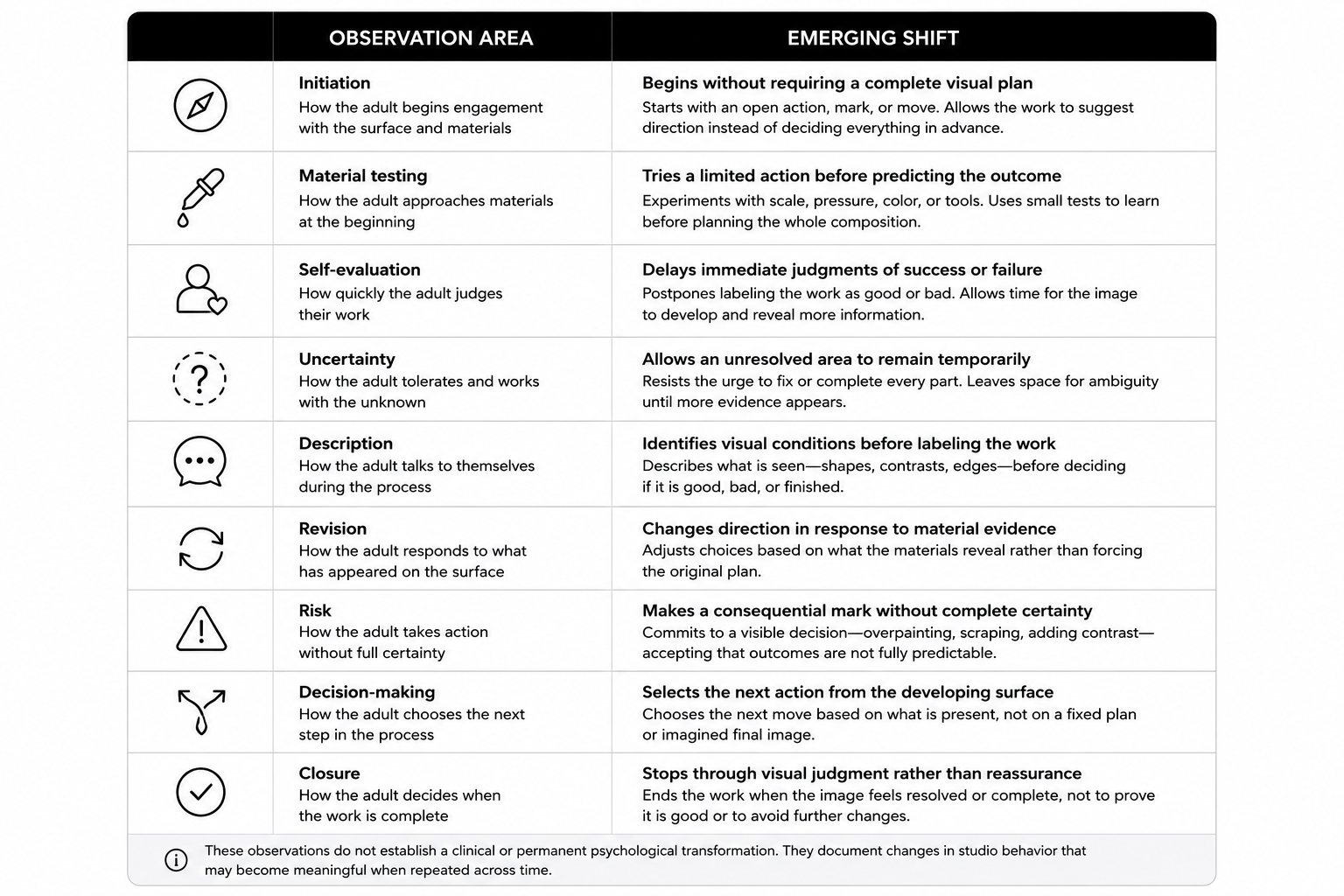
These observations do not establish a clinical or permanent psychological transformation.
They document changes in studio behavior that may become meaningful when repeated across time.
The Educator’s Role
The educator does not remove all uncertainty by supplying a finished answer.
Nor does the educator leave the adult unsupported in the name of freedom.
Support may include:
clarifying how a material behaves
reducing unnecessary technical barriers
identifying where the adult is making an evaluative assumption
asking a focused observational question
slowing premature correction
offering an additional process without dictating the result
helping separate technical failure from visual possibility
The educator protects enough uncertainty for the adult’s own judgment to remain active.
A Psychological Breakthrough Without Therapy Claims
The psychological significance of the first mark should be described carefully.
For some adults, beginning may involve:
tolerating uncertainty
loosening perfectionistic control
accepting temporary disorder
acting without guaranteed approval
allowing perception to replace prediction
discovering that revision remains possible
These experiences may feel personally significant.
CCH adult studio practice remains educational rather than clinical. Artmaking and expressive arts have been studied in health and therapeutic settings, but evidence from those fields should not be used to claim that an educational painting session treats anxiety or perfectionism.
The defensible CCH claim is narrower:
The studio creates structured opportunities for adults to begin under uncertainty, observe consequences, and develop more responsive forms of visual decision-making.
From Control to Material Responsiveness
The purpose is not to make the adult passive before the material.
Responsiveness requires active judgment.
The adult must decide:
which event matters
which trace to preserve
when to intervene
when to wait
whether the work requires contrast, reduction, repetition, or closure
whether a deviation has weakened or expanded the image
Material responsiveness is therefore not the abandonment of control.
It is the transition from total prior control to adaptive control informed by evidence.
The adult still shapes the work.
The work also shapes the adult’s next decision.
Key Takeaway
The first mark is often psychological before it is technical because it requires the adult to act before the final result is known.
Within CCH, the blank surface is not solved by supplying a template or demanding confidence.
A manageable action creates material evidence.
Material evidence creates a basis for judgment.
Through repeated cycles of action, observation, and revision, the adult can move from controlling an imagined result toward responding to the work that is actually developing.
Evidence Boundary
This case describes educational and studio-based observations. It does not diagnose perfectionism, anxiety, intolerance of uncertainty, or related psychological conditions. It also does not claim that material-based painting automatically produces generalized psychological change. Formal clinical claims would require qualified assessment, validated measures, and appropriate research design.
References
Alessandroni, N., et al. “An Ecological Approach to Conceptual Thinking in Material Engagement.” 2024.
Einstein, D. A. “Extension of the Transdiagnostic Model to Focus on Intolerance of Uncertainty.” 2014.
Goulet-Pelletier, J.-C., et al. “Investigating the Negative Link Between Perfectionism and the Generation of Original Ideas.” 2025.
Hwang, Y., et al. “Creative Anxiety, Self-Efficacy, and Creative Performance.” 2025.
Malafouris, L. “Mind and Material Engagement.” 2018.
Vaartio-Rajalin, H., et al. “Art Making and Expressive Art Therapy in Adult Health and Nursing Care.” 2020.