
ADULT STUDIO CASE 03-Perfectionism and the Difficulty of Beginning
From Controlling the Image to Responding to Materials
The material is not only used by the adult. It also interrupts, redirects, and expands the adult’s thinking.
For many adults, the difficulty of painting begins before the first mark appears.
The blank surface is not experienced as empty. It may already contain imagined standards, anticipated criticism, visual expectations, and pressure to produce a recognizable result.
The adult may want to know:
what the painting will become
whether the composition will work
whether the first mark can be corrected
whether the outcome will appear mature
whether other people will understand it
whether the finished work will justify the time and materials
This creates a paradox.
The adult wants certainty before beginning, yet the information needed to make meaningful artistic decisions usually appears only after the materials have been activated.
Within CCH adult studio practice, this difficulty is approached through material responsiveness.
The goal is not to eliminate planning or technical control. It is to help the adult move from controlling an imagined image toward observing, interpreting, and responding to the work that is actually developing.
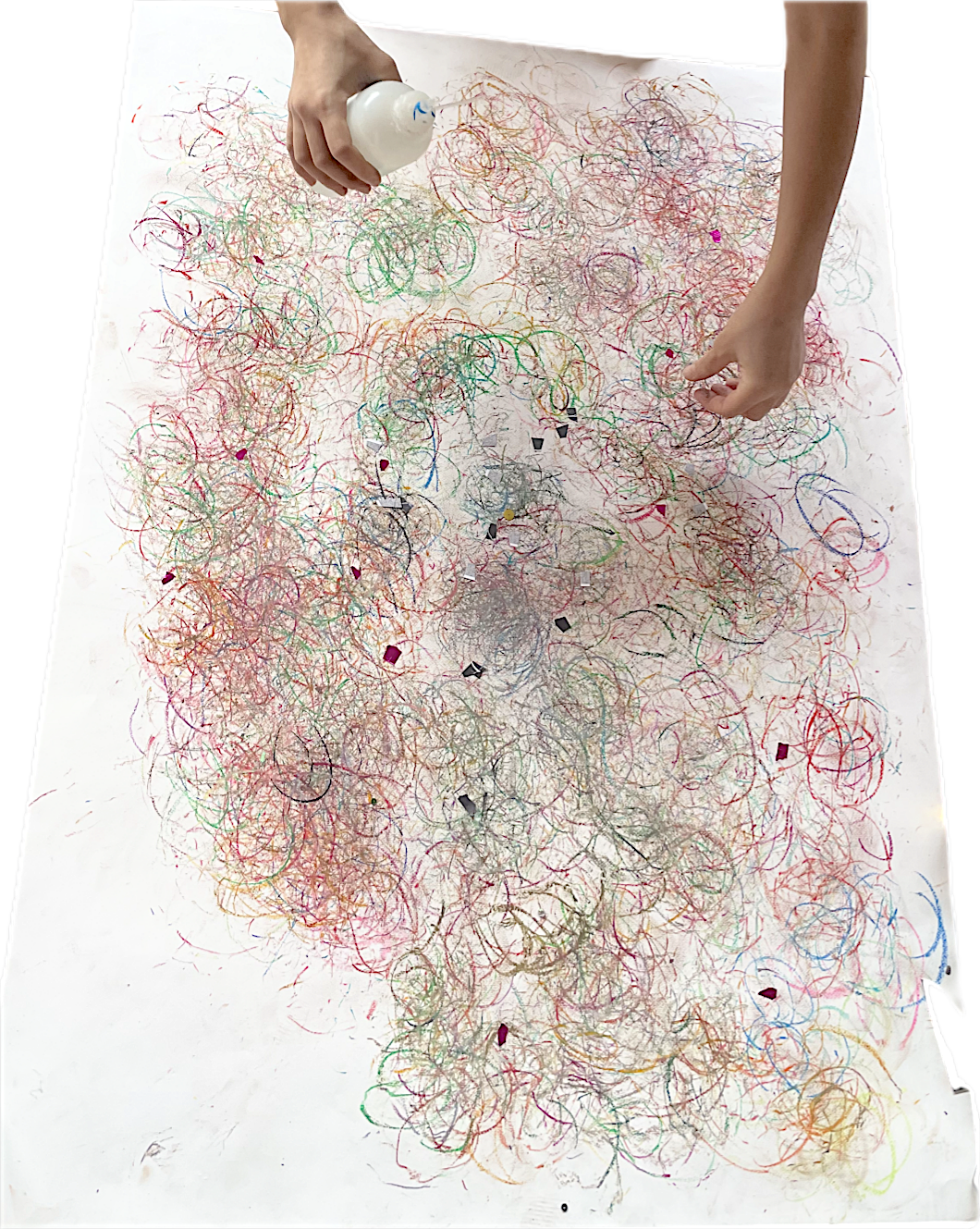
The Blank Surface Can Become an Evaluation Space
A blank surface offers possibility, but it also removes external direction.
There is no existing image to respond to, no visible mistake to correct, and no clear evidence about what should happen next. Adults who are accustomed to planning, productivity, and measurable outcomes may therefore experience the beginning as unusually exposed.
The internal sequence may become:
anticipate the outcome → identify possible failure → delay action → search for certainty → judge the work before it exists
This is not necessarily a lack of ideas.
It may be a form of self-monitoring in which the adult evaluates each possible action before allowing any material event to occur.
Perfectionism is multidimensional. Striving for quality can support sustained work, while concerns over mistakes, doubts about action, and harsh self-evaluation can inhibit experimentation. A 2025 study found that perfectionism was negatively associated with originality in divergent-thinking tasks, while striving for excellence showed a different, more adaptive relationship with idea generation.
The distinction matters.
CCH does not ask adults to abandon standards. It creates enough separation between exploration and evaluation so that standards do not close the process before it begins.
Decision Paralysis Before the First Mark
Decision paralysis can occur when the adult treats the first action as though it must establish the entire work.
A first mark may feel like:
a permanent commitment
evidence of ability
the foundation of the final composition
a mistake that will need to be hidden
a public declaration of taste
an irreversible loss of the blank surface
Under these conditions, even a technically simple action can become psychologically heavy.
The question is no longer merely:
Which color should I use?
It becomes:
What does this choice say about whether I know what I am doing?
This explains why instruction alone may not solve the problem. An adult may know how to use the brush and still hesitate to make contact with the surface.
The difficulty lies in acting before the result can be guaranteed.
Perfectionism Is Not the Same as Care
Perfectionism and care should not be treated as identical.
Care may involve:
close observation
deliberate revision
sensitivity to proportion
technical discipline
sustained attention
respect for materials
Perfectionistic control may involve:
avoiding action until success feels assured
interpreting irregularity as failure
correcting before observing
comparing the developing work with an idealized result
depending on external approval
treating uncertainty as evidence of incompetence
The relevant distinction is not between disciplined and undisciplined making.
It is between responsive precision and defensive control.
Responsive precision uses evidence from the developing work.
Defensive control attempts to prevent the work from producing unexpected evidence at all.
The First Mark Creates Information
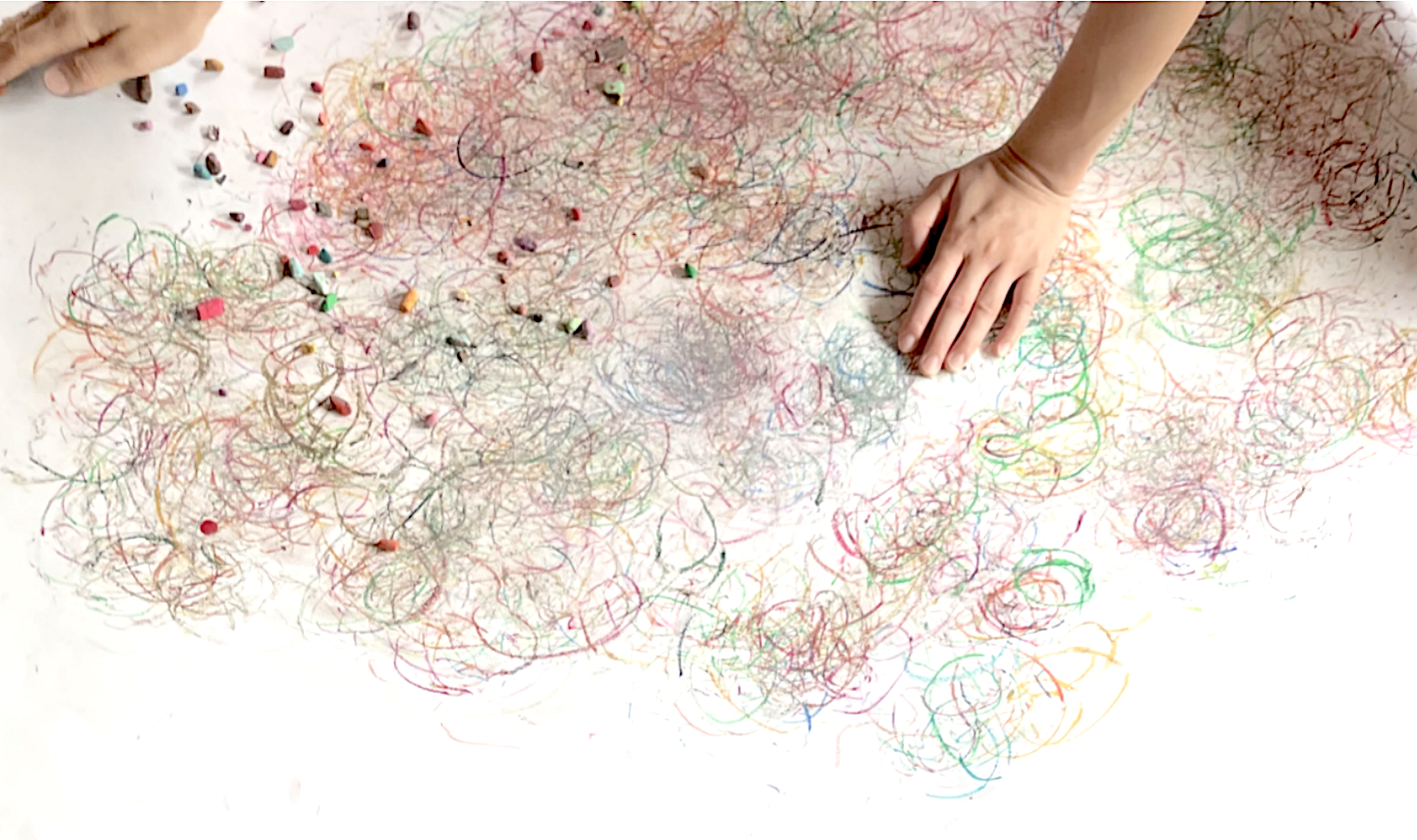
Before the first mark, the adult is working mainly with imagined outcomes.
Once material enters the surface, the work begins to provide information.
A mark may reveal:
how quickly the paint moves
how the surface absorbs liquid
whether the color appears denser than expected
how the gesture changes at a larger scale
whether an edge feels rigid or active
whether the composition needs pressure, distance, repetition, or interruption
The first mark therefore does not need to solve the image.
It needs to create enough evidence for the next decision.
This changes the central question from:
What should the finished painting look like?
to:
What has appeared, and what does it make possible?
Material Engagement Theory argues that cognition develops through active relationships among bodies, tools, objects, and environments. Materials do not simply receive completed ideas; they participate in the formation and transformation of thought.
Within CCH, the first material event is therefore treated as a thinking event.
From Controlling the Image to Responding to Materials
A control-oriented process may follow this sequence:
predict → execute → compare → correct
A material-responsive process may follow another:
act → observe → interpret → adjust
The second sequence still includes intention and control. Its defining feature is that new evidence is allowed to modify the original plan.
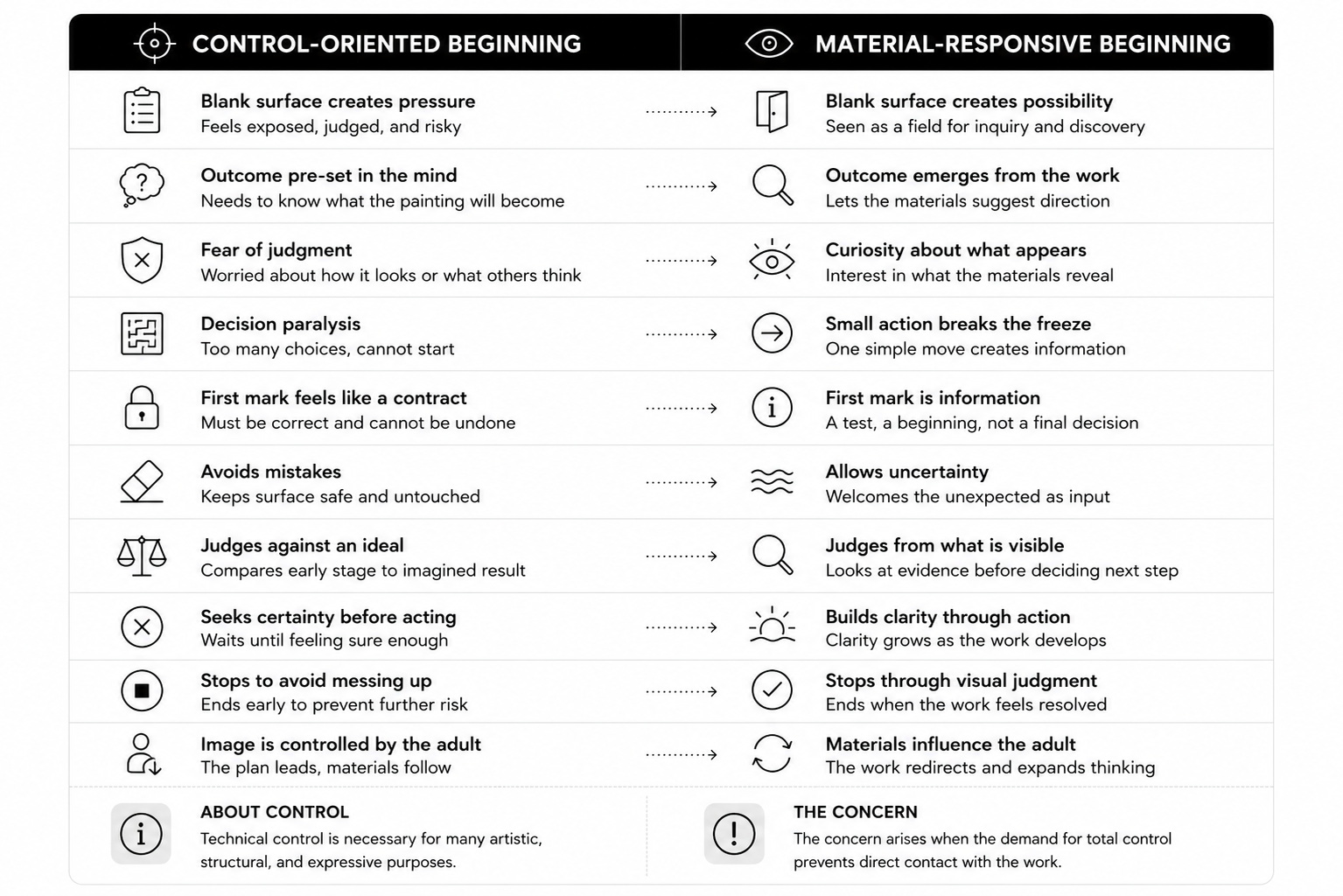
CCH does not position control as inherently negative.
Technical control is necessary for many artistic purposes. The concern arises when the demand for total control prevents direct contact with the work.
Paint Flow Introduces Uncertainty
Liquid paint does not remain completely obedient.
It spreads, pools, bleeds, dries unevenly, changes transparency, and interacts with earlier layers. Even when the adult understands the medium technically, some variation remains.
This variation can produce anxiety when the adult expects each action to correspond exactly to an internal image.
CCH may use paint flow to shift attention from prediction to observation:
Where does the pigment collect?
Which edge remains active?
What becomes visible when water changes the density?
Does the flow weaken the image, or create a new directional force?
Which part should be guided, and which part should be allowed to continue?
The point is not to romanticize accident.
The point is to make the adult’s judgment active after the material responds.
Covering and Scraping Reveal Time
Covering and scraping introduce another relationship with control.
When a layer is covered, the adult may initially experience the action as destruction:
earlier work disappears
effort appears wasted
the image loses clarity
a successful section may be altered
Yet partial covering can also create:
visual depth
interruption
memory
contrast between earlier and later decisions
tension between concealment and exposure
Scraping may remove material, but it can also reveal the structure beneath it.
The surface begins to record time.
The work is no longer a single perfect decision. It becomes a visible history of choices, corrections, concealments, and recoveries.
Research on material creativity increasingly emphasizes that creative thought is grounded in sensorimotor interaction with the environment and in sensitivity to the action possibilities materials offer.
Covering and scraping therefore do more than change appearance. They create new conditions for perception and judgment.
Collage Disrupts the Original Image
Collage introduces material from outside the painted field.
A fragment may carry:
a different texture
a recognizable image
printed language
a conflicting scale
a harder edge
a cultural association
an unexpected color relationship
The adult can no longer treat the painting as a closed system.
The inserted material changes the surrounding composition and may require the original plan to be reorganized.
This can be especially useful for adults who depend heavily on linear execution. Collage creates a visual interruption that must be negotiated rather than merely corrected.
The question becomes:
How does the work change when something unfamiliar enters it?
Layering Expands the Image Beyond One Decision
Layering allows the adult to work without demanding that each stage be final.
A layer can function as:
a temporary state
a test
a foundation
a contradiction
a record of an earlier intention
a surface to be partially obscured
a source of later discovery
This reduces the pressure placed on any single mark.
The work develops through accumulation rather than immediate perfection.
Layering also introduces a different understanding of completion. A work may become resolved through the interaction of several imperfect states rather than through one flawless plan.
Surface Traces Can Carry Meaning
Adults often attempt to remove traces that reveal uncertainty:
drips
stains
scraped edges
visible underlayers
uneven pressure
corrections
transfers
residue
These traces may be interpreted as evidence that the process was uncontrolled.
CCH first asks whether the trace is visually inactive or whether it contributes something the original plan did not anticipate.
A trace may reveal:
movement
pressure
hesitation
time
revision
contact between materials
the physical history of the work
Mark-making research suggests that marks can transform the maker’s perceptual relationship to the world and open recursive forms of material imagination and metacognition.
The adult learns that a trace does not need to be preserved simply because it occurred. It needs to be evaluated through perception rather than rejected automatically.
Material Accident Is Not the Opposite of Judgment
Material responsiveness is sometimes misunderstood as allowing random events to determine the work.
That would replace one rigid structure with another.
Within CCH, material accident creates a decision point.
The adult still needs to determine:
whether the event is visually useful
whether it should be repeated
whether it should be reduced
whether surrounding areas need adjustment
whether the accident reveals a new direction
whether it weakens the work
whether it should remain unresolved temporarily
The material event does not eliminate authorship.
It changes when authorship occurs.
Instead of controlling everything before action, the adult exercises authorship through interpretation and response.
The Work Can Change the Original Idea
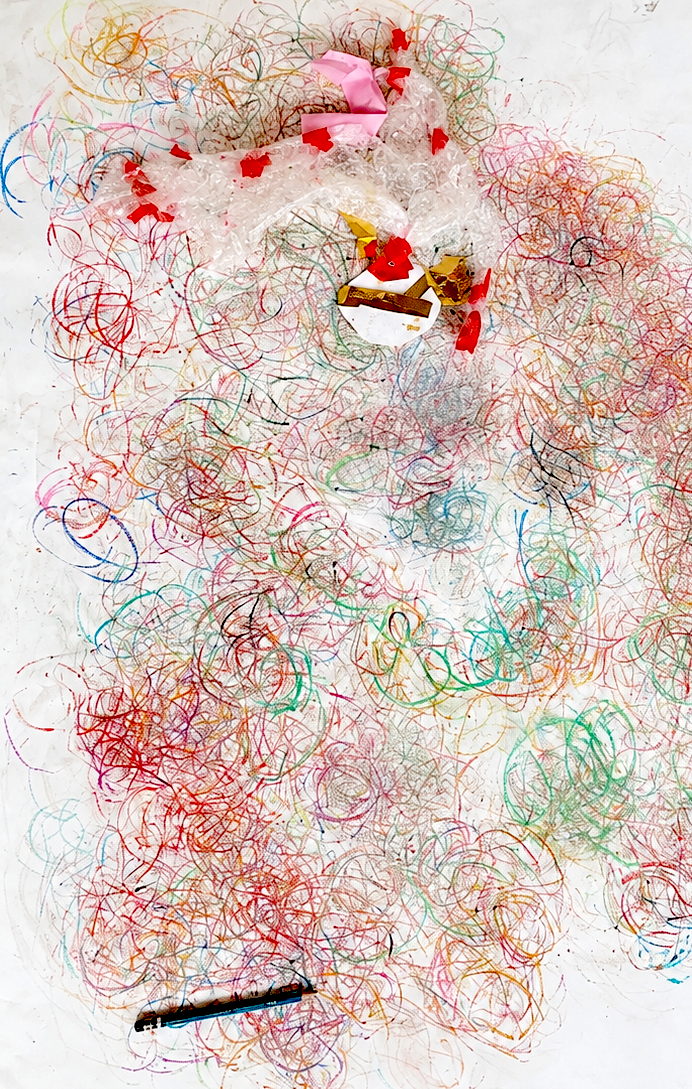
A significant shift occurs when the adult accepts that the developing work may know something the initial plan did not.
This does not mean the painting literally has intentions.
It means the visible relationships created through action now contain information that was unavailable before the work began.
The original idea may change because:
a color produces a stronger spatial effect than expected
a covered area creates necessary depth
an irregular edge introduces movement
a collage fragment changes the subject
residue becomes more compelling than the planned image
repeated marks create a rhythm that reorganizes the composition
The work begins to redirect the maker.
The material is not only used by the adult. It also interrupts, redirects, and expands the adult’s thinking.
This is the central distinction between executing an image and developing one.
When Evaluation Arrives Too Early
Premature evaluation compresses the process into binary conclusions:
good or bad
successful or ruined
mature or childish
intentional or accidental
finished or failed
These judgments often appear before enough information exists.
CCH may replace immediate evaluation with description.
Instead of:
“This is messy.”
the adult may observe:
“The central area contains several marks of similar intensity.”
Instead of:
“I ruined the surface.”
the adult may identify:
“The new layer removed the contrast between the upper and lower areas.”
Instead of:
“This looks childish.”
the adult may ask:
“Which visual qualities are making me use that word?”
Description slows judgment and produces usable information.
It does not require the adult to like everything that occurs.
It supports more precise decisions about what to do next.
What CCH Observes
The transition from perfectionistic control toward material responsiveness may become visible through small changes.
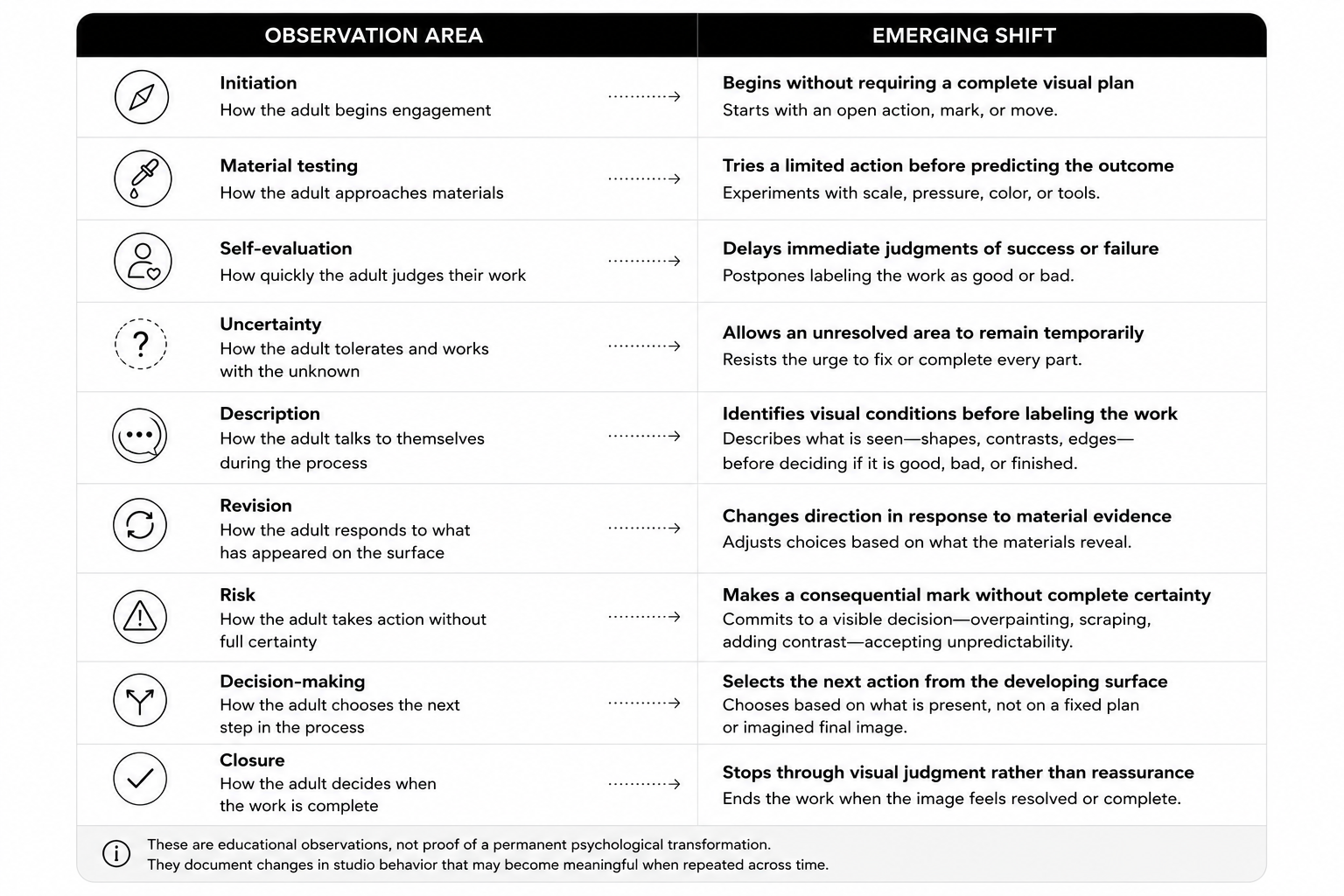
These are educational observations, not proof of a permanent psychological transformation.
CCH looks for recurring patterns across time, materials, and different studio conditions.
The Educator Protects the Process Without Taking It Over
The educator’s role is neither to guarantee success nor to leave the adult unsupported.
Support may include:
explaining how a material behaves
reducing unnecessary technical barriers
offering a limited test area
asking the adult to describe before evaluating
slowing an automatic correction
identifying where the imagined outcome is controlling perception
introducing a process such as scraping, transfer, or layering
helping separate technical malfunction from visual possibility
The educator does not decide which accidental trace is meaningful.
The adult remains responsible for observing, choosing, and revising.
Perfectionism Can Reappear During Revision
Beginning is not the only difficult stage.
Perfectionistic control may return when:
the work becomes visually complex
a successful section risks being altered
the original plan is no longer visible
several alternatives appear equally possible
the work approaches closure
the adult fears making one mark too many
This is why material responsiveness is not a single breakthrough.
It is a repeated practice of allowing evidence to inform the next decision.
The adult may move back and forth between control and responsiveness within the same painting.
The developmental value lies in becoming able to notice that movement.
Closure Without External Reassurance
Perfectionism can make closure difficult in two opposite ways.
The adult may stop too early to avoid further risk.
Or the adult may continue correcting because no state feels good enough.
CCH asks the adult to evaluate the work through visual relationships:
Does the image still require another action?
Is the unresolved area active or merely unfinished?
Would another layer deepen the work or flatten it?
Is the desire to continue coming from the work or from anxiety?
Can the work remain imperfect and still feel resolved?
Closure becomes an act of judgment rather than a request for permission.
Psychological Significance Without Therapy Claims
Material-responsive painting may give adults practice in:
acting without complete certainty
tolerating temporary disorder
allowing evidence to change a plan
postponing harsh self-evaluation
recovering after an unwanted result
distinguishing accident from failure
trusting perception before external approval
These experiences may feel psychologically meaningful.
CCH remains an educational studio framework. It does not claim that painting treats perfectionism, anxiety, or other mental-health conditions. Research links maladaptive perfectionism with stress, anxiety, and avoidant coping, but those findings should not be converted into diagnoses based on studio behavior.
The defensible claim is narrower:
Material-based studio practice creates structured opportunities for adults to notice perfectionistic control, delay premature evaluation, and practice more responsive visual decision-making.
Key Takeaway
Perfectionism makes beginning difficult when the adult believes the image must be known, controlled, and evaluated before material evidence exists.
CCH uses paint flow, covering, scraping, collage, layering, surface traces, and material uncertainty to create a different sequence:
act → observe → interpret → adjust
The adult still exercises control.
But control becomes adaptive rather than total.
The developing work is allowed to interrupt the original image, redirect attention, and expand what the adult is capable of seeing.
Evidence Boundary
This case describes educational and studio-based observations. It does not diagnose perfectionism, anxiety, or decision paralysis, and it does not claim that material-responsive painting produces generalized psychological change. Clinical or causal conclusions would require qualified assessment, validated measures, and formal research design.
References
Alessandroni, N., et al. “An Ecological Approach to Conceptual Thinking in Material Engagement.” 2024.
Goulet-Pelletier, J.-C., et al. “Investigating the Negative Link Between Perfectionism and the Generation of Original Ideas.” 2025.
Kimmel, M. “An ‘In Vivo’ Analysis of Crafts Practices and Creativity.” 2023.
Kimmel, M. “What Affords Being Creative? Opportunities for Novelty in Light of Perception and Materiality.” 2023.
Malafouris, L. “Mind and Material Engagement.” 2018.
Malafouris, L. “Mark Making and Human Becoming.” 2021.
Goulet-Pelletier, J.-C., et al. Research on perfectionism, concerns over mistakes, and originality. 2025.