
ADULT STUDIO CASE 04-When Imperfection Becomes a Creative Resource
Sustained Studio Time, Internal Judgment, and Creative Agency
Imperfection becomes useful when the adult has enough time to stop correcting automatically and begin seeing what the work is actually doing.
Many adults enter painting with a strong instinct to organize, correct, polish, and complete.
This instinct is understandable. Adult life often rewards efficiency, predictability, professionalism, and the ability to prevent visible mistakes. Work environments may require fast decisions, controlled presentation, measurable progress, and defensible outcomes.
The studio introduces a different set of conditions.
Paint may spread beyond its intended edge.
A layer may obscure an earlier success.
A scraped surface may reveal an unexpected structure.
A collage fragment may disrupt the composition.
A trace may remain after the adult has tried to remove it.
A painting may require more time than the learner initially considers reasonable.
These moments create a central question:
Must every irregularity be corrected, or can some forms of imperfection become part of the work’s visual intelligence?
Within CCH adult studio practice, imperfection is not celebrated automatically. A weak decision remains a weak decision when it does not serve the work.
The developmental shift lies elsewhere:
The adult learns to observe before correcting, interpret before rejecting, and decide from the developing image rather than from a predetermined standard.
This requires more than material freedom.
It requires sufficient time, reduced performance pressure, repeated contact with the work, and the gradual rebuilding of internal visual judgment.
Adults Often Enter the Studio in Work Mode
An adult may physically arrive in the studio while remaining mentally organized around professional efficiency.
This may appear through:
wanting a clear assignment immediately
asking how long the work should take
trying to predict the final result
avoiding materials that behave unpredictably
correcting irregularities as soon as they appear
seeking confirmation before making visible changes
measuring progress through completion
treating pauses as wasted time
This orientation is effective in many professional settings.
It becomes limiting when the same operating system is applied to open-ended painting.
Creative studio work often requires the adult to remain with incomplete information, tolerate temporary disorder, and allow visual relationships to develop before deciding what they mean.
The challenge is therefore not simply to “relax.”
It is to shift from one mode of attention to another:
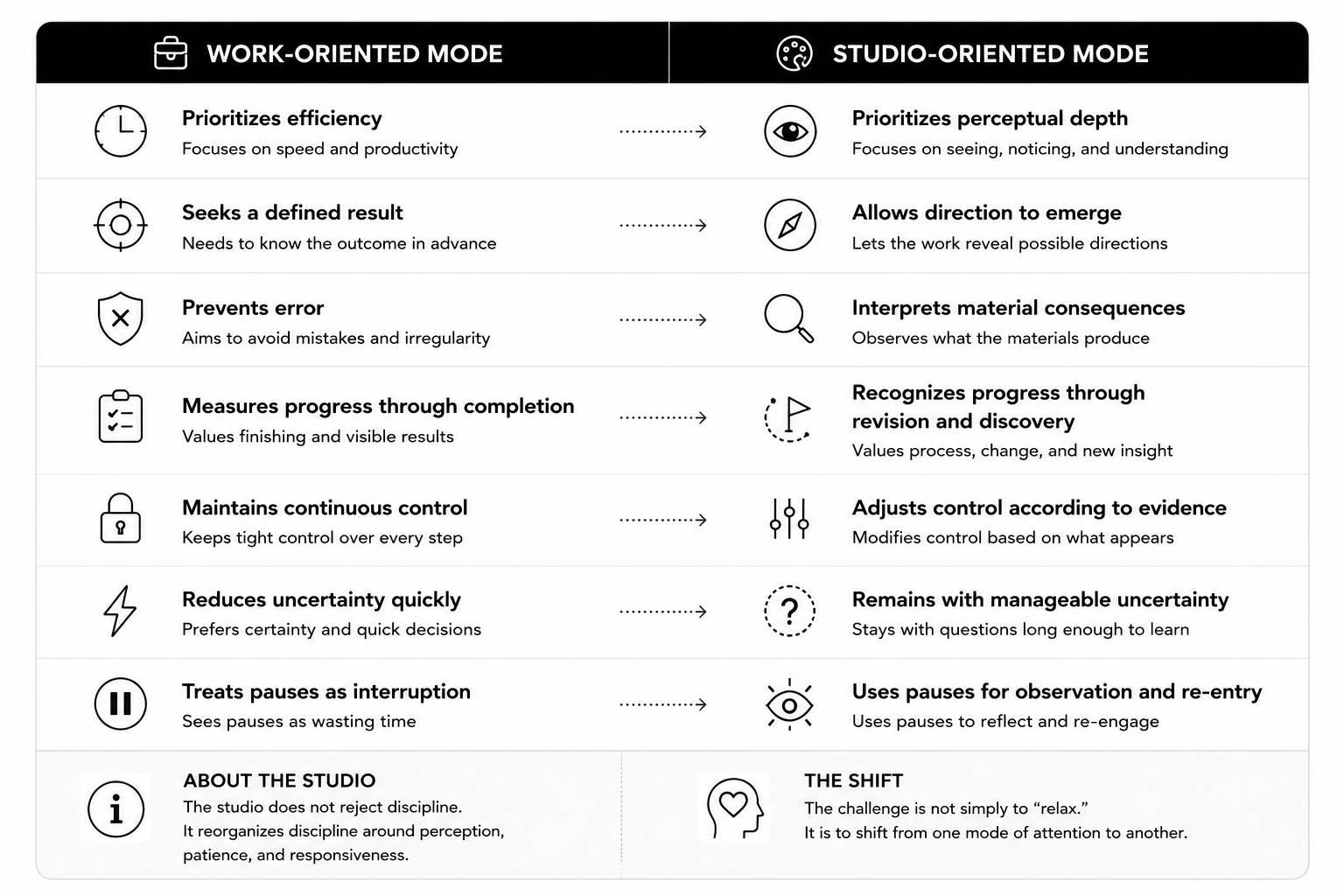
The studio does not reject discipline.
It reorganizes discipline around perception, patience, and responsiveness.
Why Sustained Studio Time Matters for Adults
Adults often need time to move through several distinct phases before deeper material engagement becomes possible.
Phase 1: Arrival
At the beginning of a session, the adult may still be carrying:
unfinished professional tasks
digital stimulation
social expectations
time pressure
self-monitoring
concern about productivity
The person has entered the room, but attention has not yet fully transferred to the work.
Phase 2: Orientation
The adult begins to notice:
the scale of the surface
the available materials
previous layers
unfinished areas
possible entry points
bodily position and movement
This stage may appear slow from the outside. It is often necessary for perceptual engagement.
Phase 3: Material Contact
The adult tests a mark, mixture, texture, transfer, or alteration.
The material begins producing information.
Phase 4: Deepening
Earlier assumptions become less dominant. The adult responds increasingly to the painting rather than to an imagined result.
Phase 5: Revision and Reorganization
The work may now require:
covering
scraping
removal
restructuring
repetition
increased contrast
reduction
temporary abandonment of the original plan
Phase 6: Closure or Continuation
The adult decides whether the work has reached a meaningful stopping point or requires return in another session.
A short session can support orientation, technical practice, or concentrated work on a defined problem. Extended time serves a different purpose: it allows the learner to pass through arrival, hesitation, experimentation, disruption, recovery, revision, and possible closure without compressing the process into immediate production.
Flow research describes deep engagement as a state involving absorption, reduced self-consciousness, and close alignment between challenge, capacity, and feedback. Such states cannot be commanded on schedule, and longer duration alone does not guarantee them. Time does, however, provide more room for attention to stabilize and for material feedback to become consequential.
Cognitive Deceleration Is Not Cognitive Inactivity
The phrase cognitive deceleration does not mean that the mind becomes empty or less active.
It describes a shift away from rapid categorization, immediate correction, and outcome forecasting.
The adult begins to:
observe longer before acting
notice smaller visual differences
hold several possibilities open
allow an unresolved area to remain
return to an earlier decision with new information
distinguish discomfort from actual visual failure
make fewer but more consequential choices
This slower rhythm can support more complex judgment.
The mind is still active, but it is no longer racing ahead of the material encounter.
Material Engagement Theory offers a useful framework here. It treats cognition as emerging through the relations among brain, body, tools, surfaces, actions, and material conditions. Thinking is therefore not completed internally and then transferred onto a passive object; it develops through making itself.
Within this framework, slowing down allows more information from the material environment to enter the decision process.
Imperfection Is Often Rejected Before It Is Seen
Adults frequently evaluate irregularity through inherited categories:
messy
unfinished
uncontrolled
childish
ugly
accidental
technically weak
not sophisticated enough
These labels may be applied before the visual event has been examined carefully.
For example, a paint drip may be rejected because it was unintended.
Yet the relevant artistic questions are:
Does the drip create movement?
Does it disturb an overly static area?
Does it connect two separated regions?
Does it introduce a useful change of scale?
Does it expose material gravity?
Does it weaken the composition?
Should it be repeated, reduced, covered, or retained?
The shift is from categorical rejection to perceptual inquiry.
Imperfection becomes a creative resource only after it has been interpreted.
This distinction matters because CCH is not promoting randomness as an artistic virtue. The adult remains responsible for visual judgment.
Must Every Mistake Be Corrected?
A mistake can refer to several different situations.

Technical mistake
A material fails to perform its intended function.
Examples:
adhesive does not bond
paint cracks because of incompatible layering
paper tears where strength was required
a structural support cannot hold weight
Technical correction may be appropriate.
Visual mismatch
The result differs from the original image but creates a new possibility.
Examples:
a color becomes more intense than planned
a scraped area reveals an active underlayer
a collage element changes the visual hierarchy
an accidental edge creates movement
This requires interpretation rather than automatic correction.
Developmental discomfort
The work feels unfamiliar because it does not resemble the adult’s previous aesthetic standards.
This does not establish that the work is visually unsuccessful.
The discomfort may come from:
loss of control
unresolved composition
unfamiliar abstraction
visible process
asymmetry
ambiguity
departure from conventional beauty
CCH helps separate these categories.
The adult learns to ask:
Is this a technical problem, a visual problem, or simply an unfamiliar condition?
That question alone can prevent unnecessary correction.
Traces Can Record the Intelligence of the Process
Surface traces may include:
erased lines
scraped paint
stains
drips
underpainting
transferred pigment
torn collage edges
uneven pressure
visible corrections
partially concealed marks
In a product-centered model, these may be treated as evidence that the work was insufficiently controlled.
In a process-responsive model, traces can reveal:
sequence
revision
time
pressure
hesitation
return
interruption
adaptation
material memory
Malafouris describes mark-making as a central form of material signification through which human thinking and becoming are organized. Marks are therefore more than decorative residue; they can participate in how the maker perceives, reflects, and continues acting.
This does not mean every trace deserves preservation.
It means traces should be read before they are erased.
Material Loss of Control Can Become Part of the Image
Materials operate within physical conditions.
Paint responds to:
gravity
viscosity
water
absorption
pressure
surface preparation
drying time
interaction with earlier layers
The adult can influence these conditions without fully eliminating variability.
Material responsiveness develops when the adult learns to work with the difference between intention and outcome.
For example:
Paint flows farther than expected.
The adult pauses instead of wiping it away immediately.
The flow creates a directional movement.
The adult decides whether to extend, contain, repeat, or counterbalance it.
The unexpected event becomes part of a deliberate visual system.
The final decision remains authored.
What changes is the source of information.
The adult no longer relies only on the image imagined before action. The actual surface enters the decision.
Research grounded in ecological and affordance-based accounts of creativity similarly emphasizes that practitioners discover possibilities through active sensorimotor engagement with materials and environments. Creative action emerges partly through sensitivity to what the material situation affords.
“Unattractive” Does Not Mean Visually Weak
Adults often use beauty as the first measure of success.
Yet visual power can also emerge through:
tension
contrast
awkwardness
density
interruption
rawness
fragility
asymmetry
contradiction
unresolved relationships
A work may be uncomfortable without being unsuccessful.
It may resist decorative beauty while remaining perceptually compelling.
This distinction is particularly important in adult practice because many learners have internalized the expectation that artwork should be:
tasteful
polished
harmonious
presentable
easy to understand
compatible with interior decoration
CCH does not reject beauty.
It expands the range of visual conditions that can be taken seriously.
The adult begins asking:
Does this work need to be beautiful in the conventional sense, or does it need to be visually coherent, active, and honest to its own development?
The Work Does Not Need to Match the Original Idea
Adults may judge a work as unsuccessful simply because it diverges from the initial concept.
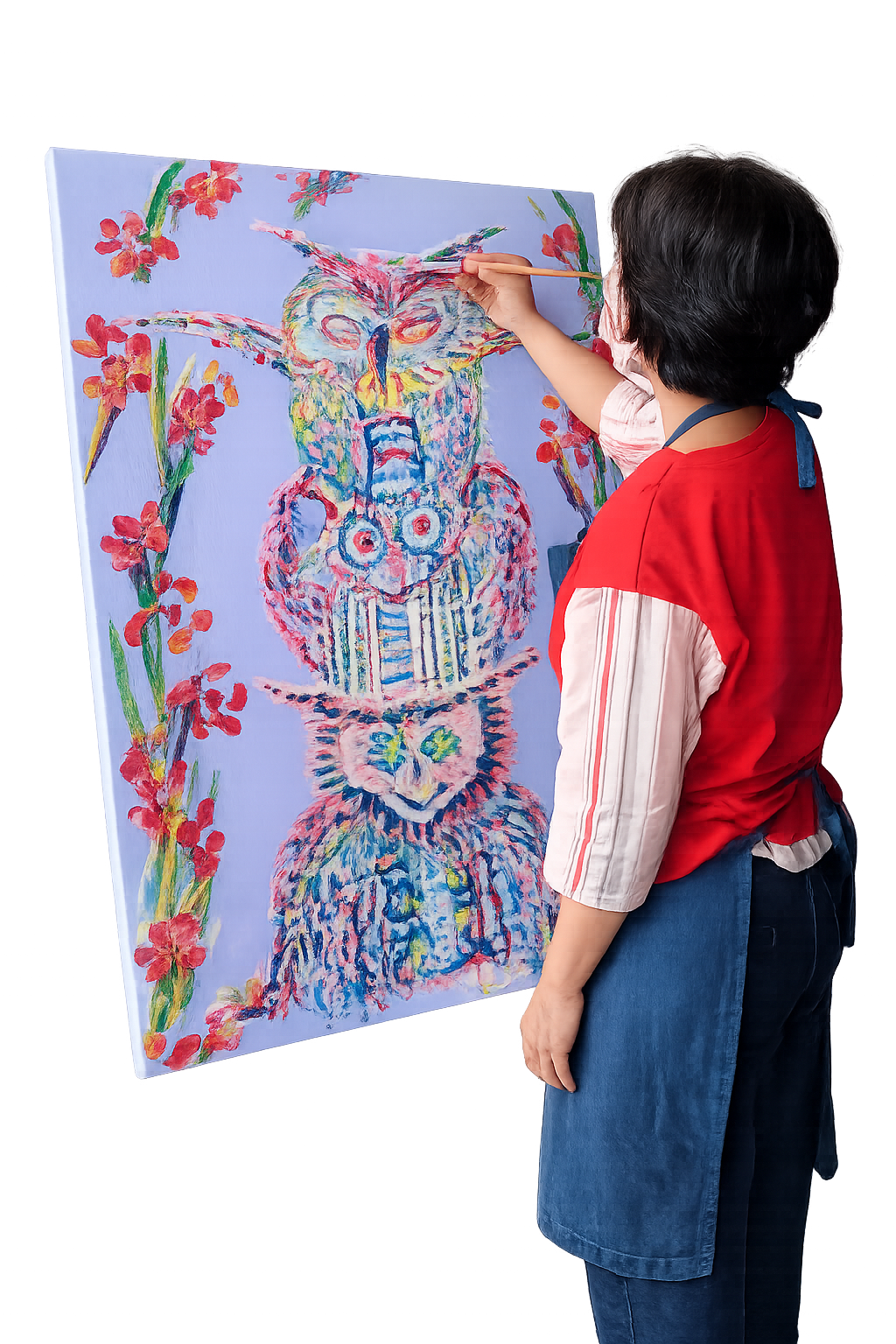
However, the original idea was formed before:
the materials behaved
the scale became real
the colors interacted
the surface accumulated history
unexpected relationships appeared
The initial plan was based on limited information.
A responsive process allows the plan to change as information increases.
This can be represented as:
Initial intention → material encounter → visual evidence → revised intention
The final work may therefore become stronger precisely because it no longer matches the first image.
Material engagement scholarship argues that thinking unfolds through practical interaction with matter rather than existing only as an internal representation. The material process can modify the maker’s concepts, actions, and subsequent understanding.
Sustained Time Allows Imperfection to Change Meaning
An irregularity often looks different at different stages.
At first, it may appear disruptive.
After additional layers, it may become:
a structural anchor
a necessary contrast
a historical trace
a visual rhythm
a boundary between two fields
the beginning of a new direction
Immediate correction freezes interpretation too early.
Sustained studio time allows the adult to:
leave the event temporarily
work elsewhere
return with perceptual distance
compare alternatives
observe how later actions change its function
decide with more evidence
This is one reason extended time matters.
The adult is not only given more minutes to produce.
They are given enough temporal distance for meaning to change.
Rebuilding Internal Judgment
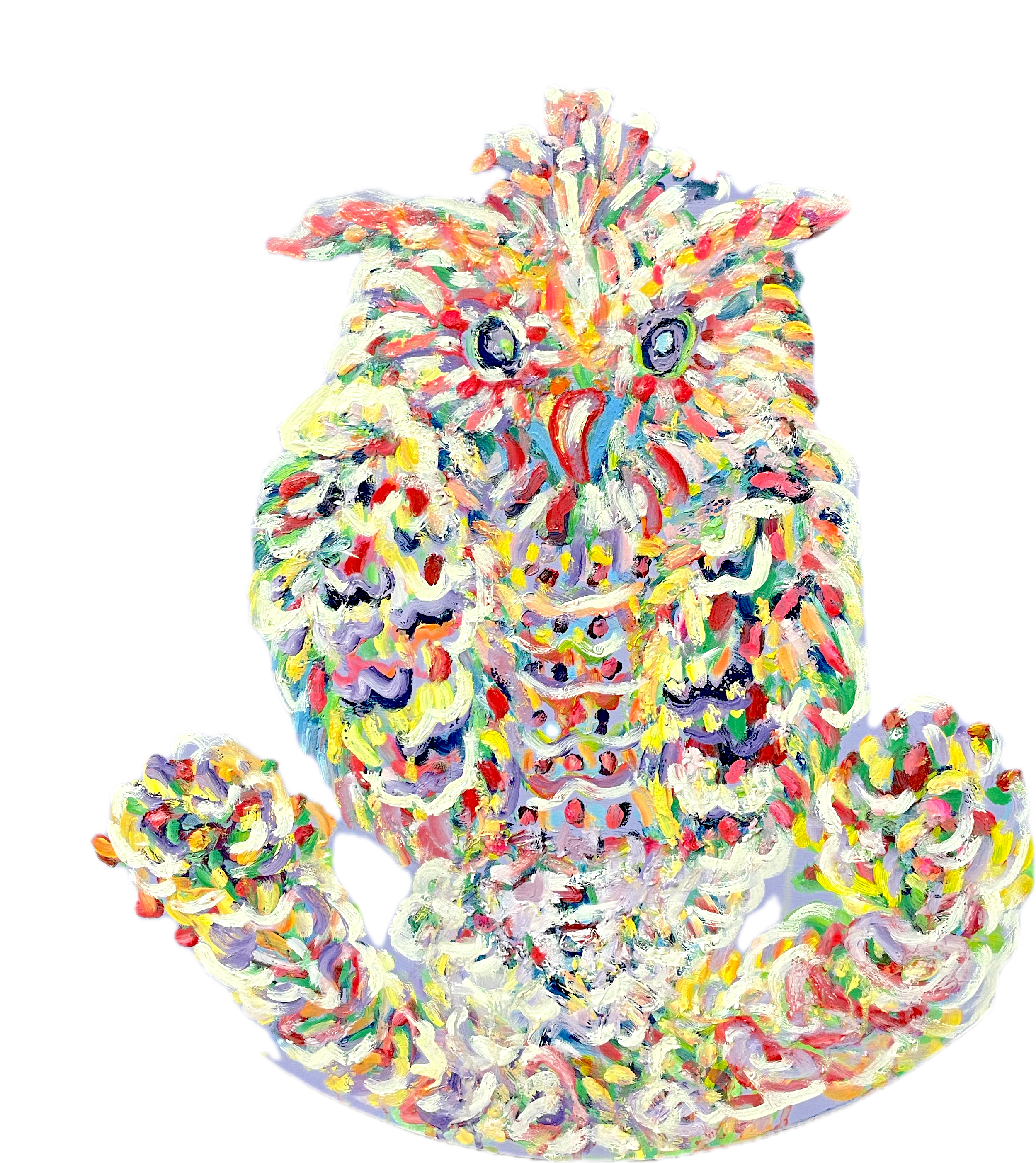
Many adults rely heavily on external standards:
Is this correct?
Does this look professional?
Would an art teacher approve?
Is this the proper use of the material?
Does this resemble recognized art?
Would someone display it?
External references can be useful. Technique, art history, critique, and professional knowledge can deepen artistic practice.
The problem arises when external standards replace perception entirely.
Internal visual judgment begins to develop when the adult can articulate:
what they notice
what is visually active
what feels unresolved
what has become too dominant
which trace should remain
which area needs reduction
when the work has reached closure
why a choice serves the painting
This is not merely personal preference.
It is perceptual reasoning grounded in the work.
Harvard Project Zero’s Studio Thinking framework identifies observing, reflecting, envisioning, engaging and persisting, and stretching and exploring as central habits developed through visual-art practice. These habits emphasize that artistic judgment forms through making, sustained engagement, and reflection rather than through final appearance alone.
From External Approval to Visual Evidence
The shift may look like this:
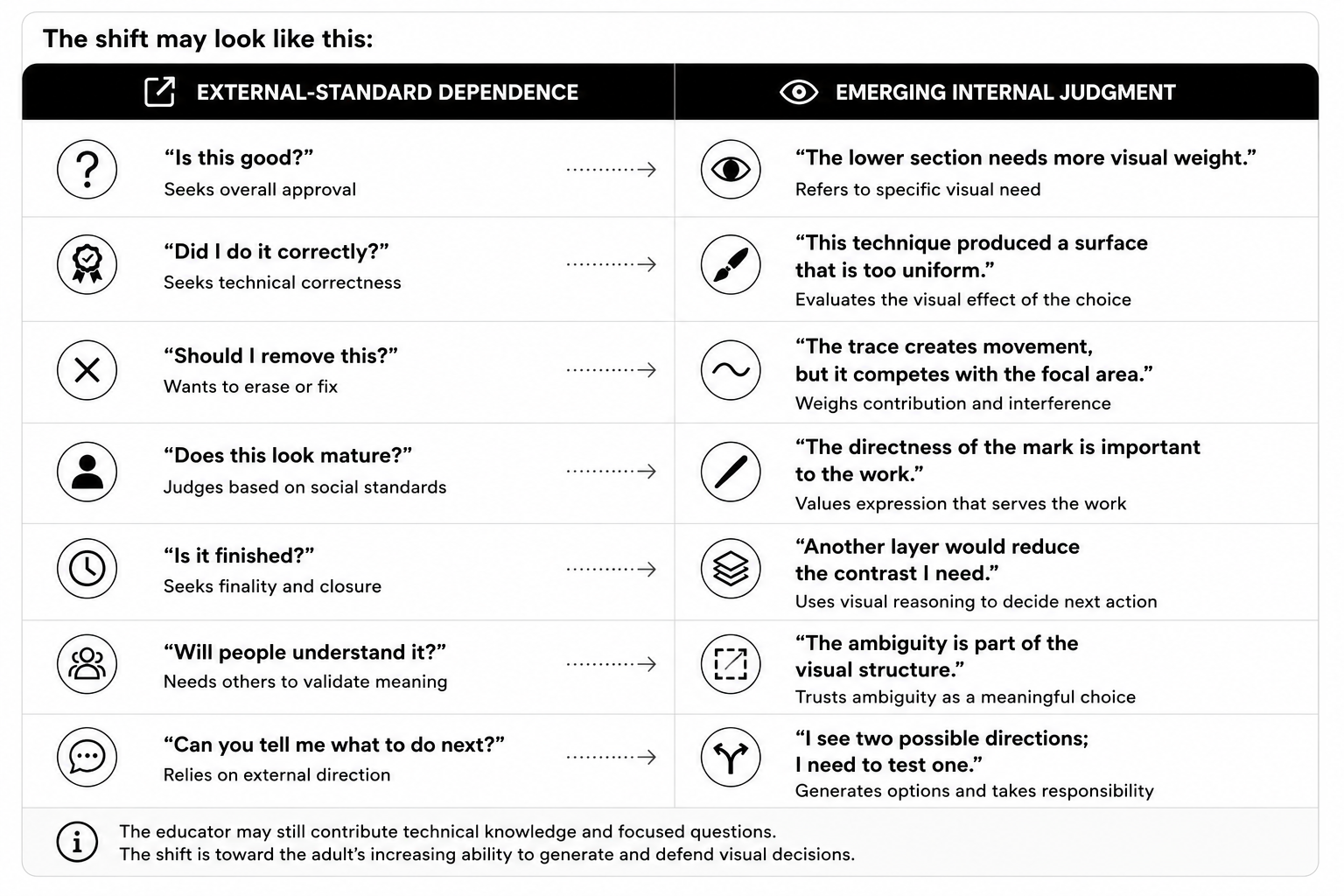
The educator may still contribute technical knowledge and focused questions.
The adult gradually becomes more capable of generating and defending visual decisions.
Creative Agency Is More Than Freedom
Creative agency is sometimes described as the freedom to do anything.
That definition is too weak.
Agency becomes visible when the adult can:
initiate action
tolerate consequences
revise a plan
interpret material feedback
request specific support
decide what to preserve
reject an option for a reason
continue without constant approval
recognize meaningful closure
Agency involves responsibility.
The adult owns both the decision and the need to respond when the decision changes the work.
The studio supports agency by providing enough structure for action and enough openness for judgment.
What CCH Observes
The transition from correction-oriented practice toward internal judgment may become visible through recurring changes.
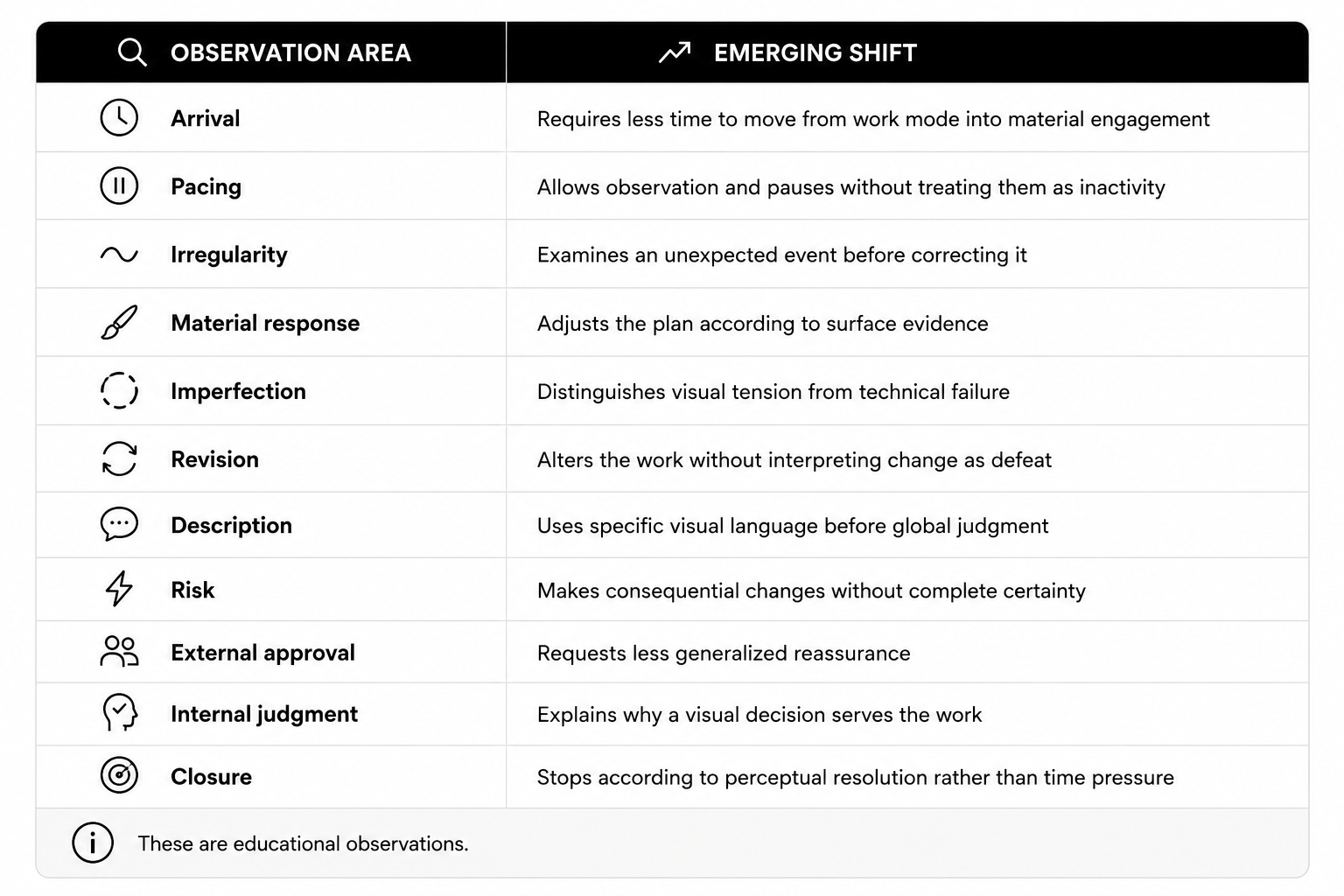
These are educational observations.
They do not prove a permanent change in personality, cognition, or mental health.
CCH looks for patterns across sessions, materials, and levels of challenge.
The Educator’s Role
The educator does not declare every irregularity meaningful.
Nor does the educator correct every deviation.
The role is to help the adult distinguish among:
technical failure
unfamiliarity
perceptual discomfort
visual possibility
unresolved structure
productive material resistance
Support may include:
explaining material behavior
identifying when correction is automatic
asking the adult to describe before judging
protecting an unresolved area temporarily
inviting comparison between two alternatives
helping the adult test rather than commit immediately
clarifying whether the next action comes from the work or from anxiety
leaving final visual ownership with the adult
The educator provides enough structure for judgment to develop without replacing it.
Imperfection and Psychological Breakthrough
The psychological breakthrough in this case is not the acceptance of poor quality.
It is the recognition that uncertainty, visible process, and irregularity do not automatically invalidate the work.
The adult may discover:
a mistake can be investigated
an unwanted mark can be transformed
a painting can change direction without collapsing
beauty is not the only form of visual value
the original idea is not a contract
unfinishedness can be temporary rather than shameful
internal judgment can become more reliable through practice
This is where psychological change and artistic language meet.
The adult does not simply feel more confident.
They develop a richer visual vocabulary through which previously rejected conditions—residue, tension, asymmetry, interruption, roughness—can be understood and used.
What This Case Does Not Claim
This case does not claim that:
long sessions automatically produce flow
imperfection is always artistically valuable
every accident should be preserved
technical standards are oppressive
external critique has no value
artmaking treats perfectionism or occupational stress
studio practice guarantees generalized psychological change
Research on arts and crafts engagement has reported possible associations with well-being, but recent reviews continue to emphasize limitations in study quality, mechanism, and long-term evidence. These findings should not be converted into therapeutic claims for an educational studio program.
The defensible CCH position is:
Extended material-based studio practice creates conditions in which adults can slow evaluation, interpret imperfection, revise decisions, and build more internally grounded visual judgment.
Key Takeaway
Imperfection becomes a creative resource when the adult has enough time to observe it, enough material evidence to interpret it, and enough ownership to decide what it can become.
Sustained studio time allows the adult to move gradually from professional efficiency and self-monitoring toward deeper material attention.
Through painting, covering, scraping, layering, traces, interruption, and return, the adult learns that a work does not need to reproduce its original idea in order to become coherent.
The developmental movement is:
from immediate correction to interpretation
from external standards to internal judgment
from controlling every result to exercising creative agency
Evidence Boundary
This case presents educational and studio-based observations. It does not diagnose perfectionism, anxiety, occupational stress, or other psychological conditions. It also does not claim that sustained studio practice produces clinical or generalized cognitive change. Such claims would require validated measures, qualified assessment, formal research design, and independent review.
References
Bartholomeyczik, K., et al. “Fostering Flow Experiences at Work: A Framework and Research Agenda.” 2023.
Gold, J., and Ciorciari, J. “A Review on the Role of the Neuroscience of Flow States in the Modern World.” 2020.
Harvard Project Zero. Eight Studio Habits of Mind.
Harvard Project Zero. Studio Thinking: The Real Benefits of Visual Arts Education.
Kimmel, M. “An ‘In Vivo’ Analysis of Crafts Practices and Creativity.” 2023.
Kimmel, M. “What Affords Being Creative? Opportunities for Novelty in Light of Perception and Materiality.” 2023.
Malafouris, L. “Mind and Material Engagement.” 2018.
Malafouris, L. “Mark Making and Human Becoming.” 2021.
Bukhave, E. B., et al. “The Effects of Crafts-Based Interventions on Mental Health and Well-Being.” 2025.