
ADULT STUDIO CASE 05-Rebuilding Trust in Personal Visual Judgment
From External Standards to Creative Agency
Internal judgment develops when the adult can observe the work, explain a visual decision, and accept responsibility for where the process leads.
Many adults enter the studio carrying a well-developed awareness of external standards.
They may know what is considered technically accomplished, visually sophisticated, tasteful, mature, professional, or culturally recognizable as art. They may also have years of experience receiving correction from schools, workplaces, social environments, and online visual culture.
This knowledge can be useful.
Technical understanding, aesthetic reference, historical awareness, and critical feedback can expand an adult’s artistic practice.
Difficulty emerges when external standards become the only source of judgment.
The adult may repeatedly ask:
Is this good?
Is this the correct technique?
Does this look mature?
Should I remove this mark?
Will other people understand it?
Can you tell me what to do next?
How do I know whether the work is finished?
These questions do not necessarily indicate a lack of intelligence or creative capacity.
They often show that responsibility for visual judgment has been placed outside the maker.
Within CCH adult studio practice, the final developmental movement is therefore not simply toward greater confidence.
It is toward a more specific capacity:
The ability to observe visual evidence, form a reasoned judgment, make a decision, and remain responsible for its consequences.
Confidence and Judgment Are Different
Confidence is a feeling.
Judgment is a process.
An adult may feel confident while making a visually weak decision. Another adult may feel uncertain while making a perceptive and well-grounded one.
CCH therefore does not define progress as the disappearance of doubt.
The relevant question is whether the adult can continue thinking while doubt remains.
Visual judgment may involve:
observing what is present
identifying a visual relationship or problem
comparing possible responses
predicting likely consequences
selecting an action
observing what changes
revising the judgment when necessary
This is closer to reflective practice than to generalized self-belief.
Harvard Project Zero’s Studio Thinking framework identifies Observe, Reflect, Envision, Stretch and Explore, and Engage and Persist among the habits cultivated through visual-art practice. These habits describe how artistic decisions emerge through sustained looking, making, reflection, and revision rather than through intuition alone.
Internal judgment is therefore not:
“I trust everything I do.”
It is:
“I can examine what I have done and decide what the work needs next.”
Why Adults Depend on External Standards
External standards reduce ambiguity.
They may offer:
a correct method
a recognizable model
a teacher’s approval
an aesthetic category
a technical benchmark
a socially validated definition of quality
reassurance that the work is finished
For adults accustomed to professional accountability, external criteria can feel safer than open-ended visual judgment.
A defined standard allows the person to ask:
Did I meet the requirement?
An evolving artwork asks a more difficult question:
What does this particular work require?
The second question cannot always be answered through a universal rule.
The adult must interpret:
scale
balance
visual weight
rhythm
density
contrast
surface tension
material history
spatial relationship
the function of ambiguity
the relationship between intention and result
The judgment must arise partly from the work itself.
The Problem Is Not External Feedback
CCH does not argue that adults should ignore critique, instruction, art history, or professional expertise.
External feedback can:
identify technical limitations
expand perception
introduce alternative interpretations
challenge habitual decisions
provide language for visual analysis
reveal cultural and historical context
prevent the maker from becoming enclosed within personal preference
The problem appears when feedback replaces the adult’s own act of seeing.
For example, an adult may ask:
“Should I remove this?”
The educator can answer directly.
Yet a direct answer may leave the underlying judgment undeveloped.
A more developmental exchange could examine:
What is the mark doing?
Which area does it affect?
What would be lost if it disappeared?
Is the discomfort technical, compositional, or emotional?
What alternatives exist besides complete removal?
Which decision better serves the work?
The educator still contributes expertise.
The adult retains responsibility for the final choice.
From Approval-Seeking to Visual Reasoning
The movement toward internal judgment often becomes visible in language.
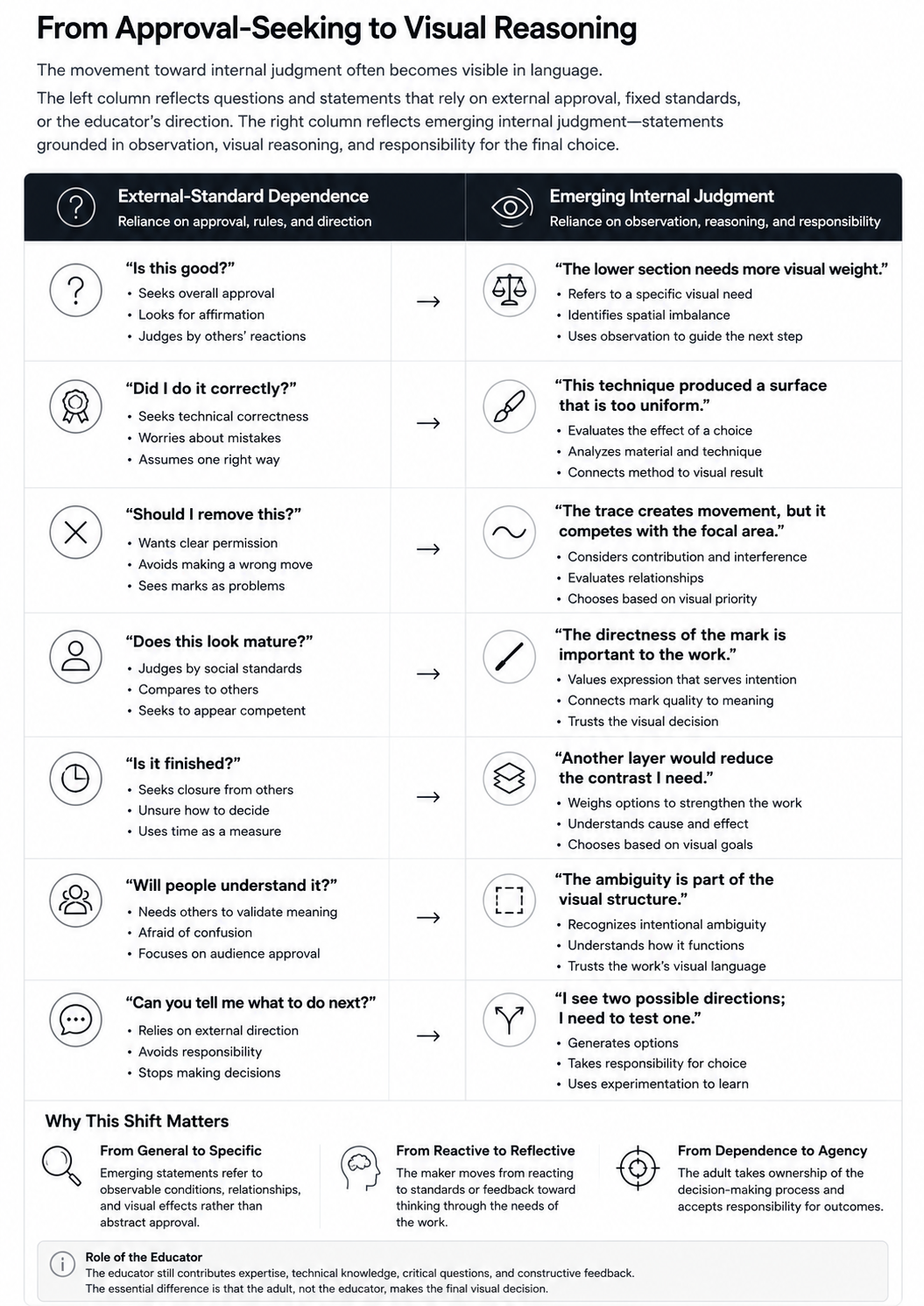
The emerging statements are not merely more confident.
They are more specific.
They refer to observable conditions, possible consequences, and the needs of the developing work.
This specificity is the basis of internal visual judgment.
Personal Preference Is Only the Beginning
Adults often describe internal judgment through statements such as:
I like this.
I do not like that color.
This feels more like me.
I prefer this style.
Preference matters.
It can reveal attraction, aversion, identity, memory, taste, and cultural orientation.
Yet preference alone does not fully explain whether a decision serves the work.
The adult may like a color that weakens the composition.
They may dislike an irregular mark that gives the painting necessary tension.
They may prefer symmetry even when the work becomes more active through imbalance.
CCH therefore helps the adult move from:
“I like it.”
toward:
“I like the density here because it slows the eye and creates contrast with the open area.”
The second statement connects preference with visual reasoning.
It allows the judgment to be examined, tested, and revised.
Rebuilding the Question: What Do I Like?
The question What do I like? can sound simple.
For adults shaped by external evaluation, it may be surprisingly difficult.
Their preferences may have been organized around:
what appears sophisticated
what is socially acceptable
what resembles professional work
what receives praise
what can be explained easily
what fits recognizable trends
what avoids embarrassment
what demonstrates skill
Rebuilding personal visual judgment does not mean discovering a hidden, pure taste untouched by culture.
All visual preference develops within experience, education, memory, identity, and social context.
The relevant shift is toward conscious ownership.
The adult begins asking:
Do I actually respond to this visual quality?
Am I preserving it because it serves the work or because it looks impressive?
Am I rejecting it because it is weak or because it is unfamiliar?
Is this choice mine, or am I anticipating someone else’s reaction?
What visual conditions consistently hold my attention?
Over time, repeated choices begin to reveal a personal visual language.
Why Did I Stop Here?
Stopping is often interpreted as a practical matter.
The session ends.
The surface is full.
The adult becomes tired.
The instructor says the project is complete.
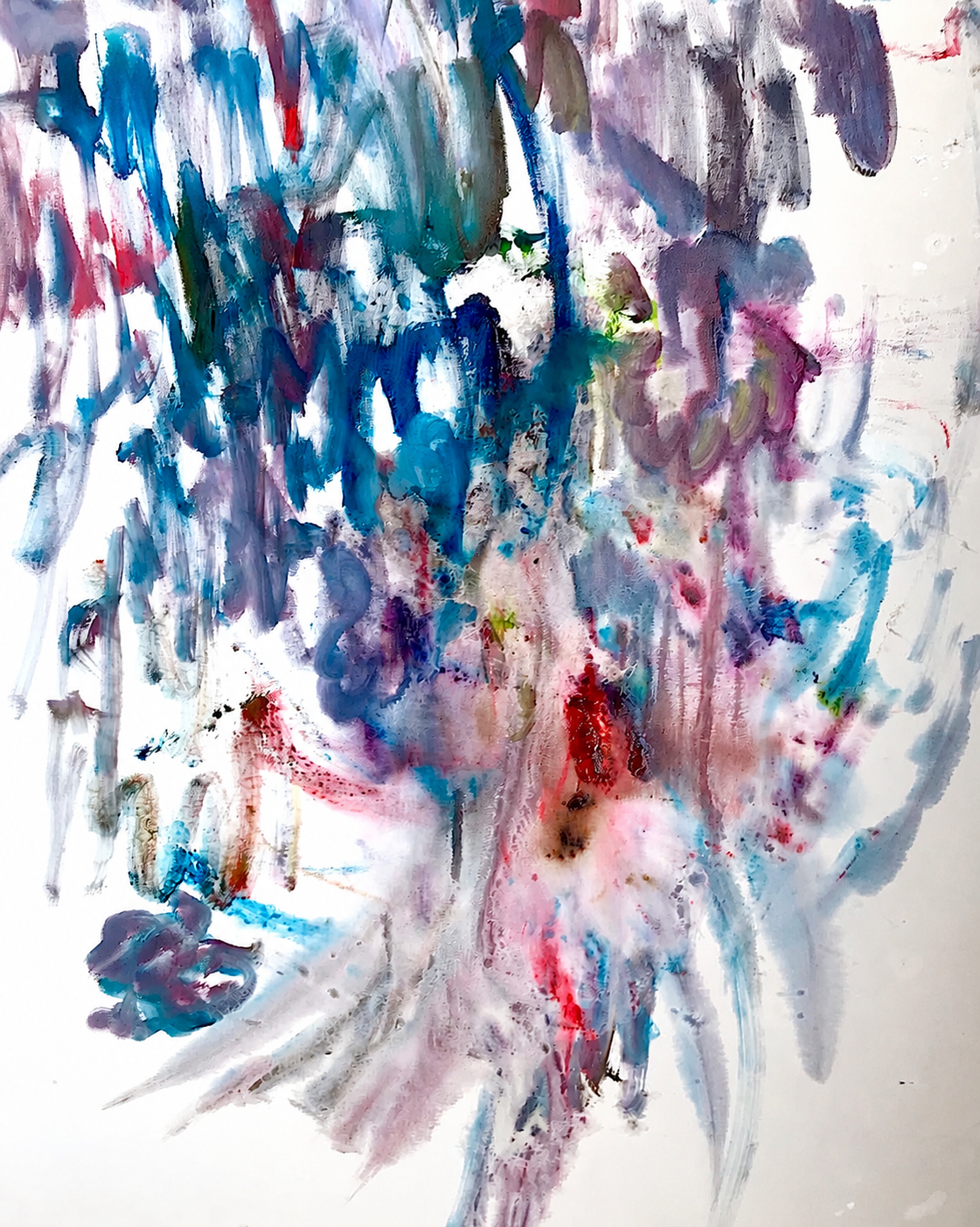
Yet closure is also a form of judgment.
The adult must decide whether:
the work has reached sufficient visual coherence
another action would deepen or weaken it
an unresolved area remains productively open
continued revision is serving the painting
the desire to continue comes from the work or from anxiety
the desire to stop comes from resolution or fear
This makes closure one of the clearest sites of creative agency.
The adult is no longer merely asking whether the work is objectively finished.
They are deciding whether the current visual relationships are sufficiently resolved.
Arts PROPEL, developed through Harvard Project Zero, integrates production, perception, and reflection. Its framework treats reflection as thinking about how a work was made and how its effects were achieved—precisely the kind of reasoning required for meaningful artistic closure.
Completion Is Not Perfection
A work may be complete without being flawless.
It may retain:
ambiguity
roughness
visible correction
asymmetry
unresolved narrative
traces of earlier decisions
material irregularity
areas of silence
contradictions that remain active
Completion means that the work has reached a state the adult can recognize and defend.
Perfectionism can complicate this recognition.
One adult may continue indefinitely because every irregularity feels unacceptable.
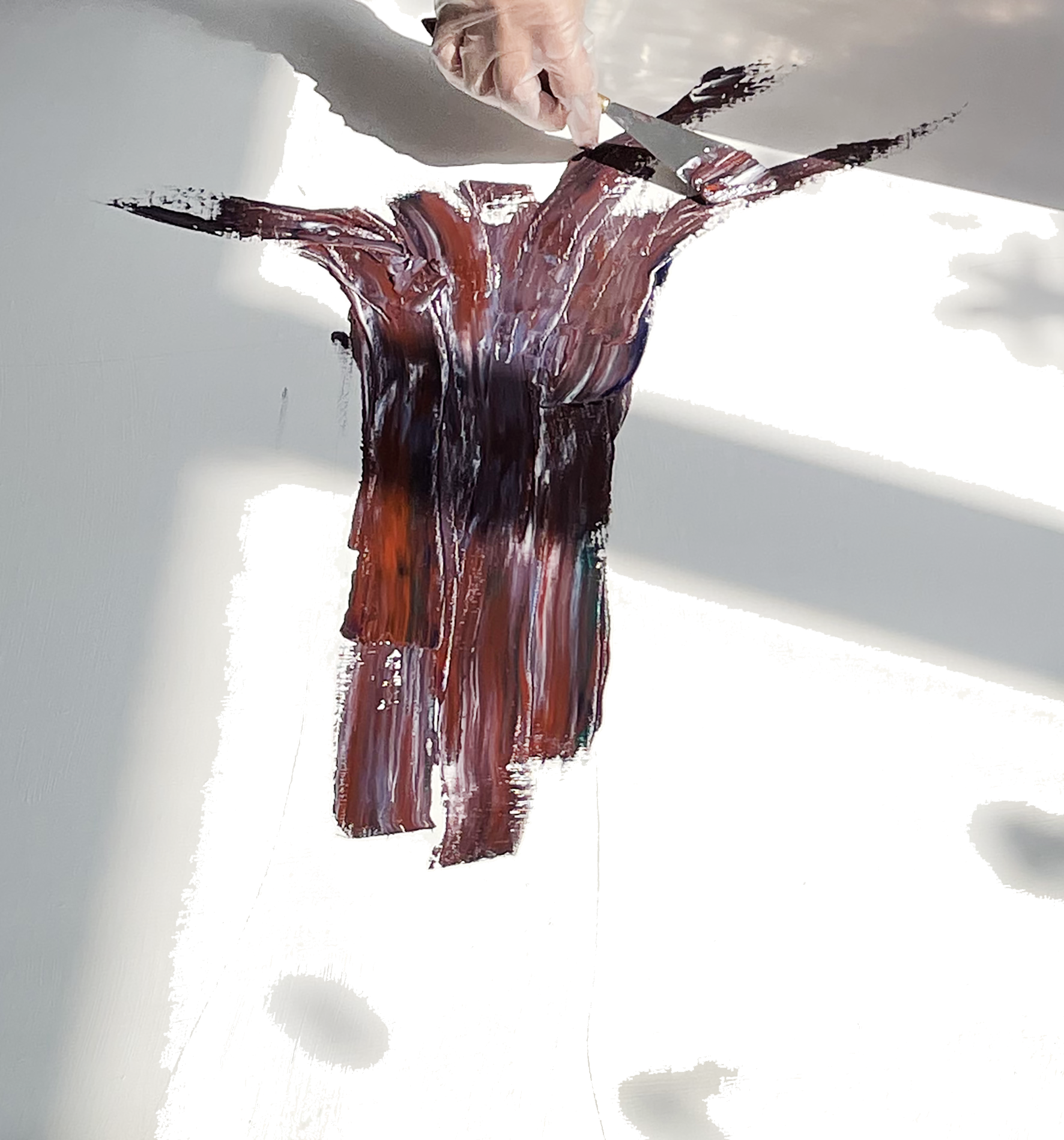
Another may stop early because further action risks exposing uncertainty.
Research distinguishes perfectionistic concerns—such as doubts about action and fear of mistakes—from striving for excellence. Perfectionistic concerns have been associated with reduced originality in divergent-thinking tasks, while excellence-oriented striving may function differently.
CCH therefore does not ask adults to lower all standards.
It asks them to distinguish between:
refinement that serves the work
correction that protects self-image
continuation that deepens the painting
continuation driven by fear of imperfection
closure grounded in visual evidence
closure used to escape uncertainty
Accepting a Work That Differs from the Original Plan
Creative agency becomes especially visible when the finished work differs from what the adult first imagined.
This difference can produce disappointment:
The painting became more abstract.
The original subject disappeared.
The color relationships changed.
A material accident redirected the composition.
The surface became rougher than intended.
An early idea no longer fits the developed work.
The adult may interpret this difference as evidence of failure.
Yet the first idea was formed before the materials generated information.
It could not account for:
actual scale
pigment behavior
surface absorption
the interaction of layers
visual tension
material resistance
new relationships discovered during making
Material Engagement Theory argues that materials participate in cognition rather than merely receiving previously completed ideas. The maker’s thinking develops through interaction with tools, surfaces, gestures, and material responses.
The final work may therefore differ from the original plan because the maker has learned more.
A changed outcome may indicate a more informed process rather than a failed one.
Internal Judgment Is Built Through Repeated Consequence
Visual judgment cannot be developed only through explanation.
The adult must make decisions and experience what follows.
For example:
The adult decides to cover an area.
The contrast disappears.
The adult observes the loss.
A new layer is introduced.
The original structure cannot be fully recovered.
The adult must decide how to reorganize the image.
This sequence develops judgment because the decision has material consequences.
The adult learns:
which kinds of contrast matter
how much density the image can hold
when a surface needs interruption
when repetition becomes excessive
when revision creates depth
when correction removes vitality
what forms of ambiguity they can sustain
Judgment becomes grounded in accumulated encounters.
It is less a rule than a history of perception, action, consequence, and reflection.
Creative Agency Requires Responsibility
Creative agency is sometimes described as freedom from rules.
That definition is incomplete.
Agency involves the ability to act, choose, revise, and accept responsibility for the developing work.
An adult exercising creative agency can:
begin without a complete answer
select among alternatives
tolerate an imperfect consequence
request specific technical support
disagree with feedback for a reason
revise a plan when evidence changes
preserve an unusual decision
abandon an attractive element that weakens the work
recognize closure
explain the reasoning behind a choice
The adult does not need to be independent from every influence.
Agency is compatible with dialogue, instruction, critique, and collaboration.
The essential condition is that external input informs judgment rather than replacing it.

The Educator’s Role Changes
At the beginning of adult studio practice, the educator may provide substantial structure:
material orientation
technical access
focused questions
limits that reduce decision overload
reassurance that exploration is legitimate
language for describing visual conditions
support in distinguishing technical failure from aesthetic discomfort
As internal judgment develops, the educator’s role may become less directive.
Questions can shift from:
Would you like me to demonstrate?
Which material feels manageable?
What happened when you used this tool?
toward:
What is visually active here?
Which relationship matters most?
What would each possible action change?
What does the work need rather than what do you feel expected to do?
Which decision are you prepared to take responsibility for?
What tells you that the work has reached closure?
The educator does not disappear.
The dialogue becomes more reciprocal and analytically demanding.
Self-Regulation and Visual Judgment
Internal judgment also depends on emotional regulation.
An adult may understand what the work requires and still avoid acting because the decision feels risky.
For example:
covering a successful passage
cutting into a stable composition
introducing a contrasting color
leaving an irregular trace
stopping before external approval is given
accepting that the work is not conventionally beautiful
Self-regulation allows the adult to remain present with the discomfort long enough to make a visual decision.
This is not equivalent to suppressing emotion.
The adult may acknowledge:
“I am afraid this change will damage the painting.”
and still ask:
“What evidence suggests the painting requires it?”
The emotional reaction remains real.
It no longer controls the entire judgment process.
Reflection Makes Judgment Visible
Internal judgment is strengthened when the adult can name how a decision was made.
Reflection may involve questions such as:
What changed most during the process?
Which decision redirected the work?
Which mark was initially rejected but later became useful?
Where did external approval influence the process?
When did the work begin to feel internally coherent?
Which technical choice served the visual intention?
What would be different if the original plan had been followed exactly?
Why did the process stop here?
Project Zero’s thinking routines are designed to help learners notice and name particular thinking moves, making those moves more available for future use.
Within CCH, reflection does not require a lengthy interpretation after every session.
It can be brief and specific.
The goal is to connect visual action with conscious judgment.
What CCH Observes
The development of internal visual judgment may become visible through recurring shifts.
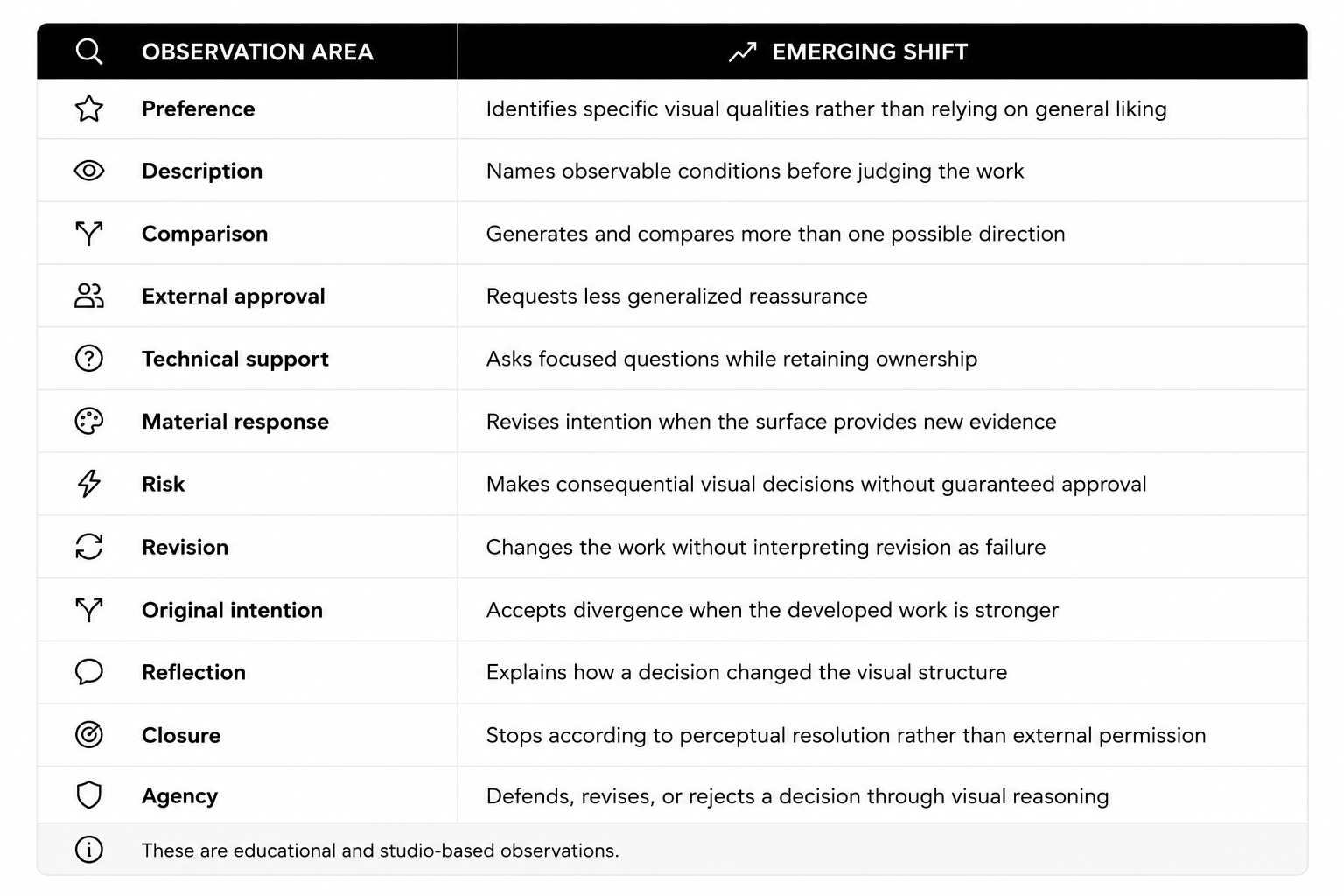
These are educational and studio-based observations.
They do not prove permanent changes in personality, self-esteem, or psychological functioning.
CCH looks for patterns across projects, materials, and time.
A Shift in the Adult’s Questions
The most meaningful change may appear not in the artwork but in the questions the adult asks.
Earlier questions
Is this good?
What am I supposed to do?
Is this the correct way?
Can you choose for me?
Does this look professional?
Am I finished?
Emerging questions
What is this area doing visually?
Which material would create the contrast I need?
Is this uncertainty productive or unresolved?
What would be lost if I covered this section?
Am I continuing because the work needs it or because I am afraid to stop?
Which of these directions am I willing to test?
The later questions do not guarantee better artwork.
They indicate that the adult’s attention has moved closer to the actual visual problem.
The Artwork Becomes a Site of Negotiation
A painting is shaped by several forms of influence:
personal intention
material behavior
technical knowledge
memory
cultural reference
emotional response
feedback from others
accidents
revision
time
Internal judgment does not eliminate these influences.
It negotiates among them.
The adult must determine:
which influence should lead
which should be questioned
which should be integrated
which should be resisted
which requires more information
This negotiation is where creative agency becomes visible.
The adult is neither isolated nor obedient.
They participate actively in shaping the terms of the work.

Rebuilding Trust
Trust in personal visual judgment does not mean believing that every decision is correct.
It means trusting that one can:
look carefully
make a provisional choice
observe consequences
recognize when a choice is weak
revise without humiliation
learn from material evidence
tolerate disagreement
ask for support without surrendering ownership
stop when the work is sufficiently resolved
Trust is built through recoverability.
The adult learns that a weak decision does not end the process.
A changed plan does not erase authorship.
Uncertainty does not eliminate intelligence.
Revision does not prove incompetence.
The person can continue thinking after something unexpected occurs.
Beyond Self-Expression
Adult art practice is often described as self-expression.
Expression is important, but internal judgment involves more than communicating a pre-existing inner state.
The adult also encounters:
unfamiliar material conditions
visual evidence that contradicts intention
formal relationships that demand response
meanings that appear only through the process
decisions that cannot be justified through emotion alone
The work is not merely a container for the self.
It is a site where perception, material, intention, and judgment interact.
This prevents the adult studio from becoming either:
pure technical instruction, or
unrestricted emotional discharge
CCH positions adult painting as a disciplined form of perceptual and material inquiry.
What This Case Does Not Claim
This case does not claim that:
external standards are inherently harmful
every personal preference is artistically valid
confidence guarantees good judgment
adults should work without instruction
critique should be removed
intuition is always superior to technical knowledge
studio participation permanently changes self-esteem
artistic agency automatically transfers to all areas of life
The more defensible position is:
Repeated studio practice can create structured opportunities for adults to observe, compare, decide, revise, reflect, and form more internally grounded visual judgments.
Research concerning artmaking, creativity, confidence, and well-being remains methodologically varied. Educational studio observations should not be converted into clinical or generalized psychological claims.
Key Takeaway
Rebuilding trust in personal visual judgment means moving from generalized approval-seeking toward specific, evidence-based visual reasoning.
The adult gradually becomes more able to answer:
What do I actually respond to?
What is the work doing?
Why am I making this decision?
What will this action change?
Do I need feedback, technical information, or permission?
Can I accept that the work has moved beyond the original plan?
What tells me that the painting has reached closure?
This is more than becoming confident.
It is the formation of creative agency:
the capacity to see, choose, revise, explain, and remain responsible for the work.
Evidence Boundary
This case presents educational and studio-based observations. It does not diagnose confidence, perfectionism, anxiety, or dependency, and it does not claim that adult studio participation produces generalized psychological or behavioral change. Clinical or causal conclusions would require validated measures, qualified assessment, formal research design, and independent review.
References
Harvard Project Zero. Eight Studio Habits of Mind. The framework identifies Develop Craft, Engage and Persist, Envision, Express, Observe, Reflect, Stretch and Explore, and Understand Art Worlds.
Harvard Project Zero. Studio Thinking: The Real Benefits of Visual Arts Education.
Harvard Project Zero. Arts PROPEL: An Introductory Handbook. Production, perception, and reflection are treated as interconnected artistic processes.
Harvard Project Zero. Arts PROPEL: A Handbook for Visual Arts.
Harvard Project Zero. Thinking Routines.
Malafouris, L. “Mind and Material Engagement.” Material engagement situates cognition within relations among mind, body, objects, and action.
Goulet-Pelletier, J.-C., et al. “Investigating the Negative Link Between Perfectionism and the Generation of Original Ideas.”
Vaartio-Rajalin, H., et al. “Art Making and Expressive Art Therapy in Adult Health and Nursing Care.”