

Why Material Constraints Matter for Leadership
How Physical Resistance Makes Decision-Making, Adaptation, and Responsibility More Observable
Leadership is often discussed through abstract language.
Organizations speak about adaptability, strategic clarity, innovation, ownership, resilience, and the capacity to operate under uncertainty. These qualities are frequently explored through presentations, questionnaires, discussion exercises, or hypothetical business scenarios.
Such formats can be useful. They allow participants to articulate values, compare ideas, and examine organizational situations from a conceptual distance.
They also have a limitation: participants can often describe effective leadership without revealing how they actually respond when their intentions encounter resistance.
Material constraints change the conditions of the inquiry.
A structure that will not stand, a surface that reacts unexpectedly, a connection that cannot support its intended weight, or a decision that cannot be fully reversed creates a different kind of problem. The participant must move beyond describing adaptability and begin adapting.
Within CCH enterprise practice, material engagement is not introduced as an artistic diversion or as a symbolic exercise in creativity. It creates a bounded decision environment in which attention, prioritization, revision, help-seeking, and responsibility can become more visible.
The purpose is not to determine whether someone is a “good leader.” It is to examine what happens when a person must make consequential decisions without complete information, a guaranteed solution, or the ability to control every variable.
Constraints Are Not the Opposite of Creativity
Creativity is sometimes presented as freedom from restriction.
From this perspective, constraints appear to interfere with imagination. Fewer rules, unlimited materials, and complete openness are assumed to produce more original thinking.
In practice, total openness can create its own difficulties. When every direction is possible, participants may struggle to identify what matters, establish priorities, or move from possibility to commitment.
Research on creative problem-solving suggests that the relationship between constraints and creativity is not simply negative. The effect depends on the type, relevance, and intensity of the constraint. Insufficient structure may leave a problem undefined, while excessive restriction may eliminate meaningful agency. Productive conditions often exist between these extremes: enough limitation to orient action, but enough openness to permit interpretation and invention.
A material constraint does not necessarily prescribe the answer.
Instead, it establishes conditions that must be taken seriously.
A participant may decide what to build, how to organize a surface, which relationships to emphasize, or whether to retain an emerging structure. The material does not determine the intention, but it influences which intentions remain possible and what additional decisions become necessary.
This distinction is central to CCH enterprise work:
A constraint does not remove agency. It gives agency something real to respond to.
Leadership Begins Where Intention Meets Reality
A plan can remain coherent while it exists only in language.
The difficulty begins when the plan enters a world of limited time, incomplete information, physical resistance, competing priorities, and consequences that cannot be entirely predicted.
This is familiar within organizational life.
A strategy may appear persuasive until it encounters budget limitations. A product concept may appear elegant until manufacturing reveals structural problems. A team agreement may seem clear until responsibilities overlap. A timeline may look reasonable until dependencies begin to interact.
Leadership is therefore not demonstrated only through the ability to establish an intention.
It also involves the ability to:
recognize when reality no longer supports the original plan;
distinguish a temporary obstacle from a structural problem;
decide what must be preserved and what can be changed;
revise without losing direction;
request support without transferring ownership;
explain the basis of a decision;
accept responsibility for its consequences.
Material work compresses these demands into a visible and relatively contained environment.
The problem is smaller than an organizational crisis, but the decision patterns can still become observable.
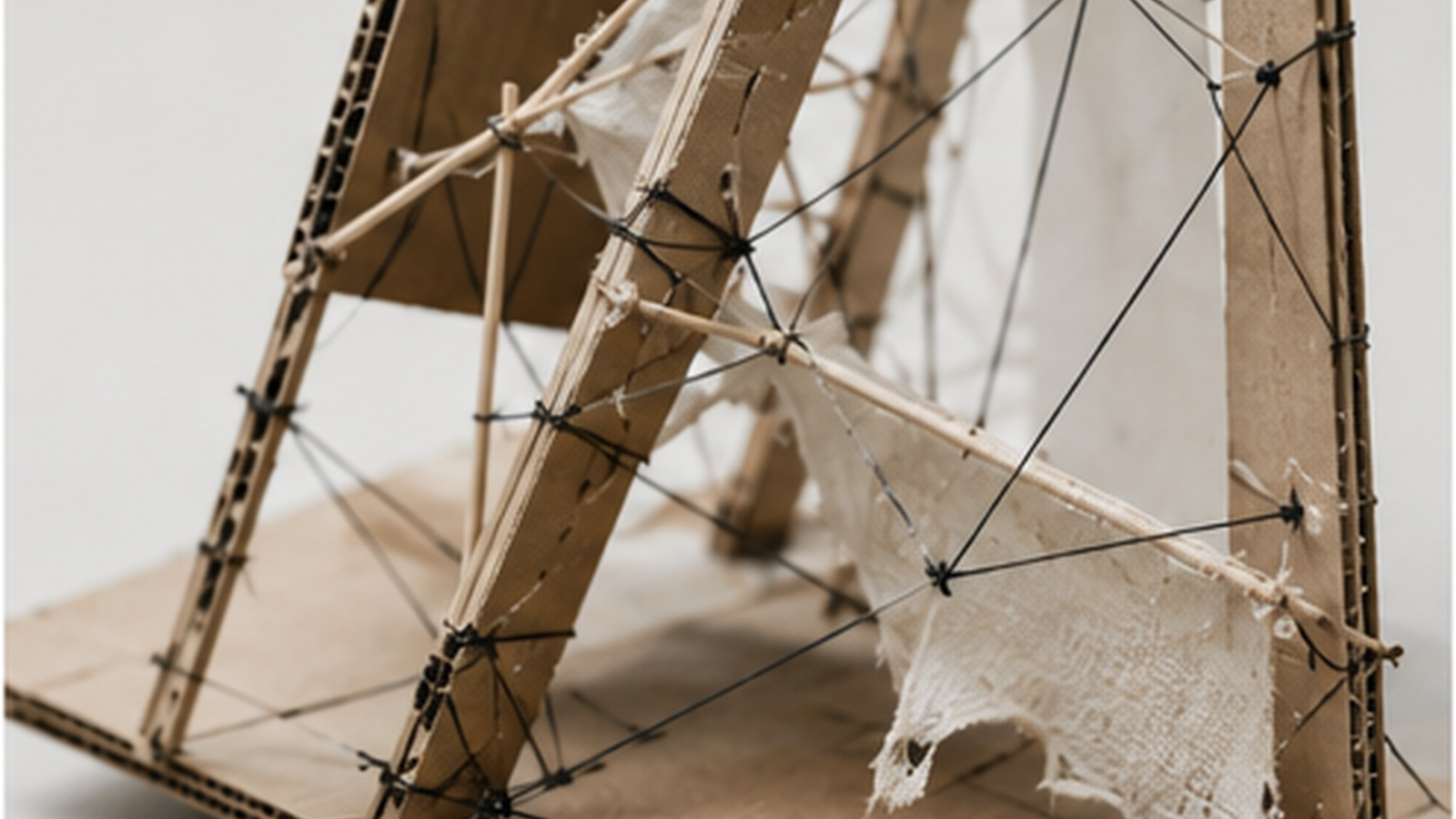
Material Constraints Create Consequence
Materials do not automatically conform to intention. Their weight, tension, flexibility, and structural limits create real conditions that participants must observe and respond to.
Material Engagement Makes Thinking Visible
Material Engagement Theory proposes that thinking is not confined to an internal mental process that is later expressed through action. Cognition can also be understood as situated and enacted through relationships among bodies, tools, surfaces, objects, and environments. From this perspective, making is not merely the execution of a completed idea; interaction with material can participate in the formation and transformation of thought itself.
A person may begin with a clear intention and discover through action that the intention was incomplete.
The weight of an object may reveal that the planned structure is unstable. A resistant surface may produce a visual relationship that was not anticipated. Limited materials may require two functions to be combined. A failed attachment may expose an incorrect assumption about balance or sequence.
The participant must then interpret what the material is showing.
This produces a continuous cycle:
intention → action → material response → interpretation → adjustment
The important point is not that the material contains an answer.
It provides evidence.
The participant remains responsible for deciding what that evidence means and what should happen next.
Abstract Environments Can Conceal Decision Habits
Professional expertise can make decision-making highly efficient.
Experienced leaders often work through familiar systems, language, roles, and expectations. They know how to frame a proposal, facilitate a meeting, delegate a task, or present a strategic rationale.
These abilities are valuable.
They can also make certain habits harder to see.
A leader may appear flexible because familiar procedures already accommodate most variables. A person may appear decisive because the organization has established what kinds of decisions are rewarded. Someone may appear comfortable with ambiguity while continuing to operate within a field in which their expertise gives them substantial control.
An unfamiliar material environment removes some of these established supports.
Participants cannot rely entirely on professional vocabulary, positional authority, or a rehearsed management identity. The work must respond to gravity, time, scale, pressure, adhesion, fragility, saturation, or instability.
This does not reproduce the workplace.
It changes the level of analysis.
Instead of asking participants only what they believe about leadership, the studio makes it possible to observe how they organize action when their existing competence does not automatically provide the answer.
What Material Constraints Can Reveal
1. How a Person Frames the Problem
When something fails, the first interpretation matters.
A participant may conclude:
the material is unsuitable;
the original concept is impossible;
the technique was incorrect;
more force is required;
additional materials are needed;
the problem lies somewhere else in the structure.
Each interpretation opens and closes different possibilities.
Effective decision-making depends not only on solving a problem, but on recognizing what the problem actually is. Design research treats framing as a consequential cognitive activity because the way an uncertain situation is understood affects which actions and solutions become visible.
In a CCH enterprise session, the facilitator may therefore avoid immediately identifying the problem for the participant.
Questions may include:
What changed?
Where does the instability begin?
Which part of the original intention still matters?
What evidence supports your current interpretation?
The purpose is not to delay progress unnecessarily. It is to prevent an externally supplied answer from replacing the participant’s own process of observation and problem definition.
2. How Priorities Are Established
Constraints force selection.
A participant may want a structure to be larger, lighter, more stable, more detailed, and completed within the available time. These aims may not all be compatible.
A decision must be made about what matters most.
This can reveal whether the person:
preserves every initial ambition;
establishes a clear hierarchy;
continues adding complexity without reassessing capacity;
simplifies while protecting the central intention;
sacrifices an essential feature to preserve a minor one;
postpones commitment by keeping all options open.
Leadership frequently requires the management of competing goods rather than a choice between an obviously correct and incorrect option.
Material constraints make this trade-off concrete.
The participant cannot merely state that priorities are important. The emerging work records which priorities actually governed the decision.

Priorities Must Be Established
When time, materials, and structural capacity are limited, every objective cannot be preserved equally. Participants must decide what is essential, what can be adapted, and what must be released.
3. How Control Is Exercised
When materials respond unpredictably, some participants increase control.
They may work more tightly, reduce experimentation, repeat the same action, or attempt to force the surface back toward the initial image.
Others abandon control too quickly and allow the process to become directionless.
Neither complete control nor complete surrender is necessarily adaptive.
Material responsiveness requires a more complex relationship:
enough intention to maintain direction, and enough flexibility to incorporate new evidence.
This is particularly relevant to leadership under uncertainty.
A leader must sometimes protect a long-term purpose while changing the immediate method. At other times, new evidence may require reconsidering the purpose itself.
The material environment allows this distinction to be explored without reducing flexibility to a slogan.
4. How Revision Is Interpreted
Revision can be understood in several ways.
It may be treated as:
evidence of failure;
a threat to competence;
wasted effort;
an expected phase of development;
a response to new information;
an improvement in the relationship between intention and reality.
A participant who experiences every revision as failure may continue defending an increasingly unworkable direction.
Another may revise so frequently that no decision is allowed to develop long enough to produce meaningful evidence.
The relevant capacity is not simply willingness to change.
It is the ability to revise for a reason.
This means identifying what has been learned, explaining what the revision is intended to address, and evaluating whether the change improves the developing structure.
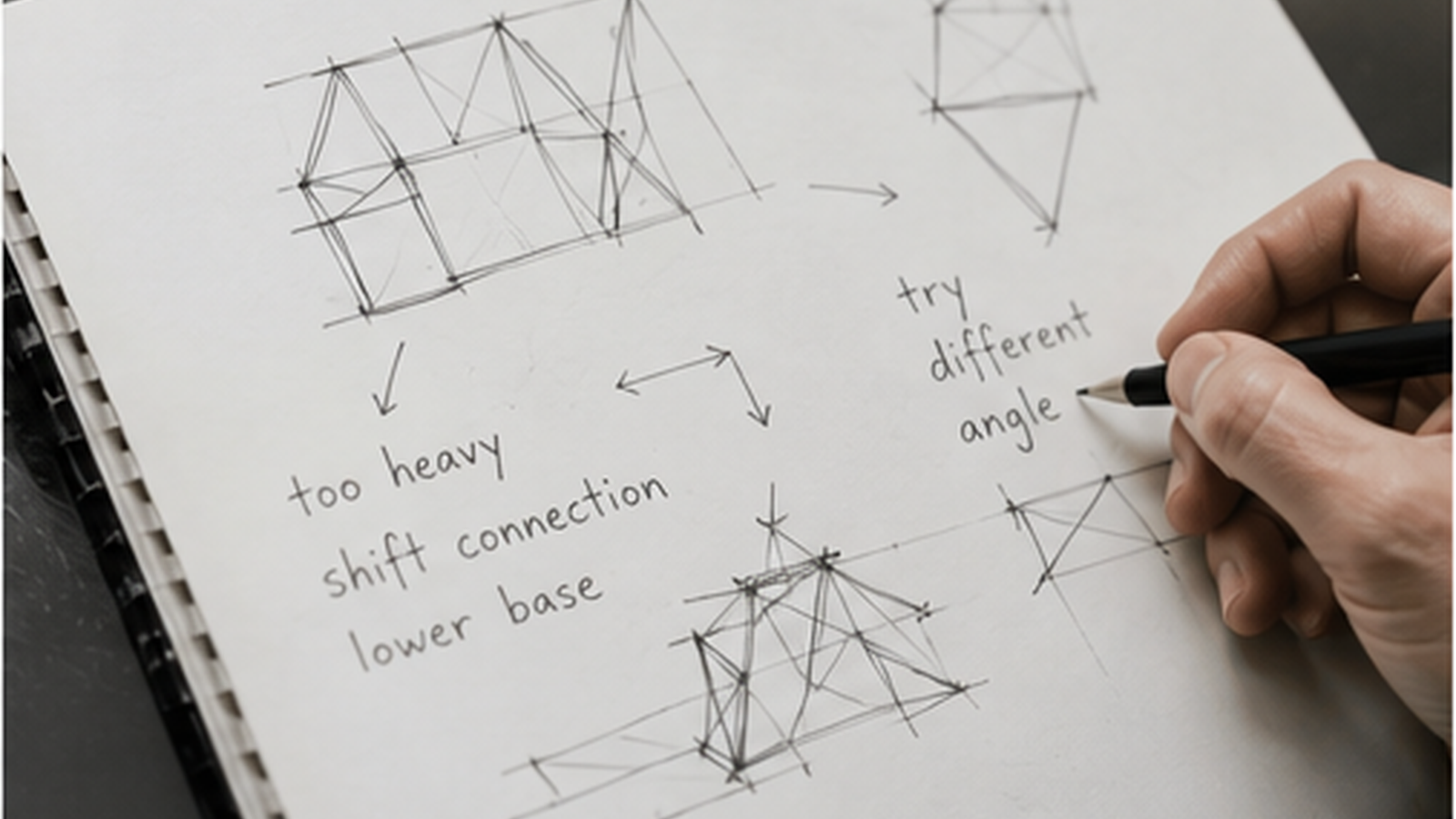
Revision Is Part of the Process
New material evidence may reveal that the original plan is incomplete or no longer workable. Responsible revision requires interpreting what changed and reorganizing the next decision accordingly.
5. How Assistance Is Requested
Leadership is not synonymous with individual self-sufficiency.
Material work can reveal how a participant uses support.
Some people avoid asking for assistance even when a technical barrier prevents further progress. Others request direction before investigating the problem themselves. Some ask for help but unknowingly transfer the final decision to the facilitator.
Focused assistance retains ownership.
For example:
“Can you show me two ways of strengthening this connection?”
is different from:
“Tell me what I should make.”
The first request seeks technical capacity while preserving responsibility for the direction. The second transfers direction itself.
CCH does not treat asking for help as weakness. The relevant question is whether support expands the participant’s capacity to decide or replaces the decision.

Decision Ownership Is Developed Through Action
Technical support may expand the available options, but the participant remains responsible for the direction of the work. Assistance supports decision-making without replacing ownership.
6. How Responsibility Is Retained
Material decisions produce consequences.
A cut cannot always be reversed. A surface may retain a trace. A structure may change after one element is removed. Time spent developing one direction reduces the time available for another.
These conditions make responsibility difficult to avoid.
Participants may respond by:
blaming the material;
blaming insufficient instruction;
asking the facilitator to authorize every consequential move;
delaying until the decision is made by circumstance;
acknowledging the result and reorganizing the work.
Responsibility does not require defending every choice.
It includes the ability to say:
I made this decision based on the information available.
The result is different from what I expected.
I now need to decide whether to retain, modify, or replace it.
This form of ownership is more useful than the performance of certainty.
7. How Closure Is Determined
Starting receives substantial attention in discussions of creativity.
Stopping is equally revealing.
A participant may stop because:
time has ended;
frustration has increased;
external approval has been received;
the work resembles the original plan;
the structure has reached sufficient resolution;
further intervention would weaken what has developed.
Meaningful closure requires evaluation.
It asks the participant to determine what has been resolved, what remains open, and whether further action would contribute to the work or merely postpone the discomfort of finishing.
In organizational terms, this relates to the difference between responsible completion and endless optimization.
Why Physical Work Can Interrupt Fixation
Professional expertise brings useful patterns, references, and prior solutions.
It can also produce fixation: continued adherence to an established idea even when it limits exploration. Design research has documented how exposure to existing solutions can narrow subsequent idea generation, while physical models may support different forms of exploration by supplementing or challenging the designer’s mental representation.
Material engagement can interrupt fixation because the participant receives information that is not entirely generated by prior expectation.
The surface behaves in its own way. The structure produces a weakness that was not visible in the sketch. A limited component suggests a different configuration.
The material does not guarantee originality.
It makes it harder for the participant to remain entirely inside an untested assumption.
This is one reason CCH enterprise work does not begin by asking participants to discuss leadership traits at length. Extended verbal explanation can reinforce the concepts people already use to understand themselves.
The material task introduces another source of information.
Not Every Constraint Is Productive
CCH does not assume that greater difficulty automatically produces deeper learning.
A constraint can become unproductive when it is:
unrelated to the central inquiry;
technically inaccessible without support;
so restrictive that no meaningful decision remains;
so open that the participant cannot orient action;
introduced primarily to provoke stress;
disconnected from the reflection that follows.
Research on constraints and creative problem-solving indicates that constraint levels require calibration. Both insufficient and excessive restrictions can impede productive engagement.
CCH therefore uses bounded constraints.
Participants receive:
a defined time frame;
selected materials;
safety boundaries;
an open but intelligible task;
access to technical assistance;
room for multiple valid directions;
a structured period of reflection.
The objective is not to create artificial hardship.
It is to establish enough resistance for decision-making to become necessary and enough support for the participant to remain capable of responding.
The Role of the Facilitator
The facilitator is not a passive observer.
They shape the environment by selecting materials, managing time, defining boundaries, documenting process, offering technical support, and asking questions that make reasoning more explicit.
At the same time, the facilitator avoids taking unnecessary control of the work.
This distinction matters because a material task can easily become a disguised instruction-following exercise. When every difficulty is immediately solved by the facilitator, the participant’s adaptation remains invisible.
CCH facilitation focuses on preserving the participant’s decision ownership.
The facilitator may ask:
What are you trying to preserve?
What has the material changed?
Which option have you ruled out, and why?
What additional information do you need?
Are you revising the method or the intention?
What would be the consequence of doing nothing?
What tells you that this phase is complete?
These questions do not assume a predetermined correct answer.
They require the participant to make the basis of a decision more observable.
Beyond the Conventional Corporate Creativity Workshop
CCH enterprise work is not designed as a rejection of corporate creativity workshops.
Idea-generation sessions, collaborative challenges, and energizing group activities can support communication, experimentation, and team engagement.
CCH addresses a different question.
Conventional creativity workshop
CCH material-based enterprise practice
Often emphasizes idea generation
Emphasizes decision development
May prioritize novelty and quantity
Examines consequence, relevance, and revision
Frequently uses hypothetical scenarios
Uses physical materials with immediate feedback
Often aims for rapid participation
Protects time for sustained engagement
May celebrate unrestricted possibility
Introduces bounded and consequential constraints
Often evaluates the final presentation
Documents the process leading to decisions
May use creativity as a team-building activity
Uses studio conditions as a decision environment
Usually concludes with a deliverable
Includes reflection on attention, adaptation, and ownership
The distinction is not that one approach is legitimate and the other is superficial.
They serve different purposes.
A conventional creativity workshop may ask:
How many possibilities can this team generate?
CCH enterprise practice is more likely to ask:
What happens when the team must choose, construct, encounter resistance, revise, and remain responsible for the result?
Studio Practice as a Bounded Decision Environment
Organizations cannot safely use every real project as an experiment in leadership development.
Operational decisions may involve financial, legal, reputational, interpersonal, or safety consequences. The cost of failure may be too high for open exploration.
A material-based studio task creates a lower-risk environment with genuine but contained consequences.
It is bounded because:
the time is limited;
the materials are defined;
the task has a manageable scale;
the operational stakes are controlled;
the participant still encounters resistance and consequence.
This makes the studio neither a simulation of the workplace nor an escape from it.
It is a separate environment in which aspects of decision-making can be slowed down, externalized, and examined.
A participant’s response in this setting should not be treated as a diagnosis of how they will behave in every organizational situation. It can, however, provide a concrete basis for reflection that is more specific than a general discussion of leadership style.
What the Organization Can Examine
Depending on the engagement design, CCH enterprise sessions may document questions such as:
Attention
Does the participant remain with the problem long enough to gather evidence?
How do interruptions affect the continuity of the work?
Can the participant return without requiring a completely new stimulus?
Framing
How is the problem initially defined?
Does the participant revise that definition when new evidence appears?
Are symptoms confused with structural causes?
Decision ownership
Who determines the final direction?
Is responsibility retained when support is requested?
Does the participant seek permission or information?
Adaptation
What triggers revision?
Is change based on evidence or discomfort?
Can the participant distinguish flexibility from loss of direction?
Collaboration
How are divergent observations handled?
Does positional authority override material evidence?
Can responsibility be distributed without becoming unclear?
Closure
What criteria determine completion?
Does the team stop too early, continue indefinitely, or recognize sufficient resolution?
Can the final choice be explained without pretending certainty?
These observations can support a structured debrief.
They are not numerical leadership scores.
Their value lies in creating a shared language around specific actions, decisions, and consequences.
Leadership Is More Than Generating Ideas
Leadership and organizational creativity are closely connected, but the research literature is complex. A major review of 195 independent samples found substantial interest in how leadership relates to creativity and innovation, while also identifying limitations in measurement, study design, and causal interpretation. The review cautions against reducing leadership and innovation to simplistic formulas.
This caution is important for CCH.
The purpose of a material-based enterprise engagement is not to claim that one studio experience produces generalized leadership improvement.
It is to make a narrower and more defensible contribution:
to create structured conditions in which decision-making under constraint can be observed, described, and reflected upon.
Leadership is not represented as unrestricted creativity.
It involves converting possibility into responsible action while remaining responsive to evidence.
Material constraints are valuable because they require this conversion.

The Outcome Records More Than the Original Plan
The completed structure reflects a sequence of choices, constraints, revisions, and recoveries. The final object provides visible evidence of how the participant responded as conditions changed.
What CCH Enterprise Work Does
CCH enterprise practice uses sustained material engagement to create observable decision conditions.
Participants are not evaluated according to artistic talent. The work does not depend on prior studio experience, and the quality of the final object is not used as a proxy for leadership ability.
The focus is placed on how participants:
orient themselves when the outcome is not fully defined;
interpret material evidence;
establish priorities;
respond when a plan stops working;
use technical and interpersonal support;
revise without transferring responsibility;
explain consequential decisions;
determine meaningful closure.
The artwork or constructed object remains relevant because it records a sequence of decisions.
It is not the sole purpose of the engagement.
Key Takeaway
Material constraints matter for leadership because they place intention in contact with consequence.
They reduce the distance between what a participant says they value and what they do when time, resources, physical conditions, and incomplete information restrict the available options.
Within these conditions, leadership becomes less about performing certainty and more about:
noticing accurately;
defining the problem;
establishing priorities;
responding to evidence;
revising responsibly;
using support without abandoning ownership;
accepting the consequences of a final choice.
CCH differs from a conventional corporate creativity workshop because it does not primarily seek more ideas, greater expressive freedom, or a visually impressive group outcome.
It uses material practice as a bounded laboratory for examining how decisions develop under real constraints.
The material does not provide the answer.
It makes the decision necessary.
Evidence Boundary
CCH enterprise engagements document educational and studio-based observations within bounded material environments.
They do not constitute psychological assessment, leadership certification, clinical intervention, employee performance evaluation, or proof of generalized organizational change.
Patterns observed in the studio should be interpreted in relation to the specific task, environment, facilitation, and participant context. Any application beyond the studio requires additional evidence and organizational analysis.
References
Alessandroni, N., Malafouris, L., & Gallagher, S. (2024). An ecological approach to conceptual thinking in material engagement. Europe’s Journal of Psychology, 20(2), 84–103. https://doi.org/10.5964/ejop.13227
Fu, K. K., Cagan, J., Kotovsky, K., & Wood, K. L. (2019). Using fMRI to deepen our understanding of design fixation. Design Science, 5, e22. https://doi.org/10.1017/dsj.2019.21
Hughes, D. J., Lee, A., Tian, A. W., Newman, A., & Legood, A. (2018). Leadership, creativity, and innovation: A critical review and practical recommendations. The Leadership Quarterly, 29(5), 549–569. https://doi.org/10.1016/j.leaqua.2018.03.001
Malafouris, L. (2019). Mind and material engagement. Phenomenology and the Cognitive Sciences, 18, 1–17. https://doi.org/10.1007/s11097-018-9606-7
Medeiros, K. E., Partlow, P. J., & Mumford, M. D. (2014). Not too much, not too little: The influence of constraints on creative problem solving. Psychology of Aesthetics, Creativity, and the Arts, 8(2), 198–210. https://doi.org/10.1037/a0036210