
METHOD NOTES 09-Studio Practice as Cognitive Training
The studio trains more than artistic skill. It repeatedly exercises attention, judgment, planning, adaptation, and self-regulation.
Studio practice is often understood as a place to learn artistic techniques or produce visual outcomes.
Within CCH, it also functions as a cognitive environment.
Every meaningful studio project asks the learner to coordinate perception, action, memory, emotion, materials, and decision-making. The learner must notice what is happening, hold an intention in mind, select a response, evaluate the result, and adapt when reality differs from expectation.
The central question is:
What cognitive capacities are exercised when a learner repeatedly makes, observes, revises, and returns?
CCH does not describe studio work as clinical cognitive therapy or standardized executive-function training. It treats studio practice as an educational context in which important cognitive processes can be repeatedly activated, observed, and strengthened.
Cognition Is More Than Thinking in the Head
Traditional accounts of learning often separate thinking from physical action.
Embodied-cognition research offers a broader view: cognition develops through interactions among the brain, body, movement, perception, tools, and environment. Reviews of embodied learning argue that meaningful action can support understanding when bodily activity is integrated with the learning task rather than added as unrelated movement.
This matters in studio practice.
A learner does not solve a structural problem through abstract thought alone. They may need to:
lift and compare materials
change body position
test balance
regulate pressure
observe spatial relationships
coordinate both hands
revise an action after physical feedback
Thinking occurs through the encounter.
The body does not merely carry out the idea. Bodily action helps form and refine the idea.
The Studio Exercises Multiple Cognitive Functions
A studio project rarely requires only one mental operation.
It often combines several capacities at once:
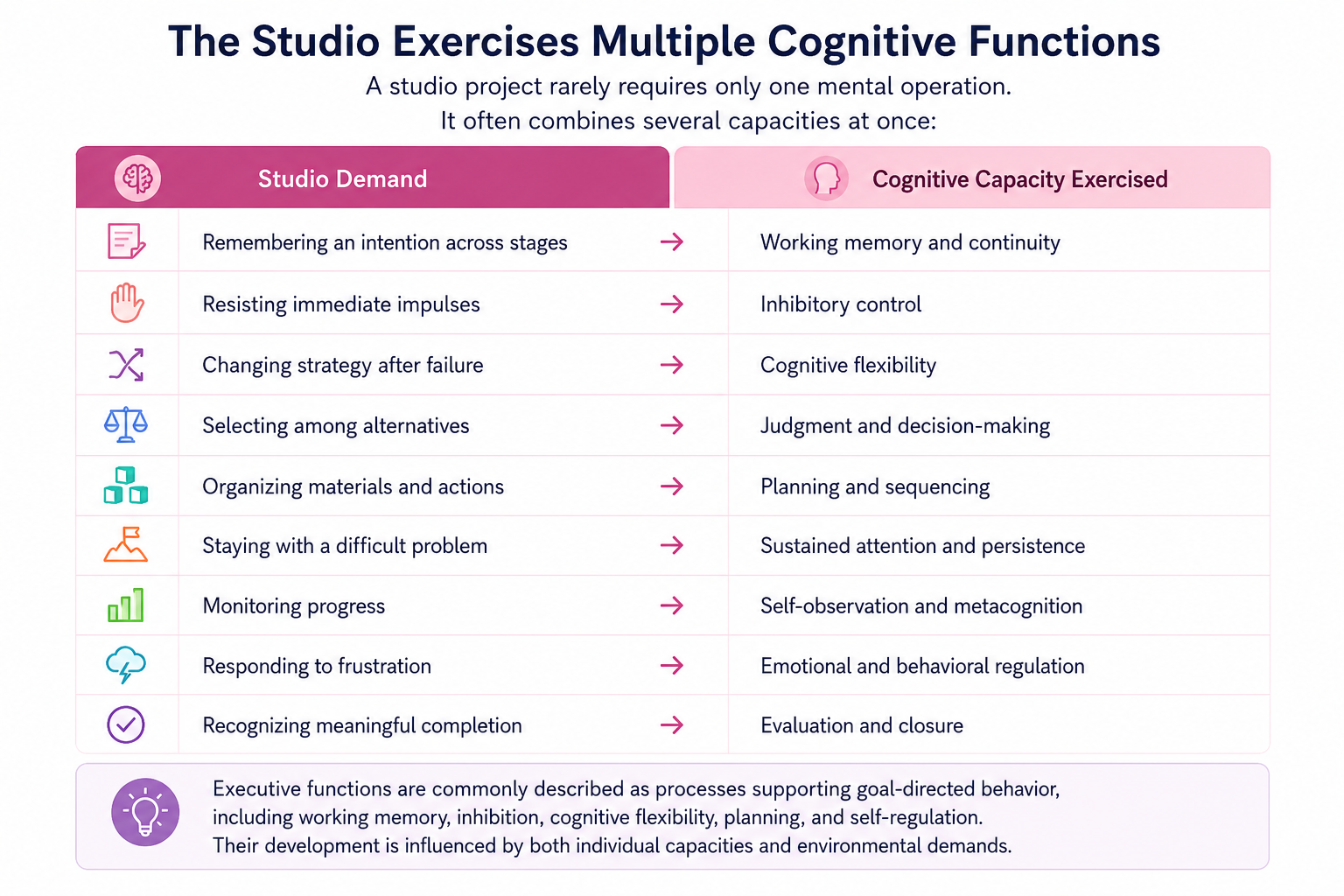
Executive functions are commonly described as processes supporting goal-directed behavior, including working memory, inhibition, cognitive flexibility, planning, and self-regulation. Their development is influenced by both individual capacities and environmental demands.
CCH does not claim that every studio activity improves each function equally. The cognitive demand depends on the material, project structure, learner, duration, and degree of adult intervention.
Making Converts Ideas into Decisions
An idea can remain vague when it exists only in imagination.
Material production forces greater precision.
A learner must decide:
how large the work should be
what should happen first
which material can carry weight
whether two parts can connect
how much pressure to apply
whether a mistake can be adapted
when additional support is needed
whether the work is ready to stop
Each choice converts an intention into action.
The material then responds.
This creates a cognitive loop:
intention → action → feedback → evaluation → revision
Repeated participation in this loop trains the learner to compare expectation with reality rather than relying only on preference or verbal explanation.
Materials Externalize Thinking
Studio materials make parts of cognition visible.
A sequence of folds may reveal planning.
Repeated repairs may reveal persistence and adaptation.
An abandoned structure may reveal a change in judgment.
A pause before cutting may indicate anticipation of an irreversible decision.
Material Engagement Theory argues that thinking can be distributed across people, actions, tools, and material objects rather than being confined entirely inside the individual.
Within CCH, the material surface becomes a record of cognition in motion.
The work does not merely represent what the learner thought.
It participates in shaping what the learner is able to think next.
Studio Habits Are Cognitive Habits
Harvard Project Zero’s Studio Thinking framework identifies eight habits associated with visual-arts learning:
Develop Craft
Engage and Persist
Envision
Express
Observe
Reflect
Stretch and Explore
Understand Art Worlds
These habits describe forms of thinking cultivated through studio work rather than artistic technique alone.
CCH shares important ground with this tradition.
Its own emphasis is placed particularly on:
sustained attention
judgment under uncertainty
autonomous decision-making
material feedback
recovery after disruption
cognitive resilience
longitudinal observation
The studio becomes a place where thinking is repeatedly made visible through action.
Difficulty Is Part of the Training
Cognitive development does not occur only when the process feels smooth.
Studio work creates manageable forms of friction:
an unstable structure
an unfamiliar tool
an unexpected color interaction
an irreversible cut
a delayed drying process
a plan that no longer works
These moments require more than creativity.
The learner must determine:
What happened?
What information does the failure provide?
Which part can still be changed?
Which consequence must be accepted?
What should happen next?
This sequence exercises reality-based problem-solving.
The educator’s role is not to manufacture unnecessary frustration. It is to preserve enough challenge for judgment and adaptation to become active without allowing the learner to become overwhelmed.
Repetition Builds Cognitive Endurance
One difficult decision does not create cognitive resilience.
The capacity develops through repeated cycles across time:
begin → encounter difficulty → regulate → revise → continue → close
Longer and multi-session projects are particularly valuable because they require learners to preserve intention across interruptions and return to unfinished problems.
This differs from completing a succession of unrelated activities.
A sustained project can require the learner to remember prior decisions, re-enter the material situation, evaluate earlier work, and continue without beginning from zero.
That continuity exercises cognitive endurance.
The Adult Must Avoid Doing the Thinking
Studio practice loses much of its cognitive demand when the adult continuously supplies:
the next step
the correct material
the preferred solution
the interpretation of failure
the moment of completion
The work may become visually successful while the learner remains cognitively passive.
CCH therefore distinguishes between:
The purpose is not minimal intervention at all costs.
It is to preserve the learner’s responsibility for observing, deciding, and adapting.
Cognitive Training Does Not Mean Speed Training
Efficiency is useful in many settings.
However, rapid completion can conceal dependence on familiar procedures.
CCH gives value to slower cognitive actions:
observing before acting
comparing alternatives
waiting for material change
reconsidering an assumption
noticing an unstable relationship
returning after a pause
allowing an idea to develop gradually
The aim is not to make thinking slow.
It is to prevent speed from replacing judgment.
A learner who finishes quickly may already possess strong skill. They may also be avoiding complexity. Only process observation can clarify the difference.
What CCH Observes
CCH looks for patterns indicating how cognitive participation changes over time.
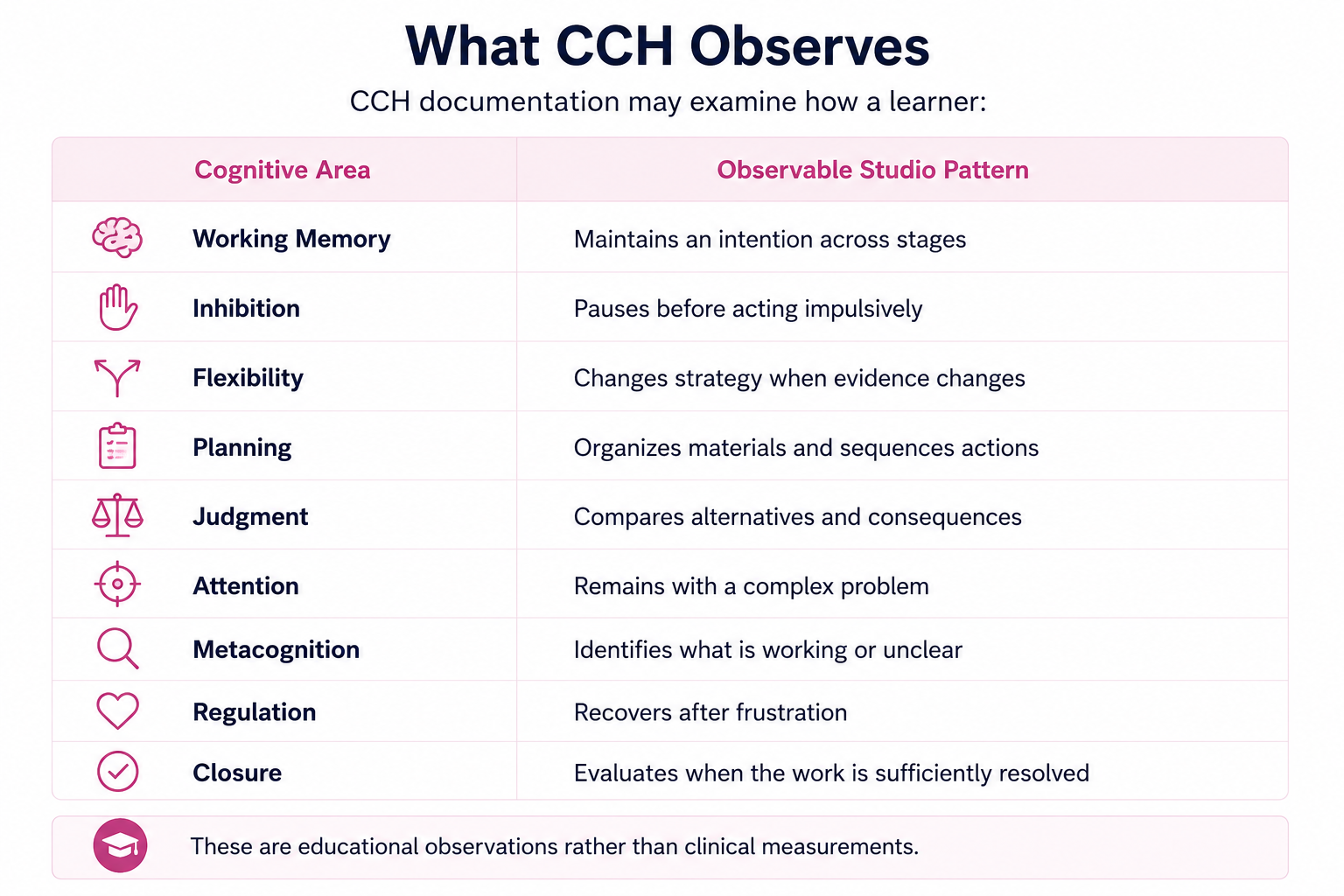
These are educational observations, not clinical measurements.
A single behavior does not prove cognitive growth. CCH looks for recurring patterns across projects, materials, studio conditions, and time.
Beyond Childhood
Studio practice as cognitive training is not limited to children.
Adults may also need to practice:
acting without guaranteed outcomes
loosening rigid expectations
tolerating imperfect first attempts
responding to material evidence
distinguishing control from judgment
maintaining attention through complexity
revising without interpreting revision as failure
Embodied-cognition perspectives describe cognitive control as dependent partly on active engagement with physical and social environments across the lifespan.
For adults, studio practice can expose established cognitive habits that remain hidden in familiar professional routines.
What CCH Does Not Claim
CCH does not claim that making art automatically increases intelligence.
It does not assume that every artistic activity develops executive function.
It does not use a finished object as proof of cognitive change.
The stronger claim is narrower:
Well-designed studio practice can create repeated opportunities to exercise and observe attention, planning, judgment, flexibility, regulation, and adaptive problem-solving.
Any claim of generalized or causal cognitive improvement would require validated measurement, formal research design, comparison conditions, and independent evaluation.
Key Takeaway
Studio practice trains more than artistic skill because making repeatedly requires learners to remember, inhibit, choose, plan, adapt, monitor, regulate, and decide.
Within CCH, cognitive training does not mean isolated drills or guaranteed neurological improvement.
It means repeated engagement with meaningful material problems that require multiple human capacities to work together.
The artwork remains important.
The deeper developmental value lies in the thinking, adaptation, and self-regulation exercised while the work takes form.
References
Diamond, A., & Lee, K. Interventions and activities associated with executive-function development.
Gottwald, J. M., et al. Embodied accounts of early executive-function development.
Harvard Project Zero. Eight Studio Habits of Mind.
Harvard Project Zero. Studio Thinking: The Real Benefits of Visual Arts Education.
Kontra, C., et al. Embodied learning across the lifespan.
Malafouris, L. Material engagement and distributed cognition.
Skulmowski, A., & Rey, G. D. Taxonomy and theory of embodied learning.
Next Method Note
→Method Notes 10— Decision-Making Under Material Constraints