
METHOD NOTES 08 - Why Finished Artwork Is Only One Form of Evidence
The artwork shows what was produced. The process reveals how learning developed.
Finished artwork is visible, shareable, and easy to compare.
It can show technical growth, material choices, visual organization, persistence, and the learner’s ability to bring a project toward completion.
Yet the final object cannot fully reveal:
how the learner entered the task
which decisions were made independently
where hesitation occurred
how difficulty was interpreted
whether adult direction shaped the outcome
how many revisions took place
whether attention was recovered after interruption
how the learner responded when materials resisted
what changed across multiple sessions
Within CCH, the artwork is meaningful evidence—but it is only one layer of evidence.
The broader question is:
What became visible about the learner while the work was developing?
Product and Process Answer Different Questions
A finished product answers questions such as:
What was completed?
Which materials were used?
What visual or structural decisions remain visible?
What technical abilities appear in the final result?
Did the work reach a meaningful form of closure?
Process evidence answers another set of questions:
How did the learner begin?
How were choices made?
What happened after failure?
When was support requested?
How did the learner revise?
Did attention depend on adult prompting?
How did the learner respond to uncertainty?
What changed over time?
Educational assessment research distinguishes between summative evidence gathered at the end of learning and formative evidence used during learning to understand progress and adjust future conditions. Formative evidence can include observation, discussion, drafts, models, self-assessment, and changes in thinking—not only final products.
A Finished Work Can Hide the Learning Process
Two artworks may look similar while representing very different developmental experiences.
One learner may have:
followed a detailed demonstration
copied a prepared example
received correction at every stage
depended on adult reassurance
completed the work efficiently
Another may have:
developed an original structure
tested several materials
experienced failure
paused and reorganized
requested specific support
revised independently
completed the work after sustained uncertainty
The products may appear equally successful.
The underlying learning is different.
This is why visual quality alone cannot explain how attention, judgment, autonomy, persistence, or self-regulation developed during the project.
Research associated with Harvard Project Zero’s Studio Thinking framework identifies several habits developed through studio practice—including observing, reflecting, envisioning, engaging and persisting, and stretching and exploring. These habits describe thinking that occurs during making and cannot always be inferred from the final object alone.
What Different Forms of Evidence Reveal
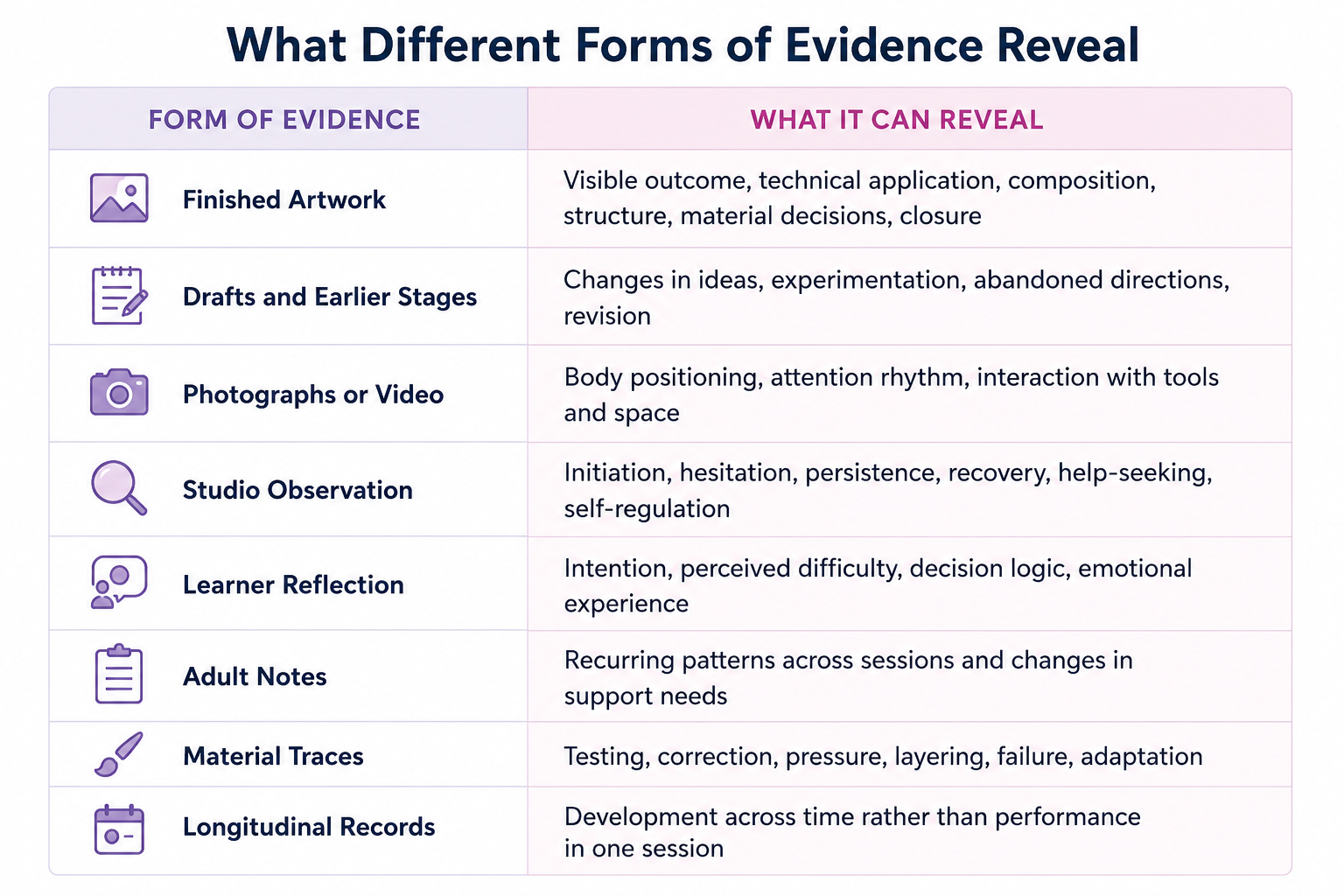
No single form provides a complete account.
CCH therefore combines multiple forms of documentation while maintaining a clear boundary: these records are educational and process-based. They do not constitute clinical diagnosis, standardized psychological testing, or proof of causal developmental change.
Drafts and Revisions Matter
A polished final work may remove visible evidence of uncertainty.
Earlier stages often reveal more.
They can show:
an idea that was reconsidered
a structure that failed
a material that was replaced
an area repeatedly reworked
an unexpected outcome that changed the direction
a decision that became more deliberate over time
Research on visual-arts assessment has used portfolios containing sketches, drafts, finished work, logs, sources of inspiration, and interviews, with criteria addressing both products and processes such as investigation, inventiveness, model use, and self-assessment.
This approach recognizes that creative development is distributed across a sequence, rather than located only in the last image.
The Artwork Is Evidence of Decisions
CCH does not dismiss the finished object.
The artwork remains important because it contains traces of prior decisions.
A fold records force.
A repaired structure records failure and adaptation.
Layered paint records revision.
Uneven surfaces record material resistance.
A completed large-scale construction may record weeks of planning, persistence, and return.
The object can therefore be read as a material record of thinking.
However, interpretation becomes stronger when the object is examined alongside observations of how it was produced.
Project Zero’s annotated student-work examples similarly connect visible work with decisions, observation, artistic voice, and development over time, rather than treating the object as self-explanatory.
Observation Must Remain Descriptive
Process documentation becomes unreliable when interpretation is presented as fact.
For example:
“The learner is resilient.”
is a broad conclusion.
A more grounded statement would be:
“After the structure collapsed, the learner paused, examined the base, requested tape, and returned to reconstruction without asking the adult to complete it.”
The second statement records observable behavior.
It allows developmental interpretation without turning one event into a fixed identity.
CCH therefore distinguishes among:
Observation — what occurred
Interpretation — what the behavior may suggest
Developmental pattern — what appears repeatedly across time
This protects the learner from premature labeling and strengthens the credibility of the documentation.
From Product Display to Developmental Documentation
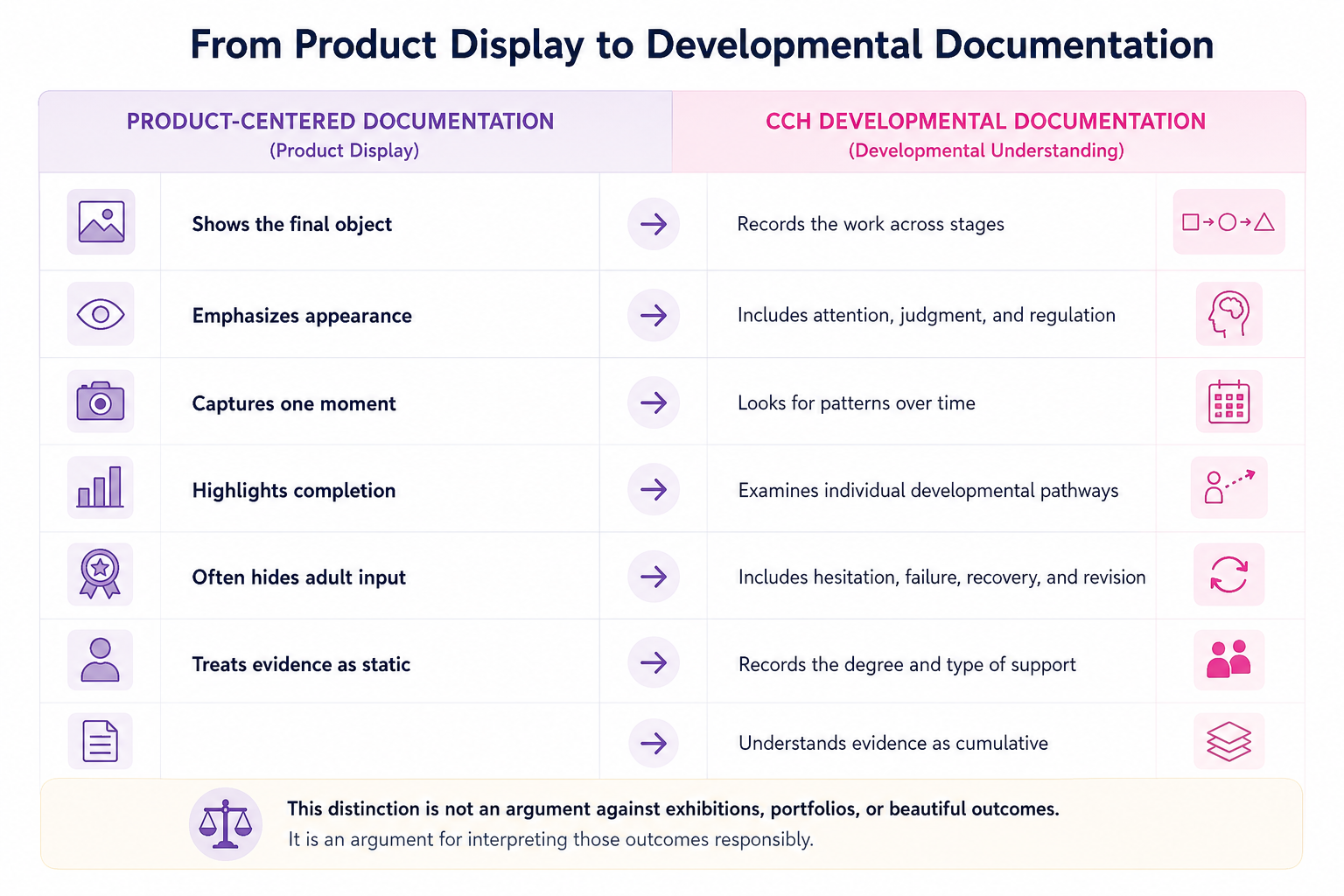
This distinction is not an argument against exhibitions, portfolios, or beautiful outcomes.
It is an argument for interpreting those outcomes responsibly.
Why Parent Reports Need More Than Photographs
Families naturally respond to what they can see.
A finished work provides a concrete record and may help the learner feel pride, recognition, and closure.
However, photographs alone can encourage an incomplete interpretation:
a large work may be mistaken for stronger learning
a polished work may appear more successful than an experimental one
a small output may be interpreted as low productivity
a visibly unfinished work may be seen as failure
adult-directed work may appear more advanced than autonomous work
CCH reports therefore connect the visible artwork with selected process observations.
For example:
The learner spent an extended period testing how two cardboard sections could stand independently. The final structure remained visually simple, while the process involved repeated balance testing, material comparison, and independent revision.
The explanation helps the family see what the final image cannot communicate by itself.
The Learner’s Voice Is Evidence
Learners may explain:
what they intended
which part felt difficult
why they changed direction
what they noticed about the material
what they would revise next
when they believed the work was complete
Reflection does not need to be highly verbal or academically polished.
It may appear through:
pointing
demonstration
naming a material
reenacting a decision
comparing earlier and later stages
identifying a preferred solution
describing what changed
Authentic assessment approaches often use portfolios and learner reflection to make effort, development, and self-assessment more visible.
Evidence Accumulates Across Time
One finished work is a sample.
One difficult session is also a sample.
Neither should define the learner.
CCH looks for recurring changes such as:
shorter delay before initiation
less dependence on adult approval
more precise help-seeking
greater willingness to test unfamiliar materials
more sustained engagement
stronger recovery after frustration
increased tolerance for unfinished work
more deliberate closure
The strongest educational evidence often comes from patterns across multiple contexts, rather than from a single impressive product.
Portfolio and formative-assessment approaches are valuable partly because they gather evidence over time and use it to understand and support learning, rather than relying only on one terminal performance.
What CCH Documents
CCH documentation may include:
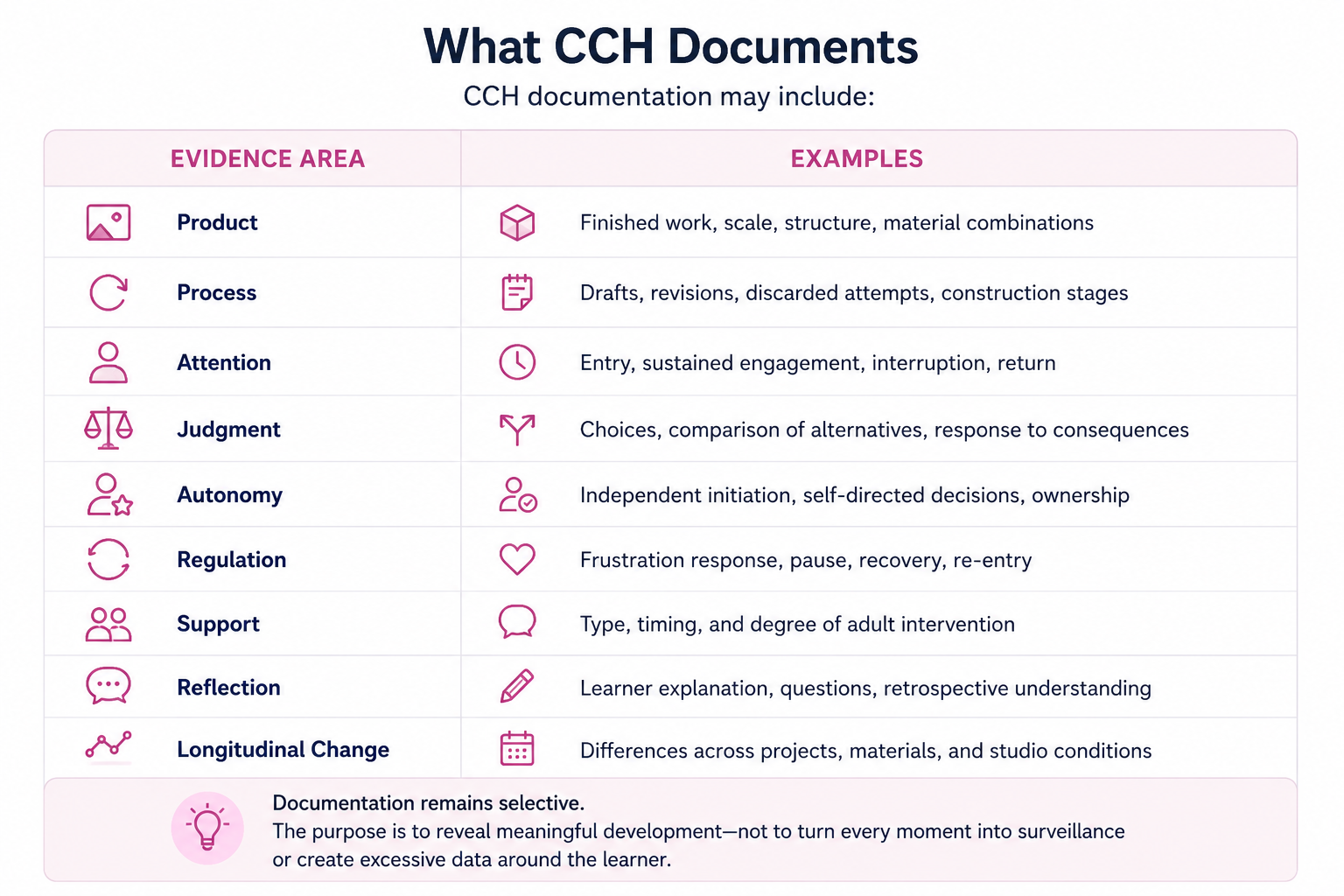
Documentation remains selective.
The purpose is to reveal meaningful development—not to turn every moment into surveillance or create excessive data around the learner.
Evidence Is Not Proof of Everything
A process photograph does not prove cognitive resilience.
A long session does not prove improved executive function.
A finished work does not prove autonomy.
A parent report does not establish clinical effectiveness.
CCH therefore uses cautious language:
observed
documented
suggests
may indicate
appeared across repeated sessions
This evidence can support educational interpretation and future planning.
Stronger causal or generalized claims would require formal research design, validated measures, comparison conditions, and independent review.
Key Takeaway
Finished artwork shows what was made. Broader documentation reveals how the learner observed, decided, struggled, revised, recovered, and developed while making it.
Within CCH, the final object remains valuable.
It is one piece of a larger evidence system.
Learning becomes clearer when artwork is interpreted together with process records, behavioral observation, learner reflection, material traces, and change over time.
References
Harvard Project Zero. Eight Studio Habits of Mind.
Harvard Project Zero. Studio Thinking: The Real Benefits of Visual Arts Education.
Harvard Project Zero. Student Work Examples.
Lindström, L. “Creativity: What Is It? Can You Assess It?” Portfolio-based assessment of creative processes and products.
National Research Council. Assessment in Practice and formative-assessment principles.