

METHOD NOTES 07-Attention Is Built, Not Taught
Attention develops through safety, meaningful challenge, material feedback, sufficient time, and repeated return.
Adults often respond to inattention with instructions:
“Focus.”
“Sit still.”
“Pay attention.”
“Finish what you started.”
These reminders may redirect behavior temporarily. They do not, by themselves, build the underlying capacity to regulate attention.
Within CCH, attention is understood as a developmental capacity rather than a measure of obedience.
It grows when learners repeatedly practice entering a task, sustaining engagement, responding to interruption, reorganizing after difficulty, and finding a way back.
The central question is not:
How can we make a learner appear focused?
It is:
What conditions allow attention to become increasingly stable, self-directed, and recoverable?
Attention Is Not Compliance
A learner may sit quietly, follow instructions, and complete a project while depending almost entirely on adult direction.
Another learner may stand, move, pause, observe, and still remain deeply connected to the material problem.
Visible stillness and genuine attention are not identical.
Within CCH, attention includes the capacity to:
enter an activity with increasing independence
remain connected to a meaningful problem
notice relevant material feedback
tolerate temporary uncertainty
return after interruption
reorganize action without constant prompting
recognize when the work has reached meaningful closure
Attention is therefore not defined as uninterrupted performance.
It is the capacity to remain, return, and reorganize.
Attention Is Developmental
Sustained attention, selective attention, and attentional control continue developing across childhood and adolescence. These capacities are also closely related to executive functions such as inhibition, working memory, cognitive flexibility, and goal-directed behavior.
This developmental perspective changes how inattention is interpreted.
Difficulty maintaining engagement should not automatically be treated as laziness, disrespect, or insufficient effort. Attention can be affected by:
developmental stage
emotional state
task meaning
environmental stimulation
perceived safety
task difficulty
available time
dependence on external prompting
CCH therefore treats attention as something that can be supported and observed across repeated studio experiences, rather than as a fixed personal trait.
Attention Has a Rhythm
Attention rarely follows a perfectly straight line.
During sustained studio practice, learners may move through a sequence such as:
engagement → uncertainty → pause → observation → adjustment → return
A pause may indicate planning rather than disengagement.
Looking away may help reorganize visual information.
Watching another person may provide a new point of entry.
Moving temporarily away from the work may help regulate frustration before returning.
CCH does not assume that every interruption represents failure. It asks:
Does the learner return?
How long does re-entry take?
Is the original problem remembered?
Is adult prompting required?
Does the return lead to revision or deeper engagement?
The ability to recover attention can be as developmentally significant as the ability to sustain it.
Common Views and the CCH Perspective
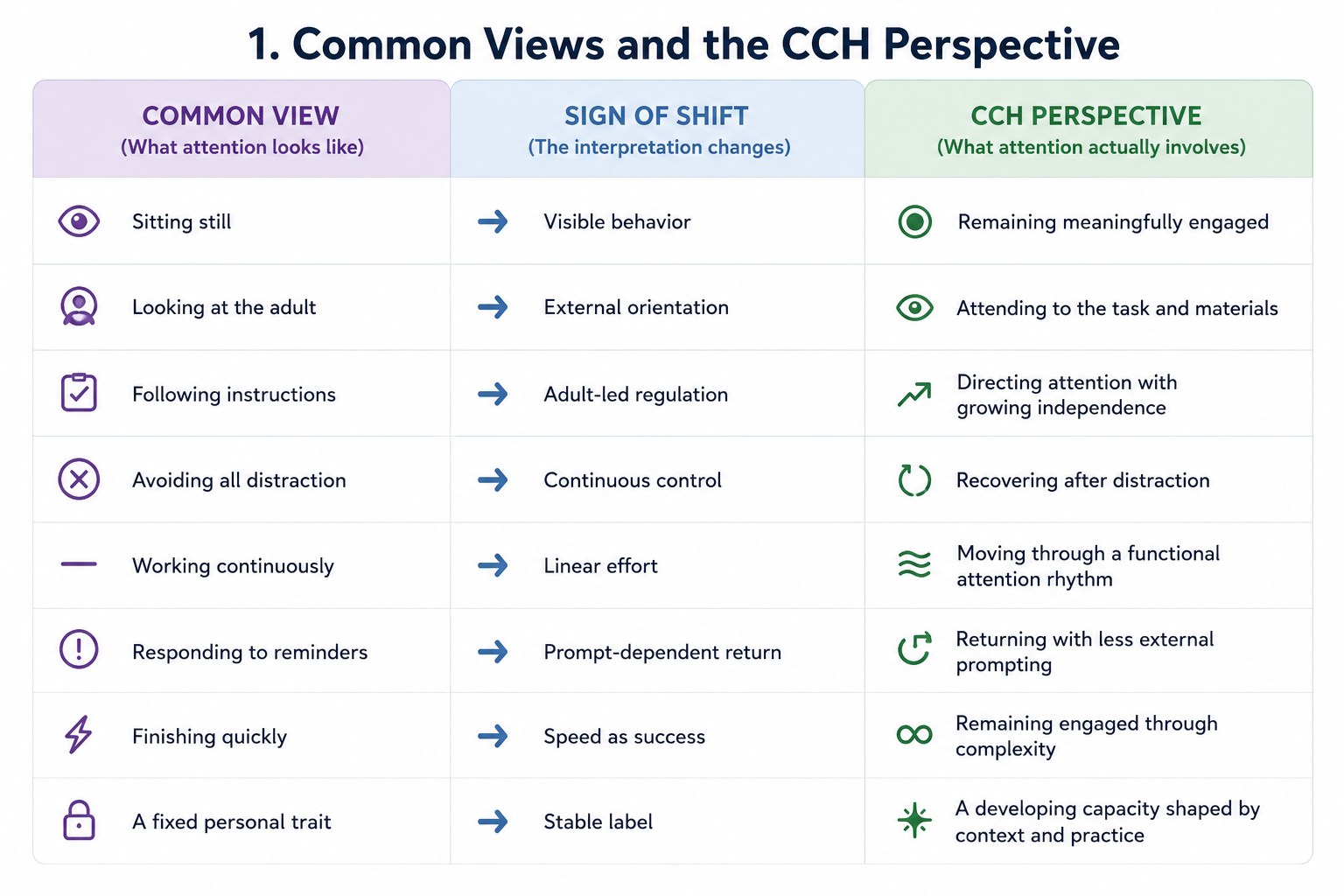
This distinction changes the role of the environment.
Instead of repeatedly demanding focus, CCH examines whether:
the task is meaningful
the level of challenge is appropriate
the learner feels sufficiently safe
materials provide useful feedback
adult intervention is helping or fragmenting attention
enough time has been provided for engagement to deepen
Safety Creates Cognitive Space
A learner cannot direct full attention toward materials while also monitoring whether an adult will leave, criticize, intervene, or judge the result.
Research on attentional control suggests that anxiety can compete with goal-directed attention by directing cognitive resources toward threat monitoring and emotional concerns. Childhood studies have also found associations between anxiety symptoms and reduced attentional-control efficiency.
Within CCH, safety may be supported through:
predictable routines
low-pressure adult presence
neutral responses
permission to observe before acting
reduced performance pressure
gradual transitions
freedom from continuous evaluation
Safety does not automatically produce concentration.
It reduces vigilance, creating more cognitive space for observation, exploration, and decision-making.
Materials Anchor Attention
Physical materials provide immediate and meaningful consequences.
Paper bends or tears.
Water changes pigment.
Clay responds to pressure.
A structure shifts under uneven weight.
Adhesive requires waiting.
These material responses create a concrete reason to remain attentive. The learner’s next action depends on noticing what is happening.
Material Engagement Theory proposes that cognition emerges through interaction among mind, body, action, objects, and environment rather than existing only as an internal mental process.
Within CCH, materials support attention through a recurring sequence:
action → material response → observation → decision → revision
Attention is sustained by an unfolding relationship with physical reality, rather than by verbal reminders alone.
Challenge Must Be Calibrated
A task that is too simple may not provide enough reason to remain engaged.
A task that greatly exceeds the learner’s present capacity may produce withdrawal, frustration, or dependence on adult rescue.
CCH therefore seeks manageable resistance:
enough difficulty to require judgment
enough access to make action possible
enough autonomy to support ownership
enough structure to prevent confusion
enough feedback to guide revision
This principle connects with flow theory.
Flow is commonly described as a state of deep task absorption, strong concentration, reduced self-consciousness, and intrinsic involvement. Research consistently identifies perceived challenge–skill balance, clear goals, and usable feedback as important conditions associated with flow, while also warning that ordinary engagement should not automatically be labelled as flow.
CCH does not promise that every learner will enter flow.
Instead, it creates conditions that may support deeper absorption:
meaningful challenge
material feedback
learner agency
limited unnecessary interruption
emotional safety
sufficient time
Flow cannot be commanded, but its conditions can be protected.
Why CCH Uses Two-Hour Studio Units
CCH uses two hours as a foundational studio unit because attention requires more than active production time.
A meaningful session also needs space for:
entering the environment
observing before acting
selecting materials
testing initial possibilities
encountering difficulty
pausing and regulating
revising an approach
returning to the task
cleaning and bringing the experience toward closure
The two-hour structure is not based on the claim that learners should concentrate continuously for 120 minutes.
It provides a wider developmental container:
arrival → orientation → engagement → challenge → pause → adjustment → re-entry → closure
A one-hour session may end while the learner is still orienting, testing, or recovering from the first obstacle.
A two-hour unit gives attention time to deepen after initial entry and allows a learner to experience more than one cycle of decision, difficulty, revision, and return.
The distinction is important:
Two hours does not automatically create flow.
Rather:
Two hours gives sustained engagement, recovery, repeated return, and possible flow enough room to emerge.
One Hour and Two Hours Serve Different Purposes
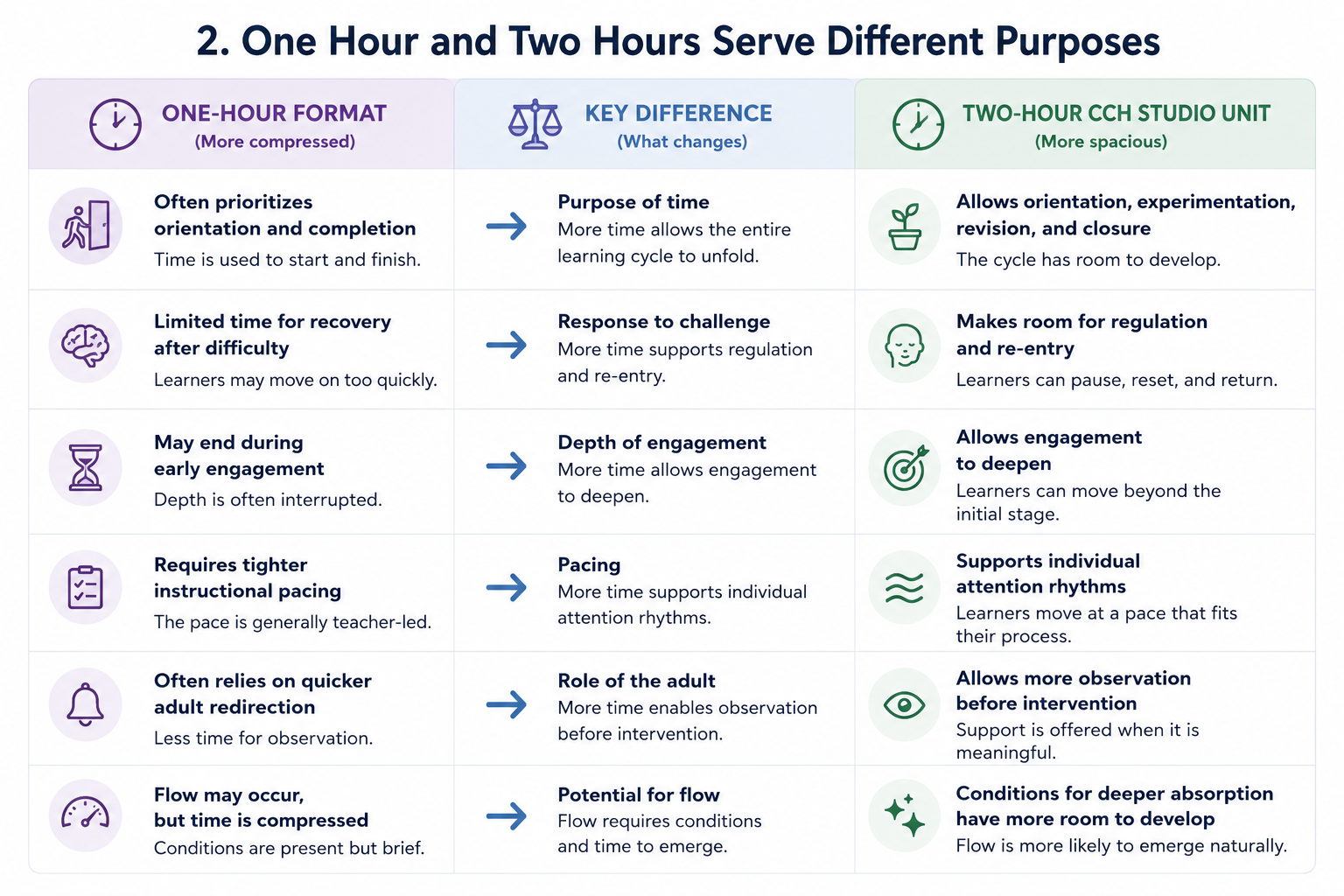
This comparison does not mean that one-hour classes have no educational value.
They may be appropriate for introductions, technical practice, or highly structured activities.
CCH uses two hours because its purpose includes observing and developing attention across a fuller learning cycle.
Attention Is Built Through Repeated Return
One focused session does not establish a stable capacity.
CCH looks for changes across time:
entering the task more quickly
requiring fewer reminders
sustaining engagement for longer periods
recovering more effectively after distraction
tolerating unfinished work between sessions
returning to previous decisions with continuity
remaining with difficult material problems
regulating pauses without abandoning the project
initiating the next step independently
Research links sustained attention with developing self-regulation and executive functioning, while longitudinal work suggests that attention-related capacities emerge through ongoing developmental and environmental interaction.
The learner does not build attention by never losing it.
Attention grows through repeated experience of:
entering → sustaining → losing → recovering → returning
External Prompting and Internal Regulation
Adult reminders can be useful.
A learner may need a concise prompt, a clearer boundary, environmental restructuring, or help identifying the immediate problem.
The issue arises when attention depends entirely on continuous external regulation.
If an adult repeatedly directs every next step, the learner may finish the task without developing a personal strategy for directing attention.
CCH gradually shifts the source of regulation.
Instead of immediately redirecting, the adult may observe:
whether the learner notices the interruption
whether the original intention is remembered
whether the material prompts re-entry
whether one focused question is sufficient
whether the environment needs adjustment
whether the learner can return independently
The purpose is not to remove support.
It is to ensure that support gradually strengthens internal regulation rather than permanently replacing it.
Attention Is Environmental
Attention is often treated as something located entirely inside the learner.
CCH examines the broader system.
The same learner may respond differently depending on:
noise and visual stimulation
adult proximity
social pressure
project scale
physical comfort
material accessibility
session duration
emotional safety
degree of choice
task complexity
This does not mean the environment explains every attentional difficulty.
It means that attention should not be interpreted without considering the conditions in which it occurs.
CCH asks two questions:
What is the learner currently able to regulate?
What is the environment asking the learner to regulate?
What CCH Observes
CCH does not diagnose attention disorders or claim clinical measurement.
Its evidence is educational, behavioral, and process-based.
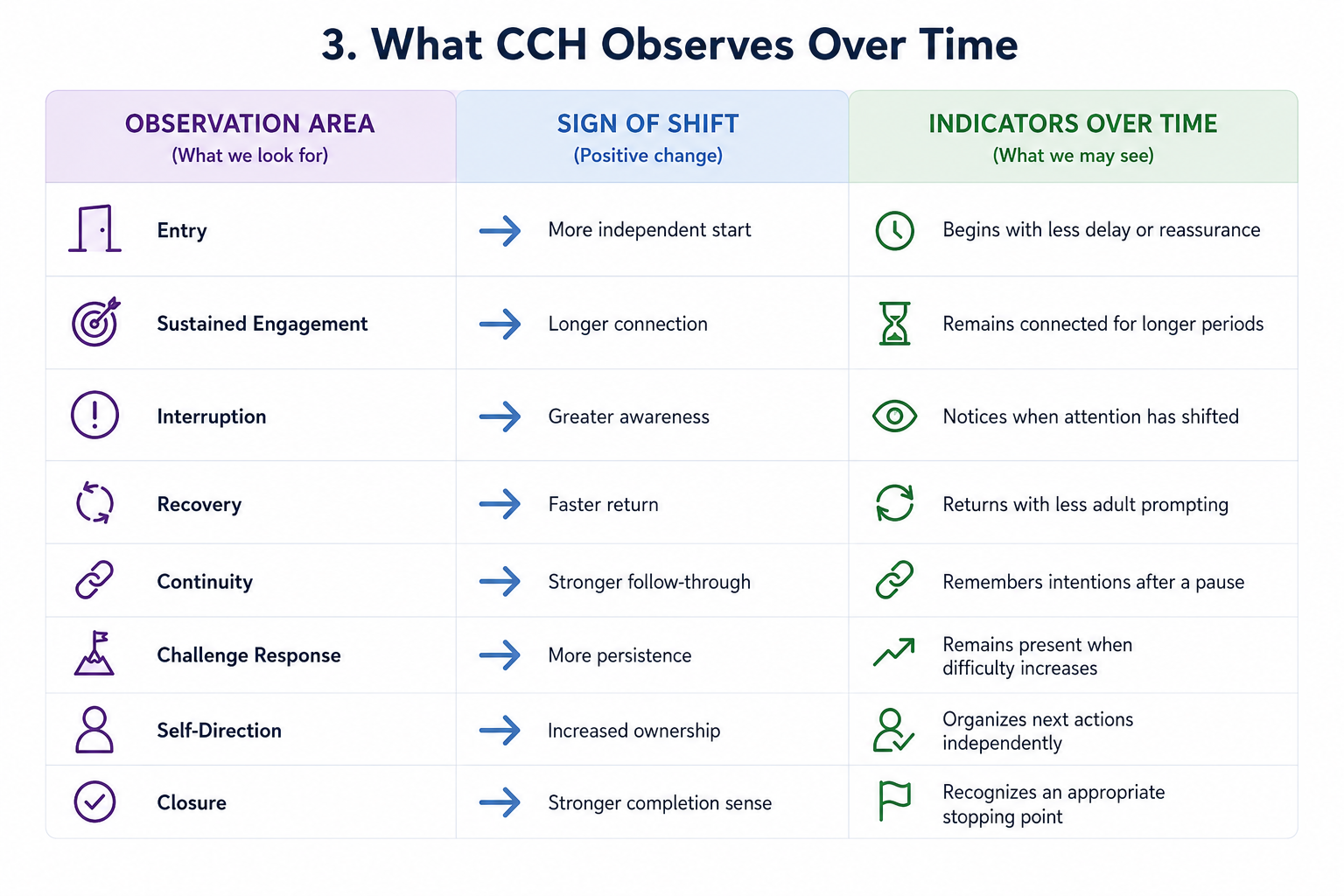
No single behavior proves that attention has been built.
CCH looks for recurring patterns across time, materials, projects, and changing levels of challenge.
Key Takeaway
Attention is not produced by telling a learner to focus. It develops through meaningful engagement, manageable challenge, material feedback, emotional safety, sufficient time, interruption, recovery, and repeated return.
Within CCH, attention is not treated as obedience.
It is treated as a developing human capacity.
The two-hour studio unit does not require continuous concentration or guarantee flow.
It creates enough time for attention to enter, deepen, break, recover, and reorganize—because the capacity to return is part of the capacity to focus.
References
Abuhamdeh, S. “Investigating the Flow Experience: Key Conceptual and Operational Issues.” Frontiers in Psychology, 2020.
Deodhar, A. V., et al. “How Attention Factors into Executive Function in Preschool Children.” 2023.
Gold, J., & Ciorciari, J. “A Review on the Role of the Neuroscience of Flow States.” 2020.
Graziano, P. A., et al. “Sustained Attention Development During Toddlerhood to Preschool.” 2011.
Malafouris, L. “Mind and Material Engagement.” 2018.
Ottiger, B., et al. “Getting into a Flow State: A Systematic Review.” 2021.
Peifer, C., et al. “A Scoping Review of Flow Research.” 2022.
Thillay, A., et al. “Sustained Attention and Prediction: Distinct Brain Maturation Trajectories During Adolescence.” 2015.
Next Method Note
→Method Notes 08 — Why Finished Artwork Is Only One Form of Evidence