

METHOD NOTES 06 -From Holding On to Letting Go
How Safety, Trust, and Adaptive Support Create the Conditions for Autonomy
Holding on is not always resistance.
A child may hold on to a parent when entering an unfamiliar environment. A parent may hold on through repeated reminders, close monitoring, or rapid intervention. An adult learner may hold on to familiar methods, external approval, or the need to know the outcome before beginning.
These responses often serve a protective function. They help a person manage uncertainty until the situation feels sufficiently predictable.
Within CCH, letting go is therefore not treated as forced separation, passivity, or the sudden removal of support. It is understood as a developmental transition:
A person gradually releases external control when enough safety, trust, and internal capacity have formed.
The central question is not whether someone should hold on or let go.
It is:
What kind of support allows holding on to soften into independent engagement?
Holding On Can Be a Form of Protection
People tend to rely more heavily on familiar relationships, routines, and forms of control when they feel uncertain.
For children, this may appear as staying close to a parent, repeatedly checking an adult’s expression, delaying entry into an unfamiliar activity, or asking for reassurance before making decisions.
For adults, holding on may appear differently:
controlling each step of a process
avoiding unfamiliar materials
seeking confirmation before acting
trying to prevent every mistake
remaining attached to a predetermined outcome
intervening quickly when another person struggles
These behaviors should not be interpreted automatically as weakness or unwillingness.
They may indicate that the person has not yet developed enough safety to redirect attention from protection toward exploration.
A Secure Base Supports Exploration
Attachment theory describes a secure base as a relationship from which a child can explore and to which the child can return when distressed. Security and exploration are therefore connected rather than opposed: reliable support can make movement away from the caregiver more possible.
This principle is relevant when a learner first enters a CCH environment.
The learner may be encountering several uncertainties simultaneously:
an unfamiliar adult
a new physical space
open-ended materials
limited visual examples
fewer predetermined answers
uncertainty about separation
uncertainty about expected performance
For a learner who is slow to warm up, immediate separation may intensify vigilance. Attention remains focused on whether the parent is nearby rather than on the materials, environment, or emerging task.
In these situations, parental presence can temporarily function as a bridge.
The purpose is not to preserve dependence. It is to provide sufficient relational stability for exploration to begin.
Co-Regulation Before Independent Regulation
Self-regulation develops within relationships and supportive environments. Co-regulation refers to the dynamic process through which people adjust to one another emotionally, behaviorally, and sometimes physiologically. Research links flexible, responsive parent–child co-regulation with stronger child self-regulation, while also showing that the quality and context of the interaction matter.
Within CCH, co-regulation may include:
allowing a familiar adult to remain nearby
maintaining a predictable rhythm
giving the learner time to observe before participating
using calm and neutral language
lowering immediate performance pressure
avoiding forced separation
reducing unnecessary demands
allowing trust to develop through repeated experience
Co-regulation is different from taking over.
Support helps the learner remain present. Control replaces the learner’s opportunity to act.
The distinction can be summarized as follows:
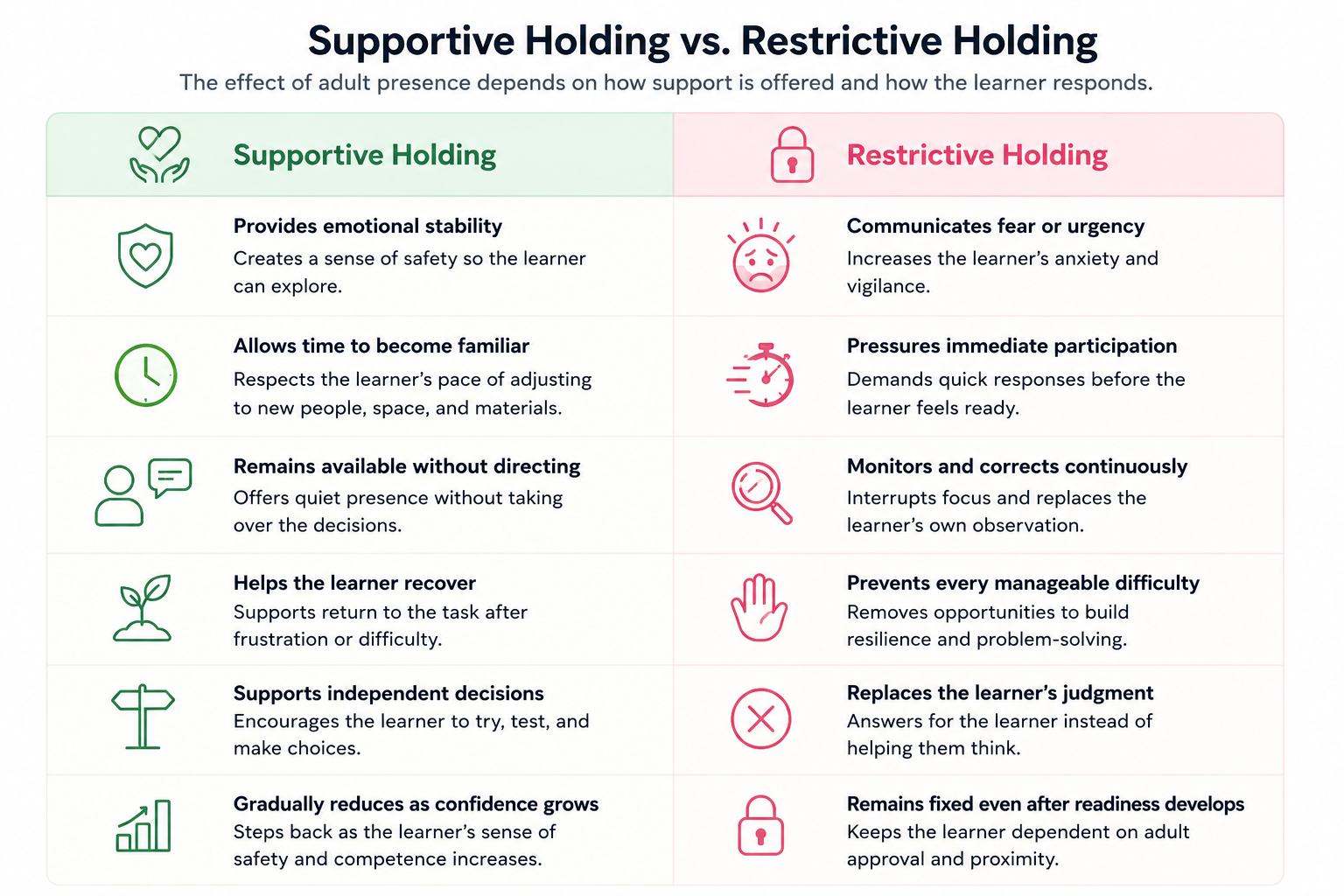
The relevant issue is not simply whether the adult is present.
It is what the adult’s presence makes possible.
Parents Can Be Both Support and Interference
Parental participation cannot be classified as inherently helpful or harmful.
A quietly available parent may help a cautious learner remain regulated long enough to enter the activity. A visibly anxious parent may repeatedly check, explain, warn, correct, or answer on the child’s behalf. The same physical presence can therefore produce very different developmental effects.
Parental emotional regulation matters because children learn partly through observing and responding to adult emotional signals. Research indicates that parents’ regulation patterns can influence emotion socialization and children’s psychological adjustment.
At the same time, the relationship between parenting and child anxiety should not be oversimplified. A major meta-analysis found that parenting accounted for only a modest proportion of variation in childhood anxiety, which means children’s responses arise from multiple interacting factors rather than parental behavior alone.
CCH therefore avoids blaming parents.
Instead, it examines observable effects:
Does the learner become more settled when the parent is present?
Does attention begin shifting toward the materials?
Can the parent remain nearby without directing?
Does the learner repeatedly monitor the parent’s reaction?
Does the parent’s anxiety increase the learner’s hesitation?
Can support gradually become less visible?
Does the learner begin expressing readiness for more independence?
The focus remains functional rather than moral.
Letting Go Is Not Abandonment
Letting go can be misunderstood as withdrawal.
Within CCH, it means reducing unnecessary control while maintaining appropriate support.
A parent may move from:
close physical proximity → quiet presence → greater distance → brief absence → independent attendance
An educator may move from:
direct guidance → focused prompting → neutral observation → learner-led decision-making
An adult learner may move from:
needing certainty → tolerating experimentation → adapting to feedback → trusting personal judgment
These transitions are rarely linear.
A learner who attends independently one week may need greater support after illness, fatigue, family change, or an emotionally demanding experience. Adaptive support responds to the current condition rather than enforcing a rigid progression.
Autonomy Is More Than Separation
Autonomy is not simply the absence of another person.
A child may be physically separated from a parent while remaining highly dependent on external approval. Another child may work beside a parent while making independent decisions.
Self-Determination Theory describes autonomy support as acknowledging a person’s perspective, providing meaningful choice, offering appropriate structure, and reducing coercive psychological control. A large meta-analysis found that parental autonomy support was positively associated with child well-being, whereas psychologically controlling parenting was associated with poorer outcomes.
Autonomy-supportive parenting has also been associated with adaptive child and family functioning in day-to-day contexts.
Within CCH, autonomy becomes visible when the learner increasingly:
enters the space with less reassurance
initiates activity independently
tolerates an unfinished process
makes decisions without continuous approval
tests alternatives before seeking help
asks for specific rather than total assistance
recovers after frustration
expresses readiness for greater independence
The learner’s statement—
“I can do the class by myself.”
—therefore represents more than logistical separation.
It may indicate that the source of safety has expanded.
Safety is no longer located only in the parent’s physical presence. It has begun to exist in the learner’s relationship with:
the studio
the educator
the materials
the familiar rhythm
previous successful experiences
their own developing competence
The Adult Also Has to Let Go
The developmental movement is not limited to the child.
Adults also hold on.
A parent may intervene because watching uncertainty is uncomfortable. An educator may explain too quickly because silence feels inefficient. An adult learner may avoid experimentation because a failed result threatens their sense of competence.
In this sense, letting go requires adults to regulate their own responses.
The adult must distinguish between:
the learner’s distress and the adult’s discomfort
genuine danger and manageable uncertainty
necessary support and premature rescue
productive hesitation and disengagement
the need for structure and the desire for control
Parental emotion regulation is relevant because adults’ emotional responses influence how they interpret and respond to children’s behavior.
Letting go may therefore involve the adult learning to remain present without immediately acting.
This is not indifference.
It is disciplined restraint.
Holding and Letting Go in Adult Development
The same pattern can appear in adult studio practice.
Adults may hold on to:
recognizable outcomes
familiar skills
perfectionistic standards
professional identities
external evaluation
the wish to eliminate uncertainty before acting
Psychological flexibility refers broadly to the capacity to remain in contact with present experience and adjust behavior according to context and valued aims, rather than becoming rigidly governed by discomfort or avoidance. Research has linked lower psychological flexibility and greater intolerance of uncertainty with more difficulty adapting to uncertain conditions.
In CCH, an adult does not “let go” by becoming careless.
Letting go means loosening rigid control enough to:
notice what is actually happening
respond to material feedback
revise an initial plan
remain engaged without guaranteed success
separate personal worth from immediate performance
act without complete certainty
This interpretation extends the article beyond parent–child separation.
Holding on and letting go become recurring human processes.
CCH Uses Adaptive Support
CCH does not use one permanent rule for adult presence.
Support is adjusted according to:
emotional safety
familiarity with the environment
developmental readiness
ability to regulate distress
level of independent engagement
quality of adult participation
current life circumstances
the learner’s expressed preferences
This approach can be described as adaptive support.
Too little support may leave the learner overwhelmed.
Too much support may prevent independent judgment from becoming active.
The aim is to maintain enough support for engagement while leaving enough space for development.
What CCH Observes During the Transition
The movement from holding on to letting go may become visible through small changes:
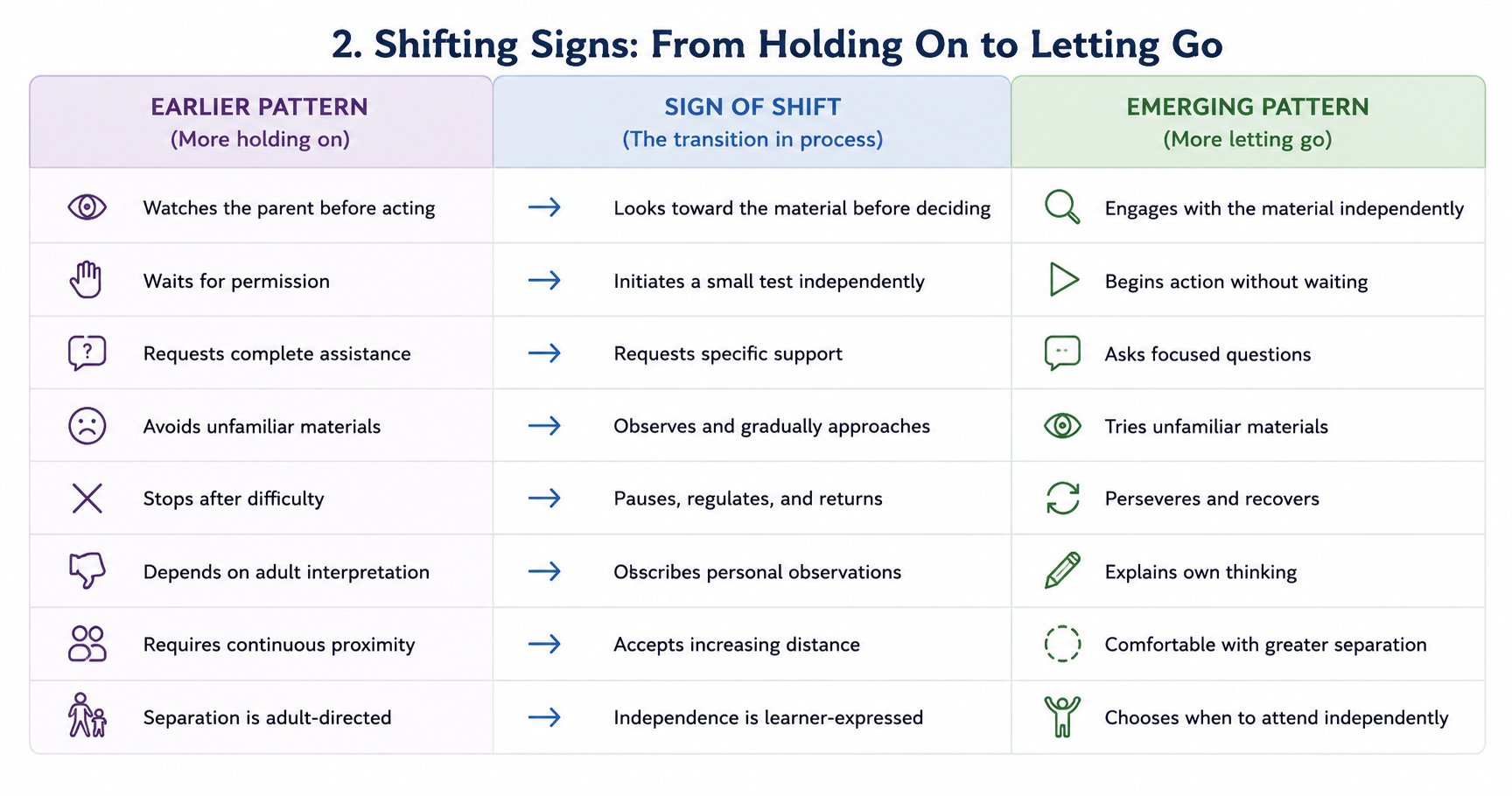
No single behavior proves that autonomy has been achieved.
CCH looks for patterns across time.
A CCH Practice Observation
In previous CCH practice, some learners initially required a parent to remain present. The parent’s presence helped the learner enter the space without excessive pressure.
Across several sessions, the learner became more familiar with:
the studio routine
the educator’s responses
the absence of forced performance
the available materials
the expectation that uncertainty was acceptable
their own ability to remain and continue
The transition did not occur through abrupt separation.
Eventually, the learner independently communicated readiness to attend alone.
This observation does not establish a universal outcome or clinical claim. It illustrates a recurring developmental possibility:
When safety becomes sufficiently internalized, independence may be expressed by the learner rather than demanded by the adult.
A Cultural Qualification
Ideas such as autonomy, separation, attachment, and secure-base exploration are interpreted differently across cultures. Some attachment research has been criticized for privileging Western expectations of individuation and independent exploration.
CCH therefore does not define healthy development as maximum separation.
The goal is not to make every learner independent in the same way or at the same speed.
The goal is flexible participation:
the capacity to receive support
the capacity to act independently when ready
the capacity to return to support when needed
the capacity to distinguish connection from control
Autonomy and relationship can coexist.
Key Takeaway
Holding on may provide protection before trust has formed. Letting go becomes possible when safety, familiarity, and competence are strong enough to support independent engagement.
Within CCH, neither closeness nor separation is treated as the automatic goal.
Support changes according to the person, the moment, and the developmental need.
For children, this may mean gradually transferring safety from a parent’s presence to the studio environment and their own capacity.
For parents and educators, it may mean remaining available while releasing unnecessary control.
For adult learners, it may mean loosening rigid expectations and learning to act without complete certainty.
The movement from holding on to letting go is therefore not a loss of support.
It is the transformation of support into trust.
References
Bradshaw, E. L., et al. Meta-analysis of parental autonomy support, psychological control, and child well-being.
Cassidy, J., et al. Attachment theory, secure-base support, and exploration.
Hajal, N. J., & Paley, B. Parental emotion and emotion regulation as influences on child emotion socialization.
Paley, B., & Hajal, N. J. Emotion regulation and co-regulation as family-level processes.
Verhagen, C., et al. Parent–child co-regulation and child self-regulation.
Waters, E., et al. Secure-base relationships across development.
Rothbaum, F., et al. Cultural variation in attachment, autonomy, and exploration.