

METHOD NOTES 05 - Why Materials Matter Beyond Creativity
Materials Do More Than Support Expression. They Shape Perception, Action, and Thought.
Materials are often discussed in art education as tools for creativity.
Paint enables color. Clay enables form. Paper enables drawing, folding, cutting, and construction.
Within CCH, materials serve a broader developmental function.
They introduce weight, texture, resistance, instability, delay, friction, and consequence. Learners must perceive these conditions, act within them, and adjust their decisions according to what the material allows.
The central question therefore becomes:
How does thinking change when ideas must pass through physical reality?
Thinking Is Embodied
Embodied cognition challenges the idea that thinking occurs only inside the brain. It describes cognition as deeply connected to bodily action, perception, and interaction with the environment.
A learner does not understand cardboard only by hearing an explanation.
Understanding develops through:
lifting it
bending it
cutting it
testing its strength
joining it to another surface
observing where it collapses
The hand, eye, body, material, and environment operate together.
From this perspective, making is not simply the execution of a completed mental idea. The idea itself continues to develop through action.
Materials Offer Possibilities
Ecological psychology uses the concept of affordance to describe the possibilities for action that an environment offers an individual.
A surface may afford drawing, folding, balancing, tearing, or attachment. These possibilities depend on both the properties of the material and the capabilities of the person using it.
A cardboard tube may become:
a structural support
a connector
a rolling mechanism
a container
a visual element
The material does not prescribe one answer. It establishes a field of possible actions.
Learning develops as the learner notices, tests, and reorganizes these possibilities.
Resistance Produces Information
Materials do not always cooperate with intention.
Paper tears.
Clay bends.
Paint spreads.
Structures tilt.
Adhesives fail.
These events are not separate from thinking. They produce information.
When a structure collapses, the learner must interpret what happened:
Was the base too narrow?
Was the weight uneven?
Was the connection weak?
Should the design be reinforced or reconsidered?
Material resistance turns an abstract idea into an observable problem.
This creates a cycle:
intention → action → material response → observation → revision
The cycle strengthens judgment because decisions are tested against physical consequences.
Materials Across Disciplines
The relationship between material and thought extends far beyond art education.
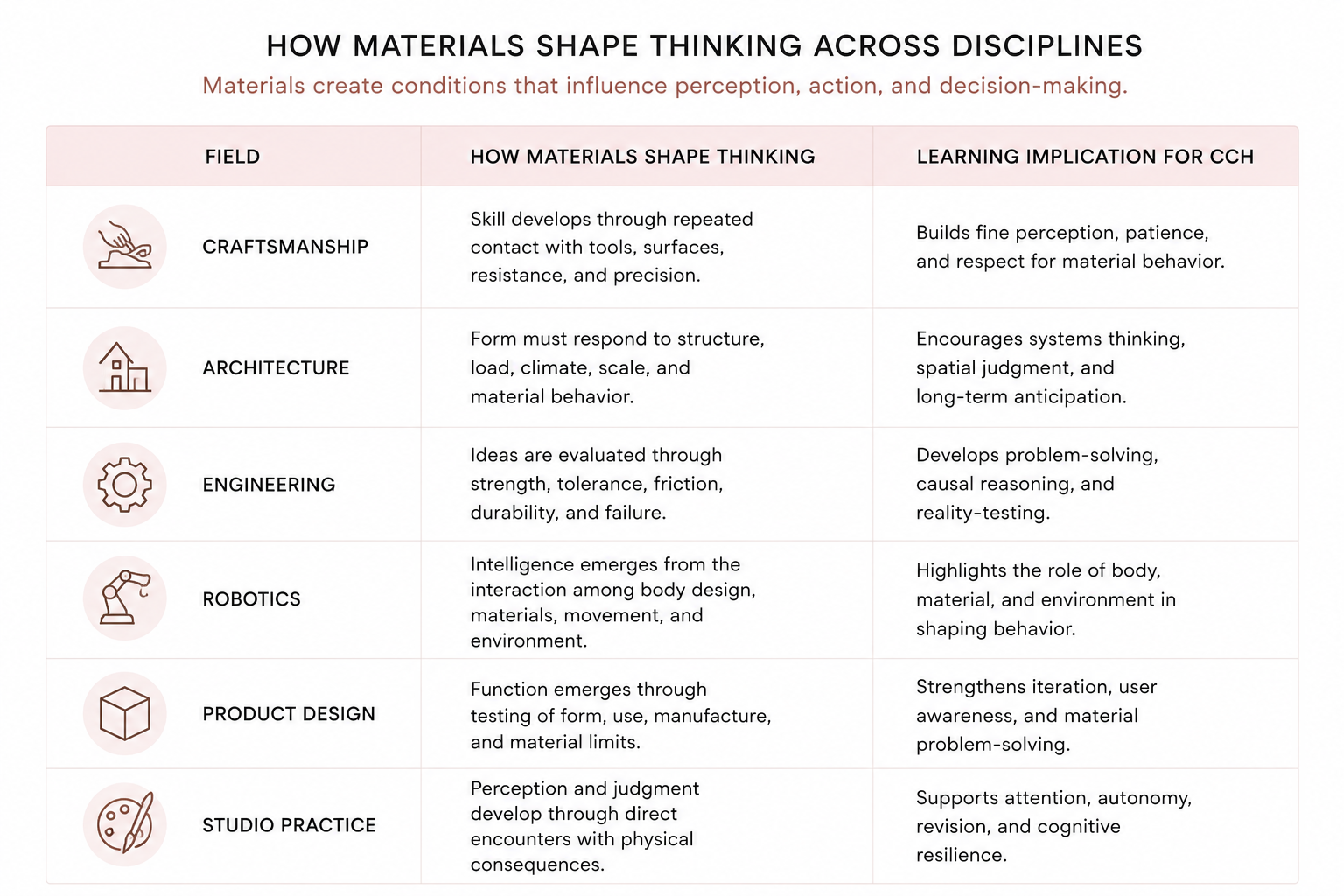
Research in embodied robotics similarly argues that intelligent behavior cannot be understood through computation alone; body form, material properties, and environmental interaction also contribute to how a system behaves.
Architecture offers a comparable insight. Material engagement can shape how people understand, inhabit, and continually adapt built environments rather than treating buildings as passive containers.
Why Material Choice Matters
Materials produce different forms of attention.
Watercolor requires sensitivity to timing, absorption, transparency, and movement.
Cardboard construction requires spatial judgment, balance, sequencing, and structural anticipation.
Clay requires pressure control, three-dimensional perception, and continuous adjustment.
Collage requires selection, arrangement, comparison, and relationship-building.
Each material creates a different cognitive demand.
The educational value therefore does not come from simply offering many supplies. It comes from selecting materials that generate meaningful perceptual and decision-making conditions.
Materials Slow Down Immediate Answers
Digital systems frequently offer rapid correction, duplication, deletion, and reversal.
Physical materials introduce another temporal structure.
Some actions require waiting.
Some choices leave traces.
Some changes cannot be fully reversed.
This does not make physical materials inherently superior to digital tools. It means they generate different learning conditions.
Material work asks learners to:
anticipate consequences
regulate force
tolerate delay
observe gradual change
respond to partial irreversibility
revise without erasing the entire history of the work
These conditions can strengthen patience and reality-based judgment.
From Creativity to Cognitive Development
Creativity remains part of CCH.
The larger purpose is to understand what develops while creative decisions encounter real constraints.
CCH pays attention to whether learners:
notice material properties
test possibilities before committing
adjust pressure or technique
revise after failure
transfer knowledge from one material to another
distinguish between an idea and what the material can currently support
The material becomes both a medium and a source of feedback.
It helps make thinking visible.
Materials and Autonomy
Adult direction can provide an immediate answer.
Materials provide evidence.
When learners are given enough time to investigate that evidence, they become less dependent on continuous approval.
Instead of asking:
“Is this correct?”
they begin asking:
“What is happening here?”
“Why is this unstable?”
“What could I change?”
This shift supports autonomy because judgment develops through observation rather than external confirmation alone.
Key Takeaway
Materials shape thinking because they transform ideas into physical encounters with possibility, resistance, consequence, and revision.
Within CCH, materials are more than resources for artistic expression.
They are active conditions through which learners strengthen perception, judgment, attention, autonomy, and cognitive resilience.
References
Varela, F. J., Thompson, E., & Rosch, E. The Embodied Mind: Cognitive Science and Human Experience. MIT Press.
Gibson, J. J. The Ecological Approach to Visual Perception and subsequent affordance research.
Pfeifer, R., Iida, F., & Lungarella, M. Research on body morphology, soft materials, and embodied intelligence in robotics.
Mulder, H. “Building Cognition Through Material Engagement.”
Next Method Note
→Method Notes 06 — Why We Reduce Adult Intervention