
METHOD NOTES 04-What CCH Actually Observes
Observation Is Used to Understand Development, Not to Judge Appearance.
A finished artwork can show what was produced. It cannot fully show how a learner entered the task, handled uncertainty, responded to difficulty, revised a decision, or returned after frustration.
For this reason, CCH observation does not begin with the question:
Does the artwork look successful?
It begins with a different question:
What patterns of attention, judgment, self-regulation, and material engagement became visible during the process?
This distinction is central to the CCH framework. The artwork remains meaningful, but it is interpreted alongside the sequence of behaviors, decisions, pauses, revisions, and responses that shaped its development.
Observation Beyond the Finished Product
Conventional assessment often emphasizes visible outcomes: technical accuracy, resemblance, completion, neatness, or aesthetic quality. These criteria may be appropriate when the educational objective is to teach a specific technique or produce a defined result.
CCH has a broader developmental focus.
During studio practice, a learner may spend significant time deciding where to begin, testing the physical limits of a material, reconsidering an unstable structure, or pausing before continuing. These moments may leave little visible evidence in the final work, yet they provide important information about how the learner approaches complexity.
CCH therefore observes both:
what the learner produces
how the learner organizes attention and action while producing it
The second dimension is essential because similar artworks can emerge from very different learning processes.
One learner may depend on continuous adult direction. Another may independently test alternatives, tolerate uncertainty, revise an unsuccessful approach, and ask for support only after attempting several solutions. The final products may appear comparable, while the developmental processes are substantially different.
The Main Observation Domains
CCH organizes observation around a set of developmental domains. These domains are not used to assign fixed labels. They provide a structure for identifying patterns across time.
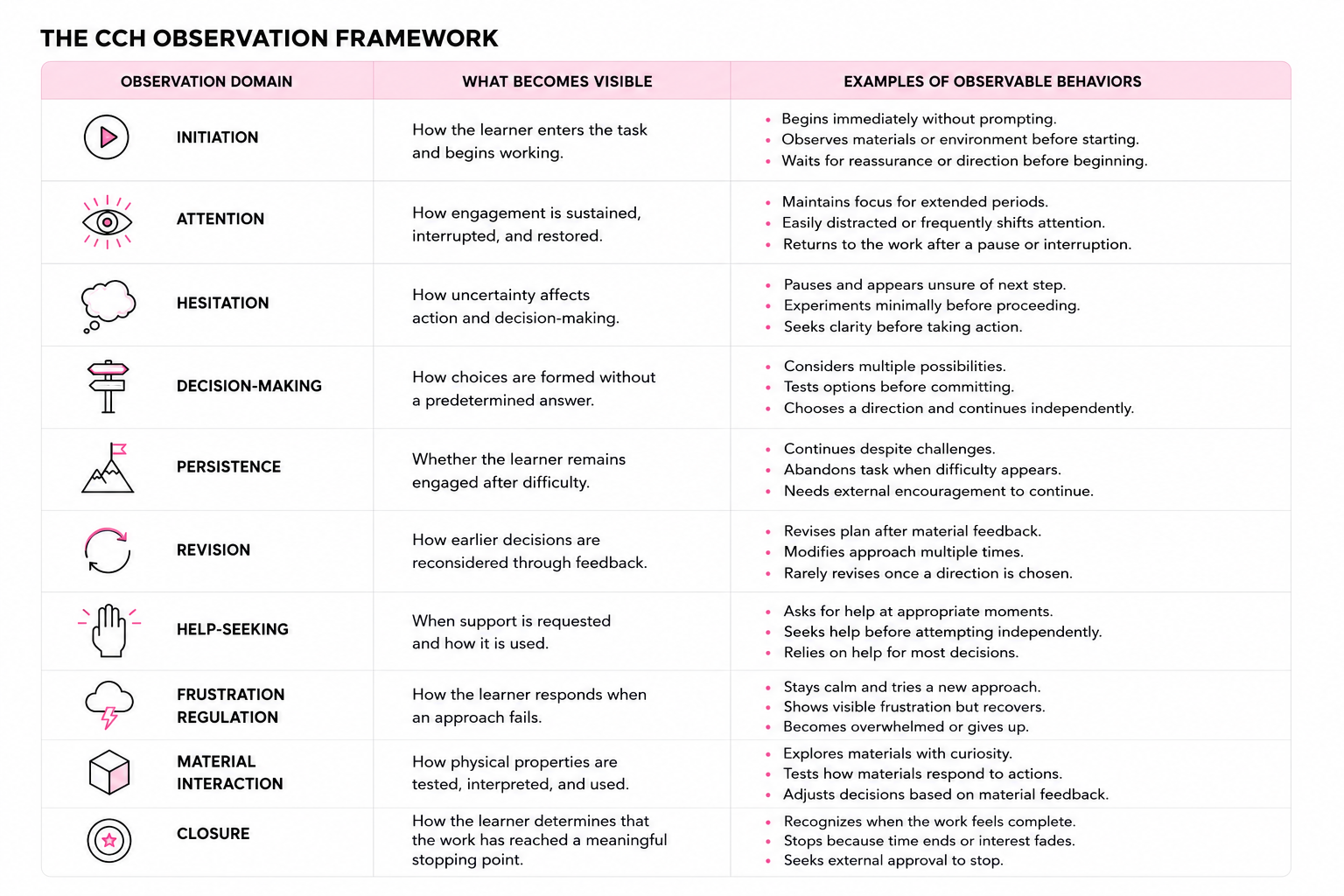
These domains are interrelated. A learner who hesitates may also be regulating fear, evaluating risk, or waiting for adult confirmation. A learner who persists may still require significant external direction. A learner who asks for help may be demonstrating dependency, appropriate judgment, or a mature awareness of limits.
Observation therefore requires context. Isolated behavior is not interpreted as a complete conclusion.
Development Appears Through Patterns
CCH does not treat a single moment as definitive evidence.
A learner may hesitate during one session because the material is unfamiliar. Another may begin quickly because the task resembles a previous experience. Temporary fatigue, emotional state, physical discomfort, social conditions, and project complexity can all influence behavior.
For this reason, CCH looks for patterns across multiple sessions.
Relevant changes may include:
beginning with less external reassurance
sustaining engagement for longer periods
recovering more quickly after difficulty
testing alternatives before requesting assistance
making more deliberate material choices
revising without abandoning the entire project
tolerating unfinished work between sessions
identifying an appropriate point of closure independently
Development is often gradual and nonlinear. Progress may appear as a change in the quality of a learner’s decisions rather than an increase in speed or output.
A learner may produce less while demonstrating stronger observation, more careful judgment, and greater independence. In that case, lower productivity does not necessarily indicate weaker learning.
Materials Make Cognitive Processes Visible
Physical materials play an important role in observation because they generate consequences that cannot be fully controlled through verbal explanation.
Paper may tear under pressure. Water may cause pigment to spread. A structure may collapse because its weight is unevenly distributed. Adhesive may fail when surfaces are incompatible. Clay may lose stability when overworked.
These responses require learners to interpret reality.
The learner must decide whether to continue, adjust pressure, change materials, reinforce a structure, wait, simplify, or begin again. Each response creates observable evidence of judgment and adaptation.
Materials therefore function in two ways:
They provide the medium through which the work is created.
They reveal how the learner responds when intention meets physical reality.
This is one reason CCH places significant value on material engagement. Digital environments can offer rapid correction, reversal, and visual simulation. Physical materials introduce resistance, delay, consequence, and partial irreversibility. These conditions make decision-making more visible.
Observation Is Different from Continuous Adult Control
Observation does not mean watching a learner intensely or interrupting every decision with questions.
Excessive adult attention can alter the very behavior being observed. A learner may begin monitoring the adult’s facial expression, waiting for approval, or adjusting decisions according to external cues rather than material information.
Within CCH, observation is designed to preserve autonomous working space.
The adult remains available, attentive, and responsive while avoiding unnecessary control over the direction of the work. Intervention is used selectively, particularly when safety, emotional regulation, access to materials, or an appropriate level of support requires attention.
This allows the learner’s own decision-making patterns to become more visible.
The purpose is not to create an absence of guidance. The purpose is to distinguish between guidance that supports development and intervention that replaces the learner’s judgment.
Help-Seeking as Developmental Evidence
Requests for help are not automatically interpreted as weakness or dependence.
CCH considers:
whether the learner attempted a solution first
whether the request identifies a specific problem
whether the learner seeks information, reassurance, permission, or direct completion
whether the support enables the learner to continue independently
whether the learner gradually develops more precise and appropriate help-seeking
A learner who asks, “Can you do this for me?” is demonstrating a different relationship to the task from a learner who asks, “This part keeps falling. Can you help me understand why?”
The second request shows problem identification and preserves ownership of the work.
Appropriate help-seeking is therefore part of autonomy. Autonomy does not mean working without support. It means using support without surrendering responsibility for the decision-making process.
Frustration, Recovery, and Re-entry
Difficulty is expected in open-ended studio work.
A material may not behave as imagined. A structure may fail after significant effort. A visual decision may become difficult to reverse. The learner may feel disappointed, embarrassed, impatient, or temporarily unwilling to continue.
CCH observes what happens after that moment.
Does the learner:
abandon the work immediately
seek adult rescue
blame the material
pause and observe
identify the source of the problem
accept an irreversible outcome
modify the original plan
return after emotional regulation
Recovery is not defined as immediate compliance. A meaningful recovery may include stepping away, observing others, discussing the problem, or returning later with a revised strategy.
The important question is whether the learner develops a broader range of responses to difficulty over time.
Observation Does Not Produce Fixed Labels
CCH observation is not intended to diagnose, rank, or reduce learners to personality categories.
Terms such as “hesitant,” “distracted,” “perfectionistic,” or “resilient” can become misleading when treated as permanent identities. The same learner may show different patterns under different conditions.
CCH therefore describes observable behavior as precisely as possible.
Instead of writing:
The learner lacks confidence.
A more grounded observation would be:
The learner waited for adult confirmation before making three major decisions and began independently after receiving a neutral prompt to test one option.
The second statement separates observation from interpretation. It records what occurred and leaves room for future development.
This distinction protects the learner from premature labeling and improves the quality of educational documentation.
Why This Framework Matters
The value of studio observation extends beyond art education.
The behaviors visible during sustained creative work are relevant to many forms of learning and problem-solving:
entering unfamiliar tasks
maintaining attention without constant stimulation
acting without complete certainty
evaluating consequences
revising decisions
recovering after failure
seeking support appropriately
recognizing when work is sufficiently resolved
These capacities are increasingly important in environments shaped by rapid technological change, abundant information, and frequent external prompting.
CCH uses the studio as a structured setting in which these human capacities can be observed and gradually strengthened through repeated encounters with materials, time, uncertainty, and responsibility.
Key Takeaway
CCH observes the developmental process behind the artwork: how learners begin, hesitate, attend, decide, persist, revise, seek help, recover, and respond to material reality.
The completed work provides evidence of what was made.
Observation provides evidence of how the learner engaged, adapted, and developed while making it.