

CCH ART NOW REFLECTION ON PISA
: THE ATTENTION CRISIS BEHIND THE SCORE DECLINE
What global education data reveals about attention, persistence, agency, and learning in the age of AI
By Chia-Chen Hsu, Founder of CCH ART NOW
The latest PISA findings reveal a contradiction that deserves closer examination. Students today have access to more information, computational power, and immediate assistance than any previous generation. Search engines, digital platforms, and generative AI can retrieve information, explain concepts, translate languages, draft arguments, and produce answers within seconds. Yet the latest OECD assessment shows that average performance in reading and mathematics has continued to decline, reaching the lowest levels recorded in PISA. [1]
It would be easy to interpret this only as an academic achievement problem. The deeper signal may concern something more fundamental: what happens to learning when students encounter difficulty, uncertainty, or a task that requires sustained engagement rather than an immediate response?
This is the point from which CCH ART NOW reflects on the report. The term “attention crisis” is our interpretive framing, not an OECD diagnostic category. PISA does not identify a single cause for the decline. What it does reveal is a pattern involving performance, effort, persistence, digital distraction, and the ways students respond as cognitive demands increase. [1][2]
The question is therefore larger than whether students know enough.
Can they remain cognitively engaged long enough to use what they know?
THE DECLINE IS REAL — BUT THE SCORES ARE ONLY THE BEGINNING
PISA evaluates how 15-year-old students use knowledge in reading, mathematics, and science rather than simply testing whether they can recall curriculum content. The latest assessment involved approximately 760,000 students across 91 countries and economies.
Across OECD countries, average reading performance declined by 28 PISA points between 2015 and 2025, an amount the OECD estimates as approximately one and a half years of learning. Mathematics declined by 22 points, equivalent to slightly more than one year of learning. One in five students is now classified as a low performer in science, mathematics, and reading simultaneously, compared with 16% in the previous assessment cycle. [1] (OECD)
These figures establish the scale of the problem. They do not, however, explain its cognitive character.
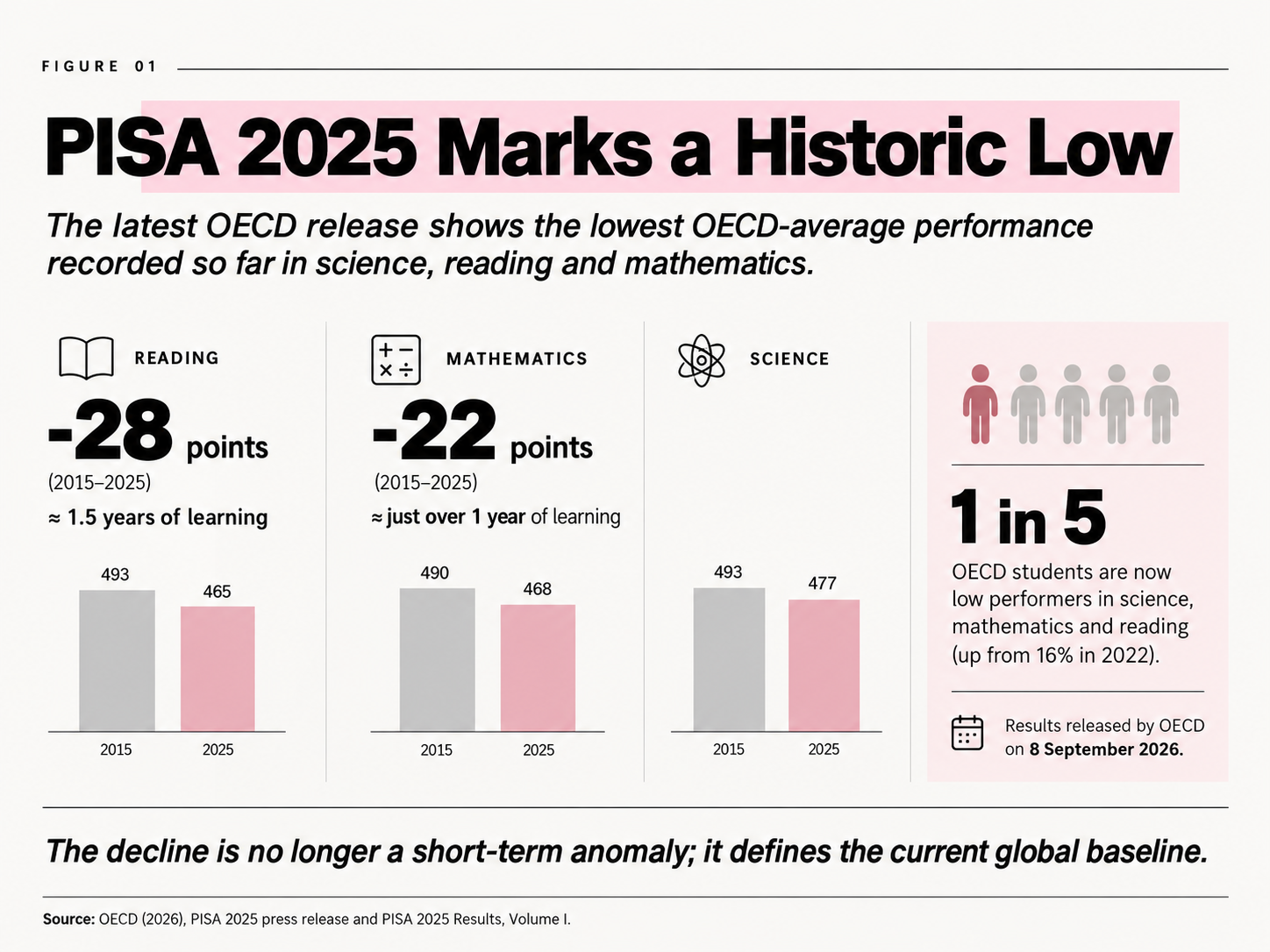
PISA 2025: A Historic Low
Figure 1. OECD-average performance in reading and mathematics has reached the lowest levels recorded in PISA. The decline represents more than a temporary fluctuation and raises questions about the conditions under which students are now learning. Source: OECD, PISA Results. [1]
READING PERFORMANCE IS NOT ONLY DECLINING — THE WAY STUDENTS READ IS CHANGING
Reading performance provides one of the clearest longitudinal signals. Across OECD countries with comparable data, performance continued to deteriorate over the most recent assessment cycles. The significance of that decline goes beyond literacy itself because reading requires multiple cognitive processes to remain coordinated: attention, working memory, comprehension, inhibition of irrelevant information, and the ability to remain engaged long enough to integrate meaning across a text.
A lower reading score may therefore reflect many interacting factors. It should not automatically be interpreted as evidence of reduced intelligence, nor can it be attributed to a single technological or social cause. What matters is that the decline is occurring at the same time as changes in students' engagement with tasks are becoming visible in the data. [2]
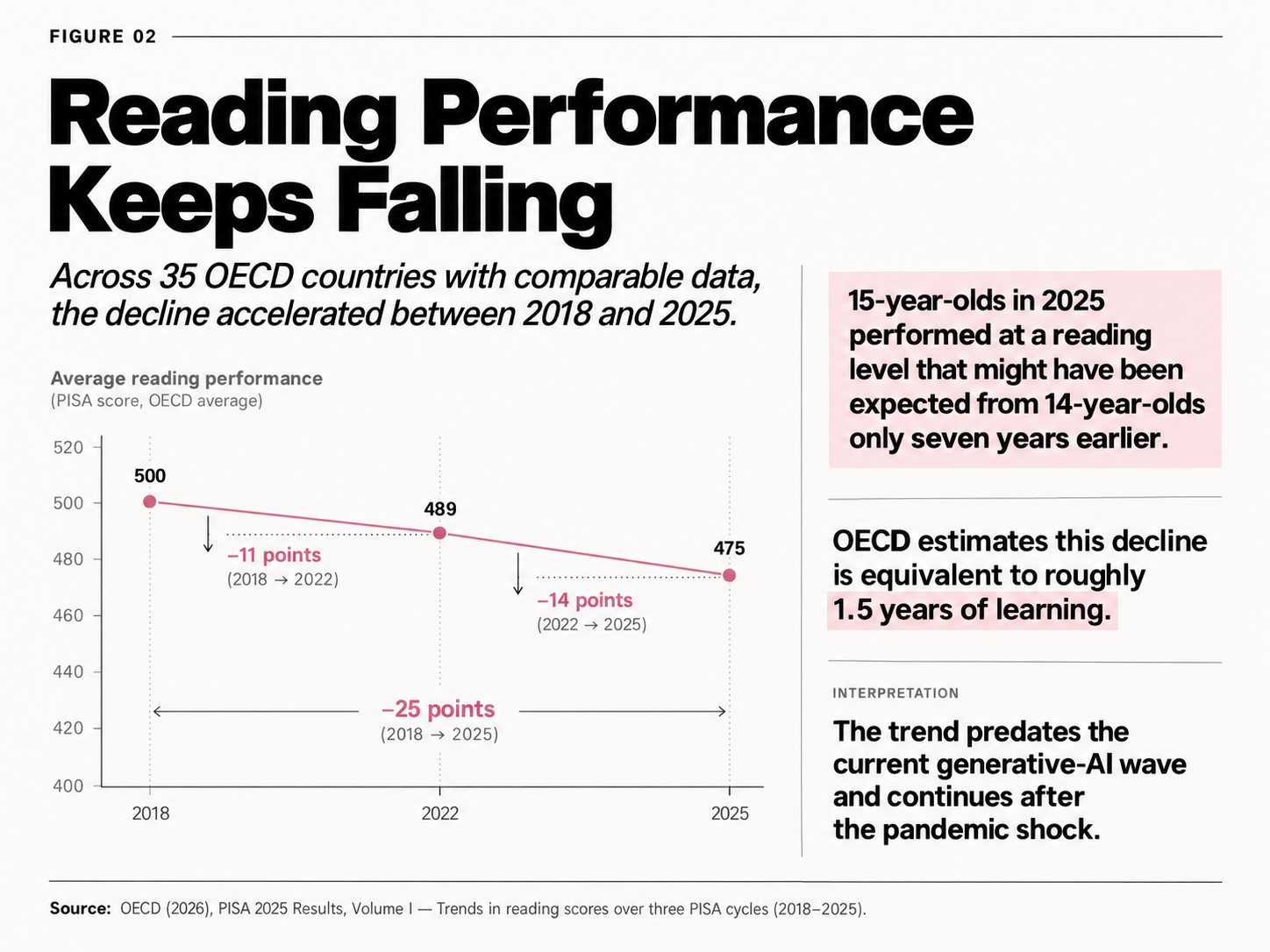
Reading Performance Continues to Decline
Figure 2. Longitudinal PISA data shows a sustained deterioration in reading performance across recent assessment cycles. The trend provides the background for examining not only what students know, but how they engage with demanding information over time. Source: OECD, PISA Results. [2]
THE ATTENTION SIGNAL BEHIND THE SCORE DECLINE
One of the most revealing findings concerns what the OECD describes as “hasty readers.”
Across 35 OECD countries with comparable data, the proportion of hasty readers rose from 6.6% to 11.4% between 2018 and 2025. During the same period, the proportion of accurate and fluent readers declined by approximately seven percentage points, while the proportion of slow readers increased by only about one percentage point. [2] (OECD)
The distinction is important. The emerging pattern is not simply that students are reading more slowly or struggling to complete tasks.
More students are responding quickly and inaccurately.
The broader assessment behaviour reinforces this interpretation. OECD analysis found that reading performance deteriorated throughout the assessment and more strongly in its later sections. The organisation explicitly notes that this pattern is consistent with the possibility that students' attention, persistence, or confidence when facing difficult tasks declined over time. [3] (OECD)
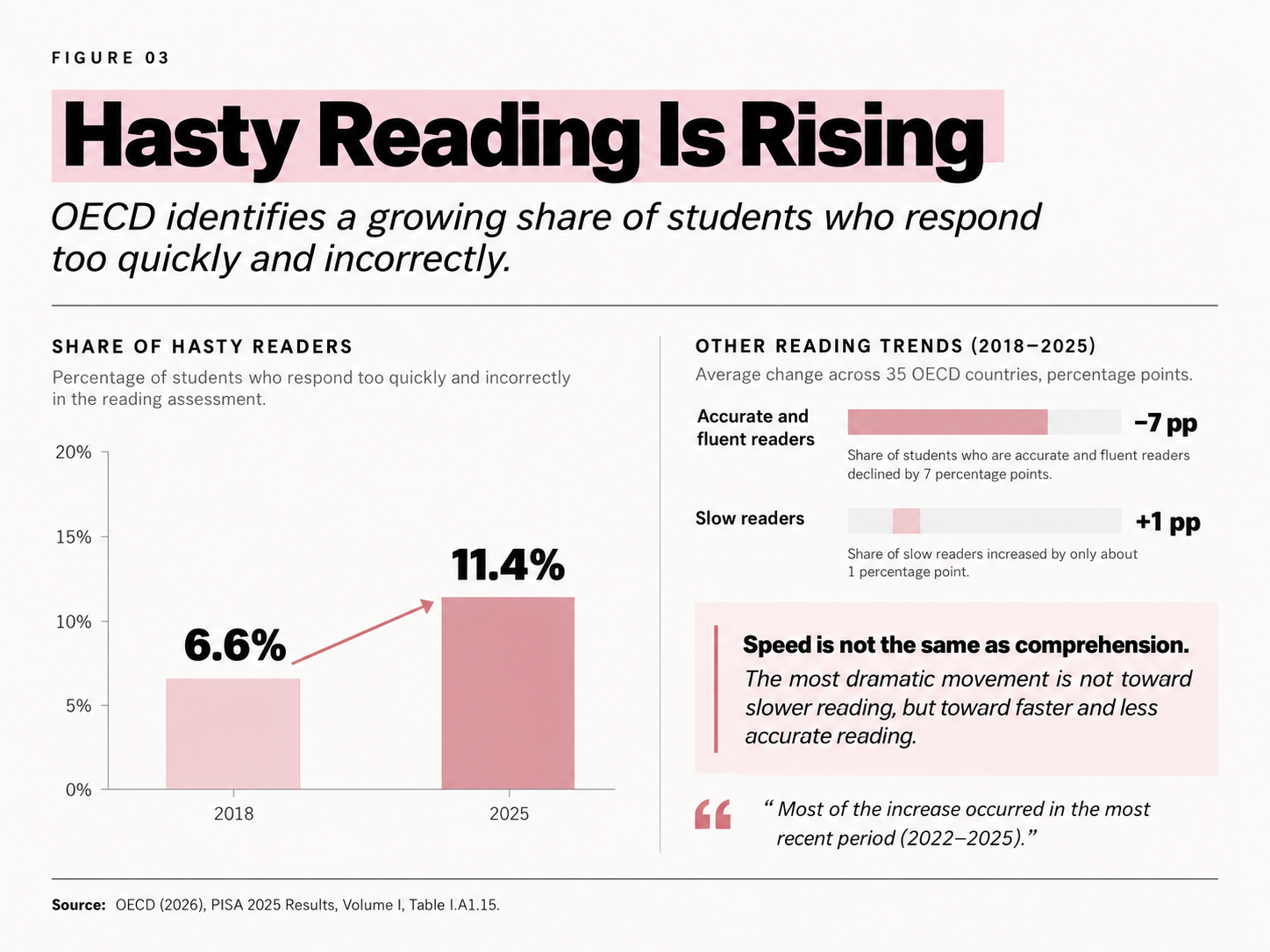
The Rise of Hasty Reading
Figure 3. The share of “hasty readers” almost doubled across 35 OECD countries with comparable data, rising from 6.6% to 11.4%. Meanwhile, accurate and fluent reading declined. Source: OECD, PISA Results. [2]
This changes the educational question. If a student lacks knowledge, additional instruction may address the gap. If a student disengages before knowledge can be applied, the problem exists at another level.
It concerns cognitive duration.
ATTENTION IS NOT A PASSIVE CONDITION
Education often treats attention as something students are simply expected to bring into the classroom. Reading, mathematics, and science are explicitly taught; attention is usually treated as a prerequisite rather than a capacity that may itself require development.
PISA provides reasons to reconsider that assumption. Students' self-reported effort declined in most participating countries and economies compared with earlier assessment cycles. Reports of motivation for learning and engagement with school also weakened. [3] (OECD)
The OECD additionally reports statistically meaningful relationships between engagement indicators and reading trends. Changes in the proportion of students saying they were “curious about many different things” correlated with changes in reading performance at r = 0.54. Changes in the proportion reporting that they finish what they start even when the task becomes boring showed a moderate correlation with reading trends at r = 0.33. [3] (OECD)
These correlations do not establish causation. They do, however, support a broader observation: learning performance and engagement are not independent systems.
The educational importance of sustained attention lies in what becomes possible after the first moment of difficulty. A learner must remain cognitively present long enough to compare, reconsider, revise, detect error, and generate another approach. When attention collapses immediately after uncertainty appears, those later cognitive operations have less opportunity to occur.
Attention, in this sense, is not simply concentration.
Attention creates duration, and duration creates the possibility of judgment.
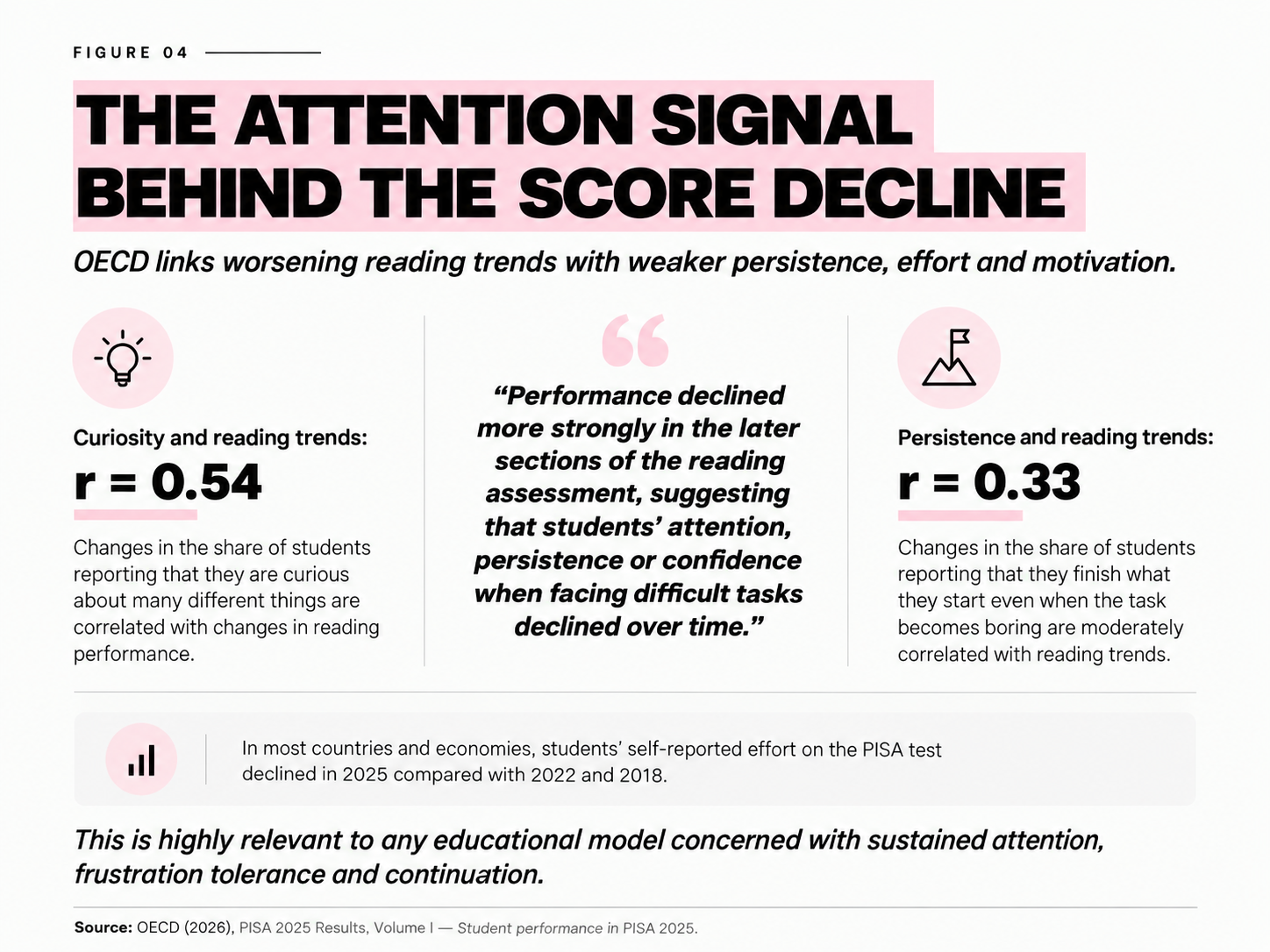
Attention, Persistence and Reading Performance
Figure 4. PISA data links changes in curiosity, persistence, self-reported effort, and engagement with changes in reading performance. These relationships are correlational rather than causal, but they indicate that cognitive engagement deserves greater attention in educational design. Source: OECD, PISA Results. [3]
THE PROBLEM IS NOT SIMPLY THE SCREEN
It is tempting to explain these patterns by blaming smartphones, tablets, social media, or digital learning. The available evidence does not support such a simple conclusion.
Digital technology can extend cognition. A search engine can expand access to information. A simulation can make invisible processes observable. Digital tools can support accessibility, translation, research, and communication. AI can provide explanations and alternative representations that would previously have required significant human resources.
At the same time, digital environments can produce distraction. More than one in four students reported that classmates were distracted by digital devices in most or every science lesson. Students surrounded by greater classroom distraction tended to perform less well, show weaker engagement, and feel less connected to school. [1] (OECD)
The meaningful distinction is therefore not technology versus no technology.
It is:
cognitive extension versus cognitive substitution.
When technology helps a learner investigate a problem that the learner is still actively directing, it can extend capability. When a tool performs the precise cognitive operation the learner is supposed to develop, the visible output may improve while the learner receives less practice in the underlying process.
This distinction becomes increasingly important as artificial intelligence moves from presenting information to actively participating in thinking.
AI CHANGES THE ECONOMICS OF COGNITIVE WORK
Generative AI can now assist with activities that schools have traditionally used as visible evidence of intellectual work. It can summarise a chapter, draft a paragraph, translate text, propose an argument, generate visual possibilities, organise research, explain a concept, or suggest the next step in solving a problem.
This does not make foundational knowledge obsolete.
It changes the cost structure of execution.
When an output that once required substantial cognitive effort can be generated almost instantly, the relative value of other processes increases. A learner still has to determine whether the question is worth asking, whether the answer is relevant, whether the reasoning is credible, whether competing possibilities should be compared, and whether a generated solution should be accepted, rejected, or reframed.
AI therefore moves part of human value upstream.
The relevant sequence increasingly extends beyond:
Instruction → Knowledge → Correct Answer
toward:
Attention → Inquiry → Uncertainty → Judgment → Decision → Action → Feedback → Revision
Artificial intelligence can participate in this sequence.
It does not remove the need for a human being capable of directing it.
TECHNOLOGY CAN SUPPORT LEARNING. ATTENTION CANNOT BE OUTSOURCED.
The OECD's position on AI is more nuanced than a simple endorsement or rejection. The latest PISA findings indicate that students tend to perform less well when digital use becomes excessive or when devices are predominantly used for leisure at school. The OECD also reports that students who used AI in certain ways without appropriate guidance did not necessarily achieve stronger results, while students taught to evaluate the quality of AI-generated information tended to perform better than comparable users without such guidance. [1] (OECD)
OECD Secretary-General Mathias Cormann captured the boundary succinctly when he stated that technology and AI can strengthen learning when they are used purposefully and “not as a substitute for attention, effort and understanding.” [1] (OECD)
That distinction is central.
The future educational question is not whether children should live without technology. They will not.
The question is whether they retain the cognitive capacity to use increasingly powerful tools without surrendering the processes required to judge, direct, and question them.
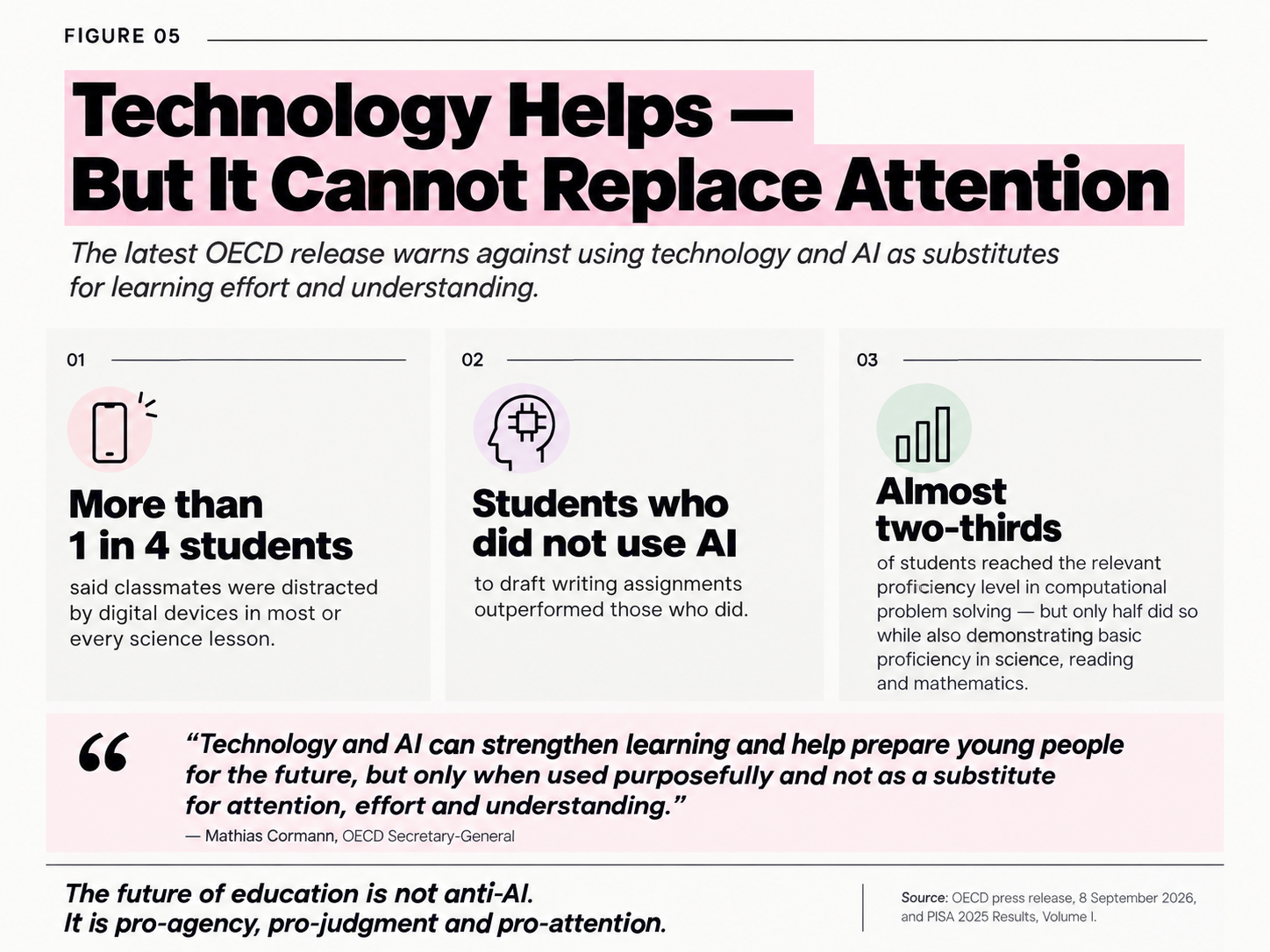
Technology Can Support Learning. Attention Cannot Be Outsourced.
Figure 5. Technology and AI may strengthen learning when used purposefully, but the OECD warns against allowing them to substitute for attention, effort, and understanding. The educational challenge is therefore not technological avoidance, but preserving human cognitive participation. Source: OECD. [1]
KNOWLEDGE REMAINS ESSENTIAL
A discussion of agency and attention should not become an argument against knowledge.
Foundational knowledge remains indispensable because judgment depends on something against which new information can be evaluated. A student cannot reliably assess an AI-generated scientific explanation without scientific understanding. A learner cannot recognise weak reasoning without language, conceptual structure, and prior knowledge.
The latest PISA findings reinforce this relationship. Its new assessment of learning in the digital world shows that students need both digital problem-solving capability and foundational proficiency in reading, mathematics, and science. The OECD explicitly frames these as complementary rather than competing requirements. [1] (OECD)
The traditional opposition between knowledge and creativity, or between instruction and agency, is therefore increasingly unproductive.
Knowledge provides structure.
Agency determines how that structure is mobilised.
The future learner requires both.
FROM INFORMATION SCARCITY TO JUDGMENT SCARCITY
For much of modern educational history, knowledge itself was scarce. Access to books, expert teachers, advanced explanations, and specialised information depended heavily on geography, institutions, and socioeconomic resources.
AI changes this environment.
Information becomes increasingly abundant. Explanations can be generated on demand. Multiple plausible answers can appear within seconds. The cost of producing options declines.
But abundance at one level creates scarcity at another.
When ten plausible answers can be generated immediately, the scarce capacity becomes the ability to determine which one matters. When fifty visual possibilities are available, selection becomes more valuable than generation. When a machine can defend opposing arguments with equal fluency, human judgment becomes more—not less—important.
The emerging educational scarcity therefore moves upstream of the answer.
It lies in determining what deserves attention, what should be questioned, which possibility should be pursued, when an answer is inadequate, and when a person should continue despite uncertainty.
AGENCY IS BECOMING EDUCATIONAL INFRASTRUCTURE
The OECD Learning Compass places student agency at the centre of its future-oriented educational framework. Its use of the metaphor of a compass is intentional: students increasingly need to navigate unfamiliar conditions and develop meaningful directions rather than simply follow fixed instructions. [4] (OECD)
Agency in this context does not mean unrestricted freedom. It involves the capacity to set goals, reflect, make responsible decisions, act, and influence one's circumstances.
This becomes increasingly important in an AI-rich environment because artificial systems are rapidly becoming capable of supplying recommendations, answers, and next steps.
The question becomes whether the learner remains the author of direction.
The labour market is moving in a similar direction. The World Economic Forum identifies analytical thinking, creative thinking, resilience, flexibility and agility, curiosity and lifelong learning, and systems thinking among capabilities expected to remain critical or increase in importance as technological transformation accelerates. [5] (World Economic Forum)
These frameworks do not prove that any particular educational method develops these capacities.
They do indicate that the value of judgment, adaptability, curiosity, persistence, and self-directed learning is increasing alongside technological capability.
The remaining question is practical:
How are these capacities actually trained?
CCH BEGINS WHERE THE ANSWER DISAPPEARS
The CCH Protocol™ was developed around a learning condition in which the final outcome has not been predetermined.
Instead of reproducing a model, the learner enters a physical material environment containing possibilities, constraints, and uncertainty. There is no single correct object to make and no algorithmically generated sequence of instructions leading toward an approved answer.
The learner has to observe the situation, initiate a direction, act, experience consequences, evaluate what changed, and determine what happens next.
Physical materials make this process concrete. Structures collapse. Connections fail. Paper bends unexpectedly. Scale introduces new constraints. A decision that solves one problem may create another.
The material does not automatically adapt itself to preserve the learner's comfort.
It does not generate the next move.
The learner must.
This creates a recurring cognitive sequence:
Observe → Decide → Act → Encounter Resistance → Evaluate → Modify → Continue
The artwork is visible.
The deeper educational process lies in the sequence of decisions required to produce it.
CULTIVATE.
CONCENTRATE.
HARVEST.
The CCH Protocol organises this process through three interconnected conditions.
Cultivate opens the field of possibility. The learner encounters materials, relationships, and emerging questions before a final direction has been determined. Curiosity initiates movement through the unknown.
Concentrate is the central cognitive condition. The learner remains with the work after the novelty of beginning has faded. As decisions accumulate, resistance becomes more consequential. A structure may need revision. A material may behave differently than expected. Fatigue may appear. The learner has to decide whether to repeat, modify, abandon, reorganise, or continue.
Concentration in this context is not passive stillness. It is sustained cognitive participation across an evolving chain of consequences.
Harvest makes that chain partially visible. The completed work records accumulated decisions, revisions, recoveries, and adaptations. The educational interest lies not only in what was made, but in how decision-making remained continuous across time.
Art and material practice provide the medium.
The deeper research interest is the cognitive architecture activated through the process.
AGENCY UNDER UNCERTAINTY
CCH uses the term Agency Under Uncertainty to describe the capacity to remain engaged when the next action has not been predetermined, generate a direction, make a decision, encounter consequences, revise a course, and continue.
The working CCH hypothesis proposes a relationship between sustained attention, independent decision-making, material resistance, adaptive modification, and decision continuity. Repeated practice under these conditions may contribute to a learner's ability to operate with greater agency when an external answer is unavailable.
This remains a testable educational hypothesis, not an established causal conclusion.
PISA does not prove that the CCH Protocol works. OECD data does not demonstrate that open-ended material practice causes improvements in attention, persistence, judgment, or agency.
What the international evidence does establish is the increasing relevance of the problem space itself. PISA identifies changes in performance, effort, reading behaviour, and persistence. The OECD Learning Compass foregrounds student agency. Future-of-work research places increasing value on analytical thinking, adaptability, curiosity, and human-centred judgment.
CCH enters with the next research question:
Can a learning environment be deliberately designed so that sustained attention, independent decision-making, resistance, and revision are repeatedly practised rather than merely discussed?
That is the direction being investigated.
WHY PHYSICAL MATERIALS MATTER IN AN AI AGE
The physical nature of CCH should not be interpreted as a rejection of technology.
Its value may increase precisely because technological environments are becoming increasingly responsive.
A digital system can correct, recommend, personalise, predict, and generate. Physical materials behave differently. They can remain unresolved. They can refuse the learner's intention. They can produce consequences that require genuine modification rather than another prompt.
This contrast matters.
Children growing up with AI need sophisticated technological literacy. They also need environments in which the next move is not automatically supplied.
A technologically advanced education does not have to eliminate physical, non-digital learning environments.
It may need them more deliberately.
Their role is not nostalgic.
Their role is to preserve situations in which the learner remains responsible for generating the next decision.
A DIFFERENT READING OF PISA
The latest PISA report should be understood first as evidence of a serious decline in foundational educational performance. Reading, mathematics, and scientific knowledge remain indispensable.
At the same time, the behavioural signals embedded within the data deserve equal attention:
Hasty reading has increased, while accurate and fluent reading has declined.
Students report lower effort and weaker engagement, particularly across recent assessment cycles.
Performance deteriorates more strongly as assessments progress, raising questions about sustained attention and cognitive endurance.
Digital distraction is now visible at classroom scale, with measurable associations with performance and engagement.
AI is increasingly participating in tasks previously performed by learners themselves, making the distinction between cognitive support and cognitive substitution increasingly important.
International education and labour frameworks are simultaneously placing greater emphasis on agency, judgment, adaptability, curiosity, and persistence.
Taken together, these developments suggest that the future educational challenge is larger than giving young people access to more intelligence.
They will have unprecedented access to intelligence.
The challenge is ensuring that they remain capable of directing it.
The future learner needs foundational knowledge and technological literacy. But between knowledge and technology sits something more fundamental: a human being capable of sustaining attention, evaluating information, making decisions, tolerating unresolved conditions, revising a direction, and remaining responsible for what follows.
CCH ART NOW is developing its research within this space.
The purpose is not to train children to compete with artificial intelligence at producing more answers.
It is to investigate the human capacities that may become increasingly valuable because artificial intelligence can produce them for us.
When AI can generate the next answer, education must still develop the human capacity to generate the next decision.
RESEARCH NOTE | EVIDENCE BOUNDARY
The term “attention crisis” in this article represents CCH ART NOW's interpretation of the emerging evidence. It is not an OECD diagnostic term and should not be interpreted as a clinical claim.
PISA identifies population-level trends and statistical associations. It does not establish that smartphones, digital devices, social media, or artificial intelligence directly caused the observed decline in student performance.
Likewise, current evidence does not establish that the CCH Protocol™ causes improvements in attention, persistence, judgment, or agency. CCH treats these relationships as testable educational hypotheses to be examined through structured observation and future empirical research.
Existing evidence defines the problem space. CCH proposes a research and training direction within it.
REFERENCES
[1] OECD. PISA Results: Student Performance and Key Findings. Organisation for Economic Co-operation and Development. Findings include historically low OECD-average reading and mathematics performance, cross-domain low performance, digital distraction, AI use, and the relationship between technology and learning. (OECD)
[2] OECD. PISA Results: Trends in Reading Scores over Three PISA Cycles. Organisation for Economic Co-operation and Development. Reports the rise in hasty readers from 6.6% to 11.4% and the decline in accurate and fluent readers. (OECD)
[3] OECD. PISA Results: Student Performance. Organisation for Economic Co-operation and Development. Includes analysis of declining effort, engagement, persistence, performance across later assessment sections, and correlations between reading trends, curiosity, and persistence. (OECD)
[4] OECD. The OECD Learning Compass 2030. Organisation for Economic Co-operation and Development. Framework addressing student agency, responsible action, and the ability to navigate unfamiliar contexts. (OECD)
[5] World Economic Forum. The Future of Jobs Report 2025: Skills Outlook. World Economic Forum. Identifies analytical thinking, creative thinking, resilience, flexibility and agility, curiosity and lifelong learning, and systems thinking among capabilities expected to remain important or increase in importance. (World Economic Forum)