
YES, HUMAN AGENCY CAN BE CULTIVATED!
—A Developmental Evidence Chain from CCH
How Self-Directed Learning Begins to Emerge Between Ages Five and Seven
FROM MAKING TO LEARNING HOW TO LEARN
At five, a child may appear to be learning how to cut, connect, arrange, build, and repair.
By seven, those same actions may begin to reveal something larger:
The child is learning how to approach learning itself.
This transition has become increasingly visible through longitudinal observations within CCH ART NOW.
Across repeated studio sessions from early childhood into the beginning of elementary school, one student, referred to here as Y, worked through increasingly complex material environments without templates, predetermined outcomes, or step-by-step instructions.
The significance of this case is not simply that he became better at making art.
What began to emerge was a transferable pattern:
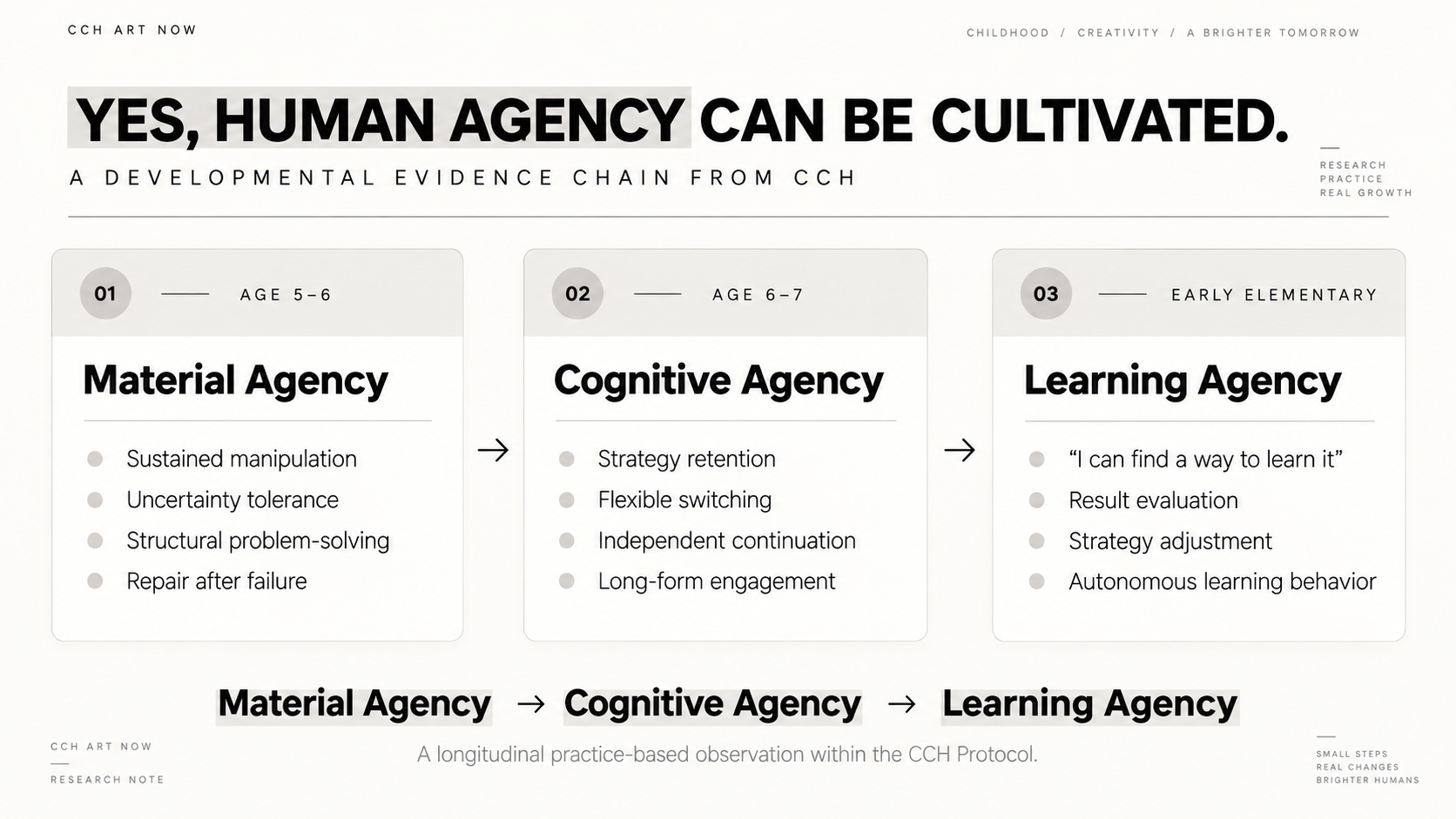
Encounter something unfamiliar → observe → attempt → tolerate an imperfect result → adjust the strategy → continue
By the time formal schooling entered the picture, this pattern was beginning to appear beyond the studio.
That is the developmental transition this case makes visible.
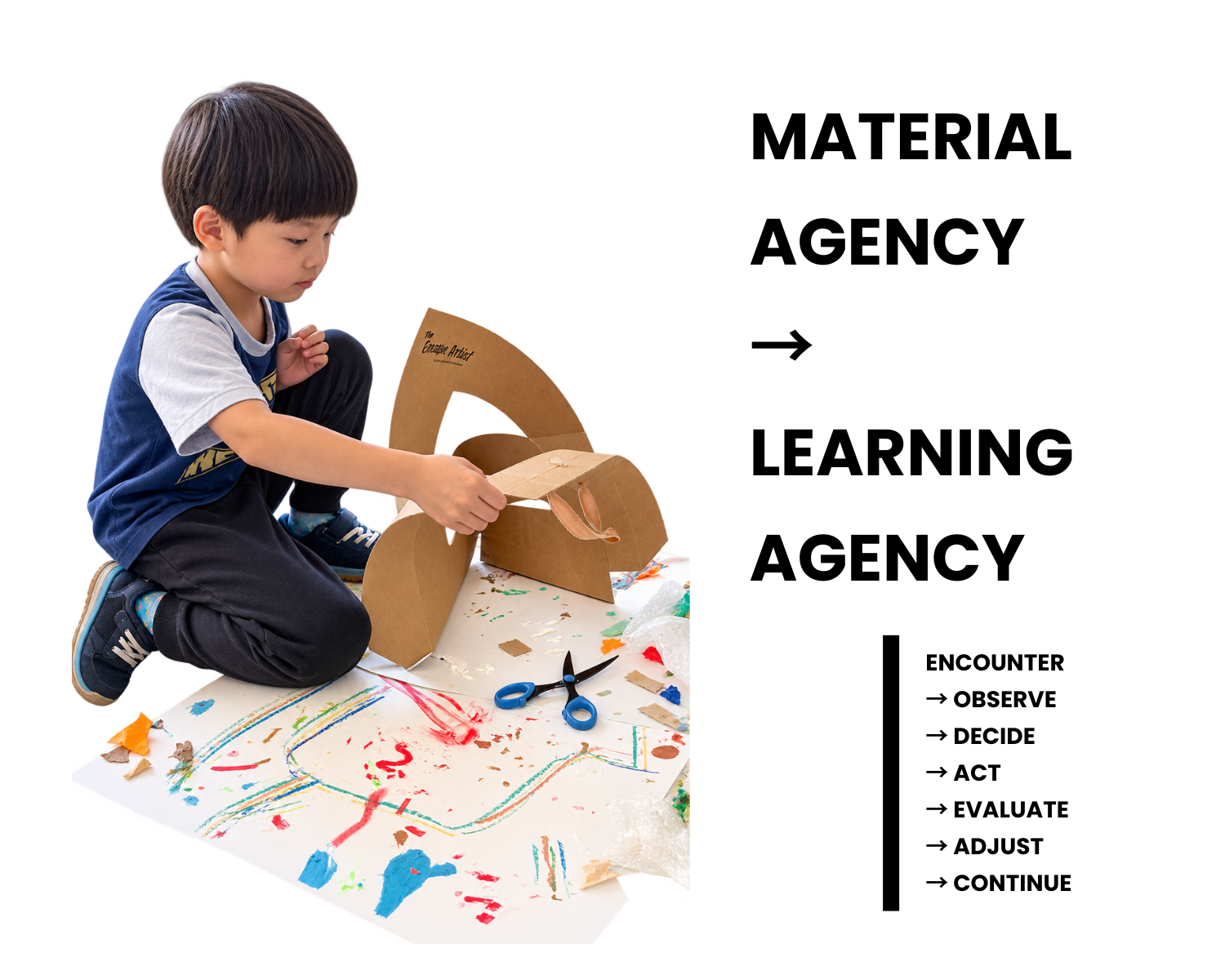
From Material Agency to Learning Agency
Between approximately five and seven, children are entering a period of rapid change in executive function, self-regulation, metacognition, and goal-directed behavior. At the same time, formal schooling begins to place greater demands on literacy, numeracy, schedules, evaluation, and independent learning.
Within CCH, preparation for this transition begins earlier—not through academic acceleration, but through repeated encounters with uncertainty.
At five, Y worked with cardboard, tape, clay, stickers, paper, found materials, and large-scale constructions whose outcomes could not be fully predicted in advance. A structure might collapse. A connection might fail. Something might be cut incorrectly. A previous solution might suddenly stop working.
The objective was therefore never simply to produce a successful object. The deeper learning began when the next action was not already given.
Encounter → Observe → Decide → Act → Evaluate → Adjust → Continue
Repeated over time, this cycle creates opportunities to practise something more fundamental than technical skill:
remaining an active agent when certainty disappears.
That is the bridge from Material Agency toward Learning Agency.
The Shift Appears When Formal Learning Begins
FROM “I DON’T KNOW” TO “I’LL FIND A WAY”
When Y entered elementary school, his father described an important change. Unlike many children who receive substantial pre-academic preparation, Y had not intensively studied phonetics, multiplication, or other formal academic content before entering school.
Yet unfamiliar material did not seem to trigger immediate anxiety. Y described himself as someone who would find a way to learn it. The significant observation here is not learning speed, but how he represents an unfamiliar problem.
An unknown task can be approached in two very different ways:
“I don’t know this.”
or
“I haven’t figured this out yet. What can I do?”
The second closely resembles what had repeatedly occurred in the CCH studio. Materials changed, structures failed, and previous solutions stopped working, but the learner remained responsible for finding a next move.
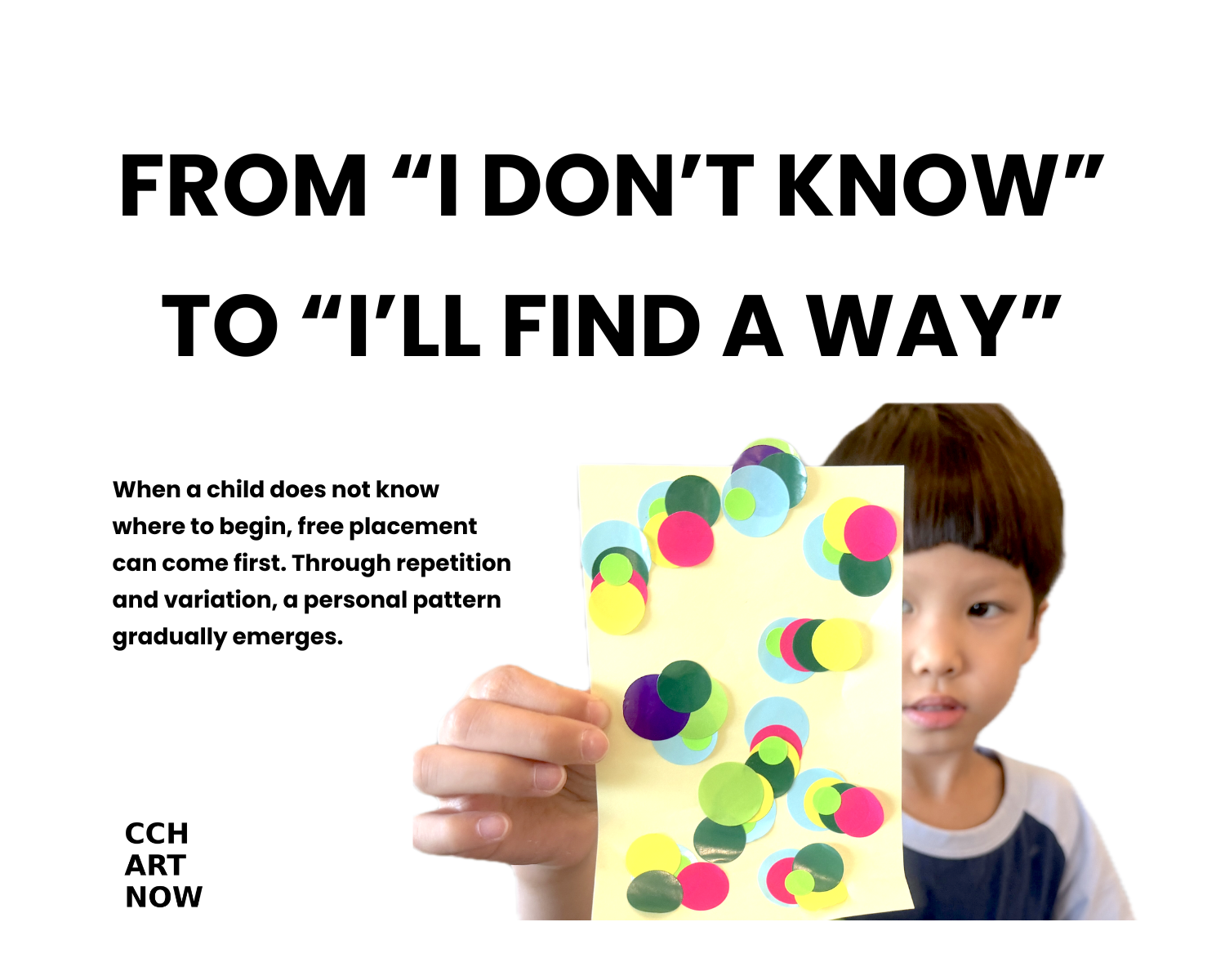
When a child does not know where to begin, the first step does not need to be a clear plan. In CCH, the learner may simply start by placing stickers freely, without deciding in advance what the final pattern should become. As the surface fills, differences in color, size, spacing, repetition, and overlap begin to emerge. The child can then notice what feels visually interesting, identify relationships, and gradually develop a pattern that feels like their own.
Action → Recognition → Pattern → Decision
This sequence matters because action comes first; recognition follows. The learner does not need to imagine the whole solution before beginning. A direction can emerge through making.
What may now be transferring into formal learning is therefore not a specific artistic skill, but a broader orientation toward uncertainty:
The problem can change without removing the learner’s agency.
The developmental shift is from manipulating materials to mobilizing strategies: when the answer is not yet known, the learner still knows how to begin.
The Switch Point
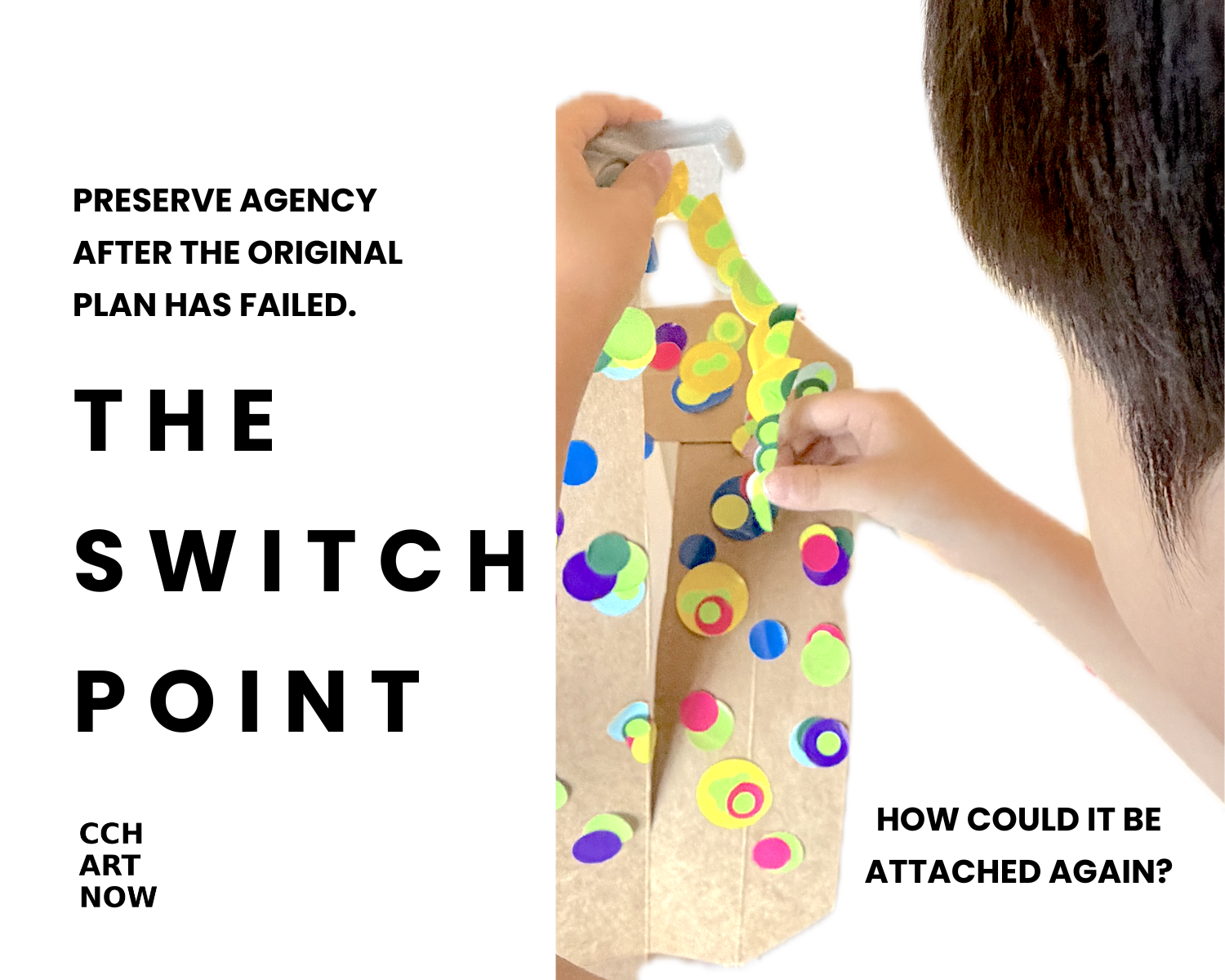
One classroom incident makes this transition especially visible. During a session, Y was cutting a form for a flowerpot structure and accidentally cut off the flower. For a young child, a small irreversible mistake can easily become an emotional endpoint—frustration, withdrawal, abandonment of the work, or immediate dependence on an adult for repair.
Y responded differently. He accepted what had happened and moved almost immediately toward a new question:
How could it be attached again?
The educational significance lies not in emotional suppression or in knowing the “correct” repair technique. What mattered was that failure did not terminate agency. The unexpected result became new information, and Y reorganized the problem rather than withdrawing from it.
Within the CCH framework, I describe this transition as a switch point: the moment when an unexpected condition stops functioning primarily as an interruption and begins functioning as material for the next decision.
In this sense, resilience is not simply the ability to tolerate frustration. It is the ability to
preserve agency after the original plan has failed.
Why CCH Uses Long Studio Sessions
Long-Form Attention as a Learning Process
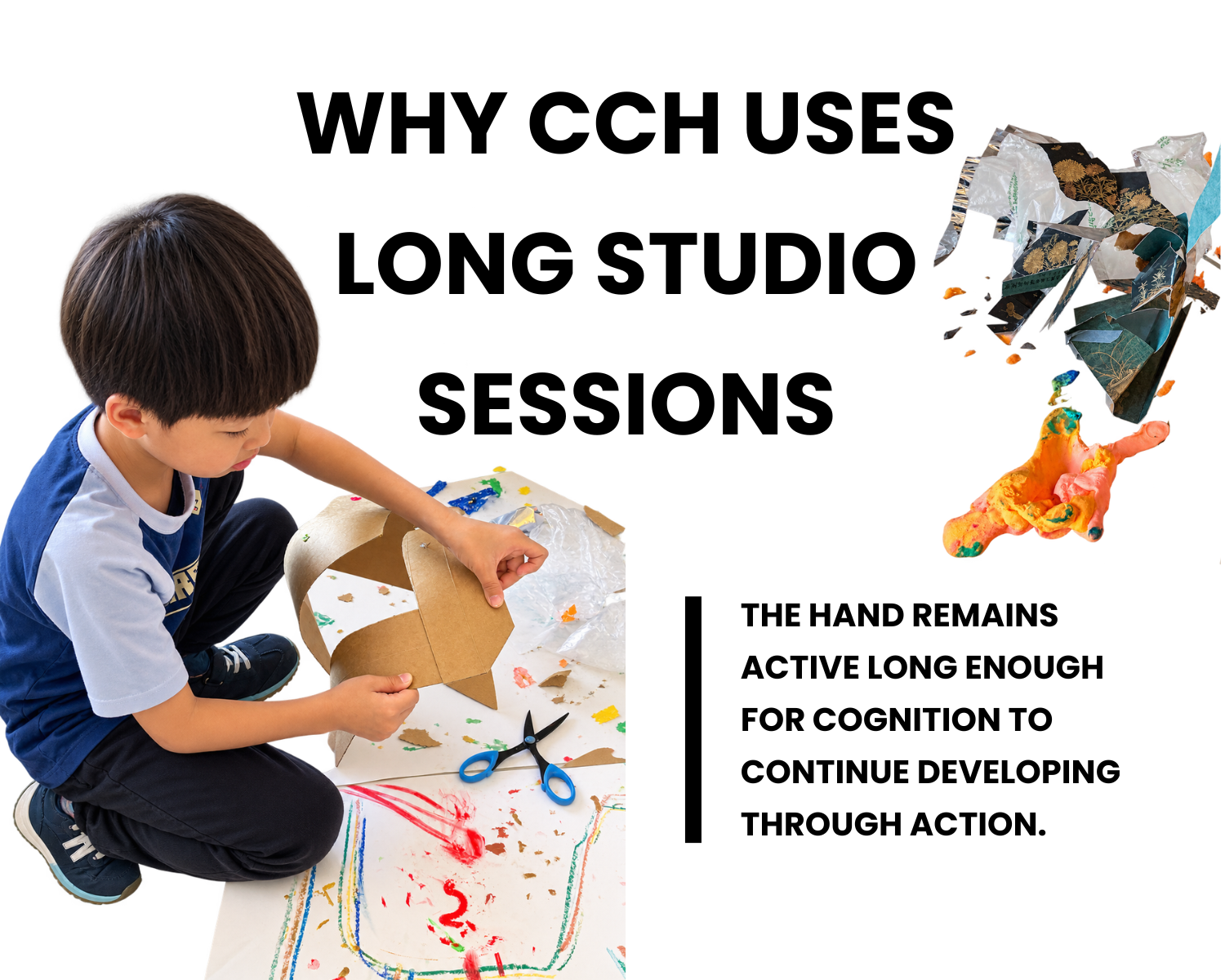
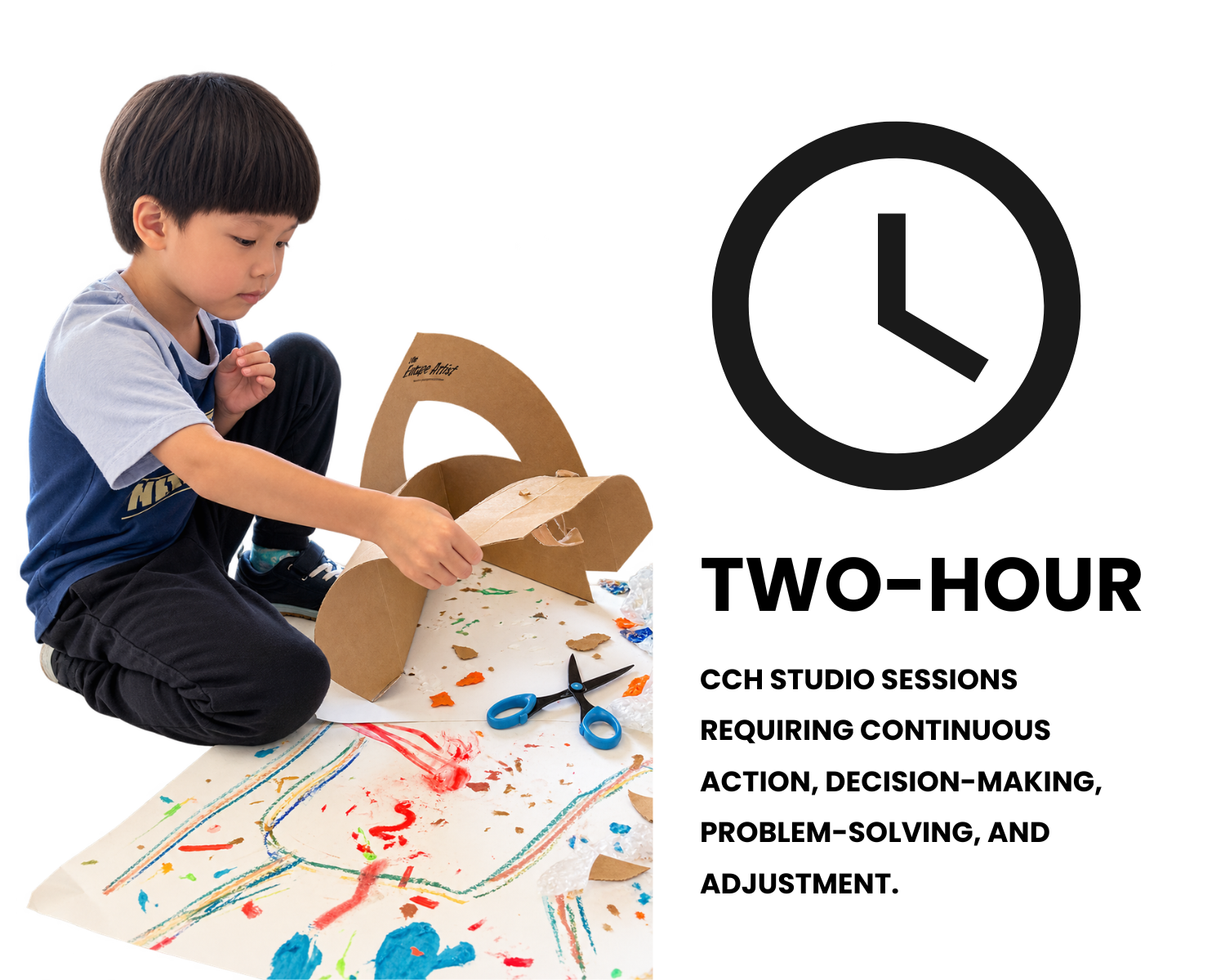
CCH sessions commonly last at least two hours, but the objective is not simply to train a child to remain seated or tolerate a longer class.
Long-form material practice places the learner inside an extended cycle of observation, decision, action, resistance, adjustment, and return. Attention is therefore not treated as a static state. It has to be rebuilt each time the child encounters new information, changes direction, revisits an earlier structure, introduces another material, or recovers from frustration.
Attention → Decision → Action → Feedback → Adjustment → Renewed Attention
This became especially visible in Y’s September session. Earlier in the class, he was repeatedly drawn into the adults’ conversation. After his father temporarily left the working area, he returned to the materials and worked with greater continuity.
He recalled a sticker-combination strategy introduced in previous sessions, layering different sizes and colors into larger visual units before integrating them into a three-dimensional cardboard structure. By the end, he proudly announced that he had used all of the stickers.
Within CCH, “use them all” is not simply an instruction to finish the materials. Extending the duration of physical manipulation increases the number of decisions, comparisons, and variations the learner must generate.
Repetition → Variation → Comparison → Selection → Discovery
Repetition, in this context, is not the opposite of creativity. It creates enough iterations for difference to emerge. As the material accumulates, the original pattern becomes insufficient: size relationships change, colors interact differently, spatial combinations become more complex, and previous solutions become starting points for new ones.
This is one of the central functions of long-form studio practice in CCH:
the hand remains active long enough for cognition to continue developing through action.
Long-Form Attention Across Contexts
Y’s father also reported that, after entering first grade, Y has become increasingly willing to watch full-length films of approximately two hours.
This observation should be interpreted cautiously. A single case cannot establish that short-form video reduces deep thinking, nor can it show that sustained viewing of long-form films is unusual among children of the same age.
What makes the observation relevant is that Y now demonstrates sustained engagement across two very different contexts:
Long-form narrative viewing
&
two-hour CCH studio sessions requiring continuous action, decision-making, problem-solving, and adjustment.
The more meaningful longitudinal variable is therefore not screen duration itself. It is Y’s growing capacity to remain engaged within an unfolding structure long enough for relationships, consequences, and possibilities to develop.
In this sense, deep attention is more than the absence of distraction. It is the ability to maintain continuity across time—to remember what came before, respond to what is happening now, and remain engaged long enough to anticipate what may come next.
Cognitive Switching Is Not Automatically Distraction
Y’s father has observed that he sometimes moves between mathematics, language, phonetics, and English rather than remaining exclusively with one subject. It would be premature to describe this pattern either as a deficit or as a cognitive advantage.
The more useful question is what happens after the switch.
Can the child re-enter the previous problem? Can he retain relevant information? Can he change cognitive modes without losing the larger learning objective? Can he still complete meaningful work?
These questions closely resemble the demands built into CCH studio environments. Children may move between drawing, construction, adhesive materials, spatial organization, color, tactile manipulation, and structural problem-solving. Sometimes several media operate simultaneously; at other moments, the learner must narrow attention and remain with one difficult operation.
The objective is therefore not uninterrupted sameness.
It is flexible continuity: the ability to shift without losing the larger thread of learning.
From “Teach Me” to “I Will Find a Way”
This may be one of the most consequential transitions between ages five and seven.
At five, adults can observe a child learning to manipulate materials. By six, increasingly complex decisions, persistence, and structural thinking begin to emerge. By seven, as formal academic demands increase, some of these earlier behaviors may begin to reappear at another level.
The object of regulation changes:
Materials → Strategies → Learning
First, the child learns to organize materials. Then the child begins to organize strategies. Eventually, the learner starts to organize his or her own learning process.
This suggests an important developmental proposition within the CCH Protocol:
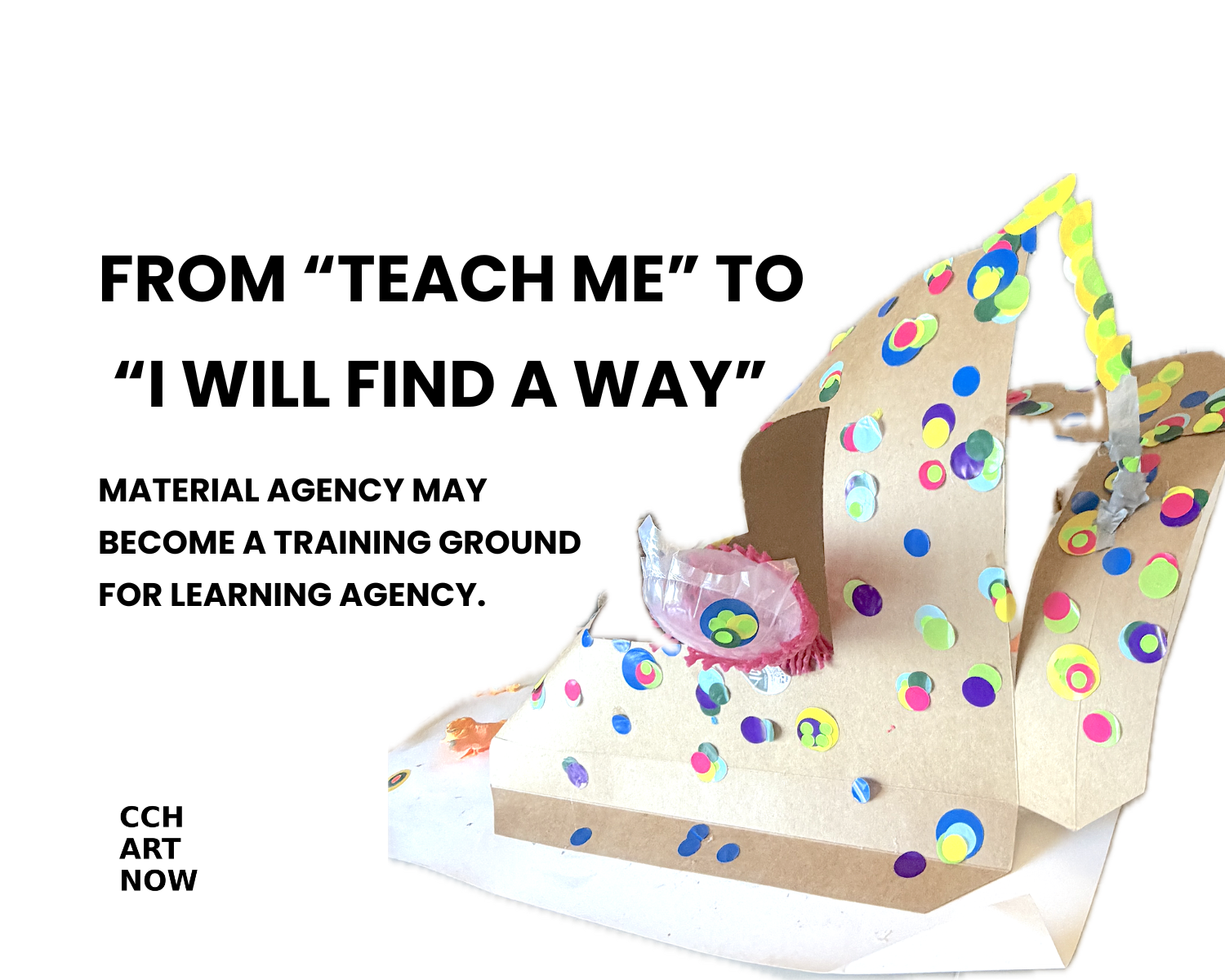
Material agency may become a training ground for learning agency.
This remains a working hypothesis rather than a causal conclusion. A single longitudinal case cannot establish that CCH produces this developmental outcome. What the Y case does provide is an observable pathway worth continuing to document.
What Parents Usually See — and What We Should Also Measure
Once children enter school, educational attention quickly shifts toward outcomes:
Can the child read?
What score did the child receive?
How quickly did the child finish?
Is the child ahead or behind?
Y’s parents described a different approach. If most students received a score around 90 and their child received 40, they would discuss the result with him. If he wanted a different outcome, they could then consider what kind of support, practice, or change might be necessary.
That distinction is important because it preserves accountability without immediately removing agency.
The learning sequence becomes:
See the result → Evaluate it → Identify the gap → Choose a strategy → Try again
Tutoring, memorization, additional practice, and direct instruction may all be useful strategies. But they remain strategies.
They should not replace the more fundamental capacity to recognize:
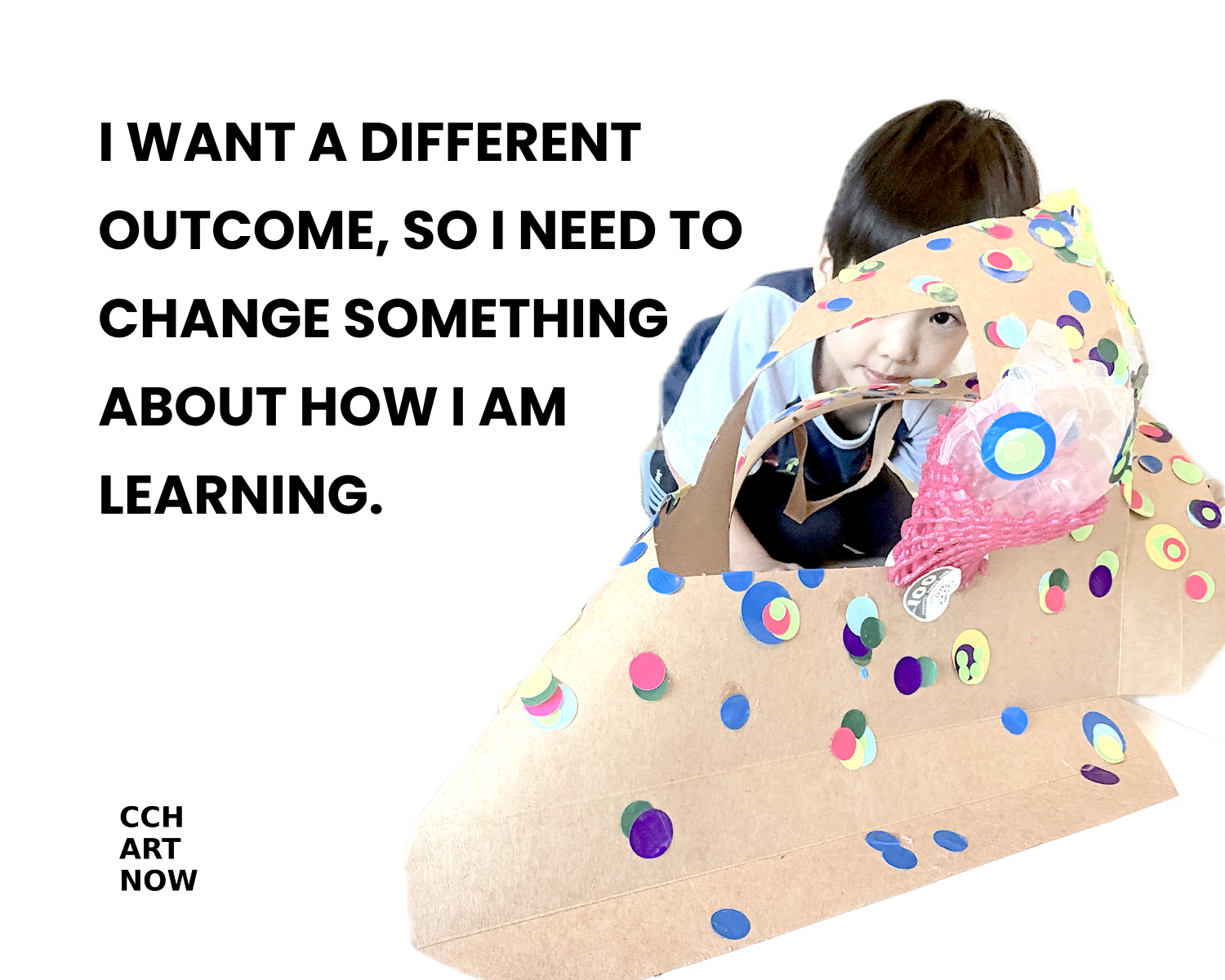
I want a different outcome, so I need to change something about how I am learning.
That is where self-directed learning begins.
The Five-to-Seven Transition
The strongest conclusion from this longitudinal observation is not that CCH produces children who can concentrate for two hours.
The deeper proposition is that sustained, open-ended material practice may provide repeated rehearsal for the architecture of autonomous learning.
A five-year-old deciding how two pieces of cardboard can remain connected may appear far removed from a seven-year-old deciding how to learn an unfamiliar academic concept. Cognitively, however, the two situations share a related structure:
There is a problem.
The answer is not immediately available.
I can observe.
I can try.
I can change my strategy.
I can continue.
That pattern is what deserves attention.
In an educational environment increasingly surrounded by systems capable of generating answers instantly, one of the most consequential human capacities may be the ability to remain with a problem before an answer is available.
The developmental achievement is therefore larger than concentration.
It is the emergence of a learner who increasingly understands:
When I do not know what to do next, I can still do something.
And somewhere between five and seven, that may be the point where making begins to become self-directed learning.
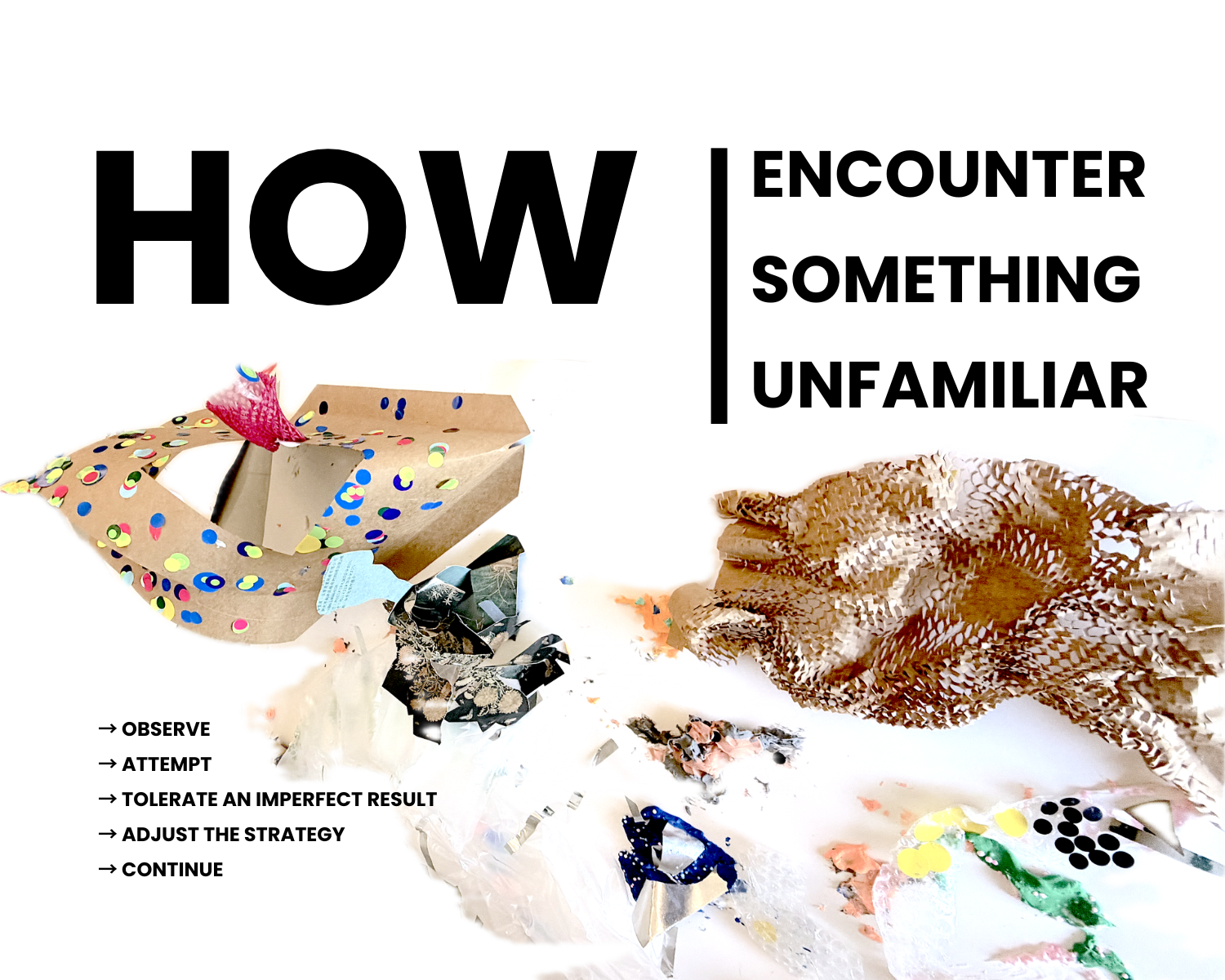
CCH Research Note
Age 5–6 · Material Agency
→ sustained manipulation
→ uncertainty tolerance
→ structural problem-solving
→ repair after failureAge 6–7 · Cognitive Agency
→ strategy retention
→ flexible switching
→ independent continuation
→ long-form engagementEarly Elementary · Learning Agency
→ “I can find a way to learn it”
→ result evaluation
→ strategy adjustment
→ autonomous learning behavior
Material Agency → Cognitive Agency → Learning Agency