
CCH HARVEST TIME: A 10-Year Trace
What one family’s long-term observations reveal about early material-led art practice, attention, and independent thinking.
How early work with colour, materials, and open-ended problems may support attention, flexible thinking, and independent decision-making.
Iris began coming to the studio as a very young child. At the earliest sessions, she was still sometimes drawing with a bottle beside her.
Her mother’s decision to begin early was not based on a wish for accelerated technical achievement. It was based on a different intuition: that a child’s relationship with colour, materials, and creative decision-making could be formed before she learned to wait for a correct answer, a model to copy, or an adult’s approval.
This article draws on a parent-retrospective observation record completed years after the child’s early studio experience. It considers what the parent observed, how those observations relate to existing research, and what this case can - and cannot - support.
Case Context and Scope
The parent recalled that Iris began attending art sessions at approximately two and a half years old. The parent’s strongest memories of the experience were material exploration, teacher guidance, and watching a work gradually take shape.
The family did not describe the experience as a conventional drawing class. The emphasis was on beginning with materials, colour, form, and possibility rather than following a fixed sequence of demonstration, imitation, outline, and colouring-in.
The parent later reported that Iris showed strong colour sensitivity, independent material use, expressive flexibility, and an ability to revise or transform an initial idea. School teachers were also said to have praised her creative ideas, hands-on ability, aesthetic awareness, colour sensitivity, oral or written expression, and self-directed learning.
These observations deserve careful interpretation. They are meaningful as longitudinal family testimony, but they are not equivalent to controlled research evidence.
Parent-Retrospective Observations
1. Colour as a way of entering the work
The parent described Iris as able to begin directly with colour, shape, placement, and movement. She did not appear to rely on first creating a heavy dark outline around every form before beginning.
This does not mean that contour drawing is inherently limiting or that one method is universally better than another. Outline-based drawing can be useful for particular visual, technical, or developmental purposes.
The relevant observation is different: Iris appeared able to use colour as an active decision-making language rather than only as a final decorative layer.
Instead of beginning with, “What am I supposed to draw?”, she could begin with questions closer to:
What happens if this colour moves here?
What shape needs to interrupt this space?
What combination creates a different feeling?
What should become larger, quieter, denser, or more open?
This form of making requires comparison and response. The child must look at what is emerging, notice whether it is working, and decide what to do next.
2. Materials as thinking partners
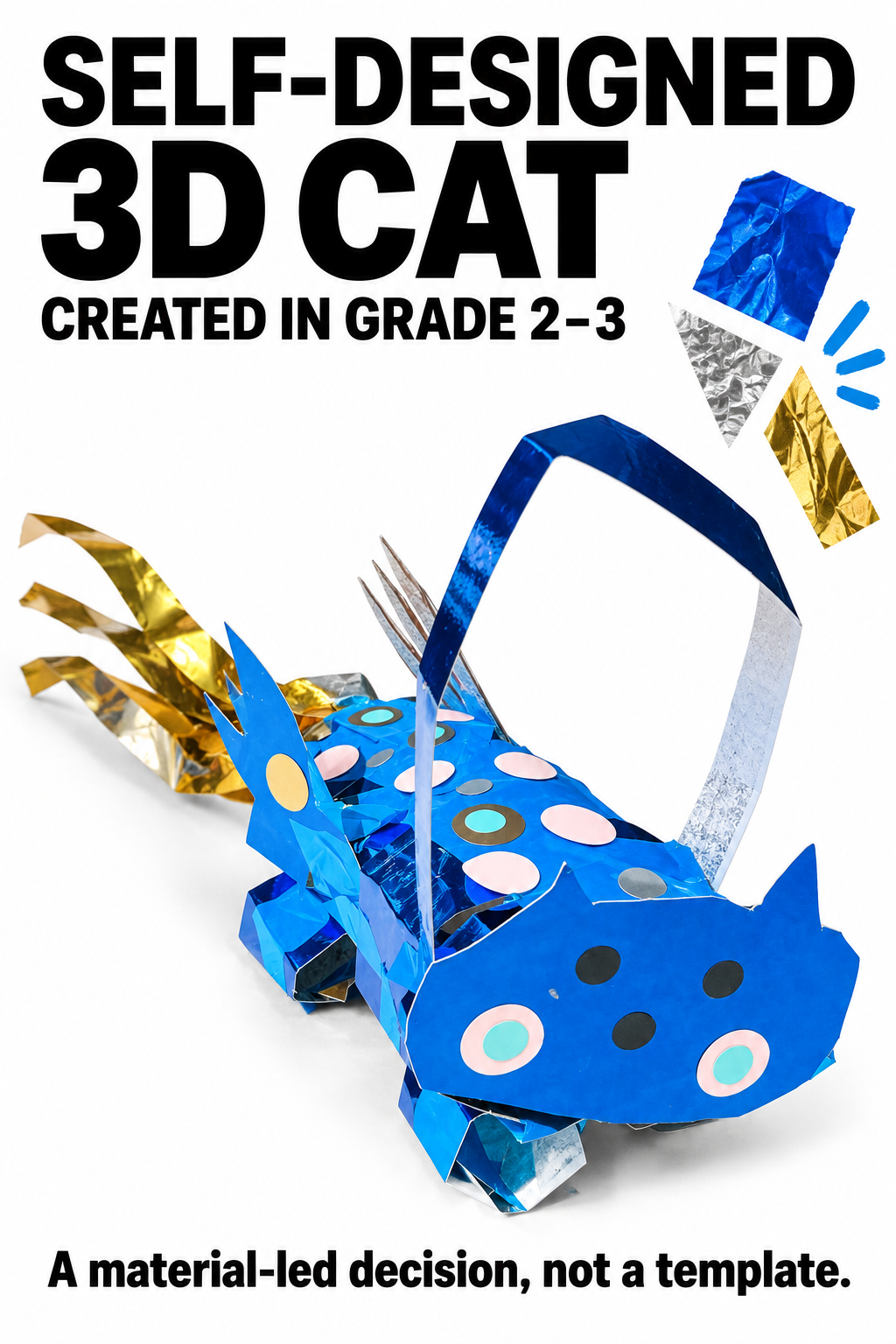
The parent also described a strong ability to work with leftover materials and to shift between materials when needed.
A fragment that did not fit the original plan was not automatically treated as waste. It could become a connection, a surface, a structural element, a new object, or the beginning of another idea.
This is an important distinction. Children are often taught that materials have fixed functions: paper is for drawing, stickers are for decoration, cardboard is for building, and unused pieces are discarded. In a material-led studio, these categories can remain open.
A failed attempt can become a new direction. An offcut can solve a compositional problem. A material can change function when the child notices another possibility.
The parent’s observation suggests that Iris was not limited by the first assigned purpose of a material. She could reconsider what was already available and make another decision from it.
3. Observation, revision, and independent reasoning
The parent record described a consistent decision-making pattern.
When Iris encountered an unfamiliar task, she was reported to observe first or look for information before acting. When the original method did not work, she tried another method. When a work or result was not as expected, she attempted revision. When there was no standard answer, she could explain her own reasoning. When her ideas differed from others, she could communicate her point of view.
This sequence is significant:
observe → test → revise → explain.
It describes more than expressive confidence. It suggests an emerging capacity to remain in contact with uncertainty rather than immediately seeking an external answer.
The parent’s note offered one concrete example: when Iris was dissatisfied with an outcome, she could use other materials to revise it into a different result.
That is not simply an art skill. It is a way of responding to constraint. The child does not have to remain fixed on the first plan, abandon the work, or wait for someone else to solve the problem. She can identify what is not working, experiment with an available resource, and construct a next step.
4. Sustained attention and later continuity
The parent recalled that, during the early period of art-making, Iris could at times remain focused on a work for approximately two hours. The parent described this sustained involvement as continuing through Grade 1.
Later, even after no longer attending the course, the parent observed that Iris could continue to reflect on what she was doing rather than simply abandoning a task when it became difficult.
The same parent record identified long-term changes in:
Material use and hands-on work
Creativity and expression
Aesthetic sensitivity and colour awareness
Focus and sustained engagement
Independent decision-making and problem-solving
The parent also identified several possible influences on this development: the art experience itself, family companionship and environment, Iris’s own interests and practice, schooling, and growth over time.
That multi-factor explanation is important. It is more accurate than claiming that one class or one teacher alone produced the child’s later capacities.
Research Context: Why These Observations Matter
This parent record is not a controlled study. It does not include a comparison group, baseline assessment, or standardised follow-up measure. It therefore cannot prove that one course alone caused Iris’s later development.
What it does provide is a detailed longitudinal account of behaviours that are meaningful within established research on material manipulation, embodied learning, studio-based thinking, creative thinking, and self-regulated learning.
1. Materials can support thinking, not only making
Iris’s record describes a child who could select tools, try unfamiliar materials, repurpose leftovers, and shift to another material when an initial approach did not work.
This aligns with research on instructional manipulatives and embodied cognition. Pouw, van Gog, and Paas (2014) argue that perceptually rich, interactive materials can support learning when they are meaningfully connected to the task. Material interaction may help learners reduce unnecessary cognitive load and draw on sensorimotor experience when approaching a new problem.
The point is not that “more materials” automatically produce better learning. Materials need to be thoughtfully selected, open enough to invite experimentation, and connected to a real decision.
In this case, the parent’s observations suggest that materials were not treated as fixed supplies with one correct use. They became thinking partners: objects to test, combine, transform, and reconsider.
2. The observed pattern aligns with studio habits of mind
The Studio Thinking framework identifies several dispositions cultivated through serious visual arts practice: developing craft, engaging and persisting, envisioning, expressing, observing, reflecting, stretching and exploring, and understanding the art world (Hetland et al., 2007).
Several of these dispositions are visible in the parent record:
Engage and Persist: The parent recalled sustained involvement in making, including periods of concentrated work.
Observe: When facing an unfamiliar task, Iris was reported to observe first or seek information before acting.
Stretch and Explore: When a method did not work, she tried a different one rather than staying fixed on the first approach.
Reflect: When a result was unsatisfactory, she could revise it, sometimes using another material to create a different outcome.
Express: She was reported to explain her own reasoning and communicate her own point of view when her ideas differed from others.
This alignment does not mean that visual arts automatically transfer into every academic or life domain. In fact, the Studio Thinking researchers explicitly caution that transfer should not simply be assumed.
Their contribution is more precise: visual arts classrooms can make particular habits of thinking visible, teachable, and observable.
3. Revision is a core creative-thinking process
The OECD’s PISA 2022 framework defines creative thinking as the capacity to engage in the generation, evaluation, and improvement of original and diverse ideas.
This distinction is important. Creativity is not only producing something unusual. It also involves recognising when an idea is incomplete, evaluating what is happening, and making an informed revision.
The parent record shows this process in concrete form:
Iris encounters a material, task, or result.
She observes and gathers information.
She makes an initial choice.
If the result does not work, she tries another method or material.
She can explain the reason for her choice.
This is closely aligned with creative thinking as a decision process rather than as a personality label.
4. Attention, self-monitoring, and proactive learning are related capacities
The record also describes sustained engagement, independent tool selection, explanation of reasoning, and a willingness to revise. These are relevant to what the OECD identifies as learning strategies: self-monitoring, critical thinking, and proactive learning behaviour.
Self-monitoring involves noticing one’s progress and adjusting when needed. Critical thinking includes considering information, reasons, and different viewpoints. Proactive learning includes connecting information, engaging diligently with tasks, and taking an active role in one’s own learning.
CCH ART NOW does not treat attention as silent compliance or simply the ability to sit still. Attention is the capacity to remain in contact with a problem long enough to notice, decide, revise, and continue.
CCH Interpretation
This case does not suggest that the goal of early art education is to make a child technically advanced at a younger age.
It suggests something more foundational.
When children repeatedly work with open-ended materials, they encounter real uncertainty. They need to decide where to begin, how to respond when a material behaves unexpectedly, whether to persist, when to revise, and how to explain what they are doing.
These are not abstract life skills added after the artwork is complete. They are embedded in the making itself.
The parent’s observations suggest that early material-led practice gave Iris repeated opportunities to work through the following sequence:
attention → sensory discrimination → choice → revision → explanation.
This is why CCH ART NOW does not prioritise templates, copied examples, or a single correct outcome. A child may produce a visually pleasing result through imitation, but imitation alone does not necessarily require independent decision-making.
The educational question is not only, “What did the child make?”
It is also:
What did the child notice?
What choice did the child make?
What happened when the first choice failed?
Could the child continue without immediate correction?
Could the child explain why the work changed?
What This Case Supports
This case supports a careful, research-informed interpretation:
Early, sustained, material-led art practice may create repeated opportunities for children to develop attention, sensory discrimination, flexible problem-solving, and decision-making under uncertainty.
It does not support a claim that art lessons alone caused Iris’s later abilities. Her growth also reflects family support, her own interests and practice, schooling, development over time, and other experiences.
The value of this record is that it makes an important developmental pattern visible: when a child is given time, materials, and freedom from a single correct model, she can learn not only how to make an image, but how to remain with an unfinished situation and construct a next step.
The child who does not need to begin with a dark outline is not simply “more creative.”
She may be learning something more foundational:
that she can enter uncertainty, make a decision, and find a way forward from the materials already in front of her.
References
Castro-Alonso, J. C., Ayres, P., Zhang, S., de Koning, B. B., & Paas, F. (2024). Research avenues supporting embodied cognition in learning and instruction. Educational Psychology Review, 36, Article 10. https://doi.org/10.1007/s10648-024-09847-4
Hetland, L., Winner, E., Veenema, S., & Sheridan, K. M. (2007). Studio Thinking: The Real Benefits of Visual Arts Education. Teachers College Press.
OECD. (2024). PISA 2022 Results (Volume III): Creative Minds, Creative Schools. https://www.oecd.org/en/publications/pisa-2022-results-volume-iii_765ee8c2-en.html
OECD. (2024). PISA 2022 Results (Volume V): Learning Strategies and Student Approaches to Learning. https://www.oecd.org/en/publications/pisa-2022-results-volume-v_c2e44201-en.html
Pouw, W. T. J. L., van Gog, T., & Paas, F. (2014). An embedded and embodied cognition review of instructional manipulatives. Educational Psychology Review, 26(1), 51-72. https://doi.org/10.1007/s10648-014-9255-5