
Art, Migration, and Belonging
How Lived Experience Becomes Visual Language Across Cultures
A Retrospective Case on Adolescent Migration, Companionship, and Visual Language
Nearly two decades ago, while supporting a young Chinese international student preparing an application portfolio for Emily Carr University of Art + Design, I encountered a question that extended far beyond art-school admission:
How does a young person find a visual language for a life that is being rebuilt across cultures?
The immediate task was practical. The student needed to develop a portfolio demonstrating artistic thinking and technical ability. One of the projects involved moving-image production. Working with the technology available at the time, he photographed scenes from his life, organized individual images into sequences, developed rhythm and continuity, and learned the fundamentals of editing and post-production.
Yet the deeper work began before any of those technical decisions.
It began by asking what, within his actual life, mattered enough to become art.
Adolescence in Cultural Transition
Adolescence is already a significant period of identity development. Young people are developing increasingly complex understandings of who they are, where they belong, how others perceive them, and what kind of future they imagine for themselves.
Migration adds another layer to this developmental process.
Young people entering a new country may simultaneously encounter a new language, educational system, social environment, cultural expectations, and set of relationships. Research on immigrant adolescents describes identity development as a multidimensional process involving personal identity, ethnic identity, and identification with the receiving society. These dimensions can develop together over time as adolescents negotiate relationships between their heritage and emerging environments (Meca et al., 2021).
Belonging is equally complex.
Research with newcomer adolescents has found that language, supportive relationships, opportunities for participation, safety, and recognition can all contribute to whether young people experience themselves as belonging within a new school and community (McInerney, 2023).
This matters educationally because the student who enters an art studio does not arrive as an isolated set of technical abilities.
A life enters with them.
Finding the Subject Inside Everyday Life
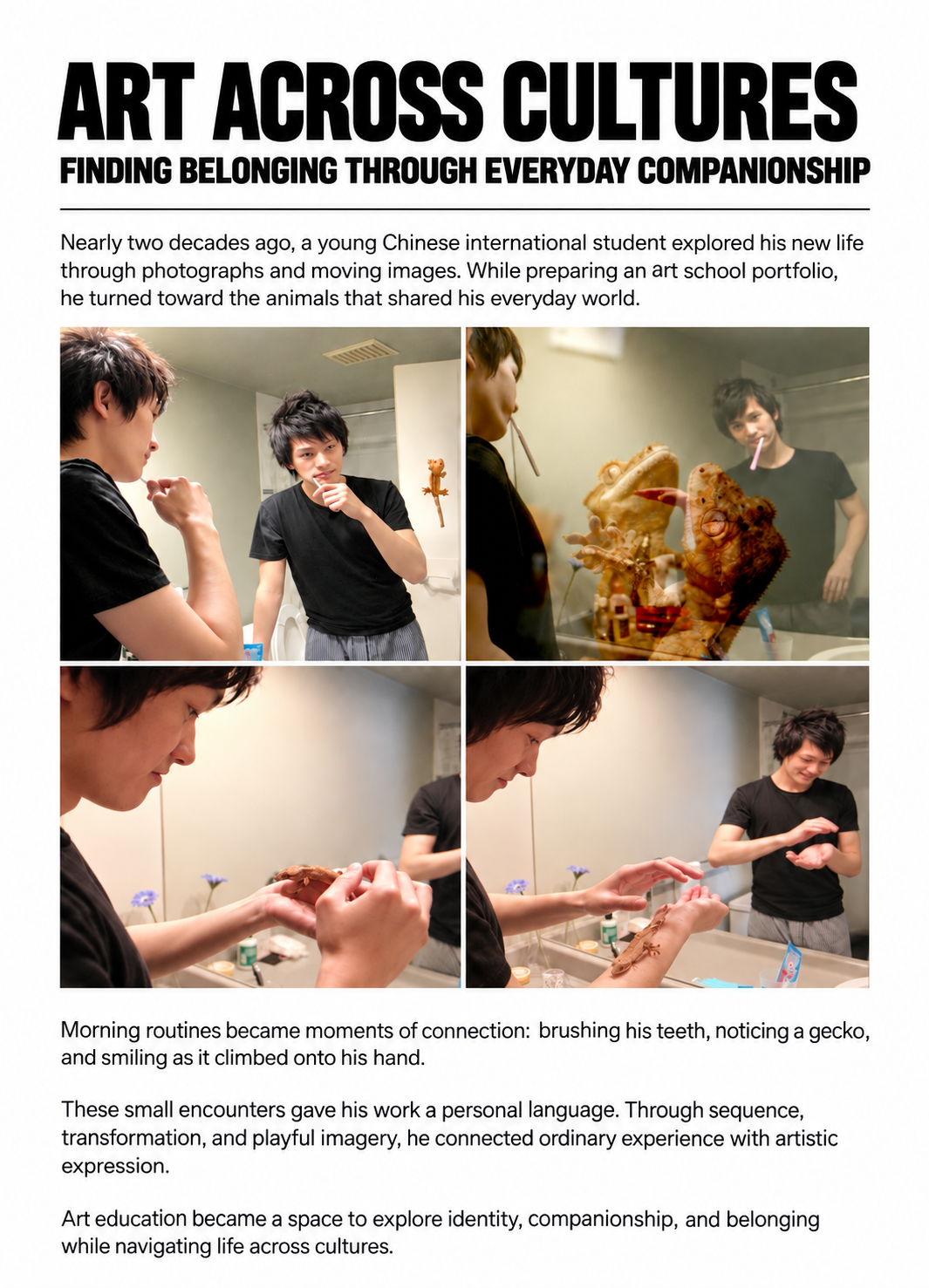
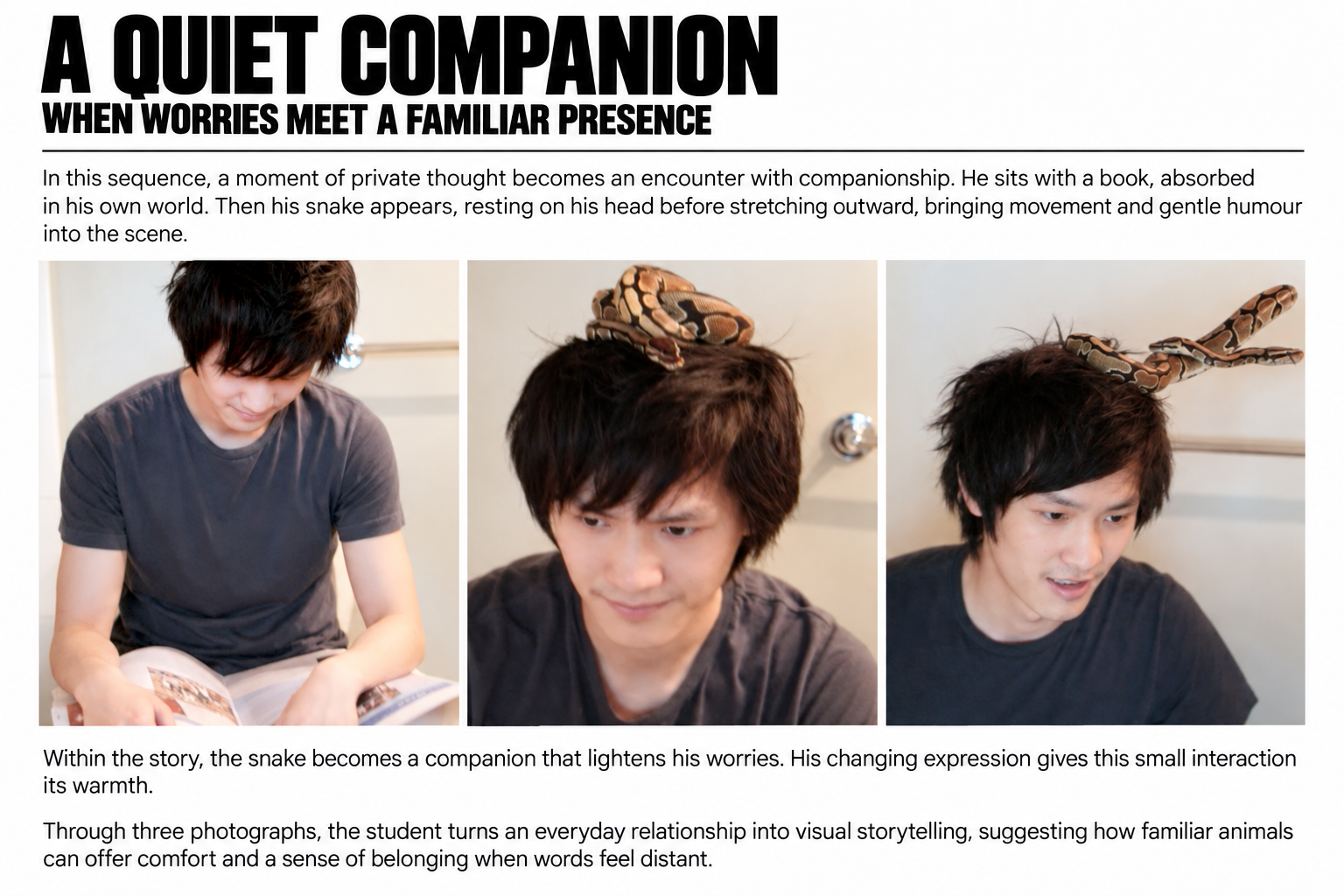
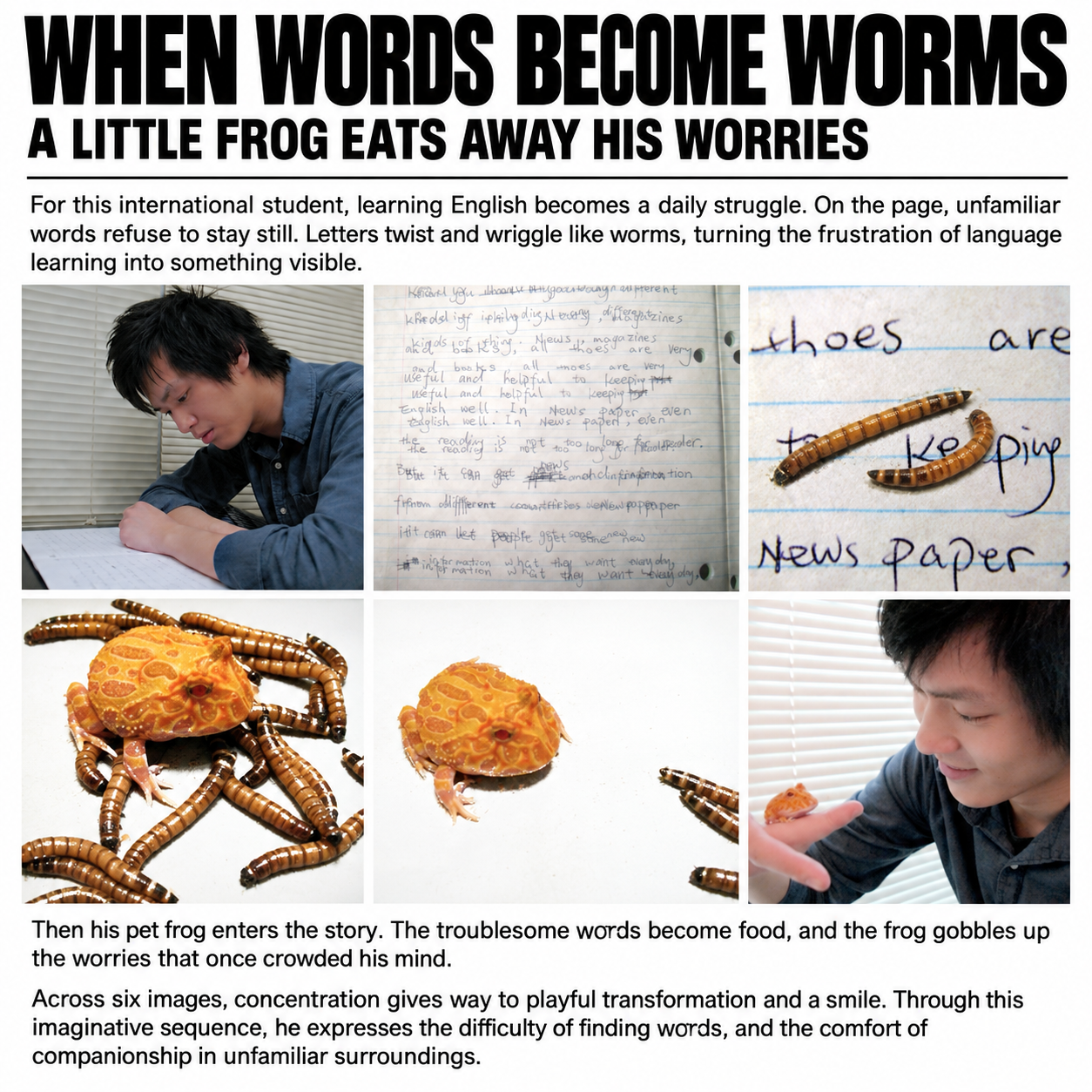
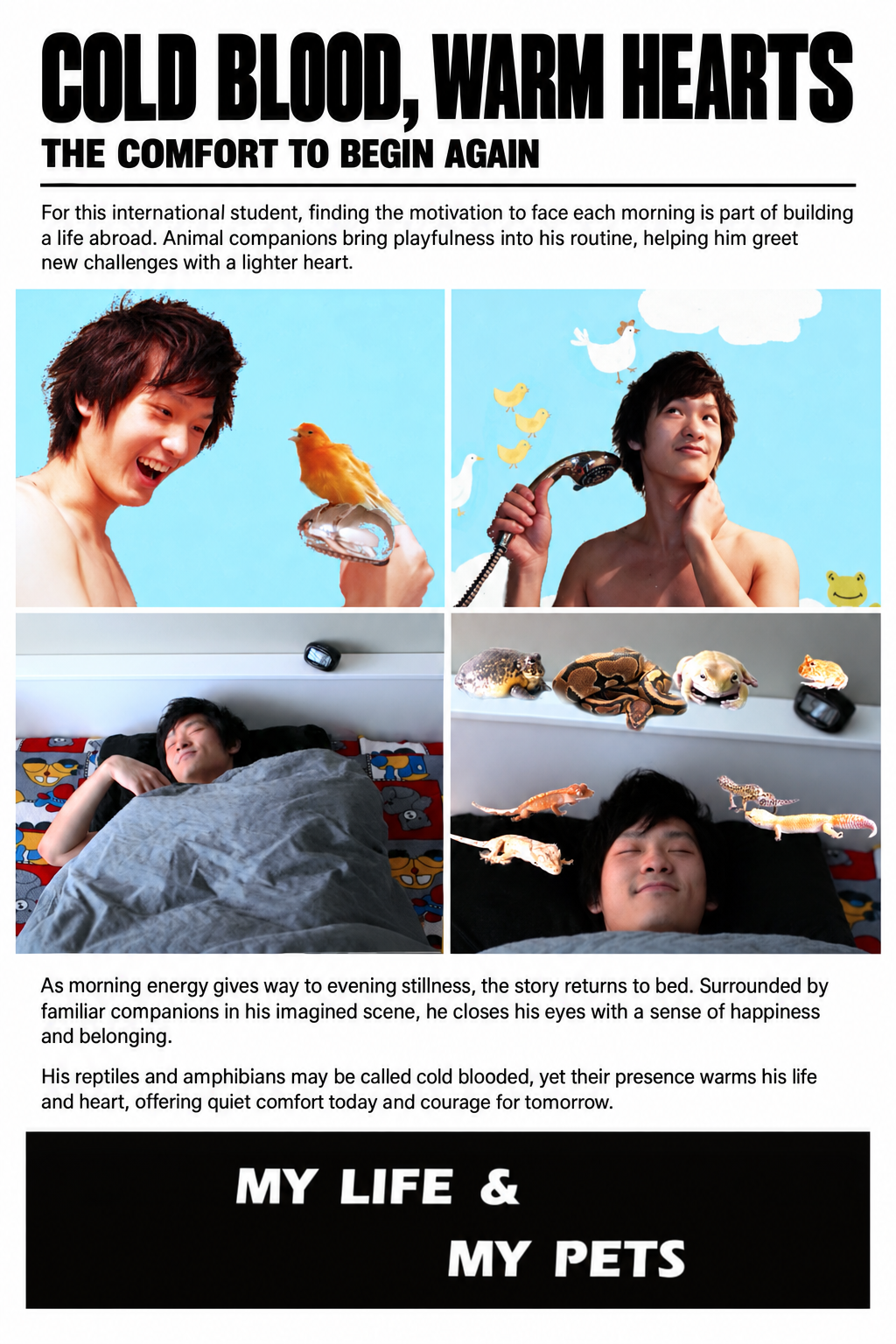
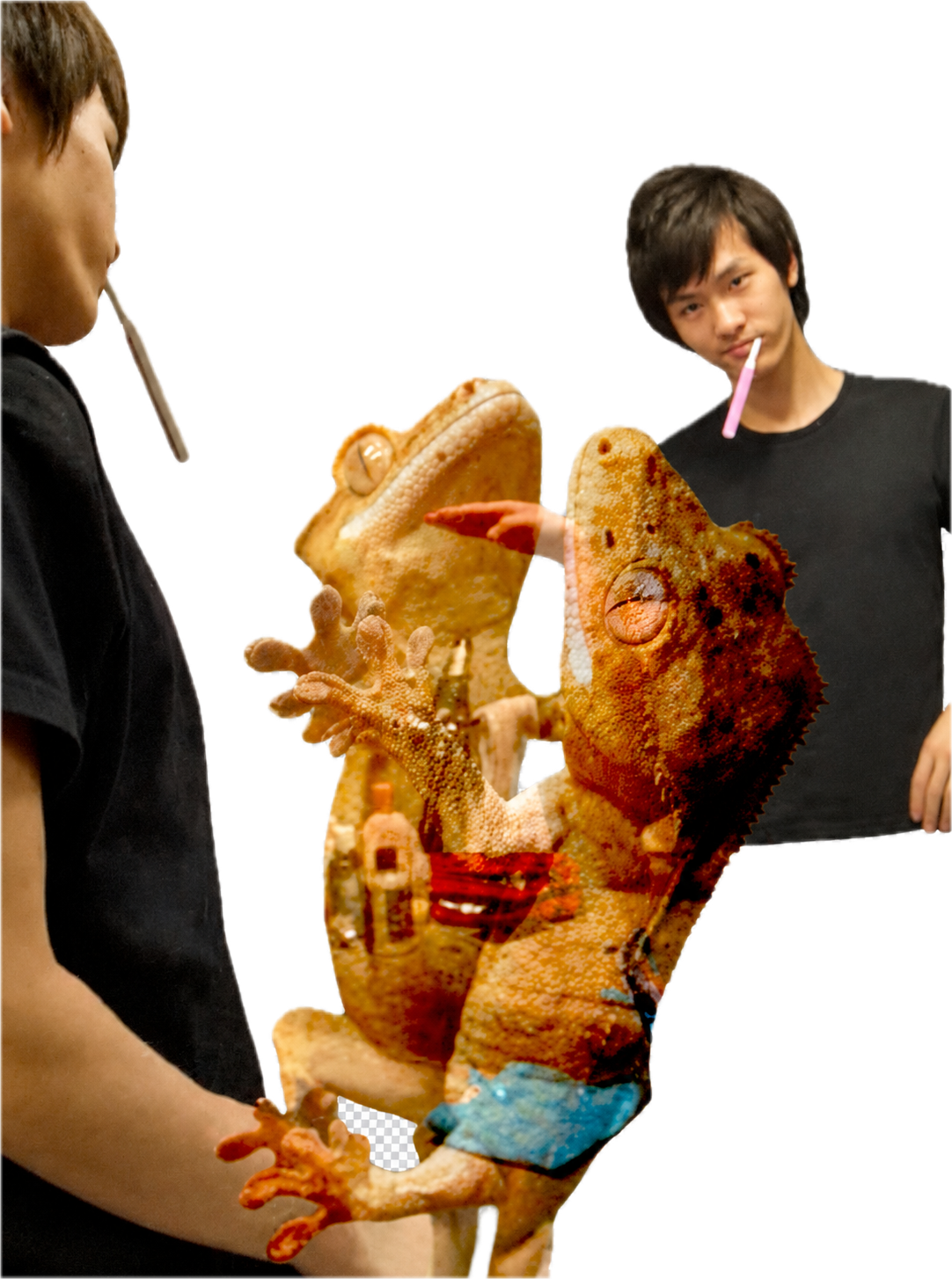
For this student, one of the most meaningful parts of everyday life was his animals.
He kept reptiles and other cold-blooded animals and spent significant time caring for and observing them. They occupied a substantial place within his daily environment.
From my observation as his educator, these animals carried an importance that extended beyond their visual appearance.
During a period characterized by cultural and environmental transition, caring for them provided familiarity, companionship, routine, and a recurring relationship within everyday life.
Research on relationships between young people and companion animals provides useful context here. A systematic review by Purewal and colleagues (2017) found evidence connecting companion-animal relationships with several dimensions of child and adolescent development, including social support, companionship, emotional well-being, and aspects of self-development, while also emphasizing variation in the quality and strength of available evidence.
The educational significance in this particular case came from something more specific:
the student already had a subject carrying genuine personal meaning.
Our task was to recognize it.
From Attachment to Artistic Inquiry
An animal can simply be an animal in an artwork.
Or it can become an entry point into a much larger question.
What does this animal mean within my life?
Why do I repeatedly photograph it?
What happens between us every day?
Which moments communicate that relationship?
What should another person understand—or feel—when encountering these images?
These questions move creative development from representation toward inquiry.
The student began working with photographs from his own environment. Individual images were selected and connected sequentially to construct a moving-image work.
Through this process, lived experience had to pass through a series of artistic decisions:
experience → observation → selection → sequencing → rhythm → editing → visual communication
The technical requirements of the portfolio therefore became part of a deeper process.
He was learning how to make a video.
He was also learning how personal experience could be translated into artistic form.
Art as a Space for Cultural Meaning-Making
Contemporary research offers a useful framework for reconsidering experiences like this.
Arts-based research with immigrant and refugee adolescents has shown how photography and creative practice can provide young people with ways to examine experiences involving home, community, culture, identity, migration, challenge, and sources of support.
In one study combining Photovoice and art-based practices with newcomer adolescents aged 13–17, photography became a means through which participants could document their environments and communicate experiences that were personally and culturally significant (Feen-Calligan et al., 2023).
This does not mean that every artwork created by a migrant adolescent should be interpreted psychologically.
It means that creative practice can provide a space for meaning-making.
A photograph can hold something that may be difficult to explain immediately in a new language.
An object can connect a previous environment with a current one.
An animal can represent a recurring relationship inside an unfamiliar world.
A sequence of images can allow fragmented experiences to acquire structure.
The artwork becomes a place where observation, memory, culture, attachment, and emerging identity can coexist.
Portfolio Development as Cultural Translation
Looking back, this changes how I understand the role of portfolio education.
Preparing an adolescent for art school involves teaching composition, media, technique, documentation, editing, presentation, and conceptual development.
For students living across cultures, another educational process may be occurring simultaneously:
cultural translation.
The educator has to learn how to see the student within context.
What has changed in this young person's environment?
What has remained stable?
Which relationships carry meaning?
What parts of their experience deserve closer attention?
What forms of visual language allow those experiences to become communicable?
The goal is not to manufacture an identity narrative for the student.
The goal is to create enough space for the student to recognize meaningful material within their own life and develop the artistic judgment required to transform it.
That distinction has remained central to my teaching.
Twenty Years Later, the Technology Has Changed
The technical environment surrounding young artists has transformed dramatically since this project was made.
A student today can capture thousands of photographs, edit sophisticated video on a phone, generate images through artificial intelligence, automate transitions, manipulate sound, and create convincing visual effects within hours.
Production has become extraordinarily accessible.
That technological shift makes another set of abilities increasingly valuable:
What deserves my attention?
Which part of my experience contains meaning?
Why am I choosing this image?
Why should this image follow another?
What belongs in the work?
What should disappear?
What am I trying to communicate?
These are decisions of selection, interpretation, continuity, and judgment.
AI can expand the possibilities of production. Human experience still provides the context from which meaningful questions emerge.
From Portfolio Preparation to Human Development
This early portfolio project continues to influence how I think about education today.
The student's reptiles were visually interesting, but their educational importance came from their relationship to his life.
They belonged to his daily routines.
They carried familiarity within a changing environment.
They gave him something worth observing.
And through artistic practice, that relationship could be selected, sequenced, edited, and transformed into a visual experience that another person could encounter.
The technology provided the medium.
The student's life provided the material.
His decisions gave that material form.
This is where portfolio development can become something larger than admission preparation.
For adolescents navigating changing languages, cultures, environments, and identities, creative practice can become a space for observing their own lives carefully enough to discover what deserves to be carried forward.
And in an era of increasingly automated production, the ability to recognize what matters may become one of the most important creative capacities we can help young people develop.
CCH ART NOW | Adolescent Practice
Within CCH ART NOW, adolescent creative development is approached through the relationship between:
Lived Experience → Observation → Meaning → Artistic Inquiry → Decision → Visual Language
The educator observes before prescribing.
The student's environment becomes part of the learning context.
Media are selected according to what the inquiry requires.
Technical development supports increasingly sophisticated forms of expression.
The finished portfolio remains important. Yet the deeper educational evidence appears in the student's growing ability to recognize meaningful experiences, make deliberate choices, develop a visual language, and communicate a perspective that belongs to them.
That capacity extends far beyond art-school admission.
It is part of learning how to locate oneself within a changing world.
References
Feen-Calligan, H., Grasser, L. R., Debryn, J., Nasser, S., Jackson, C., Seguin, D., Javanbakht, A., & Jaber, L. S. (2023). Art therapy with refugee and immigrant youth: A Photovoice exploration. The Arts in Psychotherapy, 82, 101992. https://doi.org/10.1016/j.aip.2022.101992
McInerney, K. M. (2023). Perceptions from newcomer multilingual adolescents: Predictors and experiences of sense of belonging in high school. Child & Youth Care Forum, 52, 1041–1072. https://doi.org/10.1007/s10566-022-09723-8
Meca, A., Allison, K. K., Ayers, K. L., Carr, K. A., Edwards, M. C., & Schwartz, S. J. (2021). Identity development in immigrant youth: A multilevel contextual perspective. Journal of Youth and Adolescence. https://doi.org/10.1007/s10964-021-01434-y
Purewal, R., Christley, R., Kordas, K., Joinson, C., Meints, K., Gee, N., & Westgarth, C. (2017). Companion animals and child/adolescent development: A systematic review of the evidence. International Journal of Environmental Research and Public Health, 14(3), 234. https://doi.org/10.3390/ijerph14030234
Verhoeven, M., Poorthuis, A. M. G., & Volman, M. (2019). The role of school in adolescents' identity development: A literature review. Educational Psychology Review, 31, 35–63. https://doi.org/10.1007/s10648-018-9457-3