

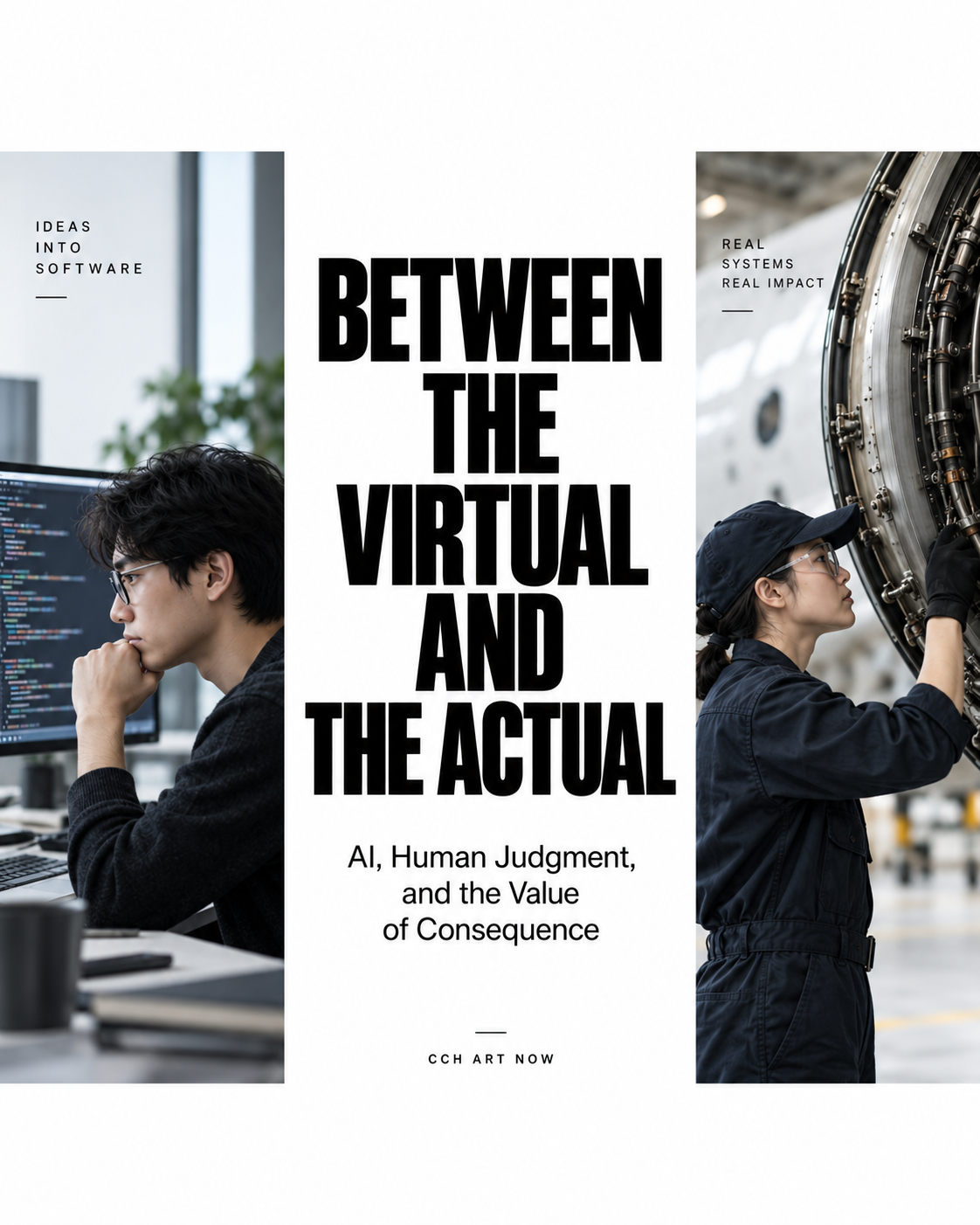
What a software engineer and an aircraft maintenance engineer reveal about judgment, consequence, and the future of human capability
Artificial intelligence is often discussed through a single question:
Which jobs will AI replace?
I am becoming less interested in that question.
A more useful question may be:
When AI makes execution dramatically easier, which parts of human capability become more valuable?
Recently, two people in my life made this question unusually concrete.
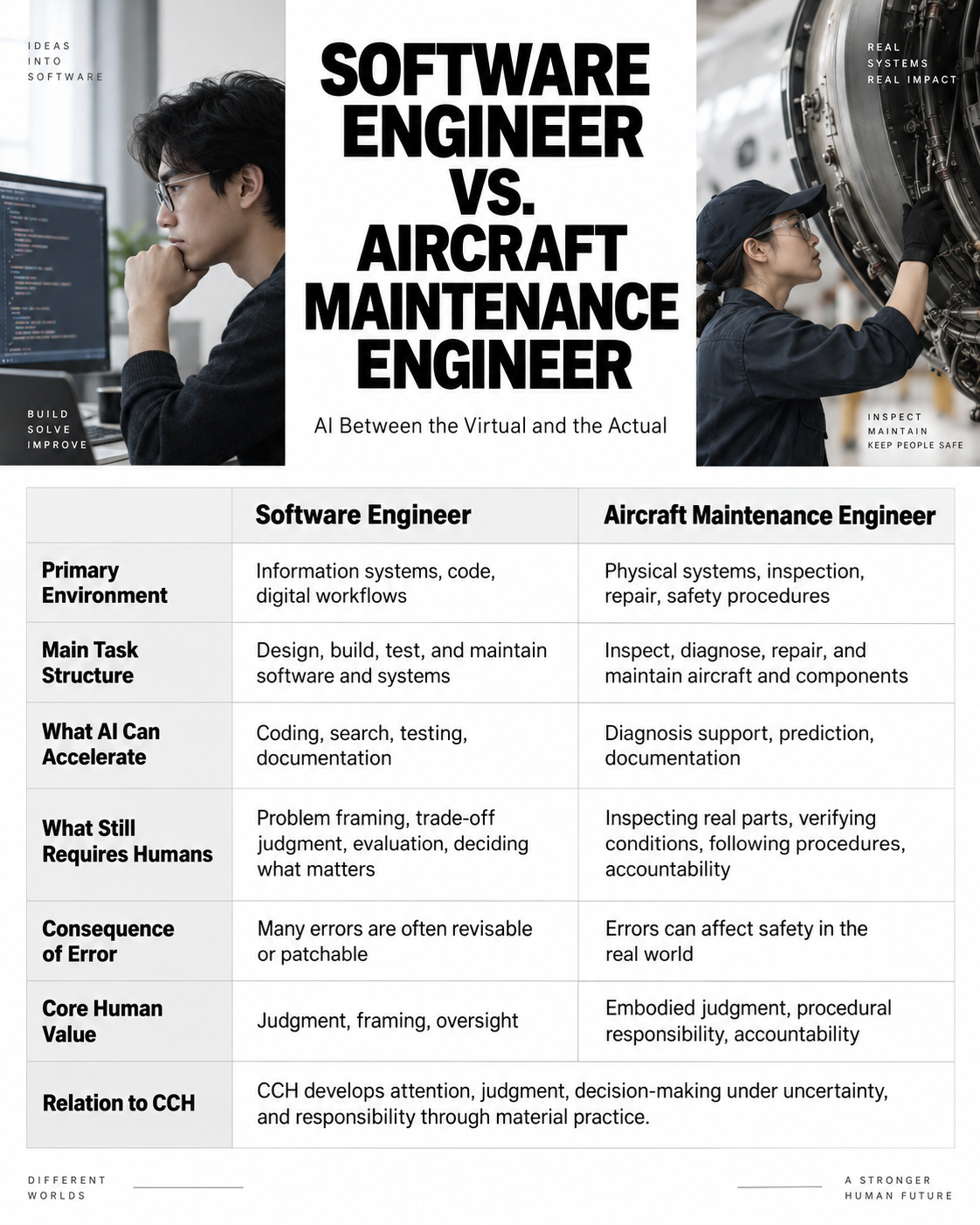
One is a senior software engineer at Google. The other is an aircraft maintenance engineer responsible for working with real aircraft systems.
Both are engineers.
Both operate in highly technical environments.
Both depend on expertise, procedures, problem-solving, and accumulated experience.
Yet they stand at very different boundaries between artificial intelligence and the physical world.
Looking at them side by side led me back to a question at the center of my work with the CCH Protocol:
What should humans practice when producing an answer is no longer the difficult part?
1. AI Is Not Eliminating Intelligence. It Is Changing Where Intelligence Is Needed.
Software engineering is one of the clearest places to observe this transition.
Generative AI can already assist developers with code completion, debugging, documentation, test generation, explanation, refactoring, and other implementation tasks.
In a 2025 study combining randomized field experiments involving 4,867 software developers at Microsoft, Accenture, and another Fortune 100 company, researchers reported a 26.08% increase in completed tasks among developers with access to an AI coding assistant. The gains were especially strong among less-experienced developers (Cui et al., 2025).
This does not mean software engineers are disappearing.
It means something more interesting is happening:
the cost of execution is falling.
When code can be generated faster, searched faster, tested faster, and modified faster, simply producing code becomes less distinctive.
Value begins moving upstream.
The important questions increasingly become:
What problem should we solve?
How should the problem be framed?
Which constraints actually matter?
What architecture should we choose?
Which trade-offs are acceptable?
When is the generated answer wrong despite appearing plausible?
When should we abandon an apparently efficient solution?
What deserves optimization in the first place?
Research on human–AI interaction already suggests that automation can shift human work from direct production toward evaluation and oversight. Simkute et al. (2024), drawing connections between generative AI and decades of human-factors research, describe one of the “ironies” of automation: making production easier can simultaneously increase the importance—and sometimes difficulty—of human evaluation.
The future senior engineer may therefore not be the person who writes the most code.
The senior engineer may increasingly be the person capable of determining which code should exist at all.
That is a very different form of expertise.
2. Then Consider the Engineer Who Maintains an Aircraft
Now move from an informational system into a physical one.
AI can also transform aircraft maintenance.
It can assist technicians by organizing documentation, analyzing sensor data, identifying patterns, supporting predictive maintenance, and potentially improving diagnostic workflows.
But eventually, someone still encounters the aircraft.
A component must be inspected.
A connection must be checked.
A surface must be examined.
A measurement must be taken.
A maintenance procedure must be followed.
A discrepancy must be interpreted.
And after all of this, the aircraft returns to service.
The Federal Aviation Administration has spent decades studying human factors in aviation maintenance and inspection precisely because aircraft safety depends on the interaction between people, technology, procedures, organizational conditions, physical environments, and human limitations.
The FAA identifies issues such as communication, fatigue, distraction, knowledge, teamwork, pressure, awareness, procedural compliance, and safety culture as significant elements of maintenance performance (FAA, 2023).
A 2022 FAA review further describes failure to follow procedures as one of the most pervasive human-factor issues in aviation maintenance and emphasizes that maintenance error cannot be understood merely as an individual failure. It emerges from interactions among organizational context, supervision, working conditions, coordination, and the maintainer's physical and cognitive state (Key et al., 2022).
This distinction matters.
Software often operates inside an environment where many failures can be detected, revised, rolled back, patched, or regenerated.
Aircraft maintenance is connected much more tightly to physical consequence.
Reality eventually closes the loop.
The machine either behaves as required—or it does not.
3. The Point Is Not That One Profession Is “AI-Proof”
It would be too simplistic to conclude:
Software engineers will be replaced. Aircraft maintenance engineers will not.
That is not the argument.
Both professions will change.
Both will integrate increasingly sophisticated automation.
Both will redistribute tasks between humans and machines.
And both will continue to contain work that can be partially automated.
The more important distinction is the structure of consequence.
In many digital tasks, AI increasingly reduces the cost of producing another answer.
In physical, safety-critical environments, a decision eventually enters a world that cannot simply be regenerated.
A maintenance mistake may affect an actual aircraft.
A structural error has material consequences.
A procedural omission cannot be repaired by convincing language.
The physical world has an unusual property:
it pushes back.
And that idea has become increasingly important to my work in CCH.
4. Material Resistance Is Not an Obstacle to Thinking. It Is Part of Thinking.
In conventional education, resistance is often treated as something to eliminate.
Make instructions clearer.
Make interfaces smoother.
Reduce frustration.
Provide the correct answer faster.
But creative practice offers another possibility.
A piece of cardboard bends when a learner expected it to remain rigid.
Tape refuses to hold a structure together.
Wet pigment moves beyond the intended boundary.
An object falls.
A construction becomes too heavy.
A material behaves differently from what the learner imagined.
Something now has to happen.
The learner must observe again.
Adjust.
Preserve.
Remove.
Rebuild.
Change direction.
Or decide that the unexpected result is more interesting than the original plan.
Donald Schön described professional practice through reflection-in-action: practitioners think within action, responding to unexpected conditions and engaging in a reflective conversation with the situation rather than merely applying predetermined rules (Schön, 1983).
Material Engagement Theory similarly challenges the assumption that cognition exists solely “inside” the individual mind. Malafouris argues that human cognition develops through dynamic interaction among brains, bodies, actions, objects, and material culture (Malafouris, 2013; 2022).
More recent educational research also supports taking embodied interaction seriously. A 2025 meta-analysis of 46 studies and 66 effect sizes found an overall moderate positive association between embodied learning and learning performance, while also noting meaningful variation across disciplines, learning formats, and levels of embodiment (Liu et al., 2025).
None of these studies constitutes direct validation of CCH.
But they provide an important theoretical context for why CCH deliberately keeps body, material, resistance, action, and consequence inside the learning process rather than removing them.
5. This Is Where CCH Enters the Question
The CCH Protocol was not designed to teach children to produce better-looking artwork.
The artwork is evidence of a process.
The deeper object of observation is the learner's relationship with uncertainty.
In a CCH environment, a child frequently encounters a situation in which:
there is no predefined final image,
there may be several possible materials,
the teacher does not immediately provide the solution,
the material may resist the child's intention,
earlier decisions constrain later decisions,
and the learner eventually has to decide what happens next.
That structure matters.
I am interested in what becomes visible over time:
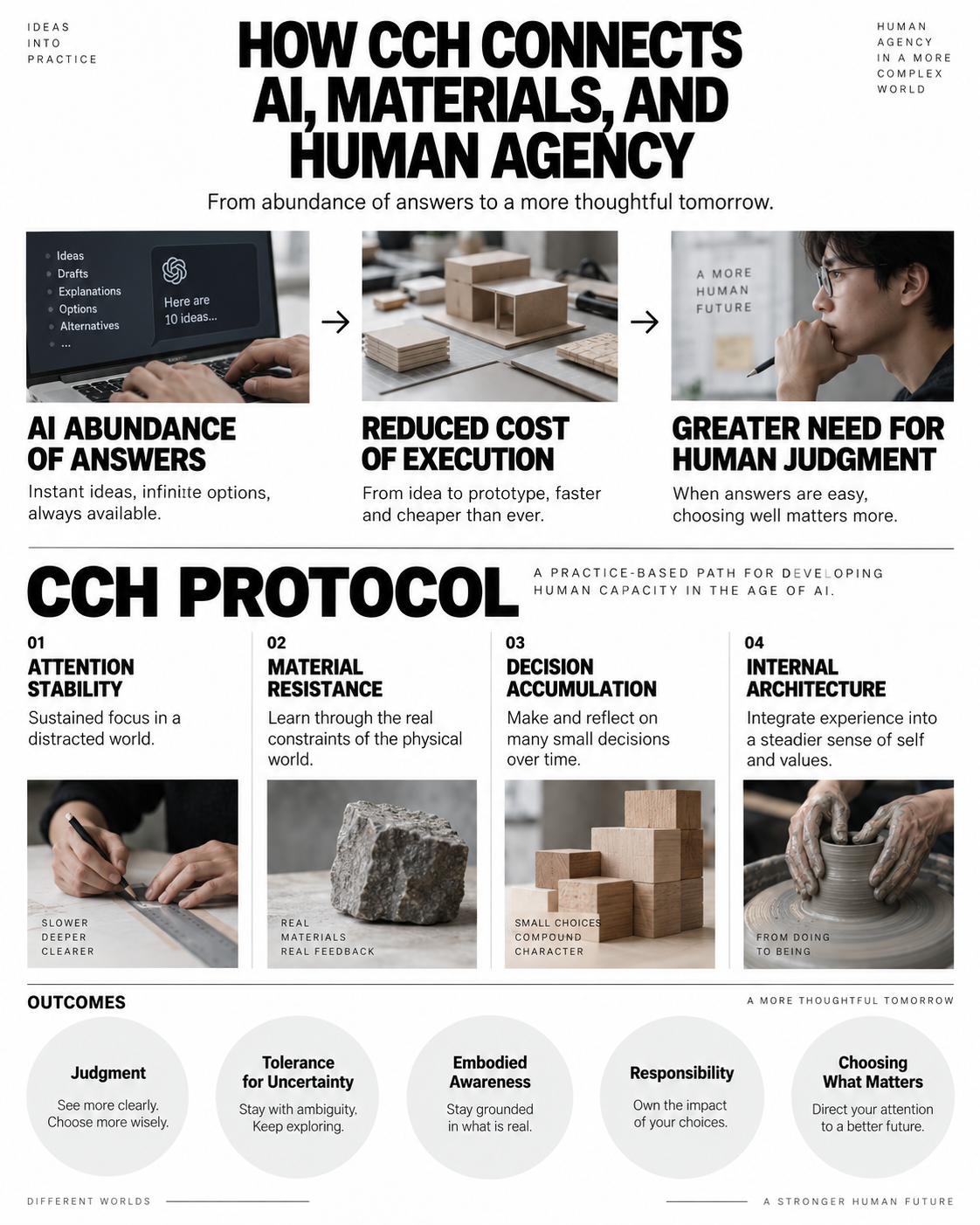
Attention Stability → Material Resistance → Decision Accumulation → Internal Architecture
A learner may begin by asking:
What am I supposed to make?
Later, the question may become:
What can I do with this?
And eventually:
What do I want this to become?
That shift is small on the surface.
Cognitively, it is enormous.
The authority for the next action is gradually moving inward.
6. CCH Is Not Training Children to Compete With AI
This distinction is essential.
I do not believe children should be trained to outperform machines at the tasks machines perform best.
That would be a losing educational strategy.
AI will calculate faster.
Generate faster.
Retrieve faster.
Produce variations faster.
And increasingly, it will execute instructions with extraordinary efficiency.
The educational question should therefore move upstream:
Who forms the intention?
Who recognizes that the original problem may be wrong?
Who decides which possibility deserves continuation?
Who remains attentive long enough to notice that reality is contradicting the plan?
Who takes responsibility for the decision when there is no guaranteed correct answer?
These are not exclusively artistic capacities.
They appear in engineering.
Scientific research.
Leadership.
Entrepreneurship.
Design.
Medicine.
Craft.
Aviation.
And ordinary human life.
7. Art Education Has Been Studying Some of These Capacities for Years
This is another reason I resist describing CCH simply as “creativity training.”
Research from Project Zero at the Harvard Graduate School of Education identified eight Studio Habits of Mind associated with serious studio practice:
Develop Craft, Engage and Persist, Envision, Express, Observe, Reflect, Stretch and Explore, and Understand Art Worlds.
Of particular relevance here are Engage and Persist, Observe, Reflect, and Stretch and Explore—capacities that involve sustained engagement, seeing beyond the obvious, evaluating one's own process, working without a predetermined path, and learning from mistakes and accidents.
CCH develops from this larger tradition of studio learning, but focuses the design of the environment more explicitly around a contemporary problem:
What forms of human agency become increasingly important as AI becomes more capable?
My current hypothesis is that the studio can function not simply as a place for artistic expression, but as a controlled environment in which learners repeatedly encounter:
attention, uncertainty, resistance, decision, consequence, and revision.
The object is not to manufacture creativity.
The object is to create conditions in which judgment has somewhere to develop.
8. Beyond Local Optima
This question also appeared in my recent exploratory CCH case with a senior software engineer.
When he first encountered an open-ended material environment, he did something that made perfect sense for an expert problem solver.
He rapidly found a solution.
A recognizable pattern appeared.
The task seemed complete.
In optimization language, he had reached a local optimum.
But nothing required him to stop there.
As additional affordances of the materials became visible, he began touching, folding, testing adhesion, manipulating structure, combining unfamiliar components, and reopening decisions that previously seemed finished.
The objective changed because the environment allowed the problem itself to change.
That moment interests me much more than whether the finished object was “creative.”
It exposes a capability that may become increasingly important in AI-mediated work:
the ability to reopen the search space after an apparently adequate answer has already appeared.
AI is extraordinarily useful when the objective function is known.
Human judgment becomes especially important when we must ask whether the objective function itself deserves to survive.
9. The Aircraft Engineer Reveals the Other Half of the Same Idea
The aircraft maintenance engineer presents the opposite side of the problem.
He cannot keep the search space open forever.
Eventually, exploration must close.
A judgment must satisfy procedure, evidence, safety requirements, and physical reality.
The aircraft must either be considered ready—or not ready.
This gives us two complementary human capabilities.
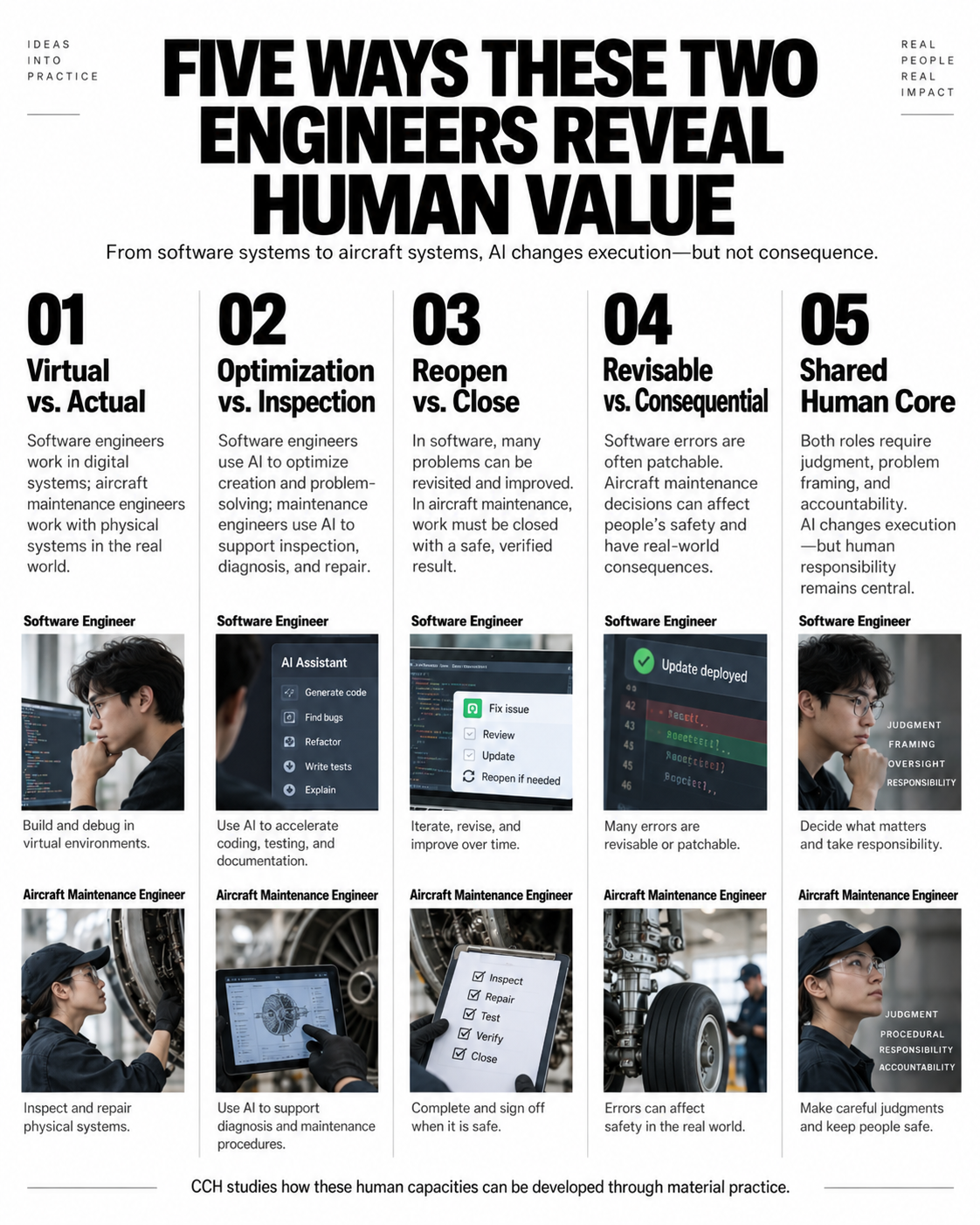
The software engineer illustrates the importance of reopening:
Is this really the problem?
Is there another possibility?
Have we converged too early?
The aircraft maintenance engineer illustrates the importance of closure:
Is the evidence sufficient?
Has the procedure actually been completed?
Am I prepared to stand behind this decision?
One expands possibility.
The other accepts consequence.
Both require judgment.
And sophisticated human agency requires both.
10. This May Be the Educational Problem of the AI Era
For much of industrial education, we trained students to produce correct outputs.
Solve the equation.
Remember the information.
Follow the procedure.
Produce the assignment.
Get the answer.
Generative AI changes the economics of that model.
When answers become abundant, the scarce resource shifts.
The scarce resource may increasingly be the human capacity to determine:
what deserves attention,
which problem deserves solving,
when an answer is insufficient,
when exploration should continue,
when exploration must stop,
and
what consequence one is prepared to own.
This is why I believe physical creative practice remains important in an increasingly computational world.
Not because machines cannot make images.
They clearly can.
Not because humans possess some mystical monopoly on creativity.
That claim is becoming less useful every year.
The reason is more fundamental.
A material environment gives decisions weight.
You choose.
Something changes.
The environment responds.
You observe the consequence.
Then you choose again.
Repeated long enough, that cycle may contribute to something deeper than a finished object.
It may contribute to the development of an internal architecture for judgment.
That is the territory CCH is designed to explore.
THE HUMAN ROLE AFTER EXECUTION
The Google software engineer and the aircraft maintenance engineer initially seemed like an amusing contradiction.
One works at the center of the AI revolution.
The other works with enormous physical machines whose safe operation still depends on highly trained people interacting with real materials, procedures, systems, and consequences.
But together they reveal a much larger pattern.
As AI becomes better at execution, human value does not necessarily disappear.
It moves.
Toward framing.
Toward observation.
Toward judgment.
Toward uncertainty.
Toward responsibility.
Toward deciding when to explore further and when to commit.
The future of education therefore cannot simply be about helping children produce more.
It must also help them develop the capacity to decide what is worth producing at all.
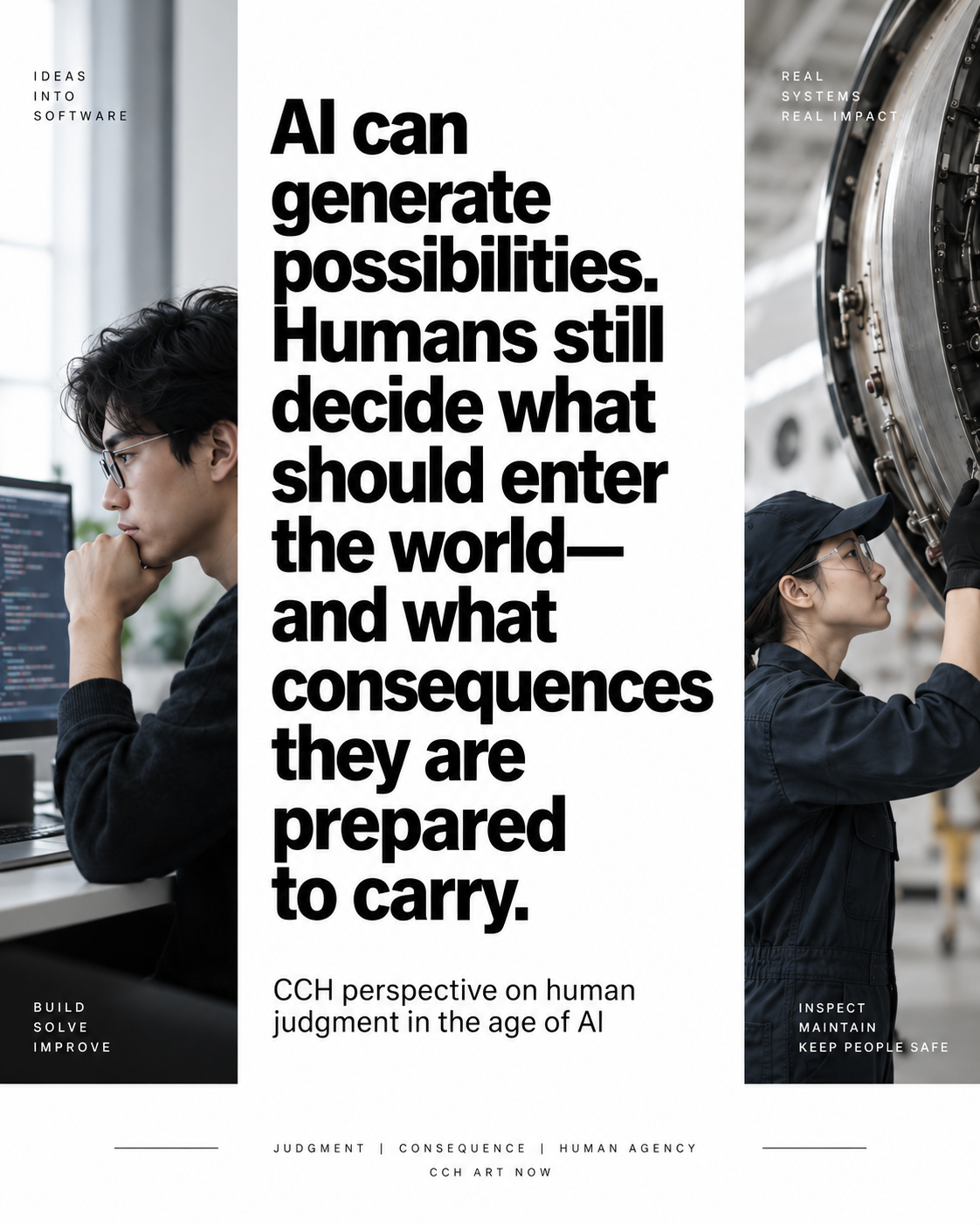
AI can generate possibilities.
Human beings still have to decide which possibilities should enter the world—and what consequences they are prepared to carry.
That is the human capability CCH is trying to make visible.
References
Cui, Z. K., Demirer, M., Jaffe, S., Musolff, L., Peng, S., & Salz, T. (2025). The Effects of Generative AI on High-Skilled Work: Evidence from Three Field Experiments with Software Developers. Microsoft Research.
Federal Aviation Administration. (2023). Human Factors in Aviation Maintenance. U.S. Department of Transportation.
Key, K., Schroeder, D., Durham, J., Choi, I., Hu, P., & Avers, K. (2022). Procedural Noncompliance in Aviation Maintenance: A Multi-Level Review of Contributing Factors and Corresponding Mitigations. DOT/FAA/AM-22/01. Federal Aviation Administration.
Liu, Z., Zuo, H., Zhao, Y., & Lu, Y. (2025). The effect of embodied learning on students’ learning performance: A meta-analysis. Frontiers in Psychology, 16, 1658797. https://doi.org/10.3389/fpsyg.2025.1658797
Malafouris, L. (2013). How Things Shape the Mind: A Theory of Material Engagement. MIT Press.
Malafouris, L. (2022). What Is Cognitive Archaeology? The Material Engagement Approach. In The Oxford Handbook of Cognitive Archaeology. Oxford University Press. https://doi.org/10.1093/oxfordhb/9780192895950.013.54
Project Zero, Harvard Graduate School of Education. (2003). Eight Studio Habits of Mind.
Schön, D. A. (1983). The Reflective Practitioner: How Professionals Think in Action. Basic Books.
Simkute, A., Tankelevitch, L., Kewenig, V., Scott, A. E., Sellen, A., & Rintel, S. (2024). Ironies of Generative AI: Understanding and Mitigating Productivity Loss in Human–AI Interaction. International Journal of Human–Computer Interaction. https://doi.org/10.1080/10447318.2024.2405782
Note: The individual professional observations described in this article are exploratory cases and personal observations. They do not represent endorsements or official positions of the individuals’ employers. CCH Protocol is an independently developed educational framework; references to external research indicate theoretical alignment and contextual grounding, not independent empirical validation of CCH itself.