

AI Generate Images Materials Build Minds
Why Material-Based Learning Matters in the Age of Artificial Intelligence

In the age of artificial intelligence, it is easy to assume that the future will be determined primarily by algorithms, computation, data, and automation. AI systems can now generate images, write text, simulate possibilities, optimize designs, and accelerate decision-making processes across industries.
Yet as digital generation becomes more powerful, an older and more fundamental condition becomes more visible:
Every idea that enters the physical world must still pass through material reality.
A design may be computationally elegant, but it must still bend, hold, resist pressure, endure use, respond to the body, survive manufacturing, and operate within cost and environmental constraints. A robot may be intelligently programmed, but it must still touch, grip, move, and interact safely with unstable human environments. A shoe may be digitally optimized, but it must still meet the ground, absorb impact, support movement, and remain comfortable over time.
In this sense, materials are not secondary to innovation. They are where abstract intelligence meets consequence.
1. AI Cannot Bypass Material Reality
Artificial intelligence can accelerate the generation of forms, models, plans, and visual possibilities. However, generation is not the same as realization. The physical world introduces constraints that cannot be removed by computation alone.
This is especially clear in soft robotics. Research in this field shows that robotic intelligence depends not only on control systems, but also on material selection, structural design, fabrication methods, flexibility, sensing capacity, and physical interaction with the environment. A soft robotic gripper, for example, does not handle fragile objects safely because of programming alone. It depends on material compliance, deformation, pressure distribution, and the ability to make contact without damaging what it touches.
The same principle applies across product design, footwear, wearable technology, medical devices, architecture, and sustainable manufacturing. A concept may begin as information, but it becomes meaningful only when it can survive contact with reality.
This produces a significant shift in how we should understand intelligence in the AI era.
Intelligence is not only the ability to generate possibilities.
It is also the ability to work with limits.
It is not only the ability to optimize.
It is also the ability to respond when materials behave differently than expected.
It is not only the ability to produce outputs.
It is also the ability to remain attentive when reality resists.
2. The Return of Materials in an AI-Saturated World
The increasing power of AI does not make materials less important. It makes them more important.
When images, concepts, and prototypes can be generated rapidly, the differentiating question becomes: which of these ideas can actually function? Which can endure? Which can be manufactured? Which can be touched, worn, used, repaired, scaled, or sustained?
Footwear offers a useful example. On the surface, shoes may seem less technologically advanced than robotics or semiconductors. Yet the success of a shoe depends heavily on materials: cushioning, rebound, breathability, weight, grip, durability, flexibility, ergonomics, sustainability, and cost.
AI can support footwear design, production forecasting, customization, and consumer analysis. But it does not remove the material problem. A shoe still has to interact with the human foot, the ground, moisture, friction, time, and repeated use. A sustainable shoe still has to confront the complexity of material separation, recycling infrastructure, durability, cost, and user behavior.
The same logic applies to robotics. The future of human-centered robotics depends not only on smarter software, but on softer, safer, more adaptive material systems. In both cases, physical reality determines whether innovation remains an image or becomes an industry.
The broader implication is clear:
As digital generation becomes faster, the ability to understand and work with material constraints becomes a more valuable human capacity.
3. Materials as Cognitive Interfaces
This principle is not limited to technology or manufacturing. It also has deep implications for education.
Materials are not simply passive tools used to complete a task. They can function as cognitive interfaces: points of contact between the learner and the world. Through materials, learners encounter resistance, instability, weight, fragility, delay, error, consequence, and change.
Material Engagement Theory, developed by Lambros Malafouris, argues that cognition should not be understood as an isolated process contained only inside the brain. Human thinking emerges through continuous interaction between body, material, action, culture, and environment. From this perspective, making is not merely decorative or expressive. It is a form of thinking through material engagement.
Embodied cognition offers a related argument. Human understanding is shaped through perception, movement, bodily action, and environmental interaction. A child does not learn only by receiving verbal instruction or viewing visual examples. A child also learns by touching, holding, testing, waiting, adjusting, failing, repairing, and continuing.

This matters because many educational environments increasingly prioritize speed, clarity, digital fluency, and immediate output. These are not inherently negative. However, when learning becomes too frictionless, children may have fewer opportunities to develop the capacities that emerge through sustained contact with difficulty.
Real materials interrupt this frictionless pattern.
They break.
They bend.
They collapse.
They absorb.
They stain.
They dry.
They decay.
They resist intention.
They change over time.
These qualities are not merely obstacles. In a well-structured learning environment, they become educational conditions.
4. What Material Resistance Teaches
Material resistance teaches capacities that cannot be fully developed through instruction alone.
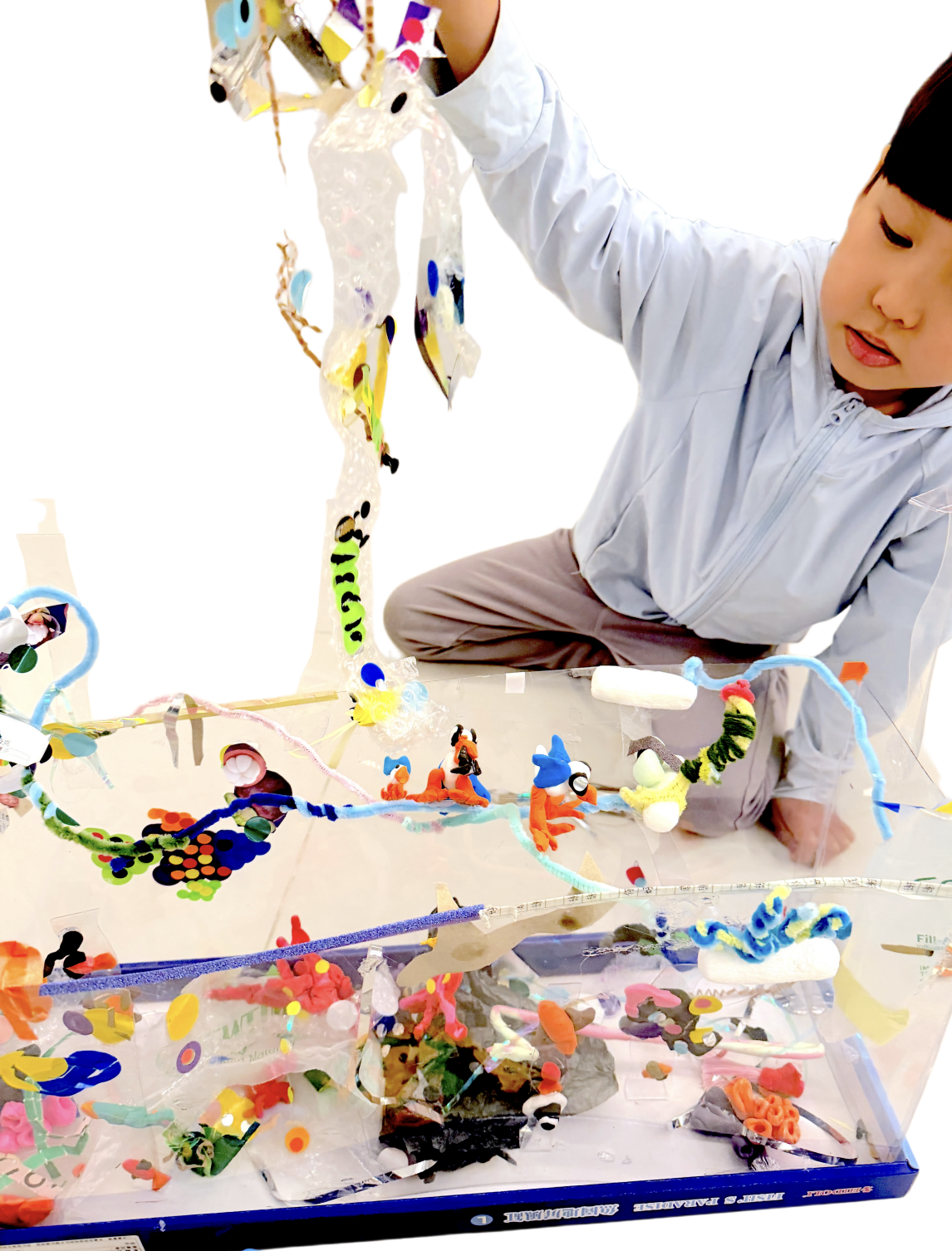
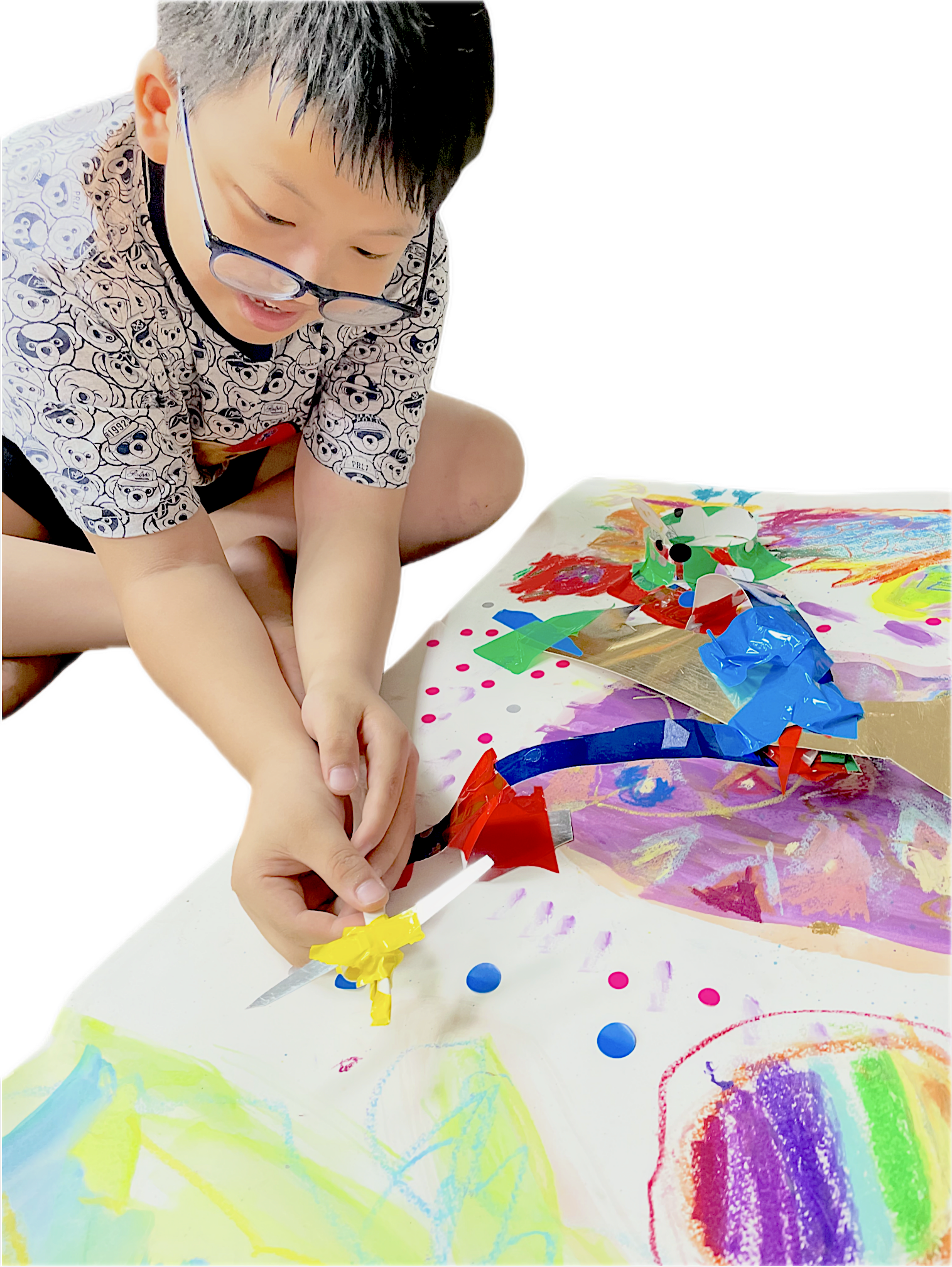
A child working with cardboard must understand balance, pressure, structure, and support. A child working with watercolor must respond to spreading, absorption, timing, and irreversible marks. A child working with fresh flowers must encounter fragility, impermanence, and care. A child working with balloons or transparent packaging must adjust force, attention, and handling. A child working with glue must wait.
Each material introduces a different form of reality.
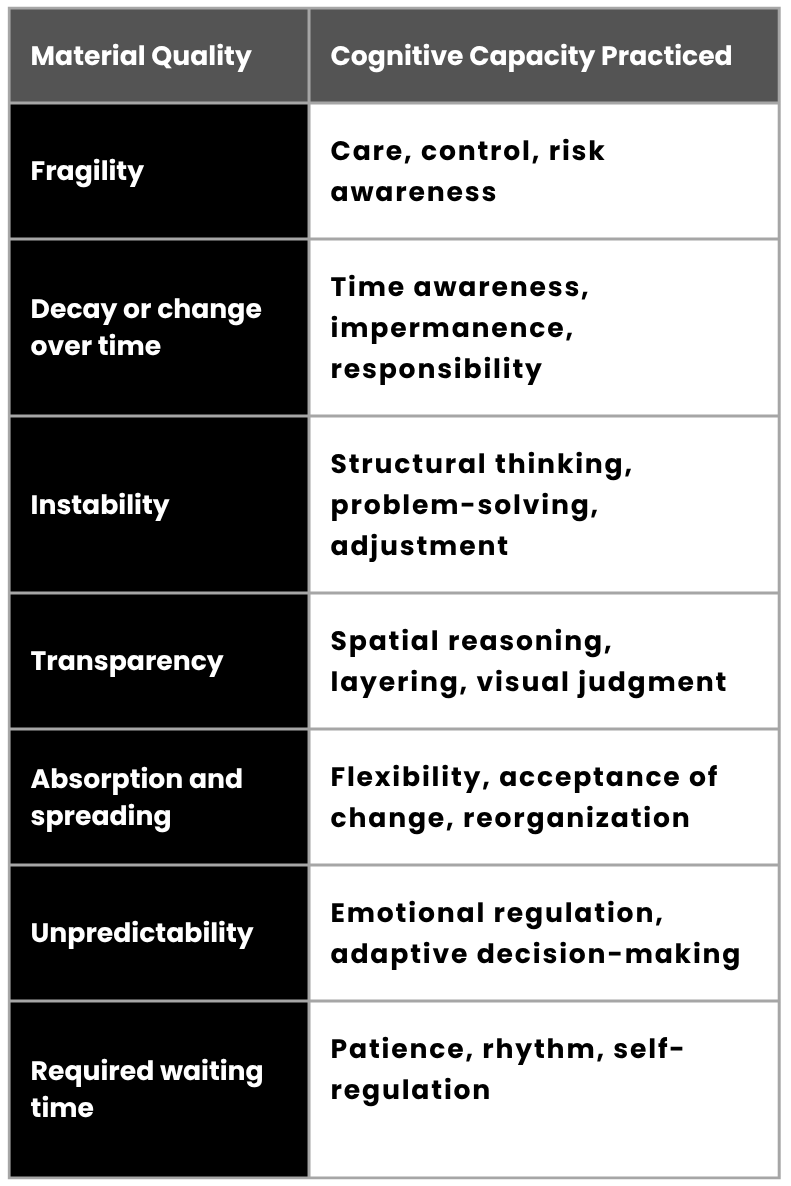
Unpredictability
Adaptive decision-making
These forms of learning are not abstract. They are built through lived experience.
When a structure collapses, the learner must decide whether to repair, reinforce, redesign, or continue differently. When watercolor spreads beyond intention, the learner must reorganize the image rather than erase the event. When a fragile material tears, the learner must adjust force and attention. When glue takes time to dry, the learner must wait before moving forward.
Through repeated experiences of this kind, children practice a relationship with difficulty that differs from immediate avoidance or adult rescue.
Difficulty becomes information.
Resistance becomes structure.
Mistakes become material for judgment.
Uncertainty becomes a space for attention.
5. Why This Matters in the Age of AI
AI can generate visual outcomes rapidly. It can provide references, styles, compositions, prompts, and polished results. For children growing up in this environment, the challenge may no longer be a lack of images or ideas. The challenge may be an overabundance of instant visual production.
This creates an educational concern.
If children become accustomed to immediate generation, instant correction, and frictionless visual completion, will they still have enough opportunities to develop patience, embodied judgment, and resilience when reality does not respond instantly?
The issue is not whether AI is good or bad. The more precise question is developmental:
What kinds of human capacities become undertrained when children have too few sustained encounters with material resistance?
Material-based learning helps address this gap. It allows children to experience the difference between image and object, intention and outcome, plan and consequence. It gives them time to slow down, observe, test, adjust, and take responsibility for decisions.
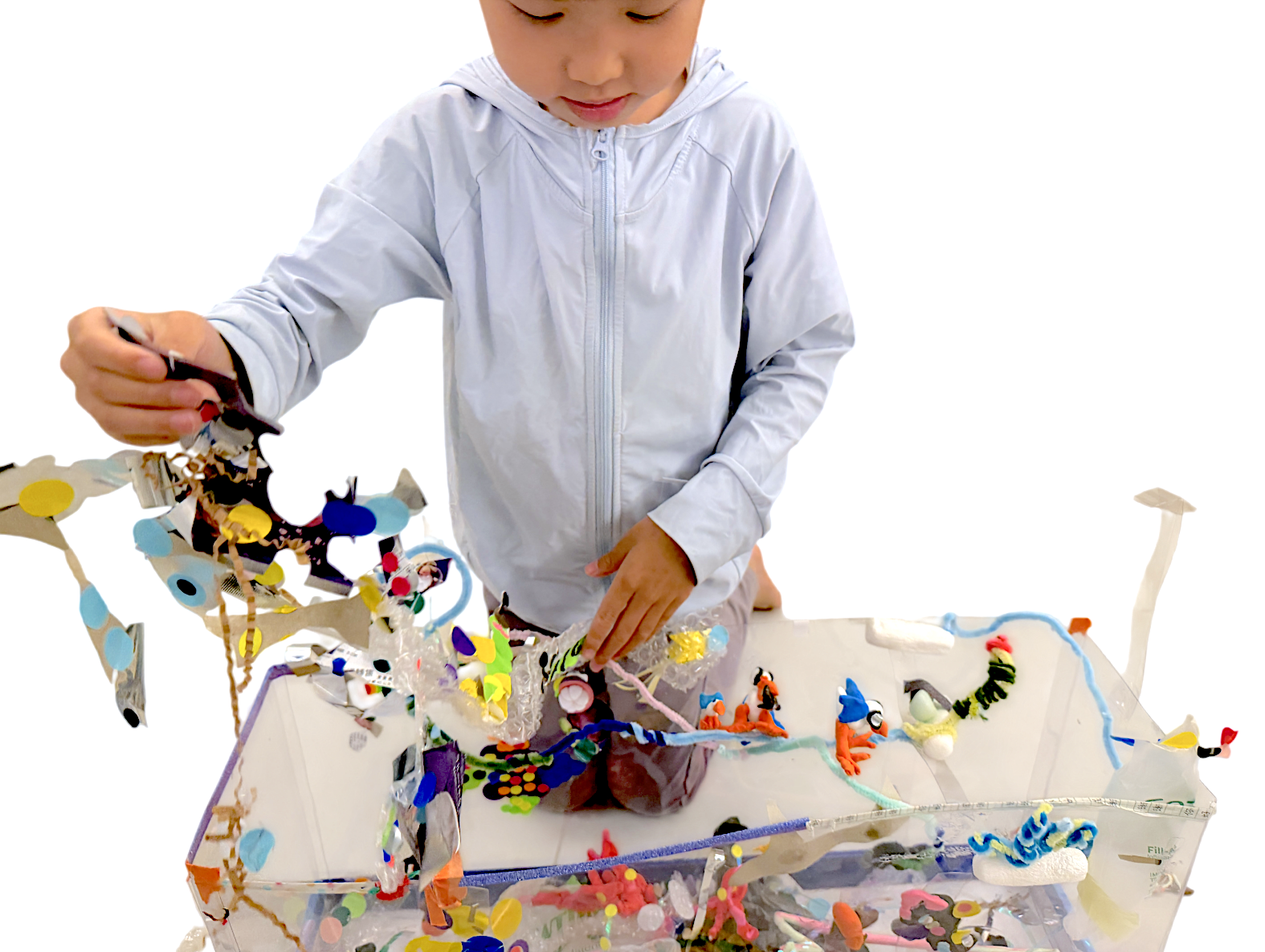
In this way, physical materials serve as training grounds for capacities that remain essential in an AI-saturated world:
sustained attention
emotional regulation
embodied judgment
patience
structural thinking
adaptive problem-solving
tolerance for uncertainty
creative autonomy
reality-based decision-making
These capacities are not anti-technological. They are the human foundation needed to use technology well.
6. From Art Activity to Human Capability Training
Material-based studio learning is often misunderstood as a form of artistic enrichment or decorative production. This is too narrow.
When structured carefully, studio practice can function as a training environment for attention, judgment, and self-regulation. The value does not lie only in the final artwork. It lies in the process through which the learner stays with complexity, responds to resistance, and makes decisions without relying entirely on templates, screens, or adult correction.
This distinction is important.
A template-based activity may produce a visually pleasing result.
A material-led process may produce a more durable capacity.
In a template-based model, the learner follows predetermined steps toward a known outcome. In a material-led model, the learner must respond to what is actually happening. The material becomes part of the learning conversation. It introduces limits, delays, accidents, and possibilities.
This is why non-screen, non-template studio environments remain important in the AI era. They give children a place to practice forms of intelligence that are not reducible to fast output.
The goal is not to reject digital tools. The goal is to preserve and strengthen the human capacities that digital tools cannot automatically generate.
7. CCH as a Material-Led Learning Framework
Within this broader context, CCH can be understood as one example of a material-led learning framework designed for the AI era.
Rather than treating materials as tools for completing a fixed craft outcome, the CCH approach uses physical materials as part of the learning structure. Fragile, unstable, changing, and unpredictable materials are intentionally included because they require attention, care, adjustment, and judgment.
The emphasis is not on producing identical results. It is on cultivating the learner’s capacity to remain engaged when the process becomes uncertain.
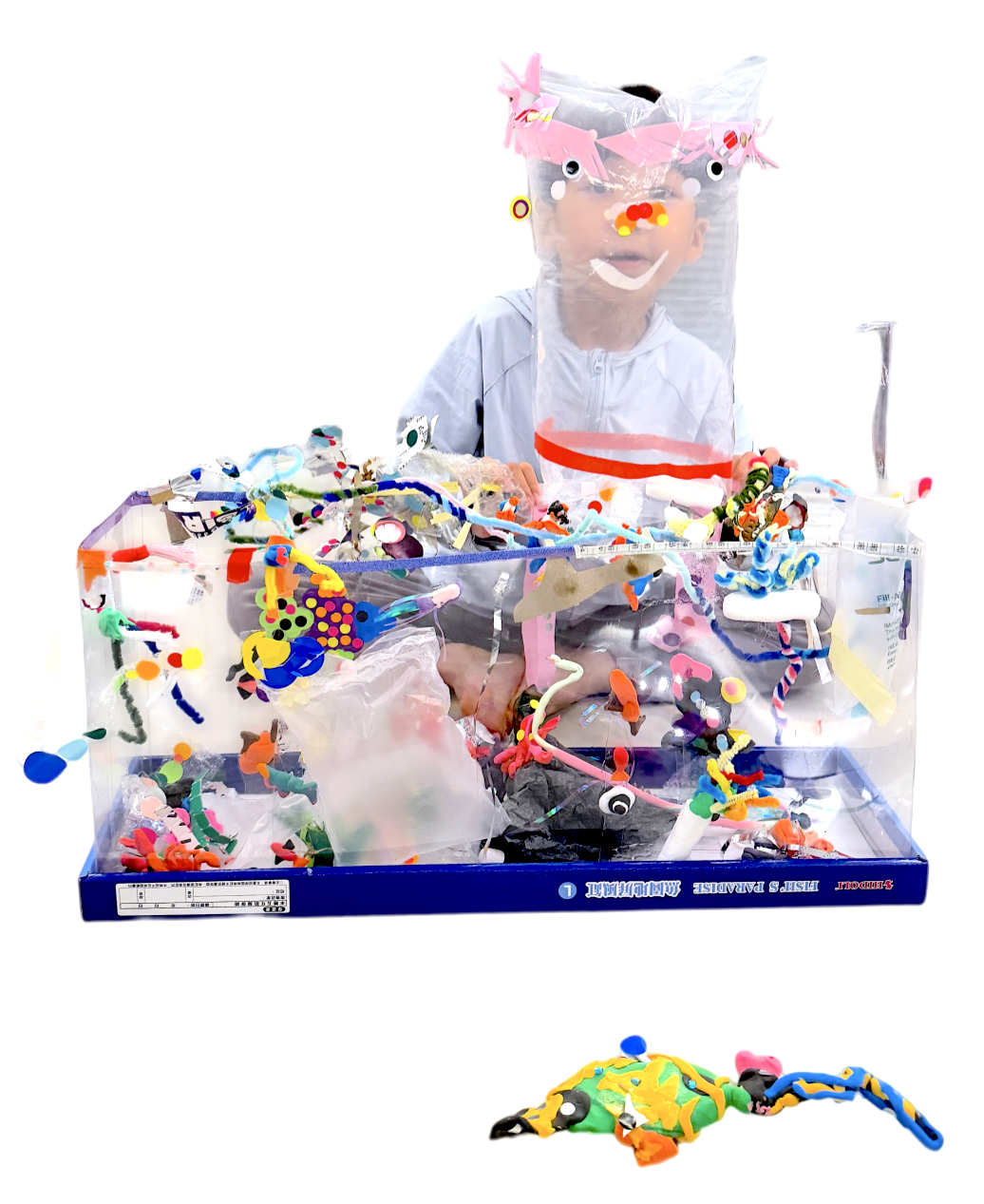
This includes the ability to:
observe before acting
tolerate delay
adjust to material behavior
make decisions without full certainty
recover from mistakes
accept irreversible outcomes
develop internal judgment
remain present through difficulty
In this sense, CCH does not position art as decoration. It positions studio practice as a disciplined environment for developing human attention, cognitive resilience, and creative autonomy.
The educational value lies not only in what the child makes, but in what the child practices while making.
8. Conclusion: Materials Train What AI Cannot Replace

The AI era is often described as a shift toward automation, speed, and generation. But the more AI accelerates output, the more important it becomes to ask what kinds of human capacities must be protected, trained, and deepened.
Materials offer one answer.
Materials require process.
Materials require patience.
Materials require contact.
Materials require adjustment.
Materials require judgment.
AI can generate an image, but it cannot give a child the lived experience of holding a fragile object carefully. It cannot replace the moment when a structure collapses and the learner decides how to repair it. It cannot fully simulate the emotional regulation required when a mark cannot be undone, or the patience required when glue has not yet dried.
These experiences may appear small, but developmentally they are significant. They teach children how to stay with reality.
In a world where images, answers, and outputs can be produced instantly, the ability to remain present with material difficulty becomes a form of human intelligence.
The future does not only belong to those who can generate more.
It belongs to those who can observe, adjust, repair, decide, and continue when reality does not immediately cooperate.
References
Malafouris, L. (2013). How Things Shape the Mind: A Theory of Material Engagement. MIT Press.
Wilson, M. (2002). Six views of embodied cognition. Psychonomic Bulletin & Review, 9, 625–636.
Li, Y., Wang, Y., & colleagues. (2024). Artificial intelligence for soft robotics: materials, structures, fabrication, integration, and applications. Nano-Micro Letters.
Frontiers in Materials. (2025). Research on soft robotic grippers and material-based compliant interaction.
Expo Riva Schuh. (2025). Artificial intelligence and the shoe business: the next industry revolution has already begun.
Vogue Business. (2024). Discussion on circular footwear, material complexity, durability, and recycling challenges.