
Artistic Origin: A New Species in the Third Space
After-Human Landscape, Hybrid Identity, and the Formation of CCH ART NOW
Artist: Chia-Chen Hsu
Medium: Oil painting / mixed media on canvas
Year: 2013
Context: Graduation work, Emily Carr University of Art + Design, Vancouver
This painting was created as part of my graduation work at Emily Carr University of Art + Design in Vancouver. At the time, the work was featured on the front page of the Chinese-language edition of Vancouver Sun as part of its graduating student coverage. Looking back, this painting represents more than an early artwork. It marks a foundational moment in my artistic and intellectual development — one that later expanded into my graduate research on cosmopolitanism, cultural hybridity, Third Space, and international art education.
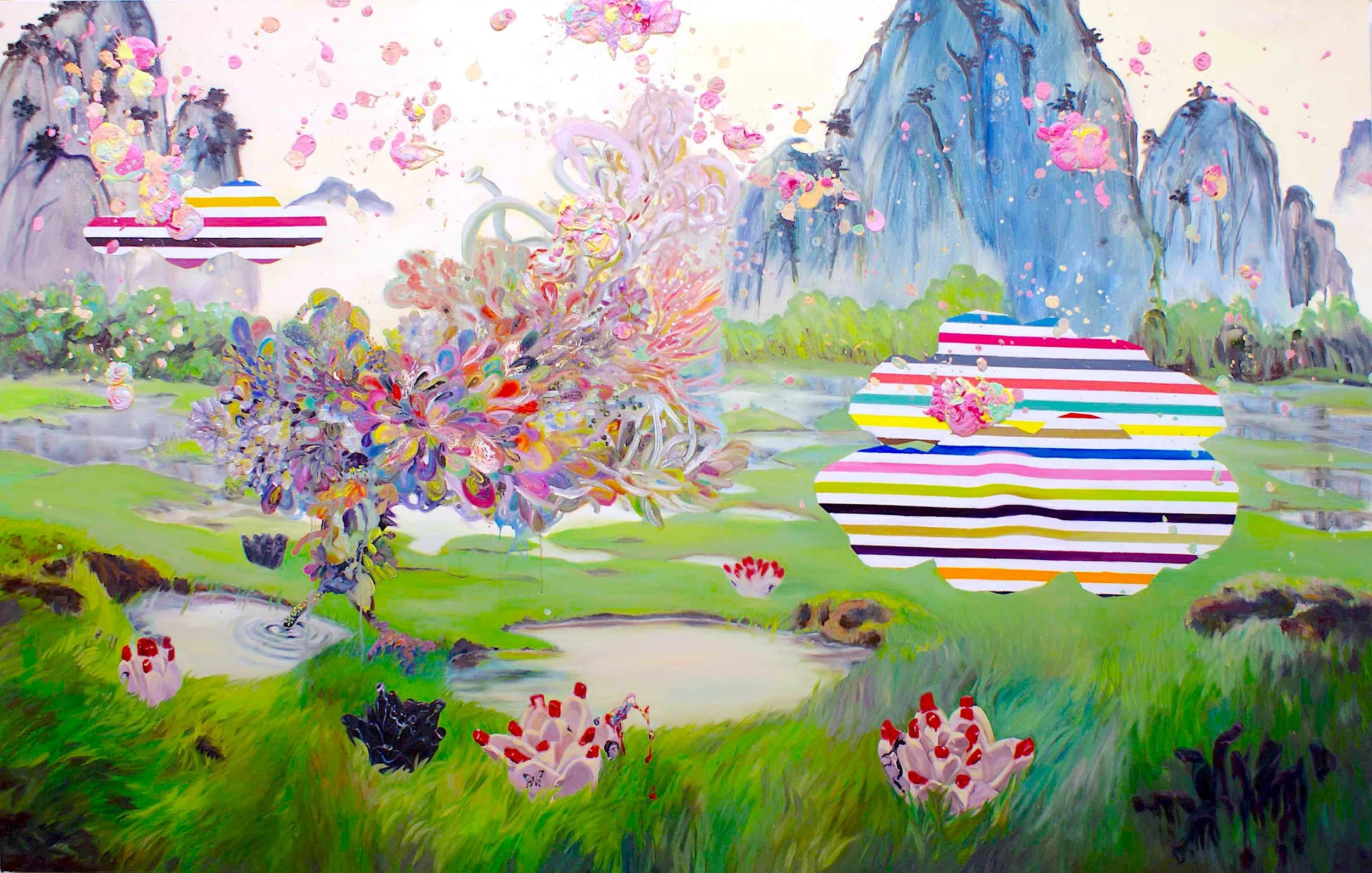
The central figure in the painting is not human. It is a creature formed from garbage, artificial materials, discarded fragments, color, and visual residue. It appears after the disappearance of human civilization, as if the world has continued to evolve without us. In this imagined landscape, waste is not treated as decay or failure. It becomes generative. The discarded becomes animated. The artificial becomes biological. The leftover becomes a new form of life.
This creature crosses a body of water between human-made matter and the natural world. It does not remain trapped inside the ruins of human production. It moves outward. It enters the landscape. It lives joyfully in nature, not as a return to purity, but as a new form of existence produced through contamination, memory, and transformation.
Landscape as Cultural Memory
The background of the painting draws from the visual language of traditional Chinese landscape painting. Mountains, water, mist, atmospheric distance, and layered spatial depth are used not as decorative cultural symbols, but as a structure of memory. They refer to an inherited visual world — a way of seeing space, nature, distance, and belonging through Chinese pictorial tradition.
The foreground, by contrast, is rooted in the natural environment of Vancouver. Vancouver’s landscape is defined by water, grass, mountains, and a direct proximity to nature. For me, this environment was not simply scenic. It was a lived space of displacement, adaptation, and self-reconstruction.
The painting therefore stages a meeting between two spatial systems: the cultural memory of Chinese landscape and the embodied experience of Vancouver’s natural environment. These two spaces do not merge into a smooth multicultural image. They collide, overlap, interrupt, and reorganize one another.
The result is not a purely Chinese painting, nor a Western landscape painting. It is a third visual field.
The Garbage Creature as Hybrid Self
The garbage creature can be read as a self-portrait, but not in the conventional sense. It does not represent my physical appearance. It represents a condition of identity: fragmented, mobile, colorful, artificial, organic, unstable, and alive.
It is made from discarded materials, yet it moves with agency. It carries traces of human civilization, but it is not limited by human systems. It is produced by what has been left behind, yet it does not appear broken. It appears newly born.
In this sense, the creature becomes a figure of hybrid identity. It does not belong entirely to one culture, one place, one language, or one visual tradition. It exists between origin and migration, artificial matter and organic life, inherited memory and imagined future.
This is why the figure is not tragic. It is strange, excessive, and almost joyful. It does not mourn the disappearance of the old world. It begins again.
Third Space Before CCH
This painting can now be understood as an early visual articulation of what I later studied through Third Space theory. In my later academic work, I examined how identity is formed across cultures, spaces, languages, and educational systems. This painting already contained that question visually.
The creature exists in an in-between condition. It is neither natural nor artificial, neither Eastern nor Western, neither fully human nor fully non-human. It occupies a border zone where fixed categories begin to lose authority.
Within this third space, identity is not inherited as a fixed label. It is produced through movement, contact, friction, and recombination.
This theoretical direction is consistent with the citation framework I later organized for CCH writing: cultural hybridity supports the understanding of identity as something formed through cultural mixing, negotiation between origin and new environments, and recombination; Third Space theory supports the idea of in-between identity, border zones, and the production of new cultural meaning.
This painting therefore does not simply describe cultural difference. It performs it. The image itself becomes a site where different visual systems, materials, memories, and identities negotiate with one another.
Color as a Way of Constructing Space
Color plays a structural role in the painting. It does not merely decorate the image or describe objects. It creates space.
The vivid, saturated colors interrupt the atmospheric distance of the landscape. They produce a world that feels dreamlike, unstable, and psychologically charged. This use of color reflects the experience of moving through cultures. Space is never neutral. It is shaped by language, memory, displacement, and the body’s shifting sense of belonging.
The painting asks two related questions:
How does space construct identity?
And how can color reconstruct space?
The answer is not given through explanation, but through visual experience. The viewer encounters a world where memory, fantasy, waste, landscape, and migration are compressed into one field. The painting does not represent a real geographic place. It creates a psychological and cultural landscape.
From Artistic Practice to Educational Philosophy
This work is important to CCH ART NOW because it reveals that my later educational framework did not emerge from nowhere. Before CCH became a structured method, my artistic practice was already investigating how people form identity through material, space, culture, and perception.
The painting’s central concern is not simply self-expression. It is formation.
A new being forms from discarded matter.
A new space forms between cultural traditions.
A new visual language forms between Chinese landscape and Western painting.
A new identity forms through movement.
These concerns later became central to my educational thinking. In CCH ART NOW, the focus has shifted from my own cross-cultural identity to the learner’s development of attention, judgment, autonomy, and material intelligence. Yet the deeper question remains continuous:
How does a person become capable of forming meaning in unstable conditions?
This question first appeared in my artwork. It later became the foundation of my research. Today, it continues through CCH ART NOW as an educational system for helping learners develop attention, perception, and agency in a rapidly changing world.
Artist Statement
This graduation painting imagines a post-human landscape in which a new creature, formed from garbage and artificial materials, emerges after the disappearance of human civilization. Rather than treating waste as decay, the work transforms discarded matter into a living species that moves joyfully across water and into nature.
The background draws from traditional Chinese landscape painting, carrying the visual memory of cultural origin. The foreground refers to Vancouver’s natural environment, where grass, water, and open space become symbols of migration, adaptation, and reinvention.
Between these two visual worlds, the painting constructs a third space: neither entirely Chinese nor Western, neither natural nor artificial, neither past nor future.
The central creature functions as a hybrid self-portrait. It is made from fragments, yet it moves with agency. It embodies the experience of crossing cultures, languages, materials, and identities. The work suggests that identity is not fixed by nationality or origin, but continuously formed through movement, perception, memory, and transformation.
This painting later became conceptually connected to my graduate research on Third Space theory, cultural hybridity, and international art education. It marks an early foundation for my ongoing interest in how space shapes human perception, and how visual practice can create new forms of identity beyond inherited categories.