
METHOD NOTES #02-Why Long Studio Sessions Matter
Time Is Not the Opposite of Learning. It Is Part of Learning.
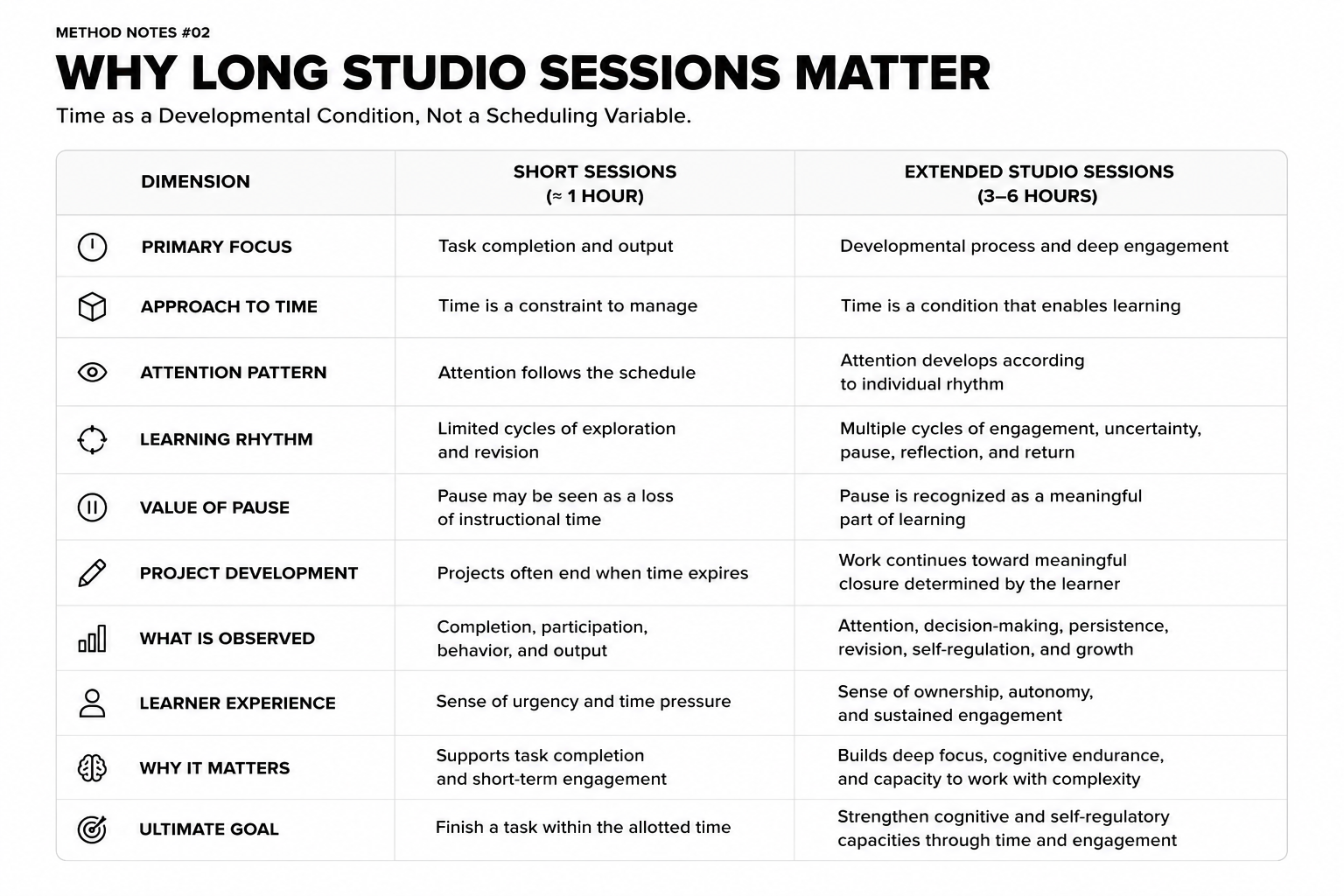
Many creative programs are designed around one-hour sessions.
This format often works well for introducing techniques, completing projects, or maintaining attention within institutional schedules.
CCH adopts a different approach.
Rather than asking, “How much can a child produce in one hour?”, CCH asks another question:
What becomes possible when learners have enough time to think, pause, revise, and return to their work?
Within CCH, time is understood as a developmental condition rather than a scheduling variable.
Why Longer Sessions?
Extended studio sessions allow learners to experience cognitive states that shorter activities often cannot reach.
These include:
sustained attention
independent decision-making
frustration recovery
reflective observation
material experimentation
self-directed revision
Rather than moving continuously toward completion, learners gradually develop their own working rhythm.
Beyond Productivity
Many educational environments measure progress by completed tasks.
Studio learning follows a different pattern.
A learner may spend twenty minutes observing.
Another may repeatedly adjust the same structure.
A third may pause entirely before returning with a new strategy.
These moments are not interruptions to learning.
They are part of learning itself.
Attention Has a Rhythm
Attention is rarely continuous.
During extended studio practice, learners often move through cycles of:
engagement → uncertainty → pause → reflection → revision → re-engagement
These transitions reveal how individuals regulate attention rather than simply maintain it.
Within CCH, these rhythms become important developmental observations.
Case Observations
Christmas Tree Project
During a multi-session collaborative construction project, two young learners voluntarily extended their studio time beyond the regular schedule.
Across several sessions—including four-hour and six-hour studio experiences—they remained deeply engaged without external rewards or digital stimulation.
Rather than demonstrating continuous activity, both learners naturally alternated between building, observing, discussing, revising, and returning to construction.
The extended duration allowed increasingly independent decision-making and greater ownership of the creative process.
Large Self-Portrait Project
A large-scale self-portrait was developed across multiple sessions rather than completed within a single class.
Learners experienced the gradual transition from initial planning to drawing, watercolor application, refinement, and completion.
Working over time encouraged patience, sustained attention, and the ability to continue engaging with an unfinished work instead of seeking immediate closure.
Why This Matters
The ability to remain engaged with complexity is becoming increasingly valuable in contemporary life.
Many meaningful activities—including research, design, engineering, scientific inquiry, entrepreneurship, and artistic practice—require individuals to tolerate uncertainty over extended periods.
Studio learning provides one environment where these capacities can gradually develop.
Rather than accelerating production, CCH intentionally preserves time for observation, revision, hesitation, and renewed engagement.
These moments are not delays in learning.
They are often where the deepest learning begins.
Key Takeaway
Longer studio sessions are not designed to produce more artwork. They create the conditions for learners to strengthen attention, judgment, persistence, and independent decision-making through time, materials, and meaningful engagement.