
Method Notes 01-Understanding Process Art and the CCH Framework
Similar Foundations, Different Questions
• What is Process Art?
• Where does CCH share common ground?
• How does CCH extend the conversation?
• Why does CCH focus on cognitive development?
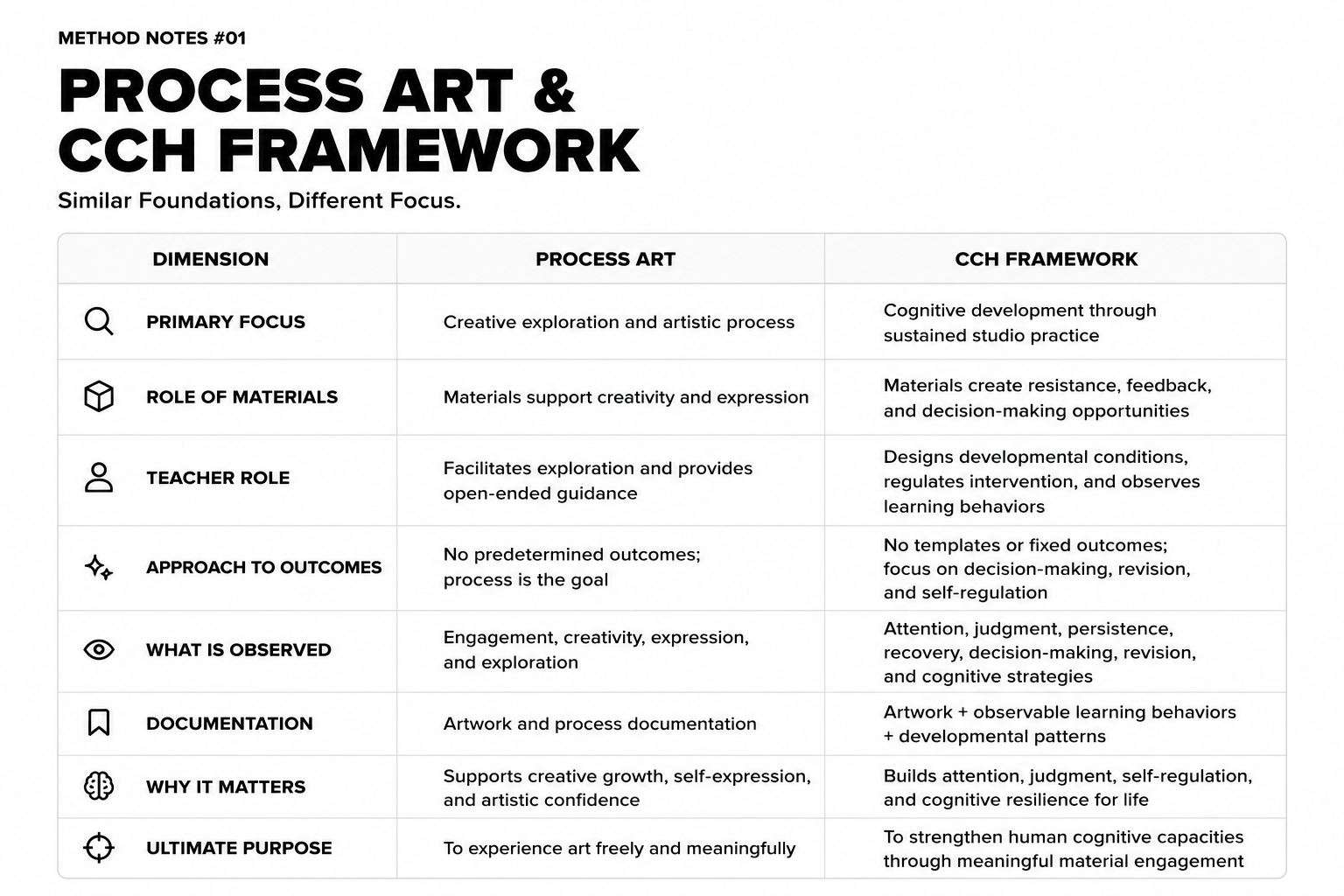
Process Art has played an important role in contemporary art education by emphasizing open-ended exploration, learner agency, and creative experimentation. Rather than directing children toward predetermined outcomes, it values the learning process itself.
CCH shares many of these educational principles. However, CCH was developed to investigate a different question.
Instead of asking:
How can children freely experience art?
CCH asks:
How do sustained studio experiences support the development of attention, judgment, self-regulation, and cognitive resilience?
Although both approaches value materials, autonomy, and exploration, their primary educational focus differs.
Shared Principles
Both Process Art and CCH:
Value open-ended exploration
Encourage learner autonomy
Avoid template-based outcomes
Respect individual creative pathways
Emphasize material engagement
Why Cognitive Development?
Within CCH, the studio is understood as more than a place for artistic production.
Extended engagement with physical materials creates opportunities for learners to:
sustain attention over time
tolerate uncertainty
evaluate alternatives
revise decisions
recover from frustration
strengthen independent judgment
These capacities extend beyond art education and remain relevant across academic, professional, and everyday contexts.
A Broader Educational Framework
Process Art represents one valuable educational influence within CCH.
The broader CCH framework also integrates perspectives from:
developmental psychology
embodied cognition
studio pedagogy
attention research
structured observational practice
Rather than positioning art as the final goal, CCH views studio practice as a developmental environment where human cognitive capacities can be strengthened through meaningful interaction with materials, time, and real-world constraints.