

Beyond Local Optima
An Exploratory Study of Search-Space Expansion in an Elite-Level Technology Engineer
What happens when a mind trained to solve complex problems enters a system with no problem to solve?
A note on “local optima.”
In mathematical optimization, a local optimum is a solution that is better than nearby alternatives, but not necessarily the best across the entire search space. Here, the concept becomes a metaphor for a simple question: What happens when a solution feels complete before the possibilities have been fully explored?
Expertise is built partly through increasingly efficient convergence.
Engineering expertise often rewards the ability to identify relevant variables, eliminate noise, reproduce failure states, recognize patterns, evaluate trade-offs, and move efficiently toward viable solutions. Artificial intelligence is accelerating this process further. Execution that once required days, weeks, or months can increasingly be compressed through AI-assisted workflows.
But this raises a different human question:
What happens before optimization?
What happens when there is no predefined problem, no objective function, no performance metric, and no correct answer against which a decision can be evaluated? In an exploratory CCH Adult Material Cognition session, an elite-level technology engineer entered exactly this condition.
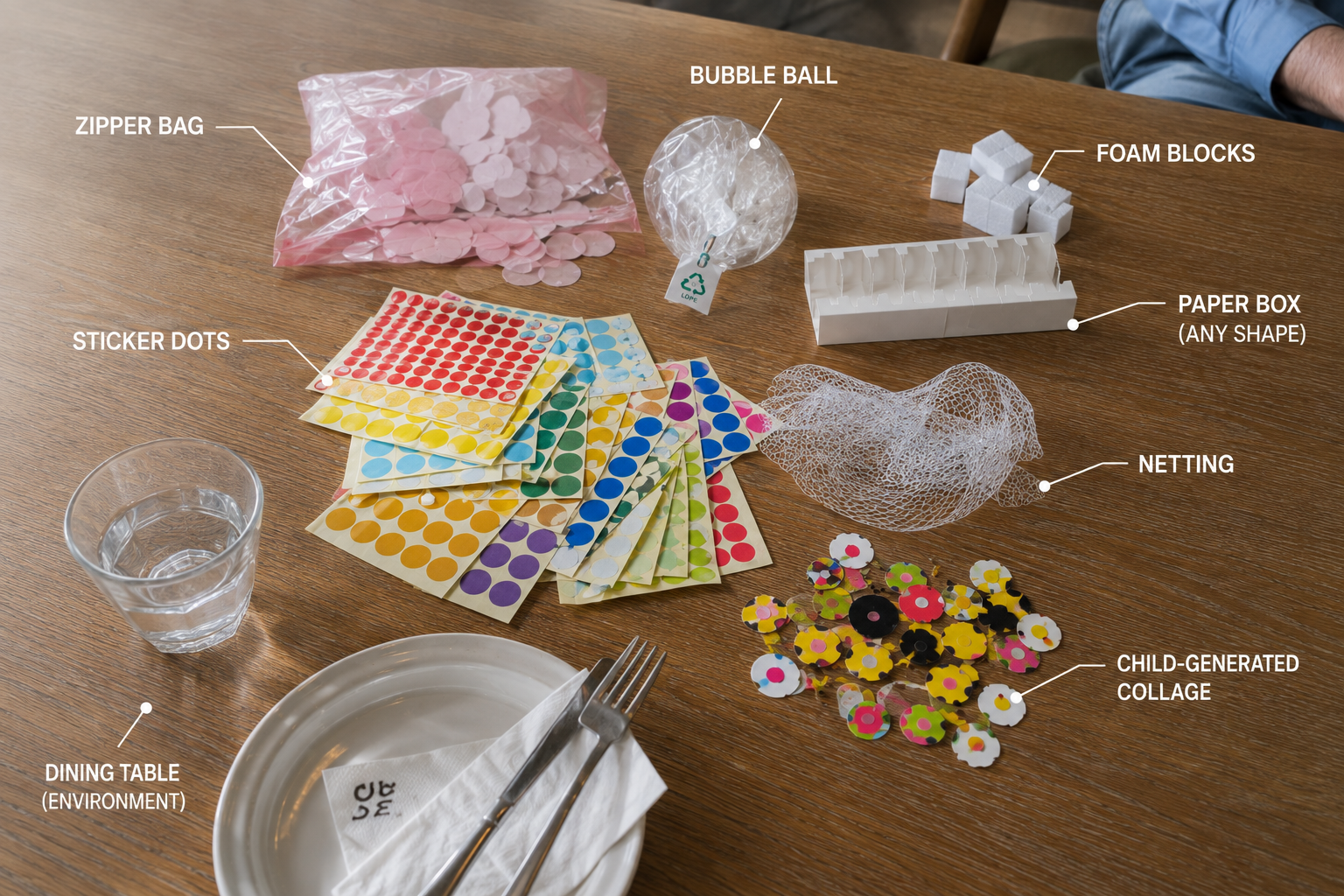
The materials were deliberately simple: circular adhesive stickers of different sizes and colors, flexible and foldable surfaces, mesh, structural objects, and other inexpensive physical elements.
There was no model to reproduce.
No artwork had to be completed.
No aesthetic standard was introduced.
The participant could stop at any time.
Within approximately five minutes, he said:
“Finished.”
That moment became the beginning of the study.
01 — Rapid Convergence
The first solution was not wrong. The search had simply stopped.
The participant’s first strategy was highly efficient. He selected familiar colors and began constructing a recognizable technology-brand color configuration. Within minutes, he had created a coherent arrangement and considered the activity complete. Initially, this behavior could have been interpreted as discomfort with ambiguity, reliance on a “safe” reference, or a lack of confidence in creative activity. His delayed reflection changed that interpretation. When asked what had actually caused him to stop, he answered:
“I didn’t realize stickers could be used in different ways.”
This distinction is important. The participant had not necessarily run out of ideas. Rather, the perceived search space available to him at that moment was narrow. If a sticker is perceived primarily as a colored circle that can be attached to a surface, then the number of meaningful operations appears limited. Within that perceived state space, he had already found a satisfactory configuration. There was little reason to continue searching.

A Human Analogy to Local Optima
In mathematical optimization, a local optimum is a solution that performs better than neighboring alternatives within a particular region of a search space, without necessarily representing the best possible solution across the entire space. This CCH case was not a formal optimization experiment. There was no objective function and therefore no mathematically defined optimum.
The concept is useful here as an analytical metaphor, not as a literal diagnosis of the participant’s behavior.
The interesting question is not whether his first solution was “suboptimal.”
It is:
What makes a highly efficient decision-maker continue searching after a valid solution has already been found?
In machine learning and computational optimization, exploration matters because a system that exploits only what it already knows may fail to discover other regions of the solution space.
Something structurally similar appeared in this material experience. The first solution was valid. But the material system contained considerably more possible states than the participant initially perceived. The challenge was therefore not simply to generate a better answer. It was to expand what could be considered an answer at all.
02 — The Engineering Schema Never Disappeared
CCH did not switch off engineering cognition. It made it observable.
The participant’s answer to a second follow-up question revealed something more significant. When asked about his initial attempt to reproduce a familiar color configuration, he explained:
“Engineering problems begin by observing a phenomenon and gathering as much information as possible before making a decision. Usually the first step is trying to reproduce the problem. So at the beginning, I tried to reproduce the logo. Later, I collected the available colors, which is similar to gathering data.”
His behavior suddenly became much more legible.
He had entered an unfamiliar material environment using a familiar professional schema:

Observe
↓
Reproduce
↓
Gather Available Variables
↓
Decide
The engineering mind had not disappeared.
It had migrated into another domain. This suggests a different potential function for CCH Adult Material Cognition. The purpose may not be to teach engineers to “stop thinking like engineers.” It may instead create a physical environment in which normally invisible decision habits become externally observable.
How quickly does someone frame an ambiguous situation?
What information do they consider relevant?
When do they begin acting?
When do they ask for more information?
What constitutes a satisfactory solution?
When do they stop?
And under what conditions will they reopen a problem they have already considered solved?
These are not exclusively artistic questions.
They are questions about decision architecture.
03 — Material as Information
The hand was not simply executing a plan.
As the experience continued, the participant began interacting with the physical properties of the stickers.
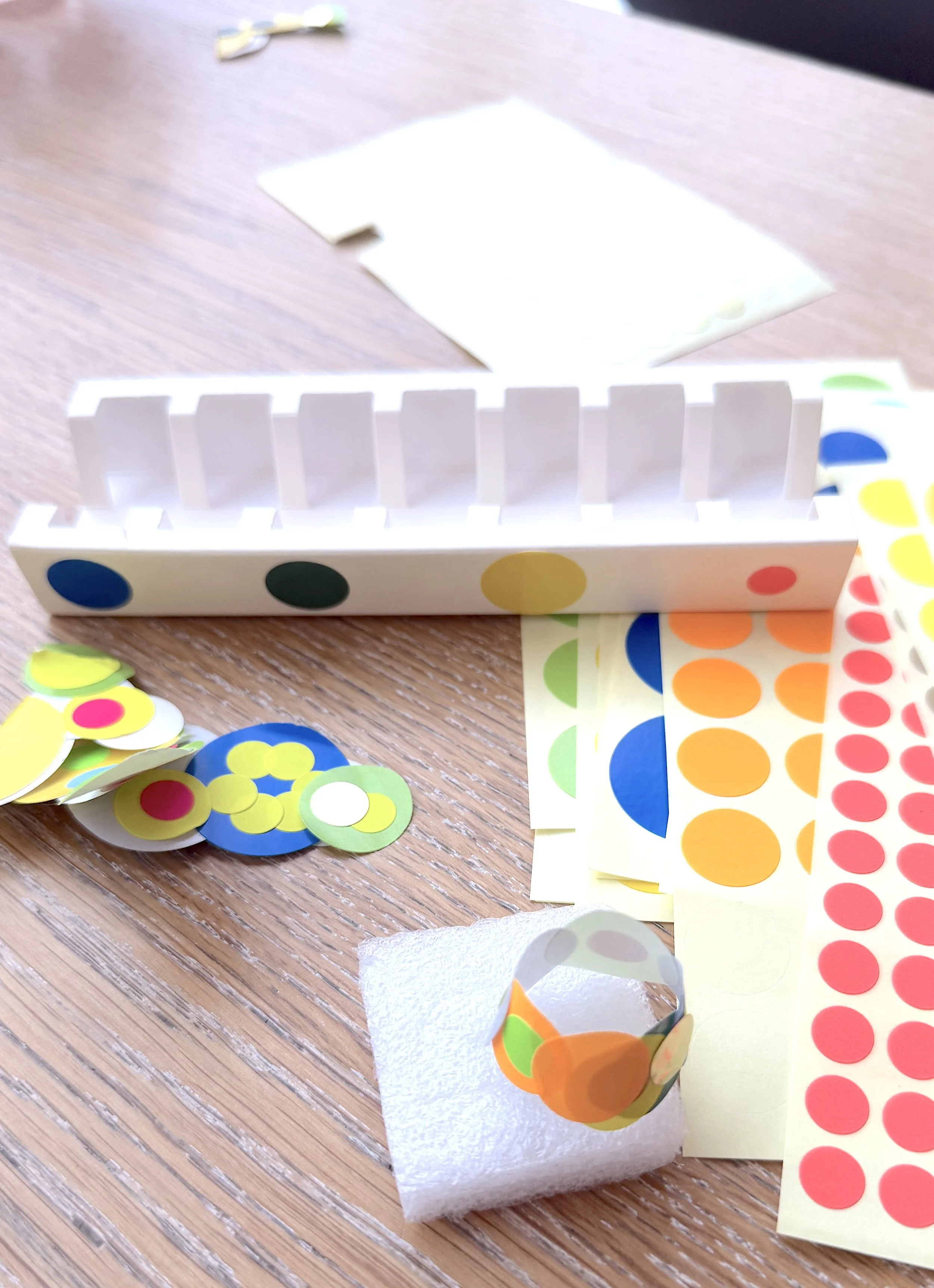
He folded them.
Tore them.
Pinched them.
Attached and removed them.
Tested their adhesive qualities.
Compared sizes and colors.
Combined small units into larger configurations.
Flat arrangements gradually became dimensional structures.
This transition matters because cognition during making does not necessarily follow a simple sequence:
Idea → Plan → Execution
Some actions instead generate information that did not exist before the action occurred. Kirsh and Maglio (1994) describe epistemic actions as actions performed in the external world partly to simplify cognitive work or reveal information useful for subsequent thought. Their distinction between pragmatic and epistemic action is useful here. An action can change the world because a task requires the change. But an action can also change the world so that the person can see what becomes possible next. This is also compatible with Malafouris’ Material Engagement Theory, which challenges a strict separation between cognition and material action. From this perspective, thinking is not always something completed internally and subsequently transferred into matter; cognitive processes can emerge through ongoing coupling among brain, body, material, and environment.(Malafouris, 2013, 2019).
The original CCH case record therefore identified a provisional material cognition loop:
TOUCH → MATERIAL FEEDBACK → PERCEPTUAL CHANGE → NEXT ACTION
The participant’s folding, tearing, pinching and adhesion testing are documented in the original case as material exploration rather than merely decorative manipulation.
04 — Perturbing the Search Space
“Why isn’t there a large red sticker?”
At one point, the participant noticed something missing. He wanted a large red circular sticker.
There wasn’t one.
The omission was intentional.
CCH material environments do not necessarily maximize available choice. In my work with children, I sometimes deliberately interrupt habitual color selection: materials may be mixed rather than perfectly organized, expected colors may not be available, or learners may select a drawing tool without first seeing its color. The objective is not randomness. It is to temporarily interrupt a predetermined path. The original case described this as an incomplete choice set:
INCOMPLETE CHOICE SET → HABIT DISRUPTION → ADAPTATION → UNEXPECTED COMBINATION
Research on creativity and constraint provides a useful but qualified theoretical connection. Tromp and Baer (2022) argue that constraints can, under appropriate conditions, focus creative search rather than merely inhibit it. Iyengar and Lepper’s (2000) work similarly complicates the assumption that more available choice necessarily produces better engagement or decision outcomes. Neither finding means that restricting options automatically produces creativity.
The more interesting CCH hypothesis is narrower:
Removing an expected variable may force the decision-maker to reorganize the search space rather than simply execute a preferred solution.
I call this, provisionally:
Search-Space Perturbation
The intervention does not provide the participant with a new answer.
It changes the conditions under which an answer can be generated.
05 — Action Before Optimization
What changes when the hand is allowed to move before the answer is complete?
During the experience, another intervention occurred repeatedly.
While we were talking, I occasionally told the participant:
“Keep your hands moving. You can just put something down. It doesn’t matter.”
The purpose was not productivity. It was not to produce more stickers, more objects, or a better-looking composition. The intervention temporarily reduced the requirement that every physical action be justified before execution. A highly analytical sequence might ordinarily resemble:
Analyze → Predict → Evaluate → Act
The material condition allowed another sequence:
Act → Receive Material Feedback → Perceive → Associate → Judge → Act Again
The distinction is subtle but important.
Judgment is not removed.
It is repositioned.
Rather than requiring a complete conceptual justification before every action, low-cost material action is allowed to create new perceptual information that can subsequently be judged. The original case therefore treated “keep the hands moving” as a working hypothesis concerning reduced pre-planning, not as evidence of unconscious processing or a proven psychological mechanism. This leads to one of the central propositions emerging from CCH Adult Material Cognition:
The goal is not to eliminate judgment. It is to delay optimization long enough for the search space to change.
06 — From Exploitation to Exploration
The material behavior did not transform instantly. The transition occurred gradually.
First came familiar color references.
Then color combinations.
Then circular arrangements.
Then dimensional manipulation.
A ring-like wearable object emerged.
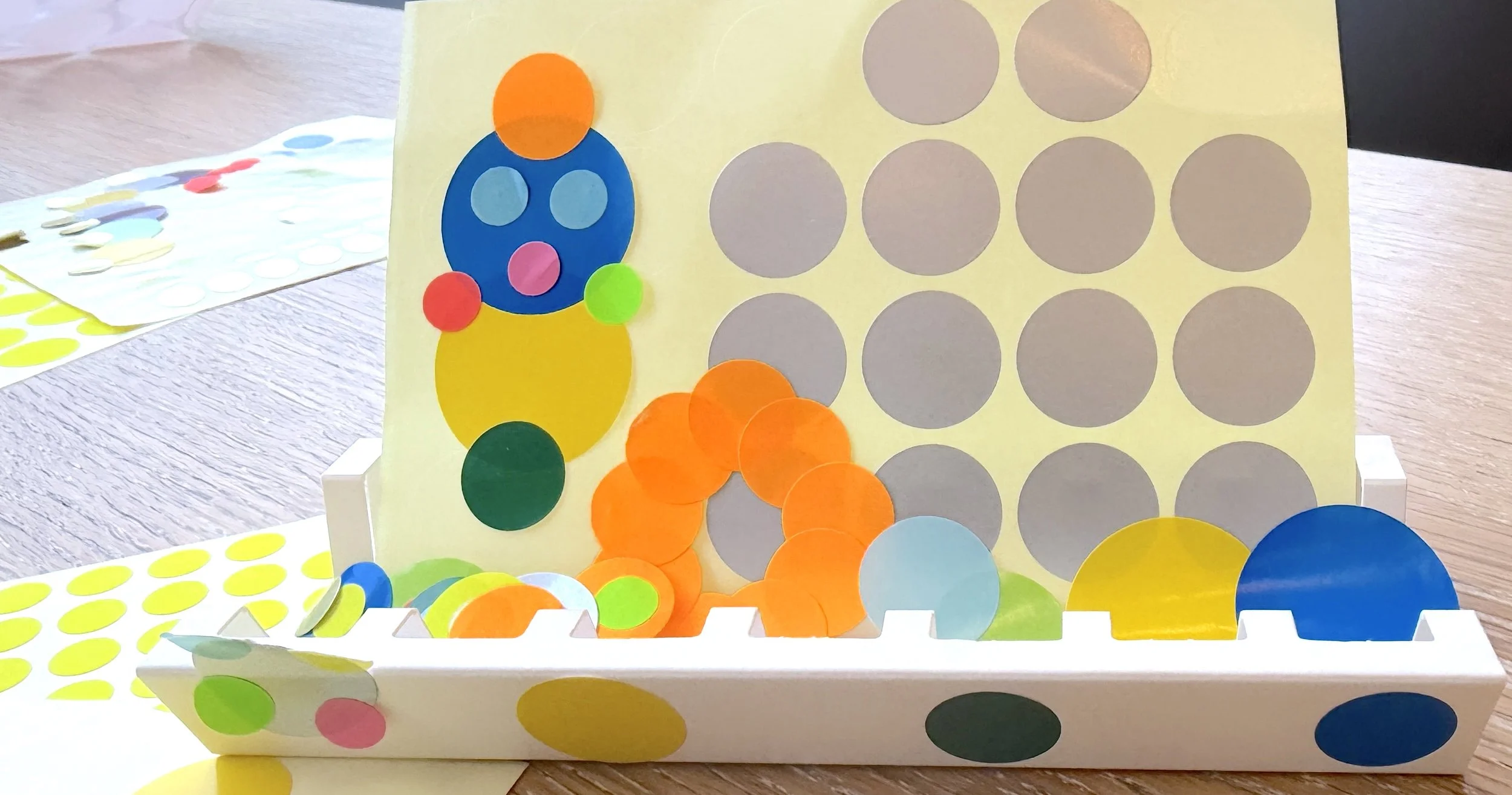
Later, a figure became a baby.
A circular arrangement became a donut.
Eventually:
the baby was eating the donut.
This sequence is interesting not because the resulting objects were artistically sophisticated. The relevant variable is the changing relationship between the participant and the problem space. Initially, the material was organized through externally established references. Later, relationships began emerging from interactions among the materials themselves.
The original report described this progression as:
KNOWN REFERENCE → COLOR PLAY → OBJECT FORMATION → ASSOCIATION → MICRO-NARRATIVE
The participant’s delayed reflection made the transition even clearer.
When asked:
“At what point did the activity begin to feel more like exploration rather than completing a task?”
he answered:
“The baby. The donut.”
This is particularly useful because the distinction between task completion and exploration came from the participant himself.
07 — Search-Space Expansion
Creativity may be the wrong first word.
Calling this transition “creativity” risks making the phenomenon unnecessarily vague. For technical professionals, another formulation may be more useful. The observed transition can provisionally be described as search-space expansion. The participant initially operated inside a limited set of possible operations. As material affordances became visible, the number of perceived possible states increased.
The process moved approximately through:
Familiar Reference
↓
Reproduction
↓
Variable Sampling
↓
Material Manipulation
↓
Affordance Discovery
↓
Search-Space Expansion
↓
Exploratory Recombination
From this perspective, creativity is not primarily artistic talent.
It is closer to:
the capacity to keep a possibility space open long enough for states outside the first viable solution to become visible.
This also connects the case to Gibson’s (1979) concept of affordances: possibilities for action are not reducible simply to the physical properties of an object, but arise in relation between an environment and an acting organism. The stickers had not physically changed. What changed was what the participant discovered he could do with them.

08 — The Unexpected Output Was Not the Artwork
The most consequential participant response came after the session.
During our broader conversation about technical work and AI, he described professional life as requiring continuous decisions based on rapidly changing conditions.
He later wrote:
“In my normal work, I constantly have to make decisions according to the current situation. It feels like being overwhelmed.”
After the material experience, he reported:
“I experienced a sense of mental release. When I returned to work afterward, my thinking felt much clearer.”
This statement should be interpreted carefully.
There was no pre/post cognitive test.
There was no control condition.
The session included conversation, food, social interaction, pauses, material engagement and facilitator intervention. It would therefore be inappropriate to conclude that CCH caused improved cognitive clarity.
What can legitimately be documented is:
The participant reported a subjective experience of mental release and perceived greater clarity upon returning to work.
That distinction matters.
But his next response may be even more valuable for protocol development.
He immediately raised two engineering questions.
Can the same effect be achieved in less time?
And:
Would repeated exposure cause the effect to diminish?
These questions move the project away from testimonial evidence and toward experimental design.
09 — Minimum Effective Dose
A three-hour exploratory experience is useful for discovery. It is not necessarily a viable intervention. The next phase of CCH Adult Material Cognition should therefore investigate dose, repeatability, and habituation.
For example:
Duration
15 minutes
30 minutes
45 minutesRepetition
Session 1
Session 2
Session 3Material Variation
Same materials
Changed material affordances
Changed constraintsObservable Behavioral Variables
Time to first closure
Number of voluntary re-entries
Number of material operations
Revision frequency
Requests for external validation
Transition from 2D to 3D
Emergence of self-generated objects or relationships
Time to first exploratory departure from familiar referenceParticipant-Reported Variables
Perceived cognitive load before activity
Mental release after activity
Perceived clarity after returning to work
Perceived usefulness
Novelty / habituation across repeated sessions
The objective is not yet to prove efficacy. It is to determine whether the phenomenon observed in Case 01 is sufficiently repeatable to justify controlled testing.
10 — Why This Matters More as AI Gets Better
AI is rapidly reducing the cost of execution. A less experienced professional equipped with powerful AI may now be able to produce substantially more output, but producing more does not necessarily mean knowing what deserves to be produced, which decision matters most, or where a system is most vulnerable.
This distinction separates execution capacity from expert judgment.
As the participant observed during our discussion, the value of senior engineering expertise lies not only in executing technical work, but in recognizing critical transition points: knowing which assumption must be questioned, which weakness cannot be ignored, and which decision cannot safely be skipped. AI may accelerate the work surrounding these moments, but acceleration does not automatically replace the judgment required to identify them.
This makes a different set of human capabilities increasingly important. When answers are not predetermined, information remains incomplete, and conditions continue to change, we need the capacity to:
01 — REFRAME
Recognize when the problem itself has been framed incorrectly.02 — STAY WITH UNCERTAINTY
Remain with uncertainty when immediate convergence would be premature.03 — EXPAND THE SEARCH SPACE
Notice variables, relationships, and possibilities outside an established model.04 — REOPEN
Return to a solution that already appears sufficient and ask what has not yet been considered.05 — GENERATE BEFORE OPTIMIZING
Produce and examine alternatives before committing resources to optimization.06 — EXERCISE JUDGMENT
Determine what matters when no predefined answer or objective function can make the decision for us.
As the cost of execution approaches zero, the value of deciding what deserves to be executed may increase.
This is where CCH enters the discussion.
CCH is not designed to make people produce answers faster. It creates conditions in which the cognitive process before optimization becomes visible: how a person explores an undefined space, responds to constraints, discovers new possibilities, reopens an apparently sufficient solution, evaluates alternatives, and ultimately forms the next direction when no objective function can determine what matters.
In this sense, the central human capability is not simply creativity, nor is it speed. It is the capacity to keep the search space open long enough to exercise judgment before convergence.
AI can accelerate execution. Human expertise determines what deserves to be optimized. CCH investigates what happens before that decision is made.
11 — Beyond Local Optima
The significance of this case is not whether an engineer can become “more creative.” The more consequential question is whether a highly optimized mind can keep its search space open before convergence.
Throughout the experience, the participant’s engineering logic did not disappear. He continued to observe, reproduce, gather available variables, and make decisions. What changed was the space within which that logic operated. As new material affordances became visible, the process moved from familiar patterns toward manipulation, recombination, and self-generated direction.
This distinction matters in the age of AI. As execution and optimization become increasingly accelerated, human value may shift toward what happens before the objective is fully defined: reframing the problem, recognizing unexplored possibilities, resisting premature convergence, and judging what deserves to happen next.
CCH therefore moves beyond the question:
Can an engineer be creative?
toward a more consequential one:
What happens to expert judgment when a mind trained to converge is placed inside a system designed to keep the search space open?
This remains a working hypothesis rather than a validated cognitive mechanism. But it points toward a research direction beyond art education: using open-ended material environments as physical spaces for observing how humans explore, reframe, and form direction under uncertainty.
CCH creates physical search spaces for minds trained to converge.
CCH Adult Material Cognition
Physical Search Spaces for Minds Trained to Converge
CCH Adult Material Cognition uses open-ended physical environments to investigate how people make decisions when the answer, path, and outcome have not been predefined.
The objective is not artistic performance. Material interaction instead makes decision behavior visible: how a person enters uncertainty, frames a problem, explores alternatives, converges, reopens a solution, and generates the next direction.
As AI increasingly accelerates execution, CCH focuses on an earlier layer of human cognition:
What happens before optimization begins?
How do we continue to question, explore, reframe, and exercise judgment when no system can determine in advance what deserves to be optimized?
CCH creates physical search spaces for minds trained to converge.
Research Status & Limitations
This is a practice-based exploratory case, not a controlled experiment.
The case involved one participant. The participant and facilitator had an existing personal relationship. The session occurred during an informal meal and conversation. Fatigue, social interaction, facilitator examples, prior exposure to CCH ideas, material novelty, and other uncontrolled variables may have influenced behavior.
No baseline measure, control condition, standardized creativity measure, cognitive-load measure, physiological measure, or blinded assessment was used.
The participant’s report of mental release and subsequent clarity therefore represents subjective delayed self-report, not evidence of causal cognitive improvement.
The purpose of Case 01 is hypothesis generation and protocol development—the same research positioning already established in the original CCH report.
References
Gibson, J. J. (1979). The Ecological Approach to Visual Perception. Houghton Mifflin.
Iyengar, S. S., & Lepper, M. R. (2000). When choice is demotivating: Can one desire too much of a good thing? Journal of Personality and Social Psychology, 79(6), 995–1006. https DOI: 10.1037/0022-3514.79.6.995.
Kirsh, D., & Maglio, P. (1994). On distinguishing epistemic from pragmatic action. Cognitive Science, 18(4), 513–549. DOI: 10.1207/s15516709cog1804_1.
Malafouris, L. (2013). How Things Shape the Mind: A Theory of Material Engagement. MIT Press.
Malafouris, L. (2019). Mind and material engagement. Phenomenology and the Cognitive Sciences, 18, 1–17. DOI: 10.1007/s11097-018-9606-7.
Schön, D. A. (1983). The Reflective Practitioner: How Professionals Think in Action. Basic Books.
Sio, U. N., & Ormerod, T. C. (2009). Does incubation enhance problem solving? A meta-analytic review. Psychological Bulletin, 135(1), 94–120. DOI: 10.1037/a0014212.
Tromp, C., & Baer, J. (2022). Creativity from constraints: Theory and applications to education. Thinking Skills and Creativity, 46, 101184. DOI: 10.1016/j.tsc.2022.101184.
CCH_Engineer_Case_Academic_Magazine_v3.pdf