
From Technical Skill to Independent Judgment

Cross-Cultural Transition, Future Orientation, and Self-Directed Learning in Adolescence
Case Context
This case began with a first-year high school student who already possessed strong representational drawing skills.
He had grown up in a financially secure environment, attended private schools, and had access to substantial educational resources. By the time we began working together, technical drawing was already one of his strengths.
He also had an ambitious long-term goal: to pursue international education and eventually enter the school he hoped to attend.
The distance between his present position and that goal was considerable.
His language ability would require substantial development over the following three years. Artistically, the challenge was different. He could draw convincingly, but the international art-school environment he hoped to enter would ask him to develop additional capacities: conceptual inquiry, independent interpretation, contextual awareness, articulation, and the ability to make and defend creative decisions.
The central developmental question became:
How can an adolescent see the distance between where he is now and where he wants to go—and understand that distance as a pathway that can be acted upon?
This question connects with research on future orientation in adolescence: the developing capacity to imagine future states, establish goals and plans, and connect present behavior with future consequences. Research has associated future-oriented thinking with academic engagement and self-regulatory behavior.
When Technical Ability Is Already Strong
Technical proficiency can sometimes coexist with another developmental threshold.
A student may reproduce objects accurately, control materials confidently, and produce visually sophisticated work while still developing the ability to determine what the work is investigating and why particular artistic decisions matter.
At this stage, the educational questions begin to expand:
What are you trying to say?
Why did you choose this subject?
What relationships do you see between these images?
What position are you taking?
How can an artwork become a form of inquiry?
Art education scholarship has similarly argued for understanding creativity beyond the finished product, with attention to creative processes, context, dispositions, and environments that support development.
For this student, the developmental objective was to expand from technical representation toward conceptual authorship.
From Social News to Visual Inquiry
One project began with a social issue receiving considerable media attention at the time: controversies involving young people from celebrity or highly privileged families, including reports involving firearms and other forms of risky behavior.
Rather than treating the news story simply as something to illustrate, the project became an opportunity to examine the social structures surrounding it.
The student began considering relationships among privilege, family expectations, wealth, public visibility, personal behavior, addiction, crime, and consequence.
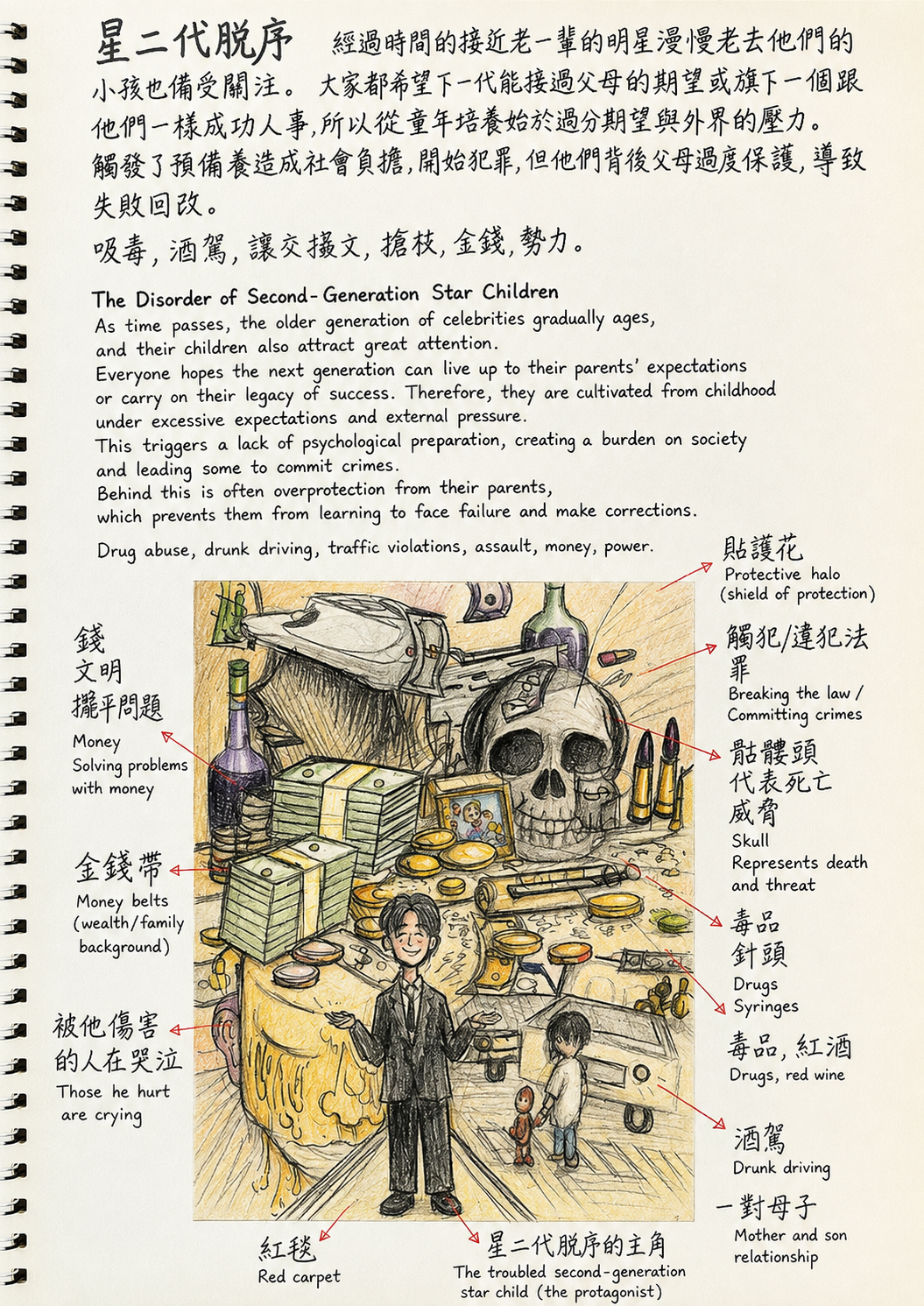
His preliminary drawing and handwritten annotations became particularly valuable evidence of this process.
The page contained money, alcohol, firearms, drugs, vehicles, family figures, a skull, and other symbolic elements. His annotations connected individual objects with larger social ideas.
The significance lies in the relationships he was beginning to construct.
A firearm could carry social meaning.
Money could indicate privilege or power.
A skull could operate symbolically.
Family figures could represent expectations and social structures.
Individual objects gradually became components of a larger visual argument.
The page documents a developing sequence:
Object → Symbol → Relationship → Interpretation
The student was beginning to use artistic skill as a tool for investigating a question about society.
From Representation to Interpretation
Representational skill answers one type of artistic problem:
Can I depict what I see?
Conceptual practice introduces another:
What do I think about what I see?
That second question requires the learner to select information, establish relationships, tolerate ambiguity, consider context, determine significance, and make deliberate visual decisions.
The resulting artwork does not need to provide a definitive answer.
Its educational value can also lie in the learner’s growing capacity to formulate questions, investigate relationships, revise interpretations, and make increasingly intentional decisions.
For an adolescent preparing for international art education, this transition becomes particularly significant.
A technically accomplished portfolio demonstrates skill.
A developing portfolio can also begin to reveal how the student observes, investigates, interprets, and thinks.
The Larger Goal: Three Years Ahead
During the same period, another conversation was taking place.
The student had identified the international school he hoped eventually to attend.
The goal was ambitious.
We approached it structurally.
We examined his current abilities.
We considered the language development that would be required.
We discussed the distance between his current artistic thinking and the level of conceptual development he would eventually need.
Most importantly, we considered time.
Approximately three years remained.
A distant university objective can remain psychologically abstract to an adolescent when the relationship between today’s decisions and an outcome several years later is difficult to perceive.
Research on adolescent future orientation helps explain why this relationship matters. Future-oriented thinking involves mentally representing future possibilities and connecting them to present plans and behaviors. A systematic review covering 21 studies found a consistent relationship between future-oriented thought and positive academic outcomes, particularly academic engagement and performance.
The educational task in this case was therefore to make the relationship between future aspiration and present action visible.
Making a Difficult Goal Visible
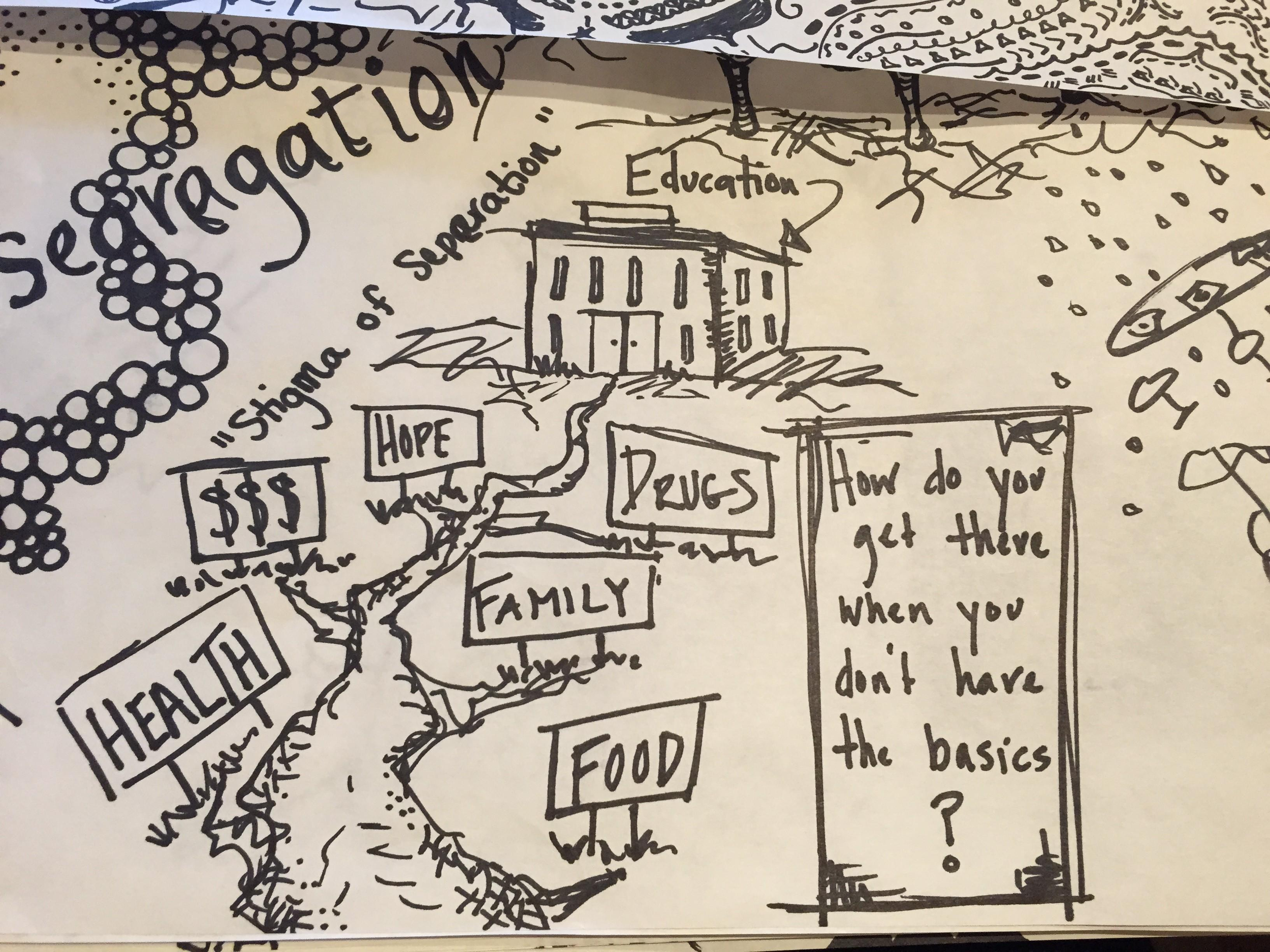
A large goal becomes more actionable when the learner can understand its internal structure.
I now describe this process through five stages:
01 — SEE THE FUTURE
Identify a meaningful and demanding destination.
02 — MAP THE GAP
Understand the distance between current capacity and the desired future state.
03 — MAKE THE PATH VISIBLE
Translate that distance into specific developmental areas and manageable stages.
04 — ACT
Connect present decisions with the longer-term objective.
05 — RECALIBRATE
Observe progress, identify emerging gaps, adjust strategies, and continue.
The objective is to make the pathway legible.
The learner can gradually understand:
I am here.
I want to reach there.
These are the capacities I need to develop.
This is something I can begin doing now.
This structure also has parallels with research on positive youth development. Reviews of adolescents’ beliefs about the future describe goal-directed development as involving valued goals, pathways toward those goals, motivation, and a sense of personal mastery.
The future begins to acquire a relationship with present action.
An Unexpected Behavioral Change
Shortly after these early conversations, the student’s mother reported something that surprised her.
During a parent meeting in the first month of school, she stood up and expressed her gratitude.
She explained that she did not know exactly what had been discussed with her son, but she had observed a significant change.
Within the first week, he independently deleted all of the games from his tablet.
According to his mother, he had begun talking about his goal and understood that he needed to start working toward it.
The decision originated with the student and occurred outside the studio.
This observation should be understood as case evidence rather than causal proof. A single behavioral event cannot establish long-term improvement in self-regulation or demonstrate that one educational conversation independently produced the change.
What it does document is more specific:
At that moment, the student appeared to be connecting a distant future objective with a decision available to him in the present.
This observation is particularly interesting alongside research suggesting that future-oriented academic identities and “possible selves” can influence adolescent self-regulatory behaviors, including initiative and academic practices.
From External Expectations to Personal Direction
Adolescents frequently receive instructions about what they should do:
study more, practice more, prepare for university, manage their time, and think about their future.
A different developmental process becomes possible when the learner can personally perceive the structure:
This is where I want to go.
This is where I currently stand.
This is the distance between those two positions.
These are the decisions available to me today.
The educational objective becomes the gradual development of self-direction.
Research on motivational self-regulation similarly identifies the management of academic goals as an important component of how students regulate their own motivation and learning behavior.
In this case, the artwork and the parent-reported behavioral change provide two different windows into that developmental process.
One appeared through visual thinking.
The other appeared through everyday decision-making.
Crossing Educational Cultures
A second dimension of this case concerned movement between educational cultures.
This requires careful language.
Educational research cautions against reducing East Asian learners to stereotypes such as technically disciplined but less creative or less capable of critical thinking. Studies of East Asian students entering Western academic environments show considerably more complex patterns: students adapt, negotiate different expectations, and often integrate elements of multiple educational traditions rather than simply replacing one mode of thinking with another.
Cross-cultural research in art teacher education likewise demonstrates that differences between educational systems involve multiple interacting factors, including curriculum policy, theoretical foundations, institutional structures, cultural values, and pedagogical attitudes.
For this reason, my work with students preparing for international education focuses on the individual developmental gap rather than assuming that a particular cultural background determines how a student thinks.
For one learner, language may be the primary challenge.
For another, independent inquiry.
For another, technical foundations.
For another, articulating an artistic position.
The question becomes:
What does this particular learner already possess, and what will the educational environment they are entering require them to develop next?
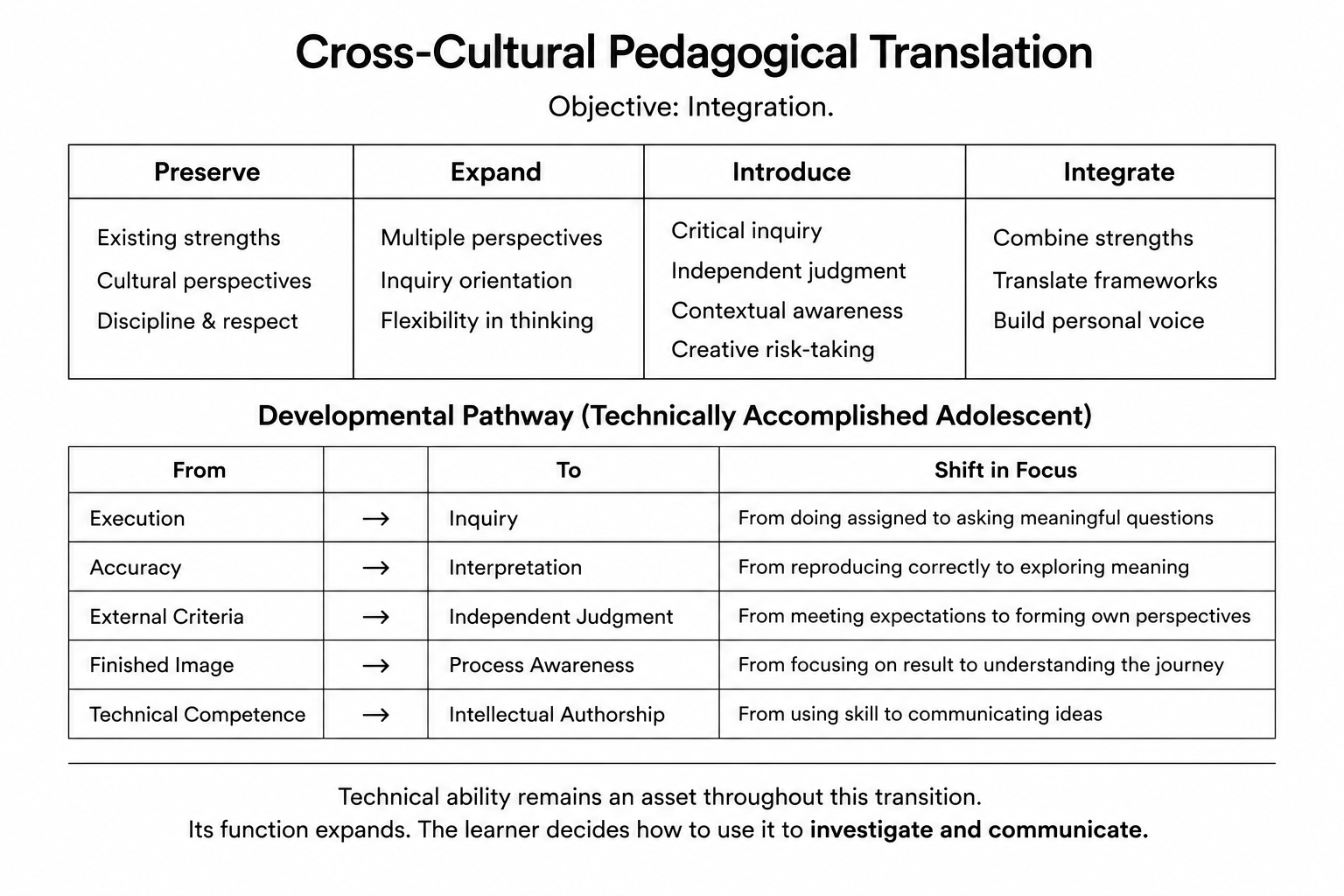
Cross-Cultural Pedagogical Translation
My own educational experience across Taiwan and North America allows me to work within this transition from both sides.
I can recognize the strengths a student has already developed within one educational environment while understanding the expectations they may encounter within another.
I describe this capacity as:
Cross-Cultural Pedagogical Translation
The objective is integration.
Research on East Asian students adapting to Western higher education provides support for this more nuanced model. Some studies describe students developing a “middle way” that integrates existing cultural and academic values with newly encountered approaches to argumentation and critical inquiry.
Within studio education, this means identifying:
what should be preserved;
what needs to expand;
what new capacities need to be introduced;
and how those capacities can work together.
For a technically accomplished adolescent, one developmental pathway might look like:
Execution → Inquiry
Accuracy → Interpretation
External Criteria → Independent Judgment
Finished Image → Process Awareness
Technical Competence → Intellectual Authorship
Technical ability remains an asset throughout this transition.
Its function expands.
The learner increasingly decides what that ability is being used to investigate and communicate.
The Educator as a Pathway Designer
This case also clarified an important dimension of my role as an educator.
Sometimes the most consequential intervention is helping a learner perceive a structure that is currently invisible.
A student may see an enormous ambition and primarily experience the distance.
An educator with knowledge of both the learner and the destination can begin revealing the intermediate architecture:
Where are you now?
What do you already possess?
Where is the actual developmental gap?
Which part matters first?
What can develop in one year?
What can develop in three years?
Which decisions can you begin making independently?
This transforms part of the educator’s role into pathway design.
Expertise, critique, scaffolding, and direction remain present while decision authority can gradually move toward the learner.
What the Artwork Documents
Seen independently, this drawing could be interpreted as a high school social-issue project.
Seen alongside the preliminary annotations and the student’s broader developmental context, it documents something more substantial.
It records an adolescent beginning to reorganize the relationship among:
skill, thought, intention, and future direction.
His technical ability provided the means to create images.
Conceptual development expanded what those images could investigate.
Goal mapping provided another layer: an emerging ability to understand personal development across a longer time horizon.
Together, these processes suggest a broader developmental trajectory:
Technical Skill
↓
Critical Observation
↓
Conceptual Interpretation
↓
Independent Judgment
↓
Goal Visibility
↓
Self-Directed Action
The finished artwork represents one point within that process.
The developmental pathway is the larger educational artifact.
Why This Matters in the AI Era
This case predates the current acceleration of generative AI, yet its underlying educational question has become increasingly relevant.
Young people now have access to systems capable of rapidly generating polished images, text, alternatives, and potential solutions.
This places increasing value on another group of human capacities:
What deserves my attention?
Which idea should I pursue?
How do I evaluate what I receive?
What matters enough to continue?
Which direction will I choose?
Can I sustain that direction over time?
For adolescents, future orientation is particularly relevant here. Research associates the ability to envision future states and connect them with present action with academic engagement, self-regulatory behavior, and positive developmental outcomes.
Studio practice provides a valuable environment for observing these capacities because decisions leave visible traces.
What does the learner select?
What do they preserve?
What do they revise?
What do they abandon?
What do they connect?
What do they eventually commit to?
The artwork can therefore function as both a creative product and a record of decision-making.
From Artwork to Agency
The educational significance of this case extends beyond the production of a more sophisticated drawing.
Development became visible across several connected domains:
Visual thinking — moving from depiction toward symbolic and conceptual relationships.
Critical interpretation — examining a social issue through interacting factors rather than isolated imagery.
Future orientation — understanding a demanding objective across a multi-year horizon.
Decision-making — recognizing relationships between present behavior and future objectives.
Self-direction — beginning to make independent choices in response to that understanding.
These capacities help explain why adolescent studio practice can extend beyond conventional definitions of art instruction.
The studio can become an environment in which young people practice:
Observation → Interpretation → Judgment → Decision → Action → Reflection
The artwork stays in the studio.
The capacity to make decisions can travel with the learner.
A Difficult Goal Can Become Reachable
One principle from this case continues to inform my work with adolescents.
Young people can hold very large ambitions.
A demanding ambition becomes more psychologically manageable when the learner can perceive a credible pathway connecting the present to that future.
Research on future-oriented thinking provides an important theoretical foundation for this observation: guiding learners to imagine future goals and connect them with current action is associated with stronger academic engagement and developmental outcomes.
For CCH, I describe the principle this way:
A difficult goal becomes psychologically reachable when the learner can see the pathway toward it.
Education can help make that pathway visible.
And once the learner can see it, the next decision can become their own.

References
Johnson, S. R. L., Blum, R. W., & Cheng, T. L. (2014). Future Orientation: A Construct with Implications for Adolescent Health and Wellbeing. International Journal of Adolescent Medicine and Health, 26(4), 459–468.
Andre, L., van Vianen, A. E. M., Peetsma, T. T. D., & Oort, F. J. (2018). Research on future-oriented thinking and academic development is synthesized in a later systematic review examining relationships among future thought, engagement, and academic outcomes.
Lo, M.-L. (2006). A Cross-Cultural Study of Art Teacher Education in Taiwan and England. International Journal of Art & Design Education, 25(2), 182–193.
Durkin, K. (2008). The Middle Way: East Asian Master’s Students’ Perceptions of Critical Argumentation in U.K. Universities. Journal of Studies in International Education, 12(1), 38–55.
Durkin, K. (2008). The Adaptation of East Asian Masters Students to Western Norms of Critical Thinking and Argumentation in the UK. Intercultural Education, 19(1), 15–27.
Moosavi, L. (2020). “Can East Asian Students Think?”: Orientalism, Critical Thinking, and the Decolonial Project. Education Sciences, 10, 286.
Zimmerman, E. (2009). Reconceptualizing the Role of Creativity in Art Education Theory and Practice. Studies in Art Education, 50(4), 382–399.