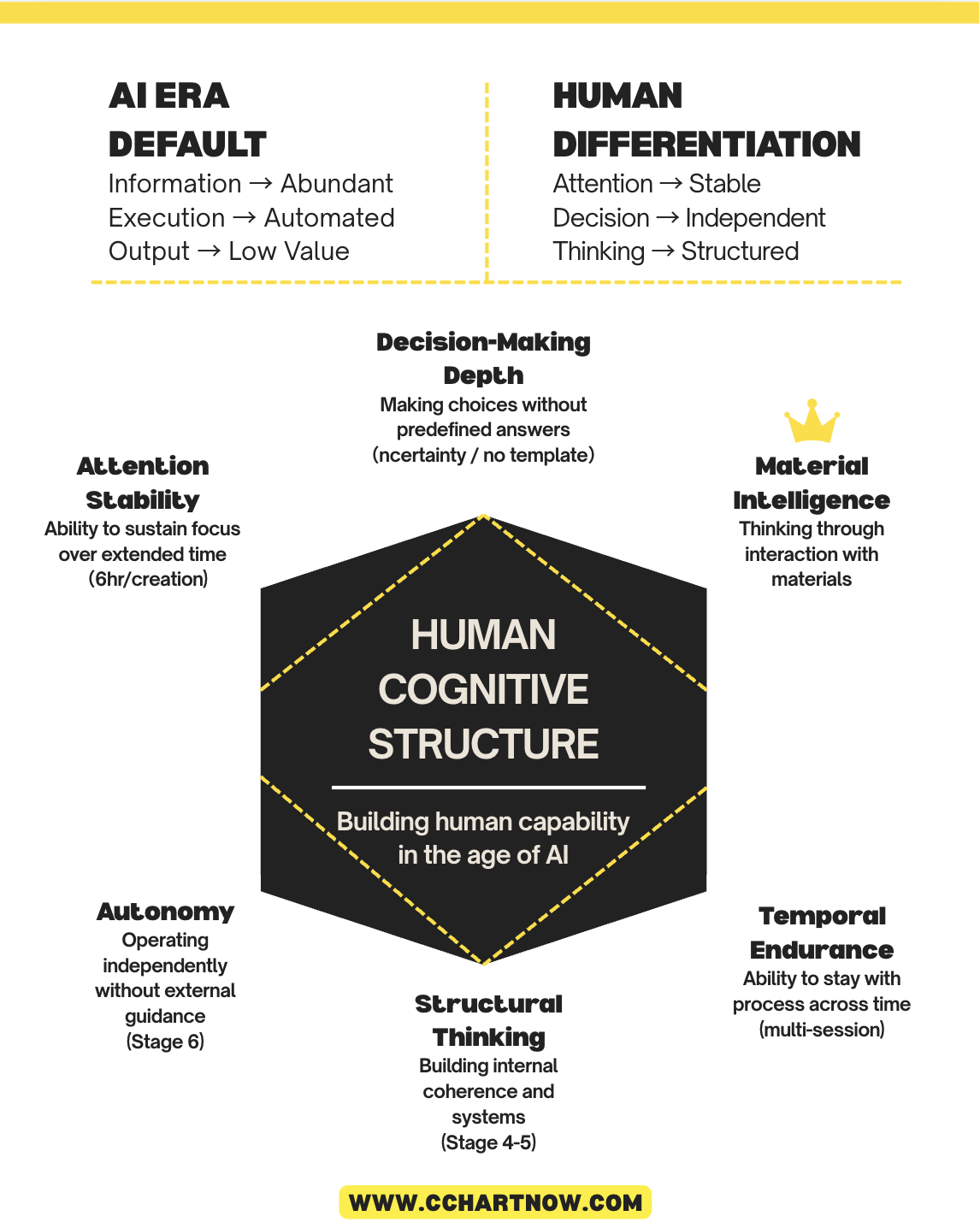
THE SHIFT IN THE AGE OF
AI
ABSTRACT
CCH is a studio-based human capability framework designed to cultivate sustained attention, adaptive judgment, and creative agency in an AI-mediated world.
Through material-based exploration and extended engagement with physical media, the studio functions as a cognitive environment where perception, decision-making, and responsibility develop through direct experience rather than instruction alone.
DEVELOPING THE INTERNAL SYSTEms THAT ENABLE SUSTAINED RESULTS
CCH focuses on strengthening cognitive capacities that support sustained attention, perceptual sensitivity, and adaptive decision-making.
Rather than emphasizing output volume, the focus is on stabilizing how individuals observe, interpret, and respond to complex environments over time.
1. Core Orientation
CCH focuses on strengthening cognitive capacities that support sustained attention, perceptual sensitivity, and adaptive judgment.
Rather than emphasizing output, the focus is on stabilizing how individuals observe, interpret, and respond to complex environments over time. Long-term capability is prioritized over short-term performance.
⸻
Why Two Hours Matters
Neuroscientific studies of attention cycles indicate that children typically require 20–40 minutes to transition from surface engagement into deep cognitive processing.
If learning environments end at 45–60 minutes, children often remain within:
• exploratory phase
• novelty phase
• emotional adjustment phase
Without crossing into:
• sustained cognitive effort
• revision-based thinking
• structural decision-making
Two hours is not extended for productivity. It is structured to allow the neural transition from initiation to consolidation.
The Neurodevelopmental Window of Sustained Attention
Human attention is not a fixed trait.
It is a trainable neural pattern shaped through repeated temporal experience. Research in developmental neuroscience consistently shows that neural circuits responsible for sustained attention, executive function, and self-regulation undergo rapid maturation during early and middle childhood. These networks strengthen not through short bursts of stimulation, but through repeated exposure to stable, time-extended engagement.
In other words:
Depth is built through duration.

When children repeatedly experience:
• entering focus
• encountering resistance
• persisting beyond distraction
• adjusting decisions over time
the brain encodes a structural memory:
“I can remain engaged.”
This becomes an internal cognitive model that transfers to reading, problem-solving, research, athletics, and creative work. CCH is designed around this neurodevelopmental principle:
Time is not a container — it is the mechanism.
⸻
Long-Term Structural Impact
Repeated deep-focus experiences during early neurodevelopment:
• Increase attentional stamina
• Strengthen inhibitory control
• Improve cognitive flexibility
• Enhance self-directed learning capacity
These effects extend beyond artistic expression.
They influence:
Reading endurance
Problem-solving persistence
Research capacity
Athletic training discipline
Independent thinking
Creativity becomes a byproduct of neural stability.
2. Why Materials
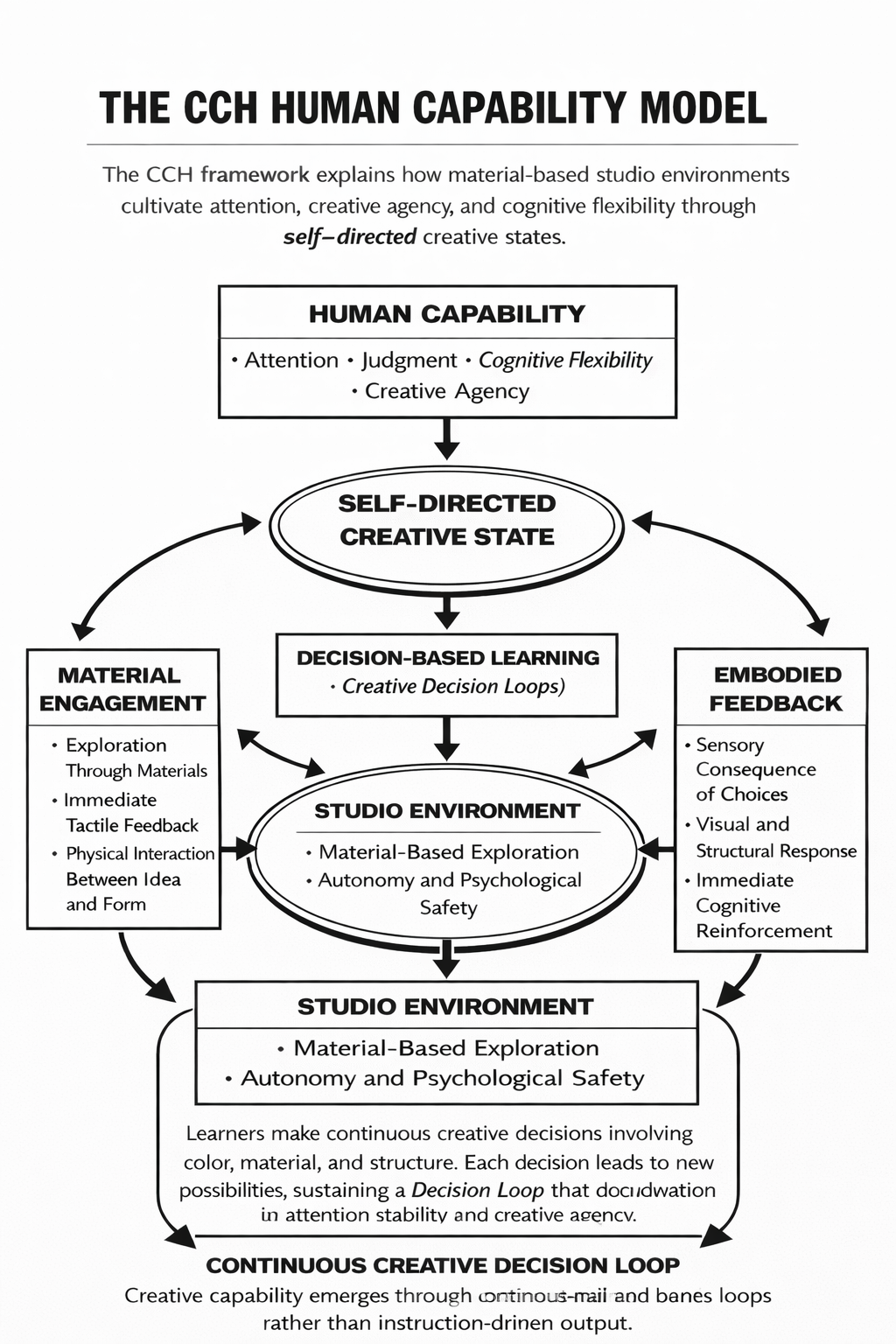
Materials provide immediate feedback, making thinking visible through action.
Embodied engagement stabilizes attention in ways purely conceptual instruction often cannot. When hands interact with physical media, perception, emotional regulation, and decision-making begin to align.
Because real-world environments are layered — practical demands, internal states, and social context continuously interacting — material-based exploration allows these layers to be observed and adjusted simultaneously.
Material interaction generates continuous decision loops through which attention stability, creative agency, and structural cognition develop over time.
CCH
operates through material-based artistic engagement
Art is not positioned as an expressive outcome, but as a structural medium through which cognition is organized, attention is stabilized, and internal decision architecture is formed.
Within sustained material interaction, aesthetic judgment, spatial reasoning, and consequence-based thinking develop as integrated cognitive processes.
These structural conditions extend across developmental stages — from early childhood to adult cognitive recalibration — wherever sustained attention and independent judgment are required.
3. Learning in the Age of Ai
Artificial intelligence has lowered technical barriers to creation and accelerated access to information. In this context, education can no longer focus on output alone.
Within CCH, AI is approached as a cognitive tool supporting exploration, while human capacities remain central: sustained attention, aesthetic judgment, contextual awareness, and interpretive depth.
As creative processes become increasingly automated, the critical question shifts from whether AI can generate content to how individuals cultivate discernment and responsibility in using emerging tools.
Art education therefore functions not only as creative practice, but as cognitive development within a visually saturated and algorithmically mediated world.
4. Creative Foundations of Practice
Creative work emerges from multiple interacting modes. Some practice is grounded in accumulated knowledge, technique, and cultural frameworks. Other forms arise from direct perception and lived experience, often observable in children’s unconditioned creative processes.
Mature creative practice develops through interaction between these modes. CCH environments support movement across structured knowledge and perceptual sensitivity without forcing premature specialization.
Cognitive
infraStructural
Architecture
Identity&
Autonomy layer
Temporal Autonomy
Creative Identity Formation
Structural
Processing Layer
Material Economy
Structural Cognition
Stability
Foundation Layer
Attention Stability
Emotional Stability
01 — Attention Stability
The capacity to sustain focused engagement within low-stimulation, materially grounded environments. Supports depth-oriented processing over speed-driven output.
02 — Temporal Autonomy
The ability to navigate extended timeframes without externally imposed urgency. Cultivates decision pacing, delayed resolution tolerance, and internal time regulation.
03 — Material Economy
Intentional interaction with physical constraints and resource variables. Strengthens clarity of choice, structural discernment, and embodied reasoning.
04 — Structural Cognition
Three-dimensional spatial logic and consequence-based construction. Develops proportional judgment, balance awareness, and systemic problem-solving.
05 — Emotional Stability Under Constraint
Regulation capacity within non-performative, comparison-free environments. Reduces reactive decision patterns and supports coherent cognitive processing.
06 — Identity Coherence Through Practice
Long-duration engagement enabling internal authority and consistent decision continuity across contexts.
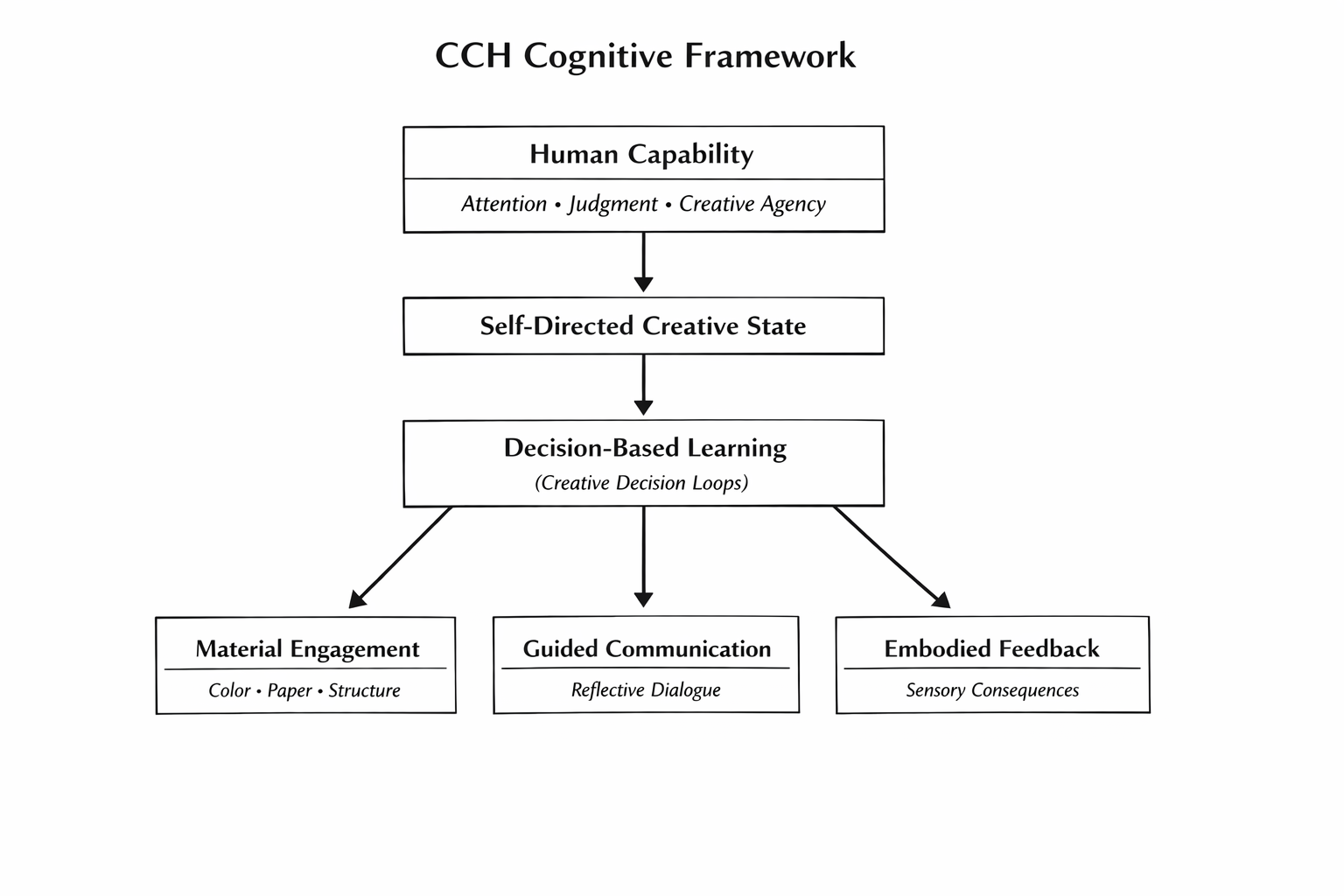
Beyond Mechanism
CCH can be understood not only as a system,
but as a form of internal composition.
CCH – Creative Work as Internal Composition
5. How It Works
Process Architecture
5.1 Observe
Identify where attention fragments, avoidance appears, and decision-making becomes constrained.
5.2 Build
Materials function as a thinking laboratory. Simple actions reveal patterns of response, preference, hesitation, and adaptation.
5.3 Iterate
Small refinements are repeated until stability develops and capability becomes reliable.
5.4 Integrate
Insights developed in the studio are translated into daily life, academic work, and long-term direction.
5.5 Closure & Consolidation
Deep engagement frequently generates cognitive momentum beyond scheduled studio sessions. Within CCH, this is not framed as excess intensity, but as a natural phase within sustained attention cycles. Structured closure intervals are intentionally built into the process to support reflection, consolidation, and intentional disengagement. These moments transform temporary immersion into transferable cognitive stability.
6. Who It’s For
Children developing foundational attention capacity
Adolescents navigating identity formation and academic pressure
Adults seeking cognitive renewal or creative recalibration
Mixed-age groups benefiting from intergenerational learning
7. Outcomes
Participants commonly demonstrate:
Increased sustained attention
Greater interpretive clarity
Strengthened creative confidence
Improved resilience in high-stimulation environments
These outcomes emerge gradually through environmental design rather than performance-driven instruction.
Opening space for intuitive choices and unexpected creative shifts.
Educational Context
As artificial intelligence becomes increasingly embedded in daily life, educational priorities are shifting. The central challenge is no longer access to information, but the capacity to sustain attention, make sound decisions, and act responsibly in complex environments.
Several structural trends are emerging globally:
1. From Knowledge Acquisition to Capability Development
Information is increasingly externalized through AI systems. Education is moving toward cultivating judgment, resilience, attention stability, and long-term cognitive capacity.
2. From Screen-Based Learning to Embodied Experience
Extended digital exposure has intensified attention fragmentation. Material-based and studio-centered learning environments are regaining importance as stabilizing contexts for perception and focus.
3. From Standardized Outputs to Adaptive Thinking
Future professional environments demand comfort with uncertainty, iterative adjustment, and decision-making without complete information.
4. From Individual Performance to Responsible Agency
As automation expands, human value increasingly lies in discernment, ethical awareness, and the ability to navigate complex systems.