
Where Art Becomes a Science of Thinking
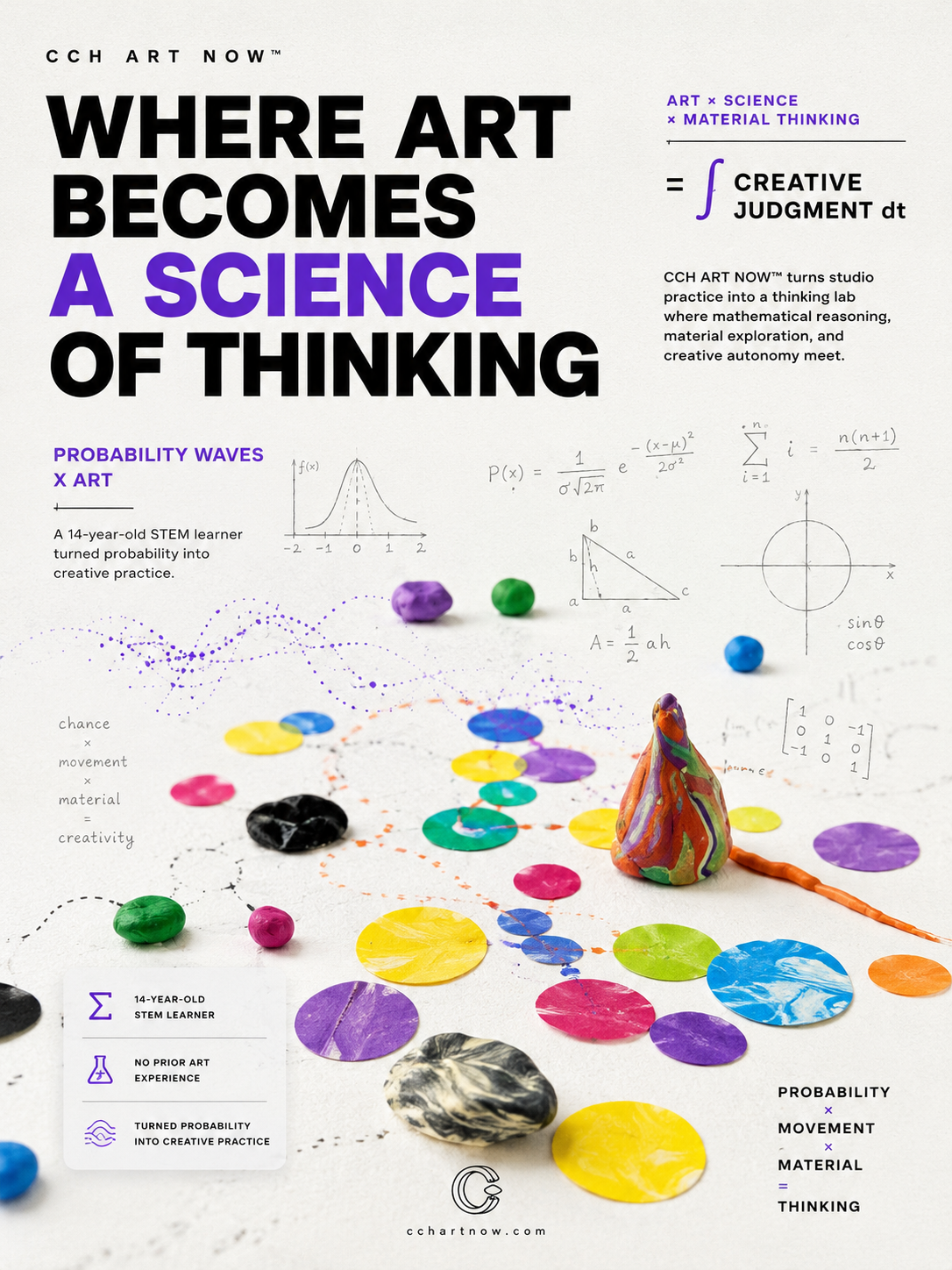
ART × SCIENCE × MATERIAL THINKING
= ∫ CREATIVE JUDGMENT dt
Abstract
The rise of generative artificial intelligence is changing the fundamental purpose of education. When images, texts, summaries, and standardized answers can be produced instantly, the central educational question is no longer whether learners can generate output. The deeper question is whether they can develop the human capacities that make output meaningful: sustained attention, independent judgment, embodied perception, creative autonomy, emotional resilience, and the ability to work through uncertainty.
CCH ART NOW™ responds to this shift by reframing visual art practice as a studio-based human capability system. Rather than treating art education as technique training, self-expression alone, or the production of visually pleasing outcomes, CCH uses long-duration, zero-screen, material-based studio practice to cultivate the learner’s capacity to observe, choose, revise, persist, and transform internal ideas into material form.
Drawing from international education research, creative thinking assessment, embodied cognition, arts education, and early CCH studio observations, this article argues that CCH is especially relevant to AI-era education because it strengthens the human capacities that automated systems cannot replace.
1. Not Art Class. A Laboratory for Human Thinking.
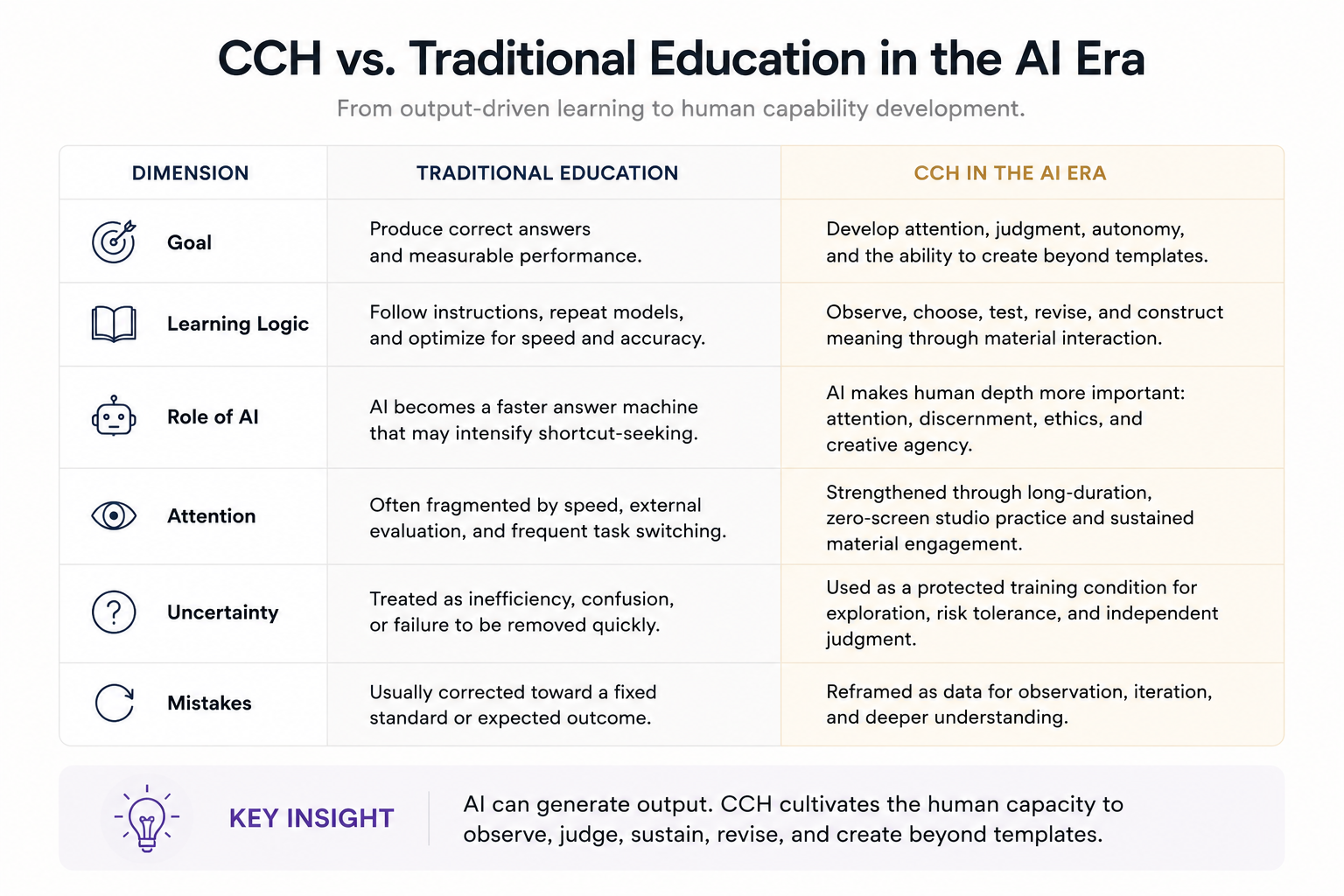
Generative AI has made output faster, cheaper, and more accessible. A learner can now produce a written paragraph, an image, a summary, or a structured answer within seconds. This technological acceleration changes the role of education. If education remains focused primarily on memorization, repetition, template application, and rapid answer production, it risks training students for tasks that machines increasingly perform well.
The problem is not technology itself. The problem is whether learners still have protected conditions to build deep attention, judgment, embodied engagement, and independent problem-solving. UNESCO’s 2023 Global Education Monitoring Report argues that technology in education must be evaluated according to context, purpose, equity, and learning need, rather than assumed to be automatically beneficial. The report’s central question — technology “on whose terms?” — is directly relevant to AI-era education (UNESCO, 2023).
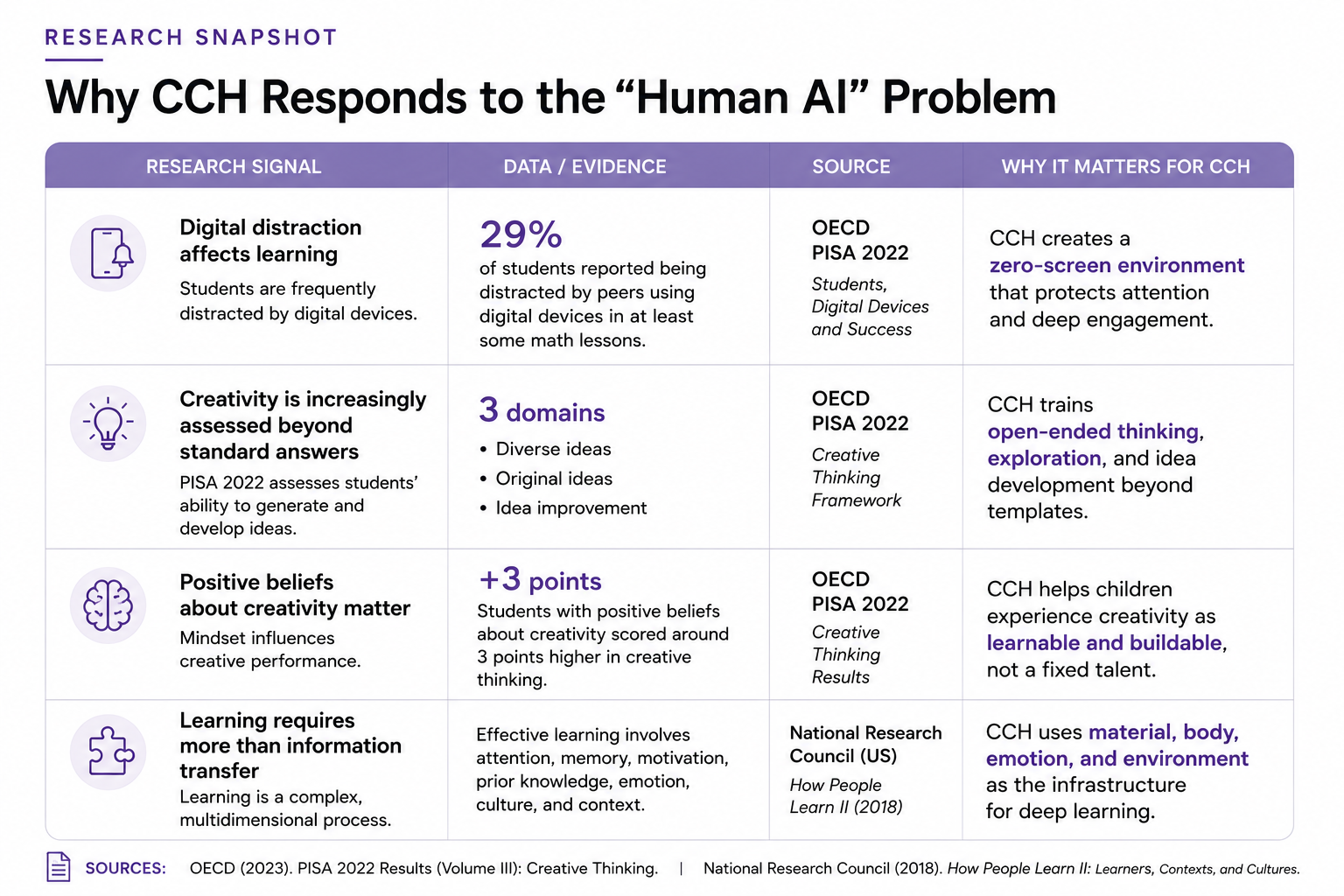
OECD data also complicate the assumption that more digital exposure automatically improves learning. In its PISA-related report on managing screen time, OECD reported that nearly one in three students, on average across OECD countries, said students in their classes are distracted by digital devices in most or every mathematics lesson (OECD, 2024). This does not mean that digital tools should be rejected. It means that education must intentionally protect the cognitive conditions under which attention, reflection, and deeper learning can develop.
CCH ART NOW™ is designed for this gap. It does not begin by asking how children can use AI tools more efficiently. It asks what human capacities children need before, alongside, and beyond automated output.
2. From Standard Answers to Creative Thinking
A major shift in global assessment is already visible. OECD’s PISA 2022 creative thinking assessment examines students’ ability to generate diverse and original ideas, evaluate possibilities, and improve their responses across written expression, visual expression, social problem-solving, and scientific problem-solving. This marks an important movement away from single correct answers and toward open-ended thinking, flexible reasoning, and the capacity to develop ideas over time.
The findings also show that creativity is not simply a fixed talent. Students with positive beliefs about creativity scored around three points higher in creative thinking than their peers. Around eight out of ten students, on average across OECD countries, believed that creativity is possible in nearly any subject. However, only about one in two students believed that their own creativity is something they can change.
This gap is educationally significant. Many students may understand creativity as valuable, but still do not experience it as personally trainable. CCH responds to this gap by creating learning conditions where children encounter materials, make decisions, test possibilities, revise when outcomes change, and develop meaning through action. In this context, creativity is not treated as decoration or talent. It becomes a cognitive process that can be supported, practiced, and strengthened.
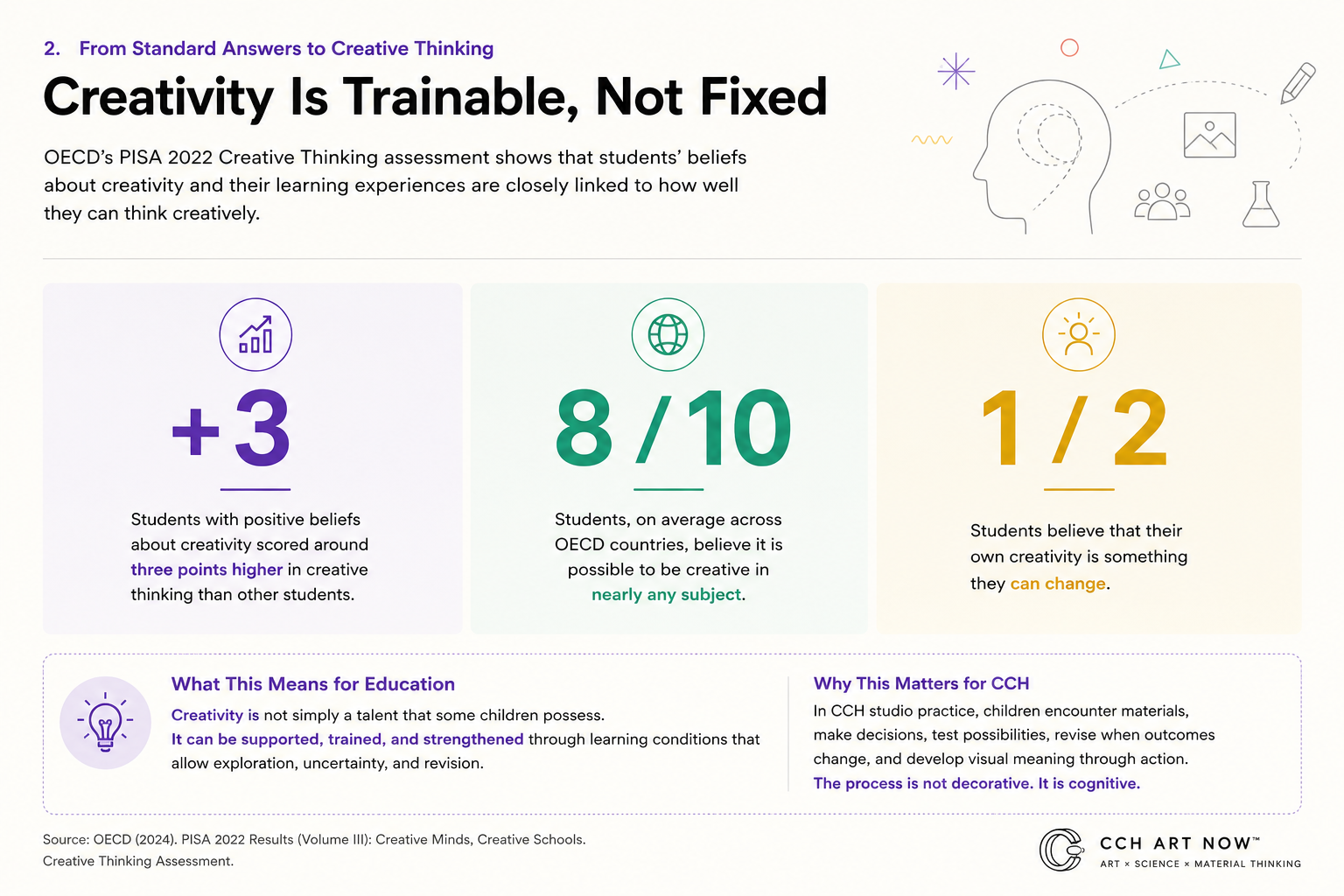
CCH aligns with this direction. In CCH studio practice, children are not asked to copy a model or produce a predetermined result. They are asked to encounter materials, make decisions, test possibilities, revise when outcomes change, and develop visual meaning through action. The process is not decorative. It is cognitive.
3. Why Studio-Based Practice Supports Cognition
Learning is not only the transfer of information into the mind. How People Learn II emphasizes that learning involves attention, memory, prior knowledge, motivation, emotion, culture, and context. Human learning is shaped by the environments in which learners act, perceive, and make meaning (National Academies of Sciences, Engineering, and Medicine, 2018).
Embodied cognition research further supports the idea that cognition is not isolated inside the brain. Learning can be shaped by bodily action, sensory engagement, spatial interaction, and environmental feedback. Educational research on embodied cognition and instructional manipulatives suggests that physical interaction with materials can support learning when the interaction is meaningfully structured rather than merely decorative (Pouw, van Gog, & Paas, 2014; Castro-Alonso, de Koning, & Paas, 2024).
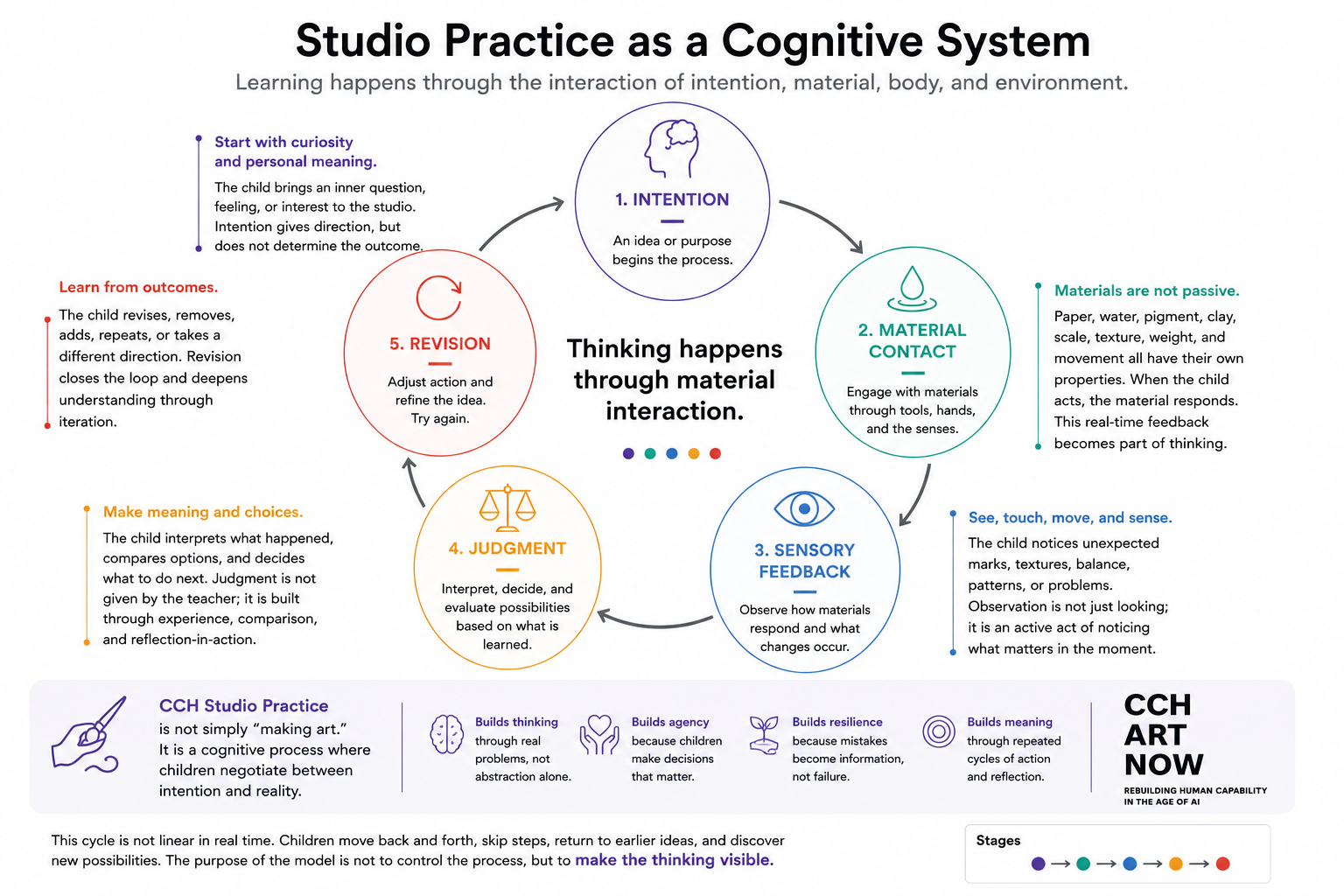
CCH turns this principle into a studio method. Paper, water, pigment, scale, texture, movement, and hand-eye coordination are not secondary to thinking. They are part of the thinking system. A child working with watercolor must observe how water spreads, how pigment changes, how paper absorbs, how pressure alters a mark, and how an intended image must adapt to material behavior.
This makes material practice a cognitive environment. The child does not simply “make art.” The child learns to negotiate between intention and reality.
4. CCH as a Response to the “Human AI” Problem
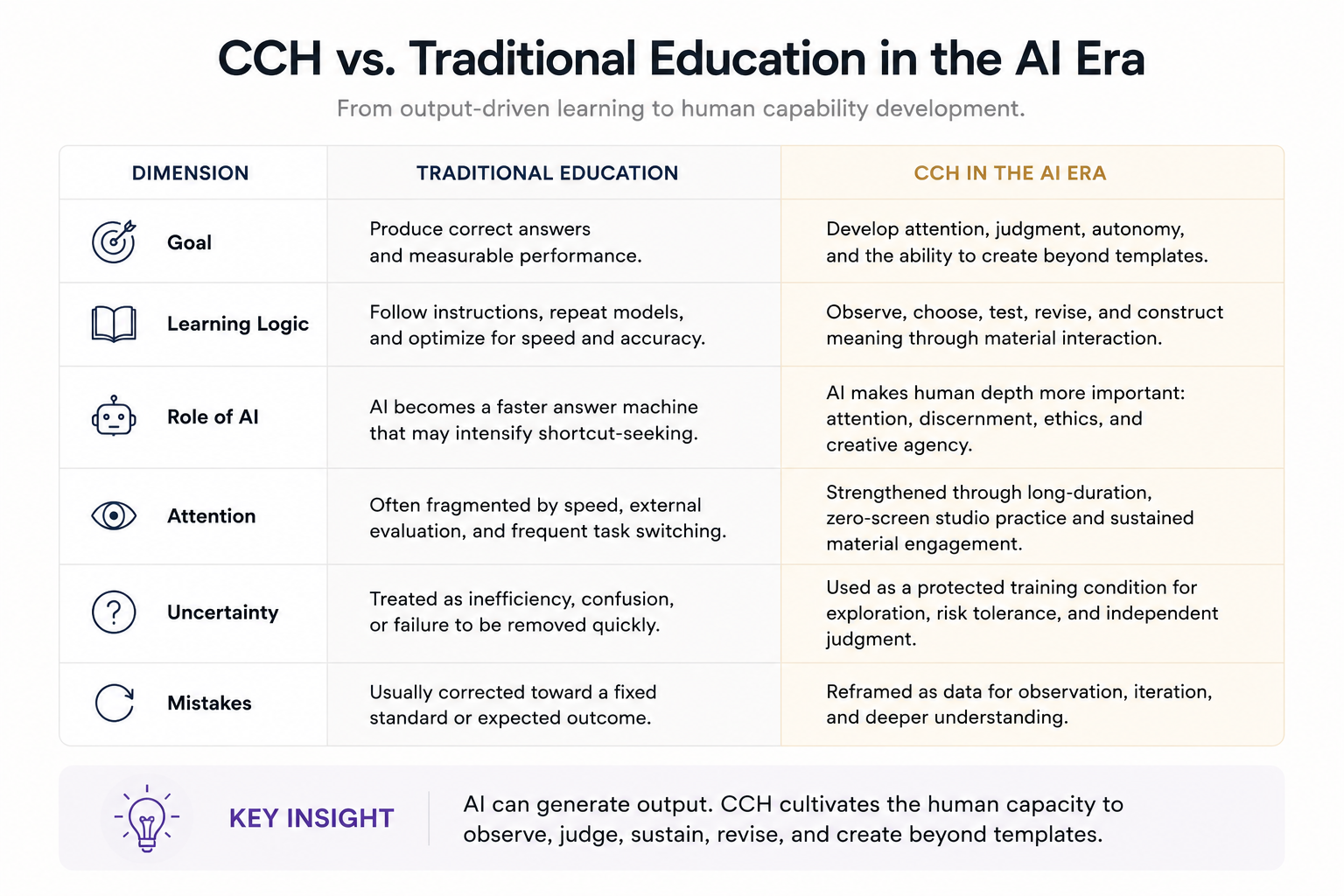
In the AI age, one of the risks of education is not that children will use technology, but that they may be trained to think like machines. When learning is overemphasized as memorization, copying, standard-answer production, and fast performance, students may become highly responsive but increasingly dependent on templates, instructions, and external validation. They may learn how to produce answers without developing the deeper capacity to observe, question, decide, revise, or create meaning independently.
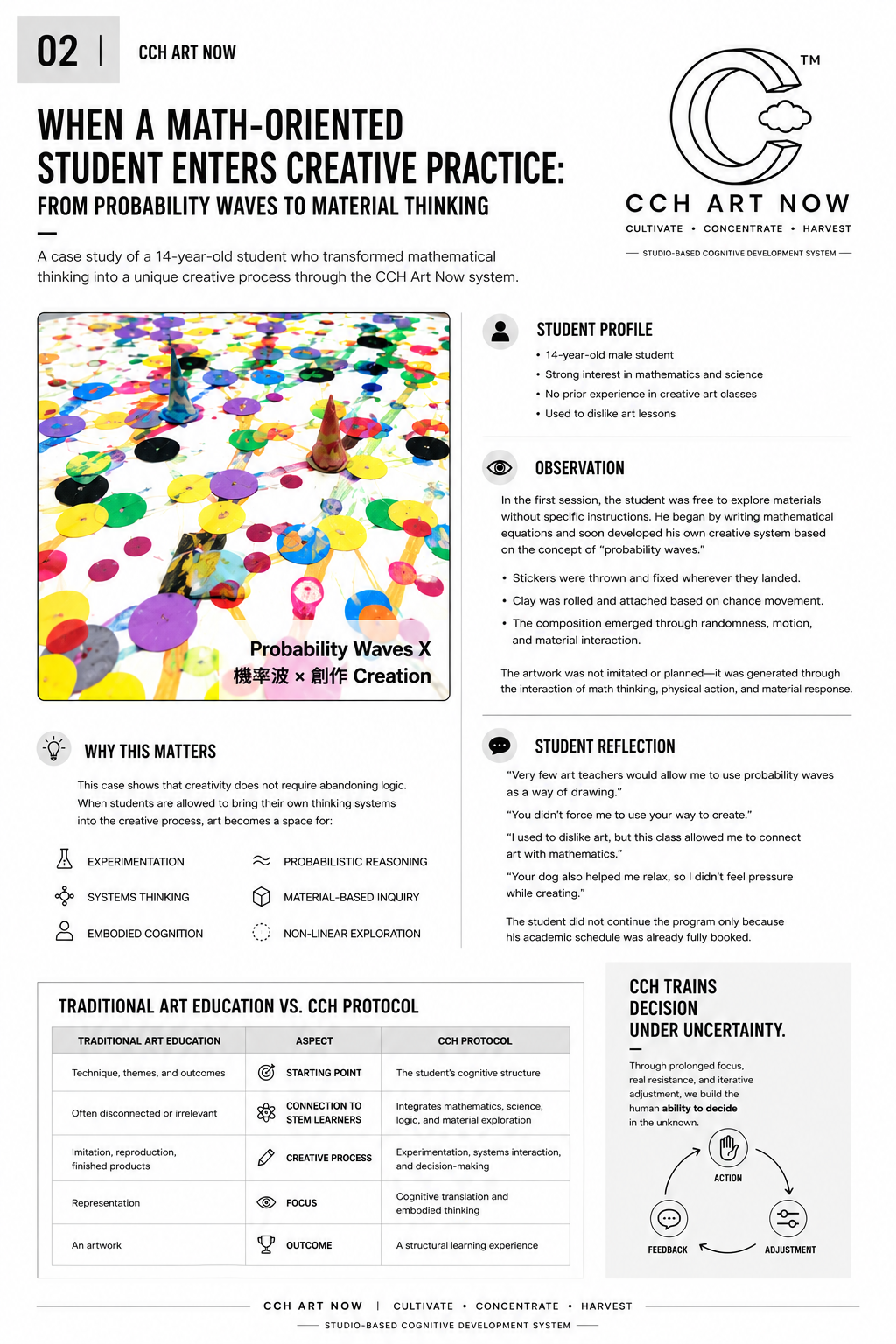
CCH is structured in the opposite direction. Instead of accelerating output, it slows the learning process down. Instead of giving children a fixed model to copy, it removes the template and places the learner in direct contact with materials, uncertainty, and choice. In a CCH studio environment, the child is not asked to compete with AI in speed or efficiency. The child is asked to notice what is happening, make decisions, tolerate ambiguity, respond to material feedback, and revise through action.
This distinction is essential. AI can generate images, texts, and answers, but it cannot give a child the lived experience of hesitation, trial, failure, adjustment, and self-discovery. It cannot replace the moment when a learner realizes that a mistake can become information, that uncertainty can become a starting point, or that an original decision has value. These are not simply artistic experiences; they are human developmental experiences.
For this reason, CCH does not position studio practice as a decorative alternative to academic learning. It treats studio practice as a protected condition for building human capacities that AI cannot develop on behalf of the child: sustained attention, patience, embodied judgment, emotional tolerance, creative autonomy, and meaning-making under uncertainty. The goal is not to make children faster than machines. The goal is to help them become more deeply human in a world increasingly shaped by automated output.
5. Early CCH Evidence: Material Risk, Attention, and Autonomy
CCH’s current evidence base should be described carefully. It is early qualitative evidence, not a formal third-party evaluation or randomized study. However, the emerging records are meaningful because they document observable learning behavior in studio settings.
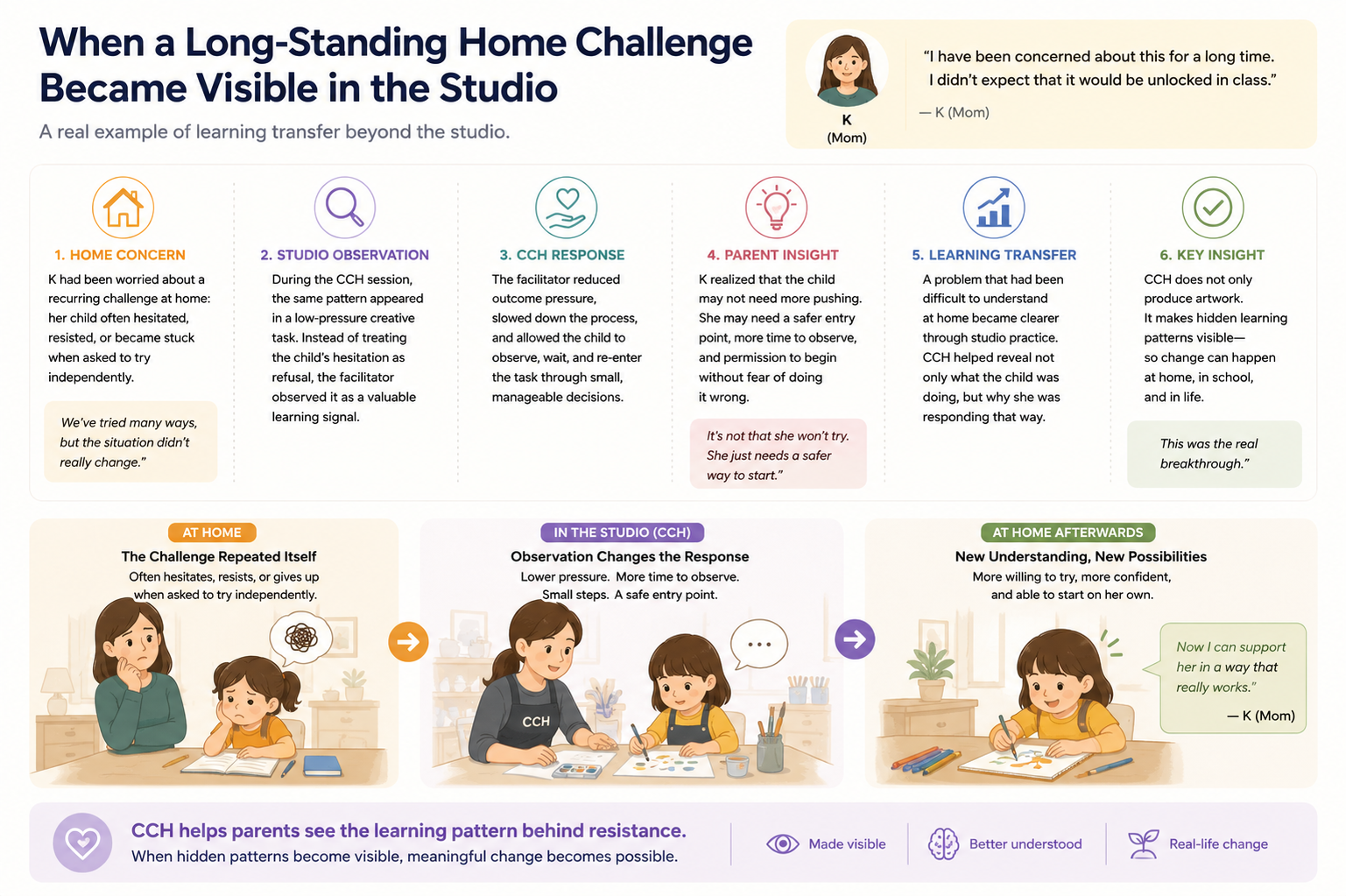
In a June 2026 CCH class observation report, Student X initially resisted a large-scale watercolor flow activity. The report notes that the child was not refusing learning itself; rather, she was encountering the risk of uncertainty, loss of control, and the possibility that the work might not look “good.” Once outcome pressure was reduced and the task was reframed as material exploration, the child gradually entered the activity. This suggests that resistance can represent the edge of learning rather than the absence of learning.
A parallel observation report for Student Y describes watercolor exploration as a process in which the child used water, pigment, brushes, hand sensation, and full-sheet paper to understand how materials change and how the self makes judgments within change. The report frames the class not as “just drawing,” but as the use of body, material, and space to build attention.
Parent feedback provides another layer of evidence. One technology-sector family reported that the learner moved from simply filling areas with color toward making intentional color choices, experimenting with different expressive methods, and developing richer visual compositions. The father observed that the child’s sustained attention and patience improved: when encountering difficulty, she increasingly tried first before seeking adult help. The mother observed stronger everyday observation, associative thinking, material collection, and the ability to transform imagined ideas into concrete work.
These observations matter because they point beyond conventional art outcomes. The evidence does not simply say that the child enjoyed art. It suggests changes in attention, patience, independent problem-solving, material thinking, and cognitive transfer beyond the studio.
6. Why Parent Feedback Matters as Early External Validation
Parent feedback should not be presented as independent evaluation. Parents are not neutral third-party researchers, and their comments should not be used as formal impact measurement. However, parent observation remains valuable because it can show whether learning extends beyond the studio environment. If a child only demonstrates attention, problem-solving, or creative confidence during class, the evidence is still limited. When parents begin to observe similar changes at home, in daily routines, in play, or in the child’s response to difficulty, the learning signal becomes stronger.
In CCH parent feedback records, parents described changes that go beyond art-making. They observed that the child became more attentive to the surrounding world, generated stronger associations, persisted through difficulty, collected and integrated materials, and worked to transform imagined ideas into concrete forms. These observations suggest that CCH may support broader human capacities such as sustained attention, creative confidence, independent problem-solving, emotional regulation, and the ability to connect internal thinking with external action.
This type of feedback is especially meaningful when it comes from parents working in technology-related fields. Their comments do not describe CCH as a conventional art class or an output-based enrichment activity. Instead, they identify its value in independent thinking, problem-solving, and the child’s ability to realize ideas through process. In this sense, parent feedback functions as early external validation: not as formal proof, but as evidence that CCH’s studio-based learning may transfer into real-life behavior, family observation, and long-term human capability development.
7. CCH and the Future of AI-Era Education
AI education is often understood as teaching students how to use digital tools, generate prompts, or produce faster outputs. These skills are useful, but they are not enough. Before learners can use powerful technologies responsibly, they need the human capacities to guide them: attention, judgment, ethical awareness, embodied perception, and creative autonomy.
CCH is not anti-AI. It prepares the human side of the AI age. Its central claim is that before output, there must be attention; before specialization, there must be integration; before tool use, there must be judgment; and before speed, there must be the capacity to stay with a problem long enough to understand it.
Within this framework, the studio becomes a protected learning environment where children practice capacities that cannot be automated for them. They learn to stay with uncertainty, make independent decisions, observe material feedback, revise without collapse, translate internal images into external form, and build confidence through process rather than approval.
These are not soft extras. They are foundational human capabilities. In a world where machines can increasingly generate answers, images, and polished results, CCH protects the slower human processes that allow children to think, judge, create, and make meaning beyond automated systems.
Conclusion
The future of education cannot be limited to faster production, better templates, or more efficient answer generation. AI has made output abundant. Human depth is becoming the scarce resource.
CCH ART NOW™ addresses this educational moment by using studio practice as a system for human capability development. Through long-duration, zero-screen, material-based creative work, children encounter uncertainty, resistance, choice, and revision. They learn not only how to make something, but how to remain attentive, make judgments, tolerate ambiguity, and bring internal ideas into material reality.
AI can generate output.
CCH cultivates the human capacity to judge, sustain, revise, and create beyond templates.
References
Castro-Alonso, J. C., de Koning, B. B., & Paas, F. (2024). Research avenues supporting embodied cognition in learning and instruction. Educational Psychology Review.
National Academies of Sciences, Engineering, and Medicine. (2018). How People Learn II: Learners, Contexts, and Cultures. National Academies Press.
OECD. (2023). PISA 2022 Results, Volume I: The State of Learning and Equity in Education. OECD Publishing.
OECD. (2024). Managing Screen Time: How to Protect and Equip Students Against Distraction. OECD Publishing.
OECD. (2024). PISA 2022 Results, Volume III: Creative Minds, Creative Schools. OECD Publishing.
Pouw, W. T. J. L., van Gog, T., & Paas, F. (2014). An embedded and embodied cognition review of instructional manipulatives. Educational Psychology Review.
UNESCO. (2023). Global Education Monitoring Report 2023: Technology in Education — A Tool on Whose Terms?
CCH ART NOW™. (2026). WISE Evidence Brief: Learning Through Material Risk. Internal application evidence brief.
CCH ART NOW™. (2026). Class Observation Report: Student X — Attention Through Material Risk. Internal studio observation report.
CCH ART NOW™. (2026). Class Observation Report: Student Y — Attention Through Material. Internal studio observation report.
CCH ART NOW™. (2026). Anonymized Parent Feedback — English Translation. Internal parent observation record.
Research and Evidence Base
This article draws on international research in education technology, creative thinking, embodied cognition, and learning science. UNESCO’s 2023 Global Education Monitoring Report frames educational technology as a contextual tool whose value depends on learning purpose, equity, and implementation conditions, rather than as an automatic solution. OECD’s PISA 2022 creative thinking assessment evaluates students’ capacity to generate diverse and original ideas, improve ideas, and solve open-ended problems across written, visual, social, and scientific domains. OECD’s work on screen time also highlights the learning risks associated with digital distraction in classrooms. How People Learn II provides the broader cognitive-science foundation for understanding learning as context-sensitive, socially situated, and shaped by attention, prior knowledge, motivation, and environment.
CCH ART NOW™ evidence is drawn from early internal documentation, including the WISE Evidence Brief, class observation reports for Student X and Student Y, and anonymized parent feedback. These records document parent observations, studio-based attention records, material-risk learning moments, and early qualitative evidence of sustained attention, creative autonomy, emotional regulation, and material-based problem-solving. These materials are used as early practice-based evidence and should not be interpreted as independent third-party evaluation.