
The First Principles of CCH
Rebuilding Human Capability Before Output
CCH ART NOW™
CCH ART NOW™ begins from the understanding that human beings were never originally formed as fragmented categories. A child does not enter the world first as an artist, engineer, scientist, designer, entrepreneur, or psychological type. A child first encounters reality as an integrated living organism: sensing, touching, moving, observing, failing, adapting, and constructing meaning through direct interaction with the environment. Fragmentation emerges later through educational, institutional, and professional systems that divide knowledge into disciplines, credentials, labels, and measurable outputs. This structure has undeniably produced enormous advances across medicine, engineering, science, architecture, computation, and design. Yet it has also produced a cognitive cost. When knowledge becomes increasingly specialized and compartmentalized, people may begin to confuse disciplinary categories with identity itself. Terms such as “artist,” “engineer,” “creative person,” “technical person,” or “manager” begin as organizational tools for knowledge, yet over time they can become psychological containers that restrict how individuals understand their own potential. CCH therefore approaches education from a first-principles perspective: before human beings become professional categories, they exist as integrated cognitive organisms capable of perception, adaptation, imagination, embodied decision-making, and meaning formation across systems.
1. First Principles: What Exists Before Creativity?
First-principles thinking asks us to reduce a problem to its most fundamental conditions. Applied to education, this means asking a deeper question before any discussion of subject mastery begins: before a child becomes “good at art,” “good at science,” “good at writing,” or “good at problem-solving,” what human capacities must already exist? From the perspective of CCH ART NOW™, creativity does not begin with technique, style, or predefined knowledge. It begins with a set of underlying cognitive conditions that allow human capability to emerge: attention stability, perceptual sensitivity, tolerance for uncertainty, embodied decision-making, material responsiveness, exploratory cognition, resistance endurance, and the capacity to remain inside an unfinished process long enough for structure and meaning to gradually form. This fundamentally reframes the educational question. Rather than asking only what subjects should be taught, CCH asks what conditions allow a human being to think, perceive, decide, adapt, and create as an integrated organism. For this reason, CCH does not begin by asking how to produce better artworks. It begins by asking what must exist before meaningful creation, independent judgment, innovation, and human capability can emerge at all.
2. CCH Evidence: Sustained Creative Immersion in Early Childhood
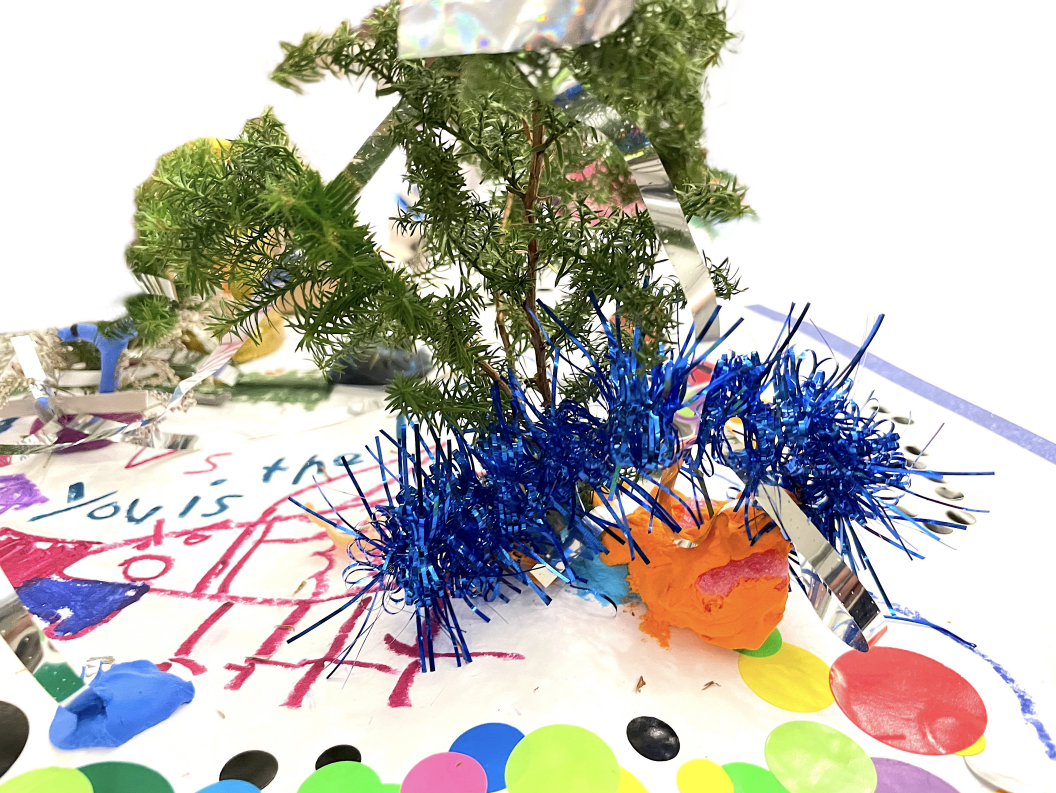
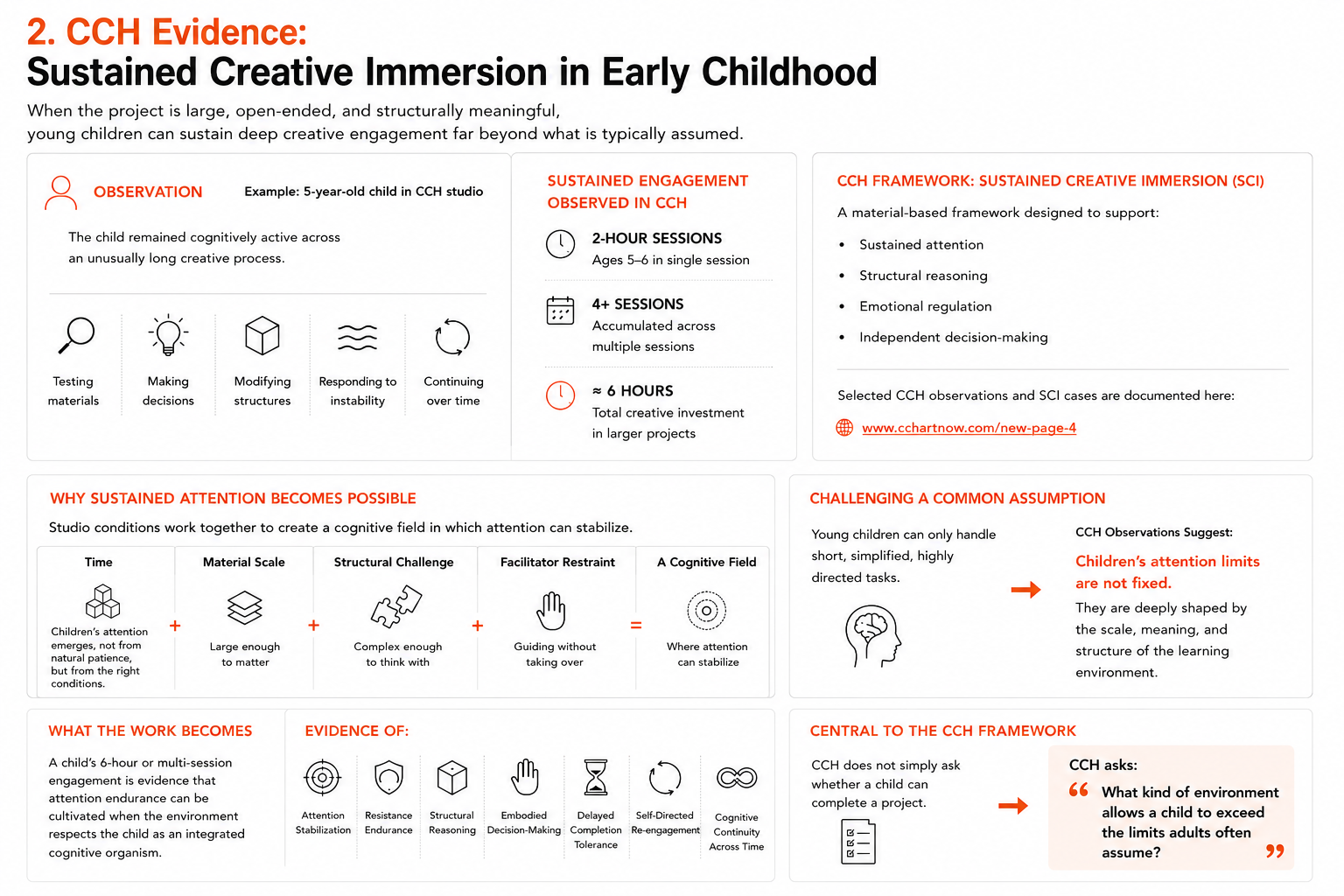
This first-principles question is not merely theoretical; it is directly observable within CCH studio practice. In one documented CCH observation, a five-year-old child sustained deep engagement across an unusually extended creative process. The child did not simply remain occupied within a structured activity, but remained cognitively active throughout the process: testing materials, making decisions, modifying structures, responding to instability, and continuously extending the work over time. Across multiple CCH cases, children between the ages of five and six have demonstrated sustained attention through extended two-hour sessions, with larger projects accumulating across four sessions or more and sometimes reaching approximately six hours of total creative investment. What initially appears to exceed the assumed cognitive capacity of early childhood becomes possible when the learning environment is designed appropriately. In CCH, projects must be sufficiently large to matter, open enough to invite exploration, and stable enough to allow children to return without psychological reset. Under these conditions, engagement becomes structurally sustained rather than externally enforced.
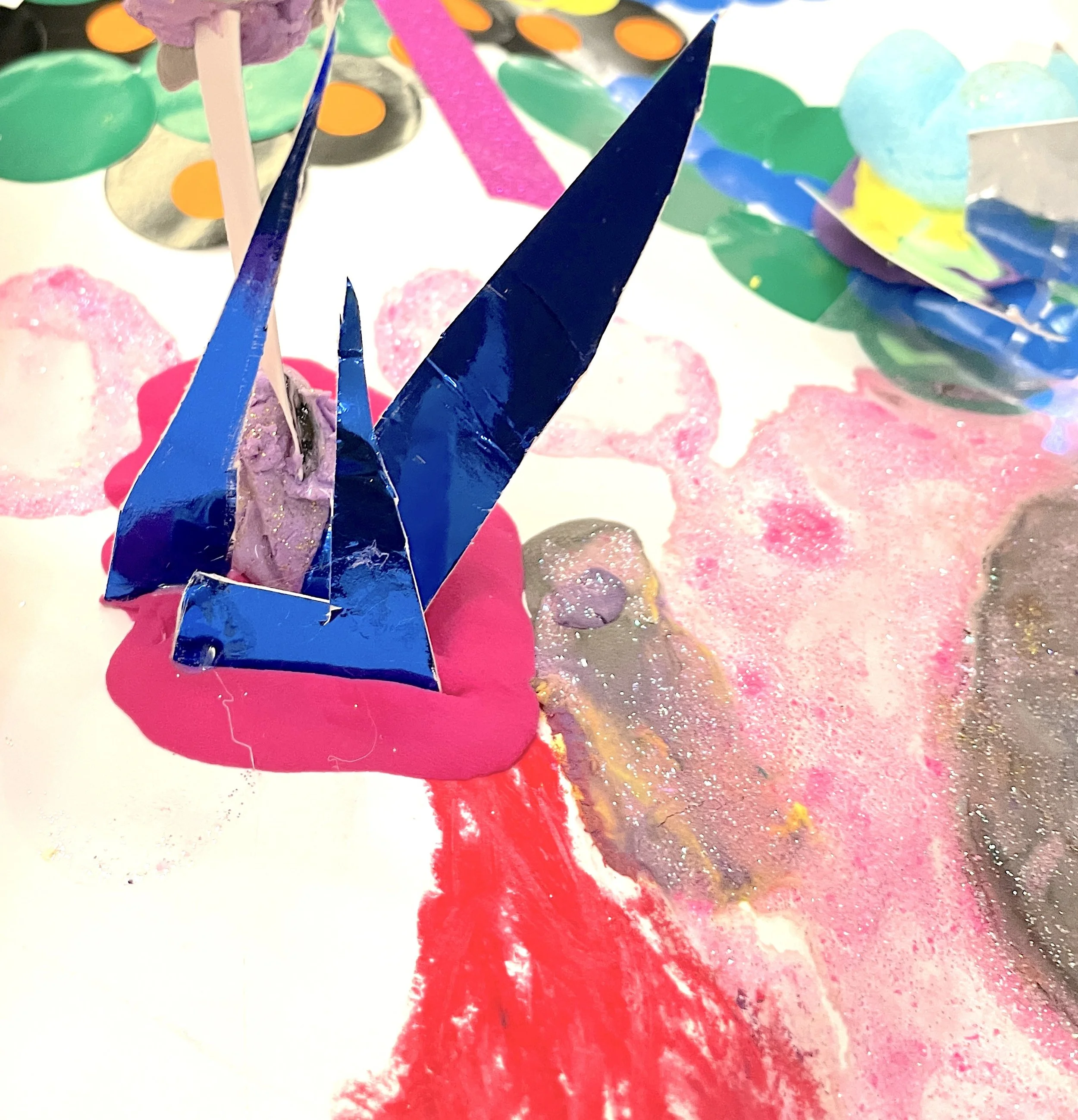
CCH refers to this phenomenon as Sustained Creative Immersion (SCI) — a material-based developmental framework designed to support sustained attention, structural reasoning, emotional regulation, and independent decision-making during early childhood. The educational implications of SCI are significant. A child’s attention does not emerge simply because the child possesses unusual patience or innate focus. Attention stabilizes because the studio conditions allow it to stabilize. Time, material scale, structural challenge, and facilitator restraint work together to construct a cognitive field in which the child can remain with difficulty rather than immediately withdrawing from it. This directly challenges a common assumption within early childhood education: that young children are only capable of short-duration, simplified, highly directed tasks. CCH observations instead suggest that children’s attentional limits are not fixed, but are profoundly shaped by the scale, meaning, and structural conditions of the learning environment itself.
From this perspective, a child’s six-hour or multi-session engagement should not be interpreted merely as “good focus.” Rather, it becomes evidence that attentional endurance can be cultivated when the educational environment recognizes the child as an integrated cognitive organism. Under these conditions, the work becomes more than an artwork; it becomes observable evidence of attention stabilization, resistance endurance, structural reasoning, embodied decision-making, delayed completion tolerance, self-directed re-engagement, and cognitive continuity across time. This principle is central to the CCH framework. CCH does not simply ask whether a child can complete a project. It asks a more foundational educational question: what kind of environment allows a child to exceed the limits adults often assume?
3. Dewey: Art as Experience, Not Merely as Object
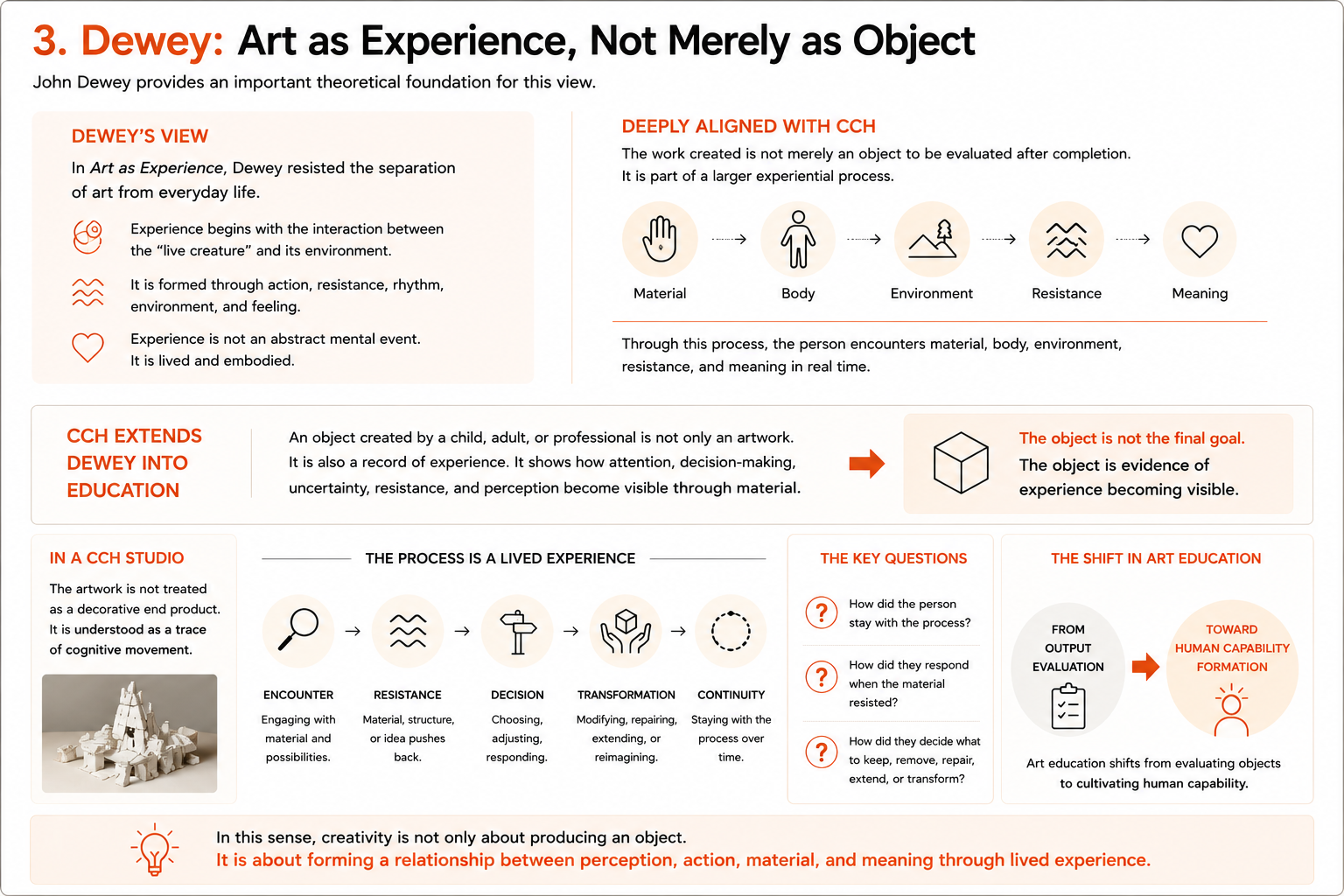
John Dewey provides an important theoretical foundation for the CCH framework. In Art as Experience, Dewey resisted the separation of art from everyday life, arguing that experience does not begin with the finished object, but with the interaction between the “live creature” and its environment. For Dewey, experience is not an abstract mental event isolated within the mind; it is formed through action, resistance, rhythm, environment, and feeling. As Dewey writes, “Experience occurs continuously, because the interaction of live creature and environing conditions is involved in the very process of living” (Dewey, 1934). This perspective aligns closely with the CCH approach, which understands creative practice not as the production of isolated objects, but as an ongoing experiential process through which participants encounter material, body, uncertainty, resistance, and meaning in real time.
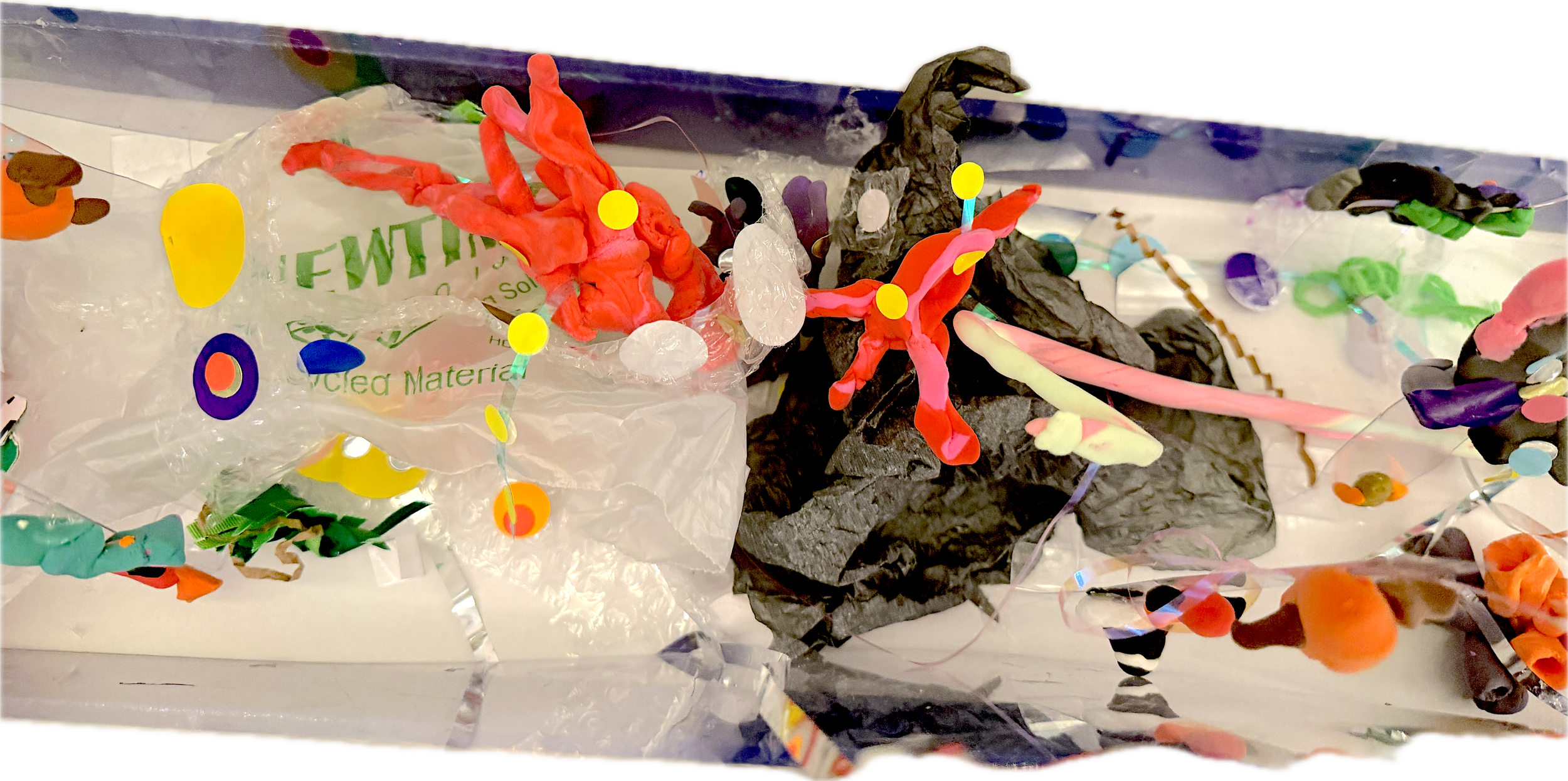
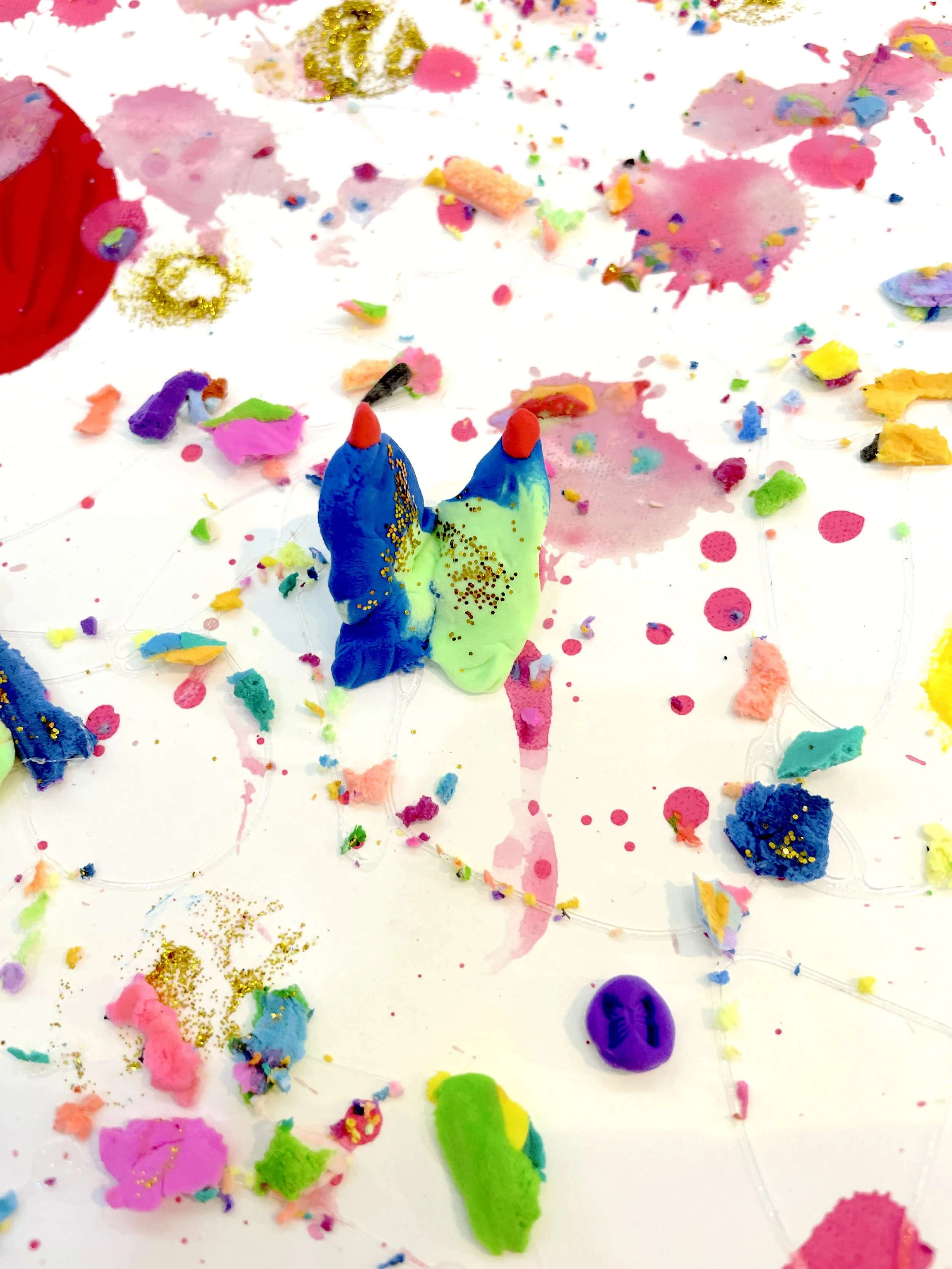
CCH extends Dewey’s experiential aesthetics into the educational field by treating artworks as records of cognitive and perceptual experience rather than decorative end products. An object created by a child, adult, or professional is not only an artwork; it becomes evidence of how attention, decision-making, uncertainty, resistance, and perception emerge through material interaction over time. Within a CCH studio, the artwork is understood as a trace of cognitive movement — a material record of how a person thinks, adapts, responds, reorganizes, and remains with process. The object itself is therefore not the final goal. Instead, the object becomes visible evidence of experience becoming externalized through material form.
From this perspective, the educational questions fundamentally shift. Rather than asking only whether an artwork is visually successful, CCH asks how the participant remained with the process, how they responded when material resisted, and how they decided what to keep, remove, repair, extend, or transform. These questions reposition art education away from simple output evaluation and toward the cultivation of human capability. Creativity, in this sense, is not merely the production of an object, but an ongoing relationship between perception, action, material, resistance, and meaning through lived experience.
4. Bhabha: Third Space and the Hybrid Human Condition
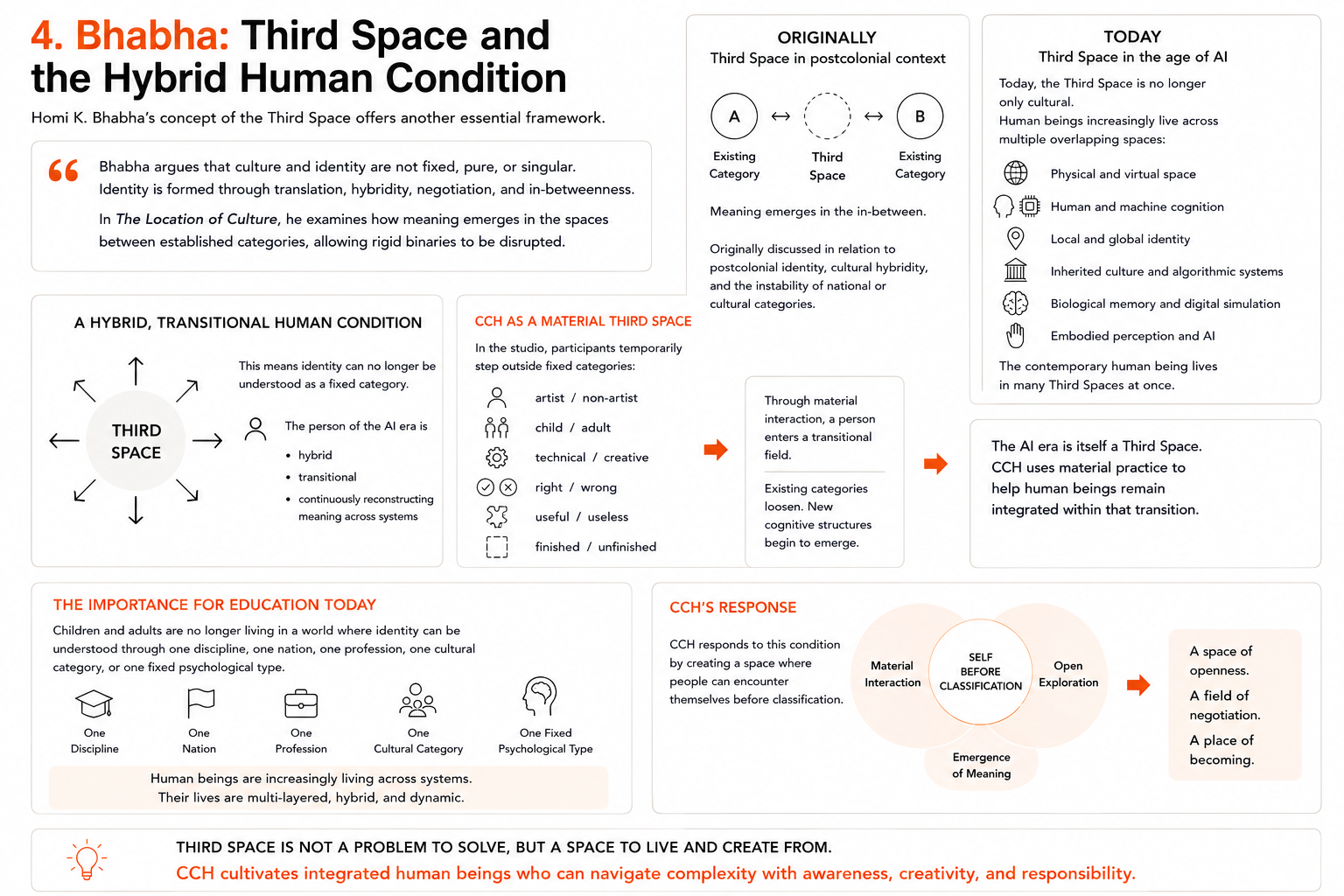
Homi K. Bhabha’s concept of the Third Space provides an important framework for understanding human identity in the age of AI. In The Location of Culture, Bhabha argues that identity is never fixed, pure, or singular, but is continuously formed through translation, hybridity, negotiation, and in-betweenness. Meaning emerges not inside rigid categories, but in the spaces between them, where established binaries begin to dissolve.
Originally developed in relation to postcolonial identity and cultural hybridity, the idea of the Third Space has become increasingly relevant beyond cultural discourse alone. In the contemporary AI era, human beings now exist across multiple overlapping systems simultaneously: physical and virtual environments, human and machine cognition, local and global identity, inherited culture and algorithmic structures, biological memory and digital simulation, embodied perception and artificial intelligence. The contemporary person therefore inhabits many Third Spaces at once.
Identity can no longer be understood as stable or singular; it becomes hybrid, transitional, adaptive, and continuously reconstructed across systems. Within this context, CCH may be understood as a material Third Space. In the studio environment, participants temporarily step outside fixed categories such as artist versus non-artist, child versus adult, technical versus creative, right versus wrong, useful versus useless, or finished versus unfinished. Through sustained interaction with material, individuals enter a transitional field in which existing classifications loosen and new cognitive structures begin to emerge.
The AI era itself can be understood as a global Third Space, and CCH uses material practice as a way of helping human beings remain integrated within that transition. This becomes increasingly important in contemporary education, where neither children nor adults can be fully understood through a single discipline, profession, nation, cultural identity, or psychological type. Human beings are increasingly living across systems, and CCH responds to this condition by creating environments in which people can encounter themselves before classification occurs.
5. Art Brut, Outsider Art, and Original Cognition
The relationship between CCH and concepts such as Art Brut and Outsider Art is important, but it requires careful distinction. Historically, Art Brut and Outsider Art emerged as attempts to describe forms of expression created outside academic art institutions and dominant cultural systems. These frameworks often emphasized qualities such as rawness, directness, non-institutional expression, and untrained visual language. However, earlier discussions were largely framed through aesthetic, cultural, or psychiatric perspectives and did not yet possess contemporary theoretical vocabularies such as embodied cognition, material engagement, developmental psychology, cognitive flexibility, attention science, or systems thinking.
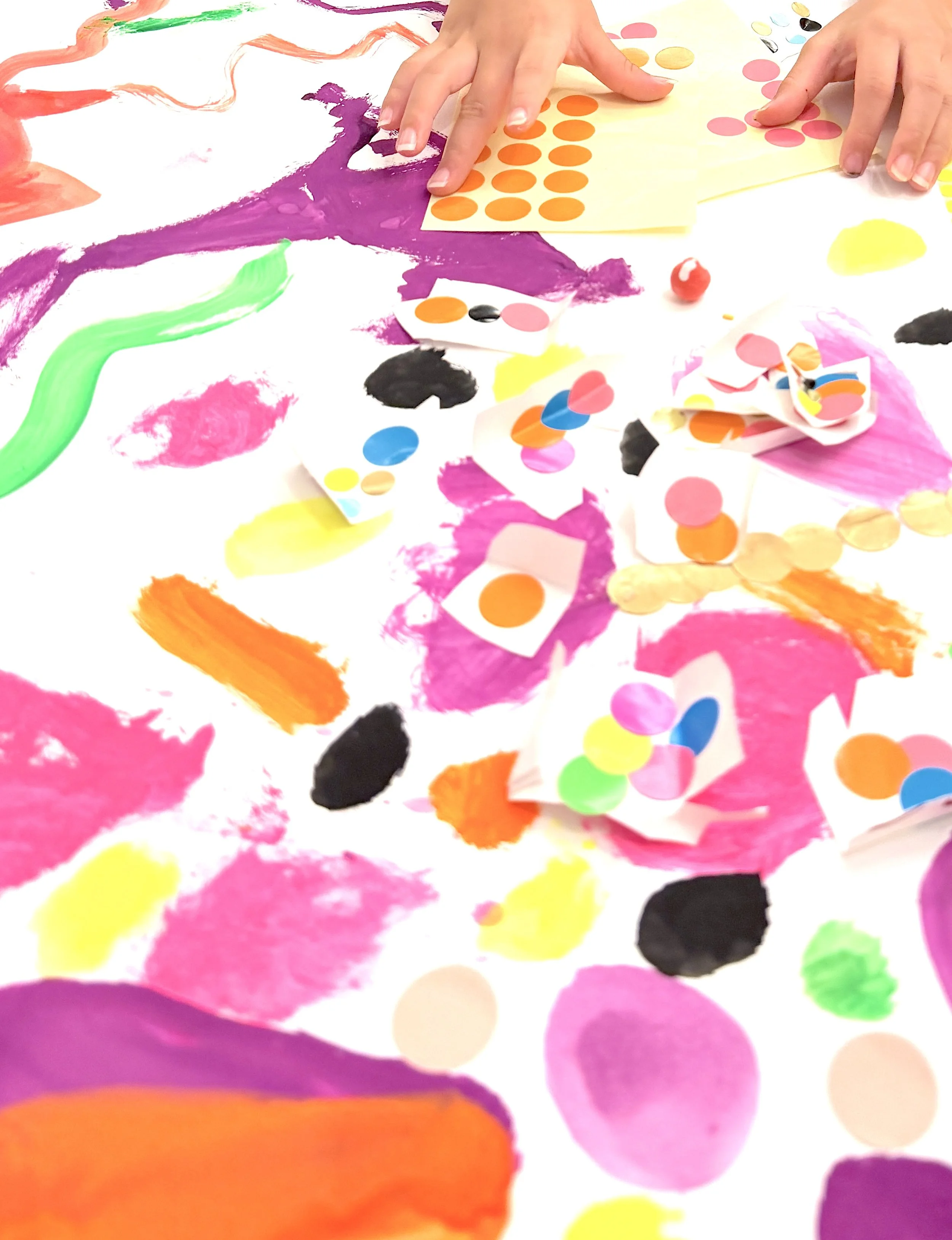
For this reason, CCH should not be reduced to the simplistic claim that “children are like outsider artists.” A more precise interpretation is that earlier concepts such as Art Brut identified forms of expression occurring outside institutional conditioning, while CCH revisits this insight through a contemporary cognitive framework. What once appeared merely raw, direct, or unrefined may now also be understood as evidence of less-conditioned perception, immediate material responsiveness, and pre-disciplinary exploratory cognition. This allows CCH to engage meaningfully with the legacy of Art Brut without romanticizing childhood or reducing children’s work to a visual aesthetic category. What art history once described as raw expression may instead be understood as cognition moving through material form before it has been heavily shaped by disciplinary identity.
Children often reveal this condition more visibly because they carry fewer conceptual divisions between domains. They do not necessarily separate art from engineering, play from research, material from thought, or imagination from construction. A child may build, destroy, test, repeat, narrate, invent, and reorganize materials without needing to determine whether the activity belongs to art, science, design, storytelling, or problem-solving. This does not imply that children are “purer” in a sentimental sense; rather, it suggests that their cognition may be less constrained by rigid disciplinary categorization. As a result, children frequently demonstrate powerful forms of original, material-based thinking when the environment provides sufficient time, scale, openness, and structural freedom.
6. Vygotsky: Creativity as Process, Not Product
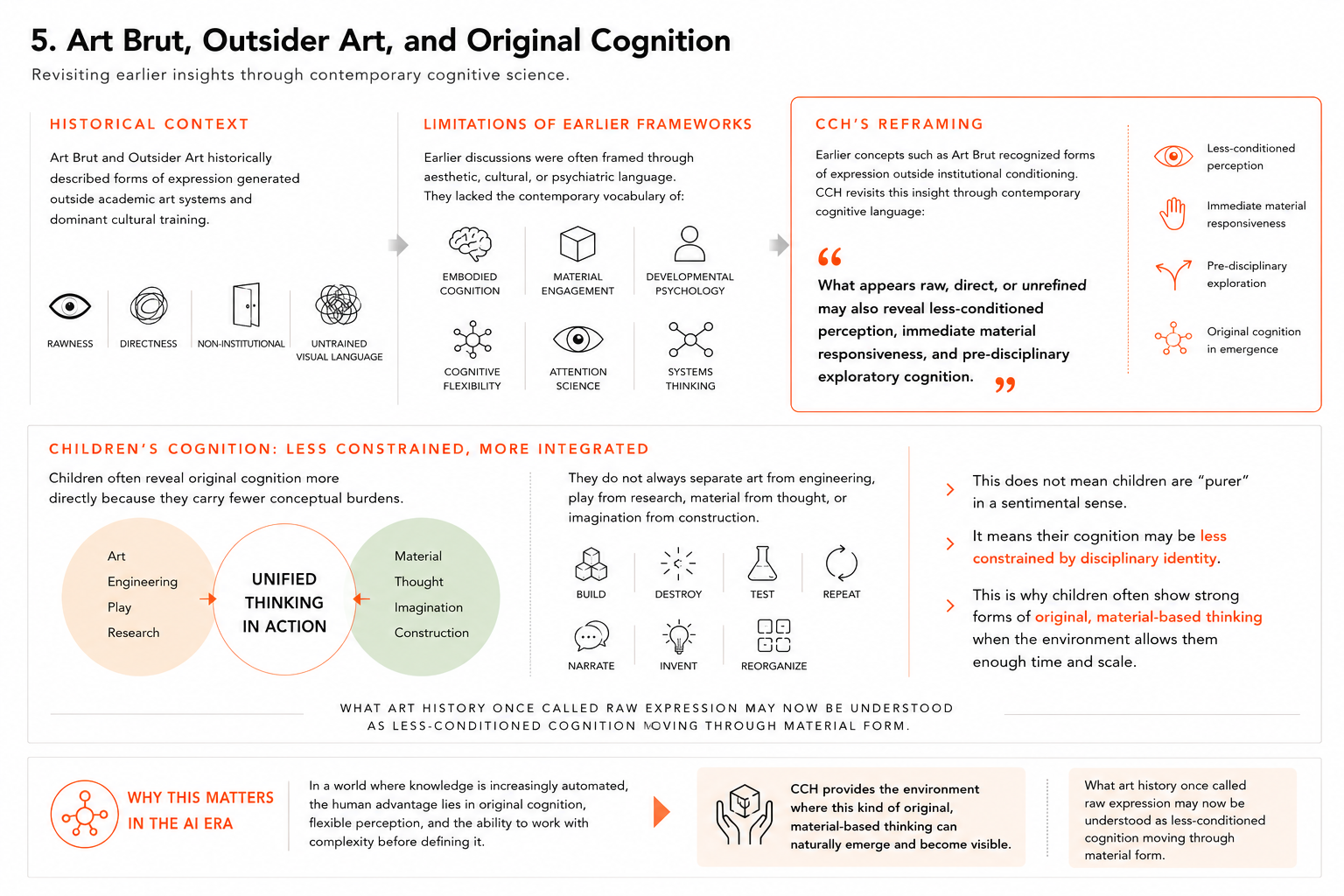
Lev Vygotsky provides important theoretical support for understanding creativity as a developmental process rather than merely the production of artistic objects. In Imagination and Creativity in Childhood, Vygotsky described creativity as a broad human activity in which any act that generates something new—whether external or internal, material or psychological—can be understood as creative. This perspective is highly relevant to CCH because it shifts the focus of creativity away from finished products and toward the reorganization of human cognition through experience. From this view, the value of children’s creative activity lies not only in what they make, but in how the process itself reorganizes imagination, perception, action, memory, emotion, and meaning over time.
Within CCH studio practice, this becomes visible when children combine unrelated materials, invent functions, modify structures, remain engaged in open-ended exploration, narrate while constructing, discover meaning through action, and transform mistakes into new directions. Although the resulting artwork may appear visually simple, the child is simultaneously coordinating body, material, attention, imagination, memory, emotion, and decision-making in real time. For this reason, CCH does not evaluate only the completed image; it evaluates the structure of the process through which cognition becomes visible.
Sustained engagement across multiple sessions further supports Vygotsky’s position that creativity cannot be reduced to the final object alone. When a child remains immersed in a project for hours across time, the educational significance lies in the development of attention endurance, tolerance for uncertainty, adaptive thinking, and the capacity to remain with complexity without immediate withdrawal. Through repeated interaction with unstable material conditions, children learn that structures can be modified, problems can be reorganized, and large-scale projects can emerge gradually through ongoing decisions. Creativity therefore becomes developmental rather than decorative. It is not simply the production of something new, but the continuous reorganization of attention, action, memory, material, and meaning over time.

7. Embodied Cognition: The Body Is Not Secondary to Thought
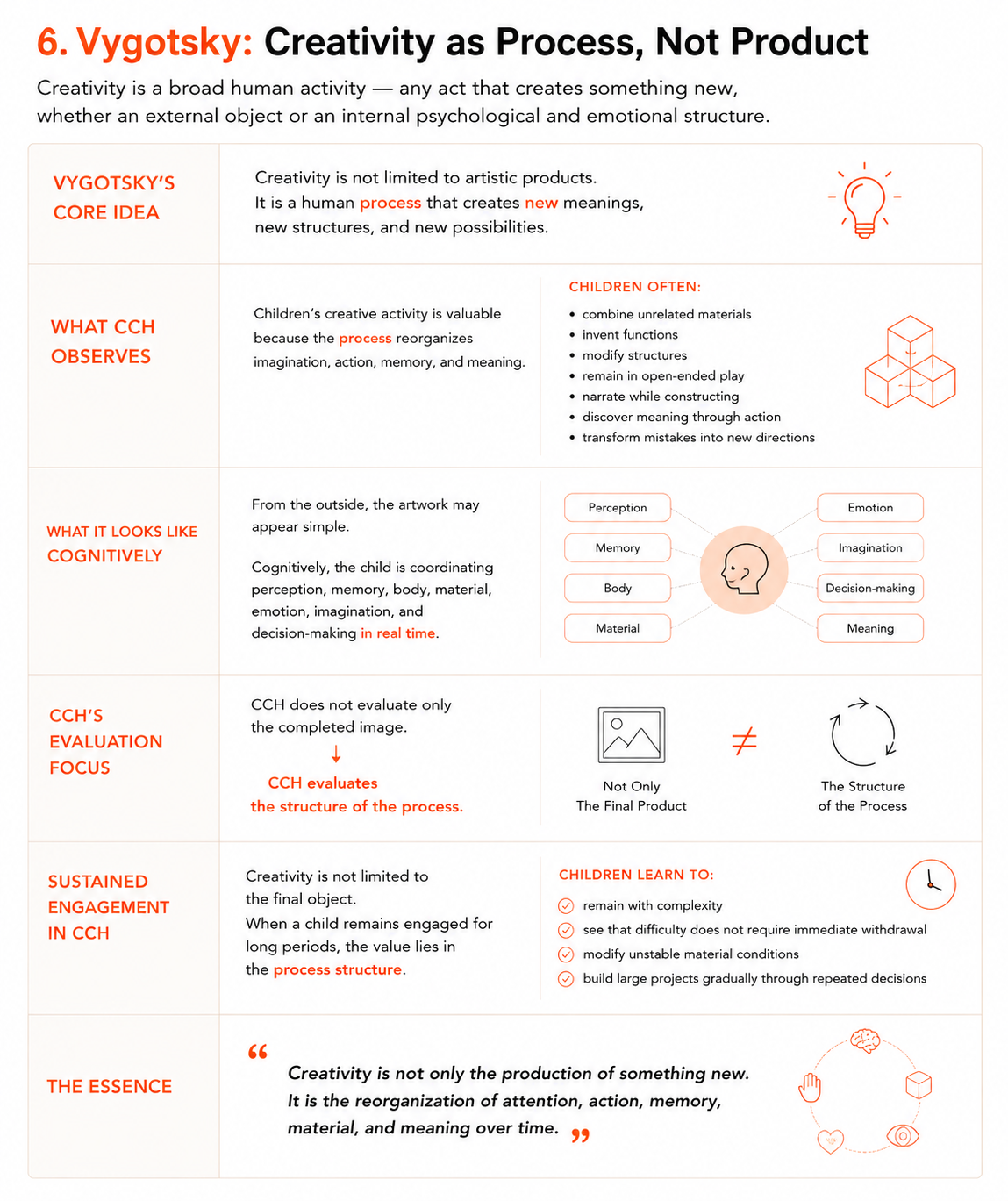
Modern education has often treated thinking as something that occurs primarily inside the brain, separating cognition from bodily action and material interaction. Embodied cognition challenges this assumption by arguing that cognition is not confined within the mind alone, but emerges through the continuous interaction between brain, body, environment, perception, action, and material feedback. Embodied and enactive approaches therefore understand thinking as something distributed across lived experience rather than isolated within abstract mental processes. This perspective strongly supports the CCH framework, which approaches material engagement not as secondary to cognition, but as one of the conditions through which cognition itself becomes possible.
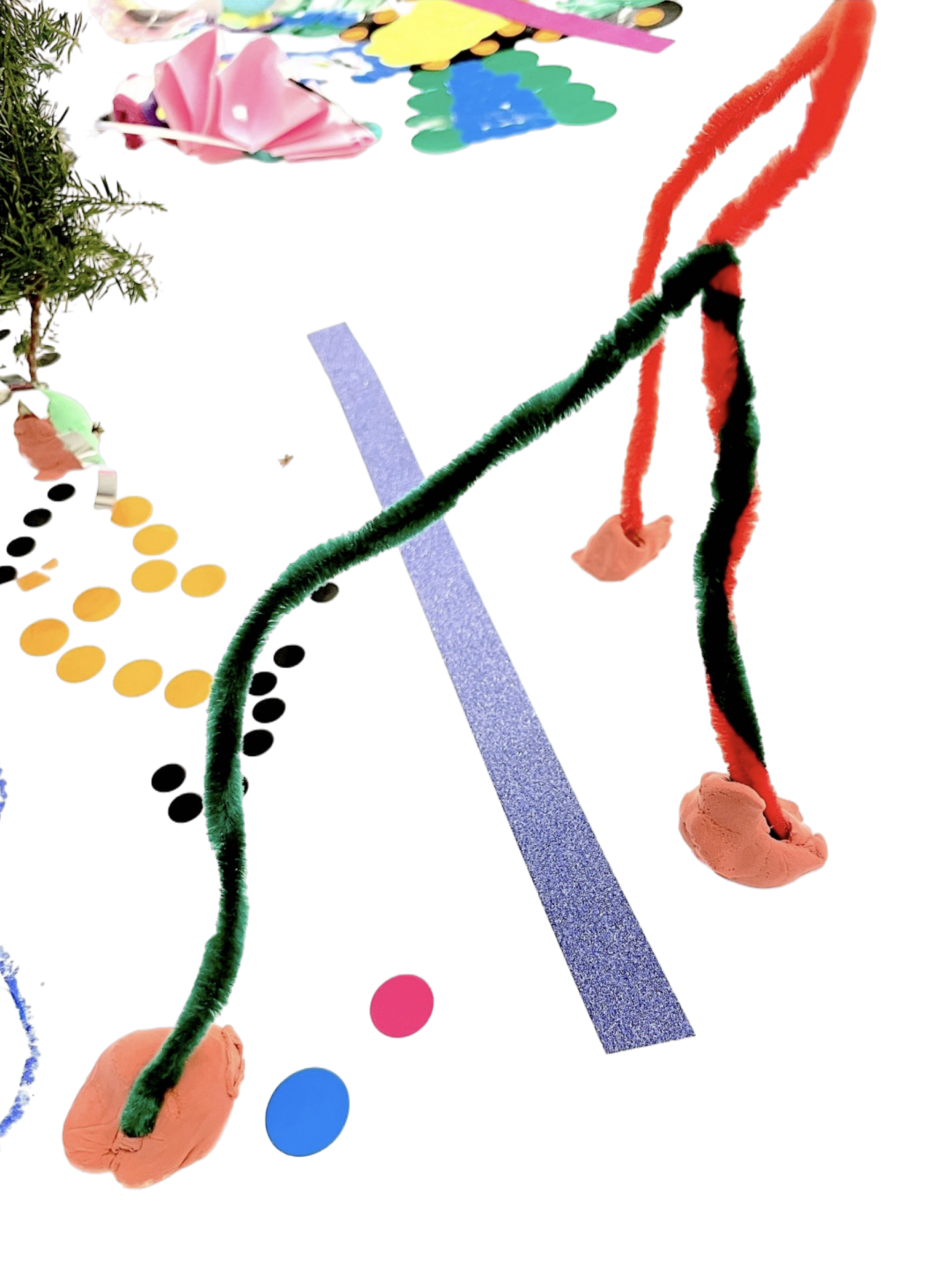
Within CCH practice, when a participant touches, cuts, folds, arranges, breaks, repairs, layers, or reconstructs material, the body is not merely executing a pre-existing idea. The body actively participates in the formation of thought. The hand does not simply carry out cognition; the hand thinks with matter. This position closely aligns with Lambros Malafouris and his Material Engagement Theory, which argues that tools, objects, materials, and material signs are not merely external aids to thinking, but are themselves part of the human cognitive system. Material can therefore be understood as an extension of cognition. This is precisely where CCH operates in practice: material is not passive, decorative, or neutral. Material gives feedback, creates resistance, generates surprise, and continuously alters the participant’s next decision.
For this reason, material interaction within CCH becomes a site of cognitive reconstruction rather than simple craft production. Material is not decoration; it is cognition becoming external, visible, and negotiable through process. This distinction is important because CCH cannot be reduced to a traditional craft activity focused primarily on producing a known result. Instead, CCH uses material as a cognitive environment through which participants encounter how they think, decide, hesitate, resist, repair, adapt, and reorganize themselves over time. The educational significance therefore lies not only in what is made, but in how cognition emerges, transforms, and becomes observable through sustained interaction with material conditions.
8. Psychology, Personality Systems, and the Limits of Classification
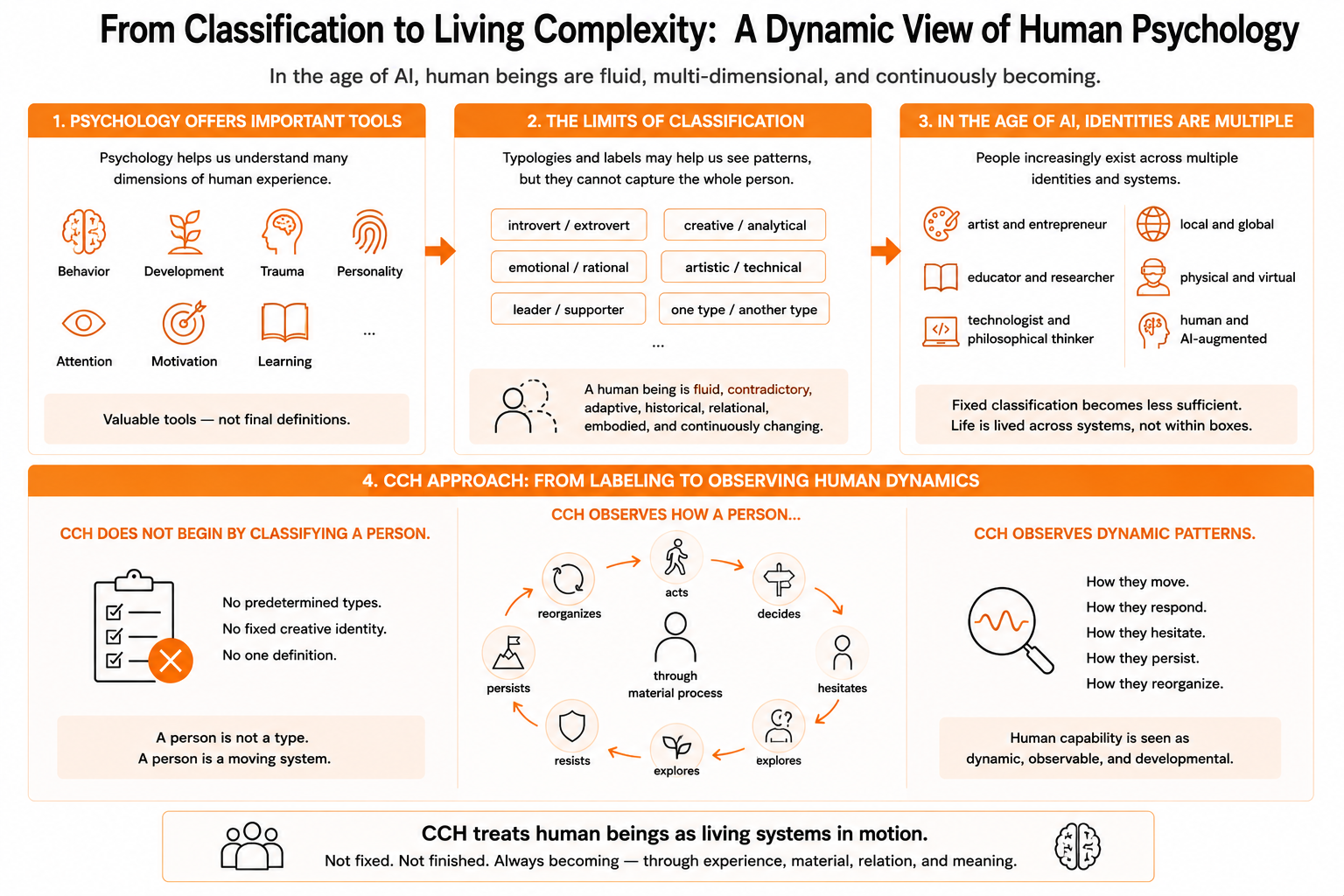
Psychology has provided important frameworks for understanding behavior, development, trauma, attention, motivation, and learning. However, psychological classification becomes limiting when provisional categories are mistaken for fixed identity. Systems of personality and typology may offer temporary clarity through distinctions such as introvert versus extrovert, creative versus analytical, emotional versus rational, or artistic versus technical, yet these categories cannot fully account for the complexity of a living human being. Human cognition is not static; it is fluid, adaptive, relational, embodied, historically shaped, and continuously reorganized through experience. From this perspective, identity should not be understood as a fixed psychological container, but as an ongoing developmental process.
In the age of AI, rigid classification becomes even less sufficient because individuals increasingly operate across overlapping systems and identities simultaneously. A person may exist as artist and entrepreneur, educator and researcher, technologist and philosophical thinker, physical and virtual, human and AI-augmented at the same time. Contemporary human experience therefore exceeds the stability of singular categories. As technological systems increasingly blur disciplinary, cognitive, and social boundaries, psychological frameworks based solely on fixed identity types become less capable of describing how people actually move, adapt, and reorganize themselves across environments.
CCH responds to this condition by approaching psychology dynamically rather than categorically. It does not begin by assigning identity labels or predetermined creative roles. Instead, it observes how a person acts, decides, hesitates, persists, explores, resists, adapts, and reorganizes through material process over time. Within the CCH framework, human capability is understood not as a fixed type, but as a living cognitive system in motion. Cognition becomes observable through interaction with material, uncertainty, environment, and experience, allowing development to emerge as something fluid, embodied, and continuously evolving rather than predetermined by static classification.
9. CCH as Post-Disciplinary Education
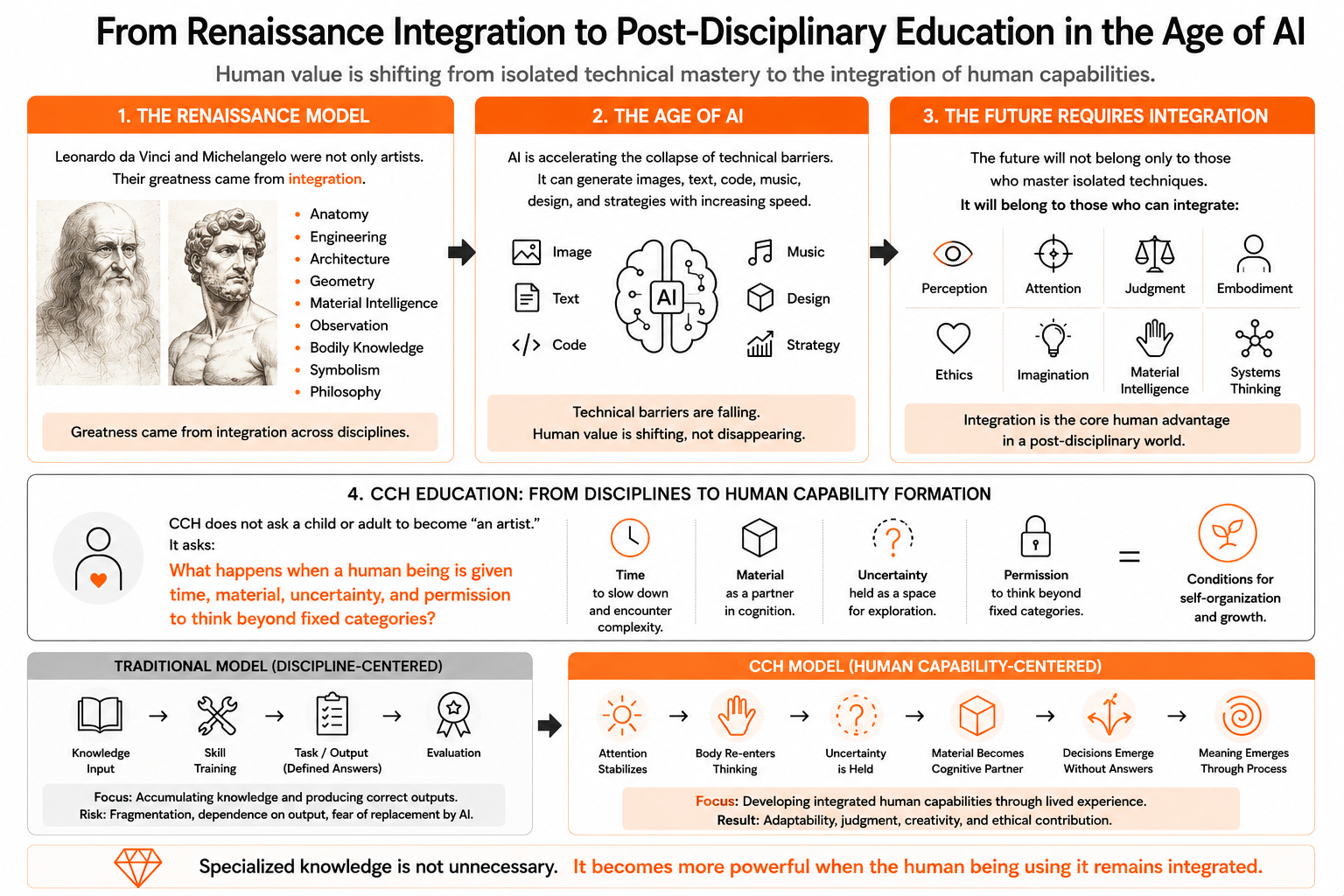
The Renaissance model offers an important reference point for understanding human capability in the age of AI. Figures such as Leonardo da Vinci and Michelangelo are often remembered primarily as artists, yet their work emerged through the integration of anatomy, engineering, architecture, geometry, material intelligence, observation, philosophy, and embodied knowledge. Their significance did not come from specialization alone, but from the ability to move fluidly across systems of thought while remaining cognitively and structurally integrated. The Renaissance model therefore reminds us that human capability has historically emerged most powerfully not through fragmentation, but through synthesis.
Today, the rise of AI is accelerating the collapse of many technical barriers by generating text, images, code, music, and design with increasing speed. This does not eliminate the importance of knowledge; rather, it changes where human value resides. The future will increasingly favor individuals capable of integrating perception, attention, judgment, embodiment, ethics, imagination, material intelligence, and systems thinking across disciplines. As automation expands, isolated technical execution becomes less uniquely human, while the ability to navigate complexity, uncertainty, and meaning across systems becomes increasingly important. Human value therefore shifts away from narrow specialization alone and toward integrated cognitive adaptability.
CCH approaches education from this post-disciplinary position. It does not begin by asking whether someone should become an “artist,” but instead asks what becomes possible when a human being is given time, material, uncertainty, and permission to think beyond fixed categories. The apparent simplicity of the CCH method is therefore structural rather than superficial. It does not rely on immediate knowledge accumulation or predefined outputs, but creates conditions in which cognition can self-organize through sustained attention, material engagement, and decision-making over time. Specialized expertise remains valuable, yet its value deepens when the individual using it remains cognitively integrated rather than fragmented by disciplinary isolation.
10. The AI Crisis Is Also an Identity Crisis
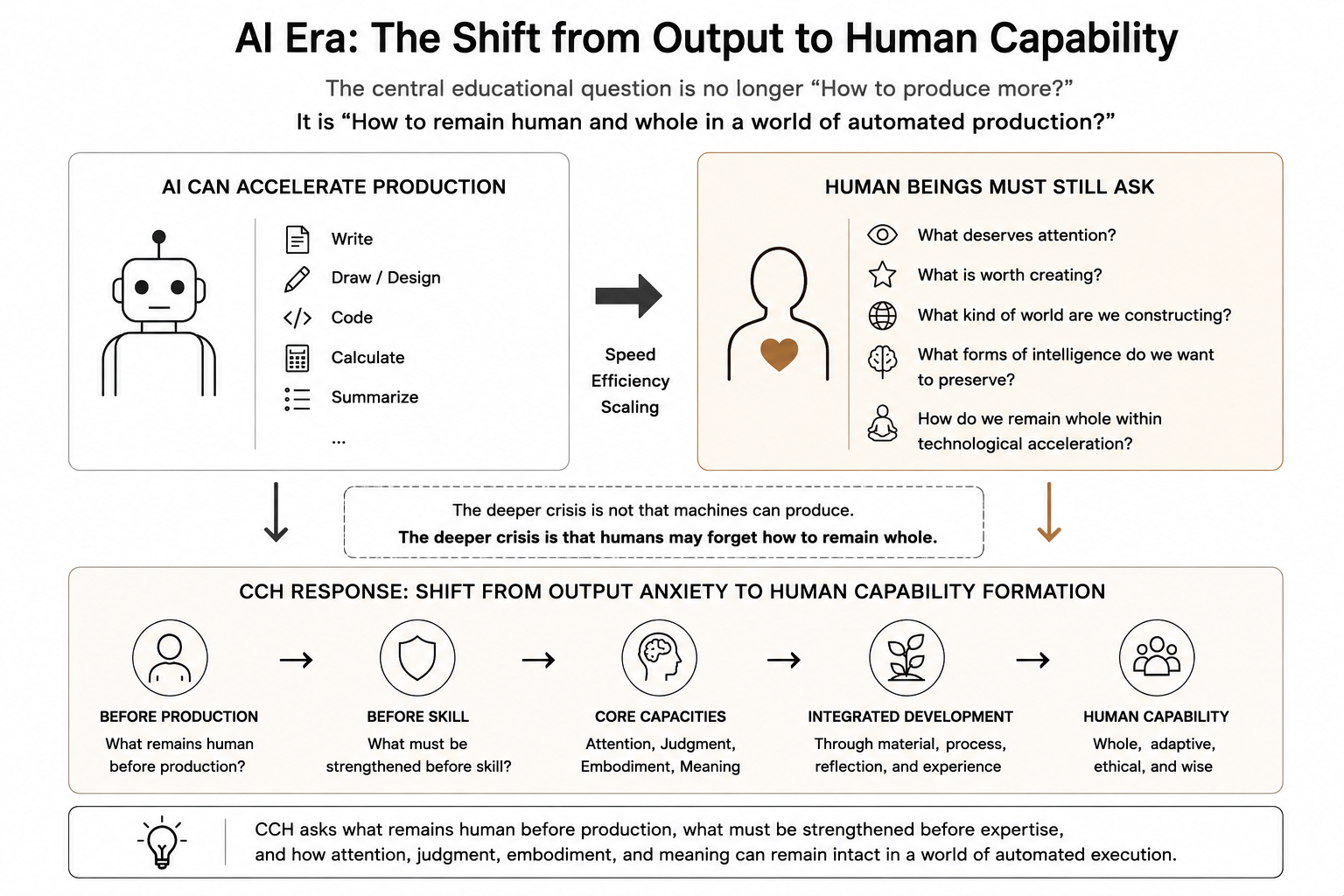
The fear of being replaced by AI is not only an economic or employment issue; it is fundamentally an identity issue. When individuals are trained to define their value primarily through output — writing, drawing, designing, coding, calculating, summarizing, or producing — the emergence of AI-generated production naturally becomes psychologically threatening. If human worth is reduced to efficiency and execution alone, then faster machines appear to diminish human significance. However, the question changes when human value is understood at a deeper level: not as output itself, but as the capacity to integrate attention, perception, judgment, ethics, embodiment, emotion, memory, and meaning into coherent forms of action and understanding.
AI may accelerate production, but human beings must still decide what deserves attention, what is worth creating, what forms of intelligence should be preserved, and how to remain psychologically and ethically whole within systems of technological acceleration. From this perspective, the central educational challenge of the AI era is not simply that machines can produce, but that humans may gradually lose the conditions necessary for integrated cognition to remain intact. The deeper crisis is therefore not automation alone, but the fragmentation of attention, meaning, embodiment, and human judgment within increasingly accelerated systems of production and consumption.
CCH responds to this condition by shifting education away from output anxiety and toward the cultivation of human capability itself. Rather than asking only how to improve performance, CCH asks what remains fundamentally human before production, what conditions must exist before expertise, and how attention, judgment, embodiment, and meaning can remain coherent within a world increasingly organized around automated execution. In this sense, CCH approaches education not as the optimization of output, but as the preservation and reconstruction of integrated human cognition in the age of AI.
11. CCH ART NOW™: Human Capability Before Output
CCH ART NOW™ understands art education as a human capability system. It does not begin with medium, technique, style, or final product, but with the conditions that allow human cognition to become integrated again: attention must stabilize, the body must re-enter thinking, uncertainty must be held, material must become part of cognition, decisions must emerge without predefined answers, and meaning must develop through process rather than prescription. This is why CCH aligns closely with first-principles thinking. Rather than asking how to improve an existing art class, CCH asks a more fundamental question: what conditions must exist before creativity, innovation, leadership, and expertise can emerge at all? The answer is not a subject, but a set of human cognitive conditions.
For this reason, CCH does not teach people what to think. It creates the conditions for people to observe how they think. This is also why the framework can operate across age groups, disciplines, and professional backgrounds. The method appears simple because the entry point is material interaction, yet the deeper work is cognitive. Participants are not merely making objects; they are encountering their own structures of attention, hesitation, control, risk, resistance, imagination, and decision-making through process. The object ultimately becomes a visible record of this cognitive encounter — evidence of how perception, material, and meaning reorganize through lived experience.
Conclusion: Toward Integrated Human Education
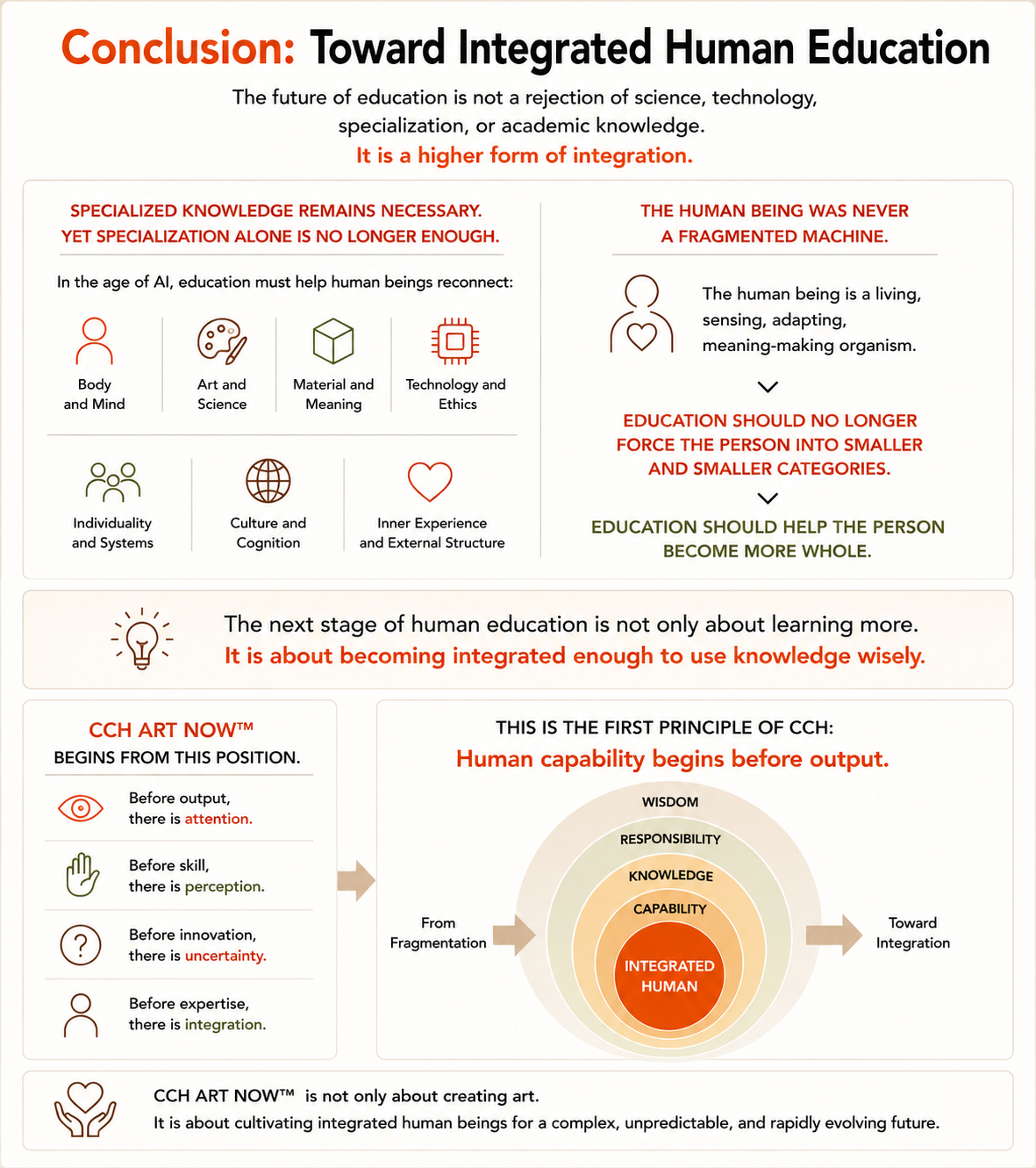
The future of education is not a rejection of science, technology, specialization, or academic knowledge, but a movement toward deeper human integration. In the age of AI, specialized expertise alone is no longer sufficient. Education must help individuals reconnect body and mind, material and meaning, technology and ethics, individuality and systems, and inner experience with external structure. Human beings are not fragmented machines, but living, sensing, adaptive organisms whose cognition emerges through interaction with environments, materials, uncertainty, and experience. CCH responds to this condition by treating education not merely as skill acquisition or output production, but as the cultivation of integrated human capability through sustained attention, embodied engagement, perceptual sensitivity, and open-ended material interaction. From this perspective, creativity is not decorative performance, but a developmental process through which perception, decision-making, resistance, and meaning become organized over time. The next stage of education is therefore not only about learning more, but about becoming integrated enough to use knowledge wisely. CCH ART NOW™ begins from this position: before output, there is attention; before skill, there is perception; before innovation, there is uncertainty; and before expertise, there is integration. Human capability begins before output.
Academic References
Bhabha, H. K. (1994). The Location of Culture. Routledge.
Dewey, J. (1934). Art as Experience. Minton, Balch & Company.
Malafouris, L. (2013). How Things Shape the Mind: A Theory of Material Engagement. MIT Press.
Vygotsky, L. S. (2004). “Imagination and Creativity in Childhood.” Journal of Russian and East European Psychology, 42(1), 7–97.
Suggested Website Link Placement
Related CCH children’s observations and Sustained Creative Immersion cases are documented here:
https://www.cchartnow.com/new-page-4