
From Visual Culture Art Education to CCH
Visual Cognitive Education in the Age of AI
By CCH ART NOW™
In the age of AI-generated images, social media, and highly visualized everyday life, art education can no longer be understood only as technical training, aesthetic development, or the production of finished artworks. Drawing and material-based creation should also be understood as fundamental human practices through which individuals form perception, attention, judgment, embodied awareness, and self-understanding.
CCH ART NOW™ is built upon this educational shift.
CCH does not define art education through whether a child can draw realistically, produce a visually pleasing result, or complete a standardized artwork. Instead, CCH focuses on the creative process itself: how a child or adult observes, chooses, uses materials, faces blank space, handles uncertainty, organizes visual complexity, and gradually develops a personal visual language over time.
In this sense, CCH is connected to Visual Culture Art Education (VCAE), while also extending it toward embodied cognition, long-duration attention, and human capability development in the age of AI.
From Technical Skill to Visual Culture
Visual Culture Art Education argues that contemporary art education should move beyond medium-specific skill training and formal aesthetic instruction. It should help learners understand how images, symbols, cultural codes, social values, and power relations produce meaning. Art education, therefore, is not only about making images; it is also about learning how images operate within culture.
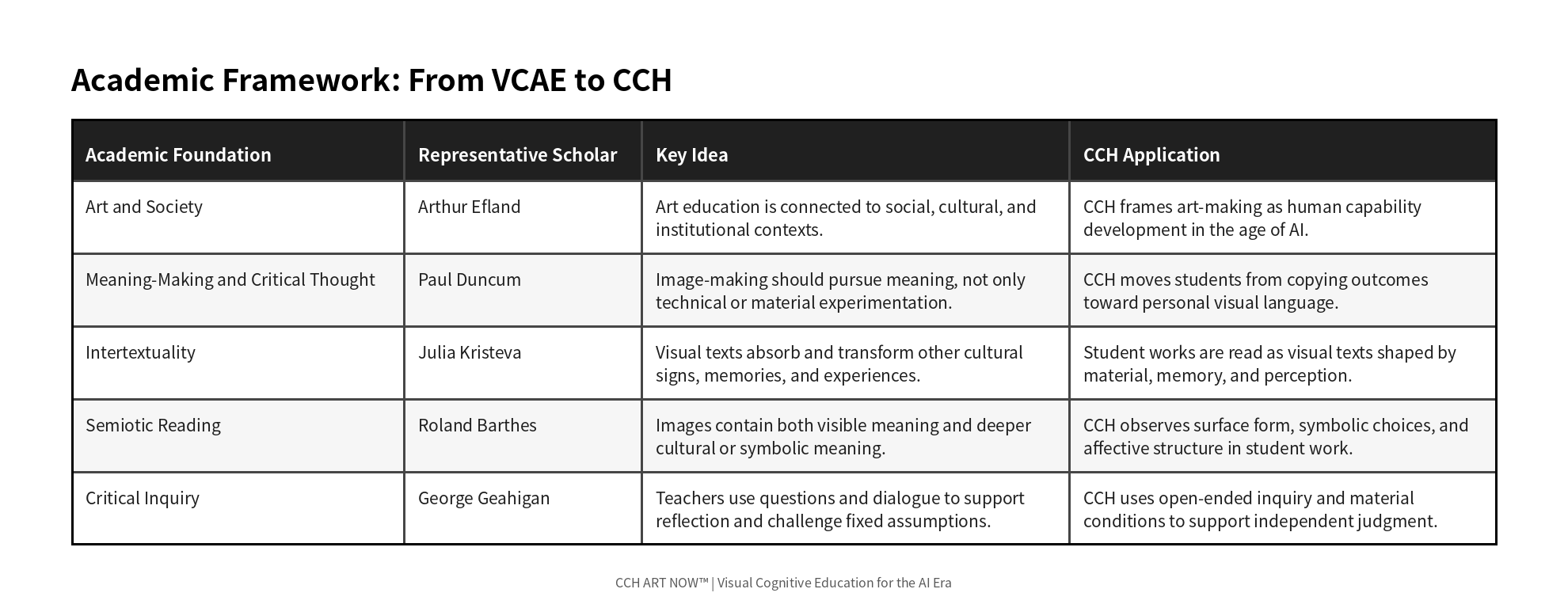
Arthur Efland’s historical analysis of art education reminds us that art education has never been isolated from social, cultural, and institutional forces. Different movements in art education have reflected broader shifts in society, knowledge, and educational ideology (Efland, 1990). Paul Duncum’s work on VCAE further emphasizes that art education must respond to contemporary visual culture and help students develop critical awareness of the images that shape everyday life (Duncum, 2002, 2004).
Within this framework, the central question of art education is no longer simply:
How can students make better images?
The deeper question becomes:
How do students understand the visual world they live in?
Images are never neutral. They may carry cultural values, gender assumptions, class signals, consumer desires, political messages, and social hierarchies. Roland Barthes’ semiotic analysis of images, especially his distinction between denotation and connotation, provides an important method for understanding visual meaning. An image may appear to show a simple object or scene at the denotative level, while also transmitting deeper cultural, ideological, and symbolic messages at the connotative level (Barthes, 1977).
Julia Kristeva’s theory of intertextuality further reminds us that no text exists in isolation. Visual images, like written texts, absorb, transform, and reorganize other cultural signs, memories, histories, and symbolic systems (Kristeva, 1986). A child’s artwork, therefore, should not be dismissed as a simple image. It can be understood as a visual text shaped by perception, bodily experience, material interaction, memory, culture, and emerging cognition.
VCAE provides CCH with an important theoretical foundation: art education should help learners read images, understand visual culture, and develop critical awareness.
However, CCH asks an even more foundational question:
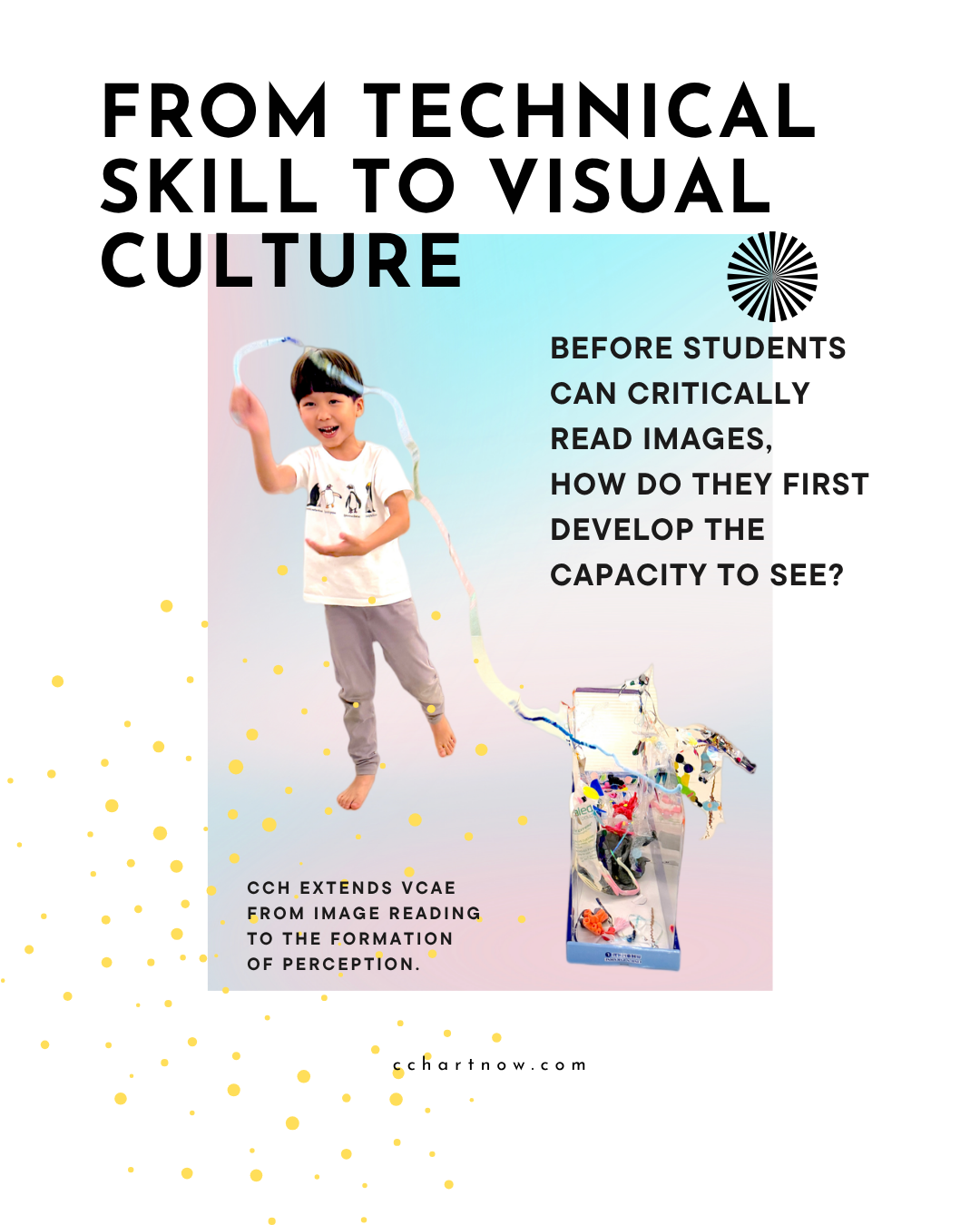
Before students can critically read images, how do they first develop the capacity to see?
CCH’s Extension of VCAE: From Reading Images to Forming Perception
VCAE asks how students read visual culture. CCH extends this inquiry by asking how students form the capacity to perceive, attend, and visually judge in the first place.
VCAE may ask:
What does this image mean?
What cultural codes does it carry?
How does it reflect power, identity, or ideology?
How does visual culture shape the way we see the world?
CCH adds another layer:
How does a person begin to see?
How does a child notice difference?
How does perception emerge through body, material, color, movement, and time?
How does observation become personal visual language?
How does a learner sustain attention long enough to transform perception into form?
This is the key position of CCH.
CCH extends VCAE from the critique of visual culture to the embodied formation of perception, attention, and visual judgment.
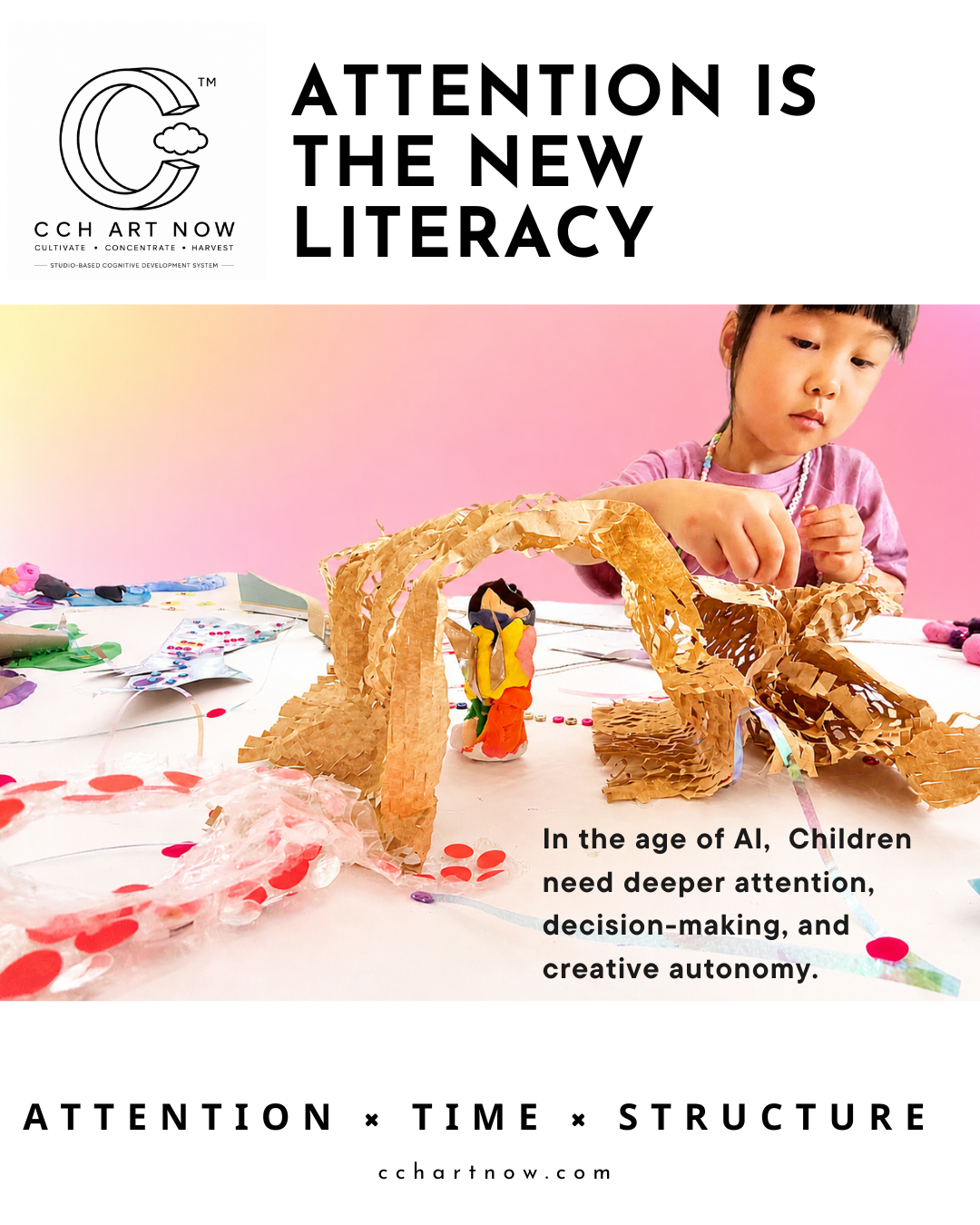
In CCH, drawing does not begin with copying a fixed form or filling in a pre-drawn outline. A child does not need to begin by producing an image that adults can immediately recognize. More importantly, the child needs opportunities to experience color, material, gesture, scale, resistance, time, and bodily movement as part of their own perceptual development.
For example, when a child encounters a flower, conventional instruction may teach the child to draw a standard flower: a circular center, several petals, a stem, and leaves. This may produce a recognizable result quickly, but the child may only learn to reproduce a visual formula.
If the child is instead given ten different flowers to observe, something more important begins to happen. The child may notice the direction of petals, the curve of stems, the proportion of leaves, the density of color, the irregularity of growth, and the differences among plants. The child is no longer copying a flower. The child is learning how to observe.
CCH shifts the focus from copying completion to observational transformation.
The goal is not realism. The goal is not immediate visual recognition. The goal is for observation to become perception, and for perception to become personal visual language.
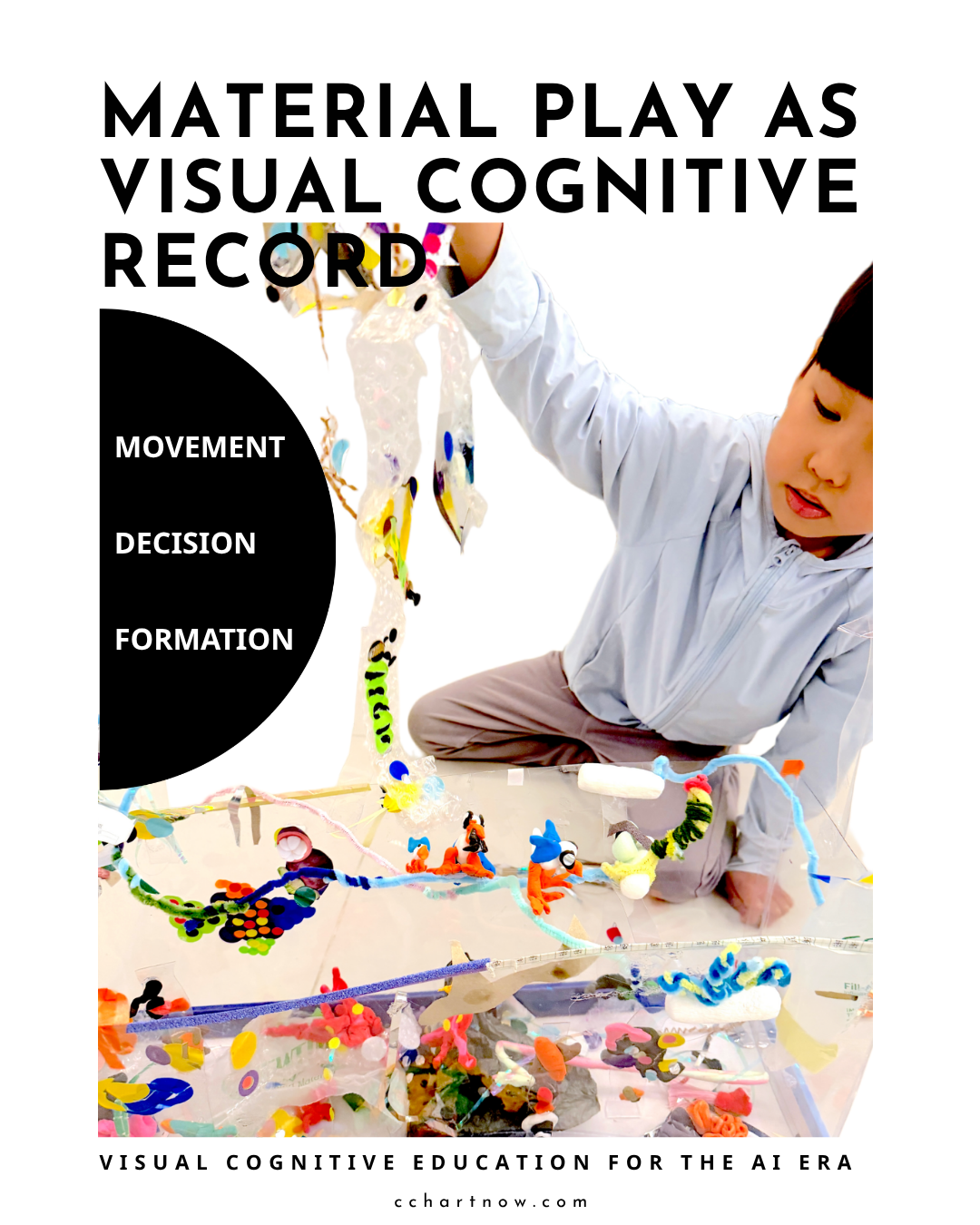
In CCH, material play is not treated as casual craft activity. It is observed as a visual cognitive record: a process through which children form attention, movement, decision-making, material response, and personal visual language over time.
Creative Process as Visual Cognitive Record
In CCH, a student’s work is not treated merely as a finished artwork. It is understood as a visual cognitive record.
A drawing or material-based construction can be read as a trace of perception, attention, bodily movement, emotion, decision-making, and material interaction at a particular moment in time. Color, line, pressure, repetition, blank space, layering, erasure, spatial arrangement, and material choice are not only formal elements. They are evidence of how a person engages with the world, with materials, and with themselves.
This transforms the CCH classroom from a conventional art classroom into a field of human capability observation.
In this field, the teacher does not replace the student’s decision-making through demonstration. The teacher does not correct the work according to adult aesthetic standards. Instead, the teacher observes, asks questions, designs material conditions, protects time, and supports the student in forming their own judgment.
This approach resonates with George Geahigan’s model of critical inquiry, which emphasizes questioning, dialogue, reflection, and the development of critical understanding in art education (Geahigan, 1998). However, CCH moves this inquiry into the creative process itself. Students do not only reflect through language after the artwork is completed. They think through material, body, color, spatial decisions, and time.
CCH is therefore not free expression without structure. It is structured openness.
The student has freedom, but not aimlessness.
The teacher provides guidance, but does not impose answers.
The process may contain confusion, but confusion is gradually transformed into visual order.
The work may begin with emotion, but emotion is guided toward visible and communicable structure.
This is the difference between CCH and conventional art enrichment.
CCH does not simply ask:
What did the child make?
It asks:
What capacities were forming while the child was making?
The Academic Transformation Framework of CCH
CCH can be understood through a three-level transformation: theoretical foundation, pedagogical mechanism, and practical execution.
At the theoretical level, CCH is grounded in two major lines of VCAE-related thought.
The first line is the relationship between art and society. Efland’s social and historical framing of art education allows us to understand artistic learning as part of a larger cultural and institutional context (Efland, 1990). Duncum’s VCAE further supports the idea that image-making should not be reduced to media experimentation or technique, but should be connected to meaning-making, culture, and critical thought (Duncum, 2002, 2004).
The second line is the analysis of image and text. Kristeva’s concept of intertextuality allows student artworks to be understood as visual texts that absorb and transform personal experience, cultural signs, and symbolic systems (Kristeva, 1986). Barthes’ semiotic framework allows educators to consider both the visible surface of an image and its deeper cultural or affective implications (Barthes, 1977).
At the pedagogical level, Geahigan’s critical inquiry offers a bridge between theory and classroom practice. The teacher’s role is not to deliver fixed interpretations, but to open questions, create dilemmas, support dialogue, and help learners clarify their own positions (Geahigan, 1998).
At the practical level, CCH translates these theories into three concrete forms of execution.
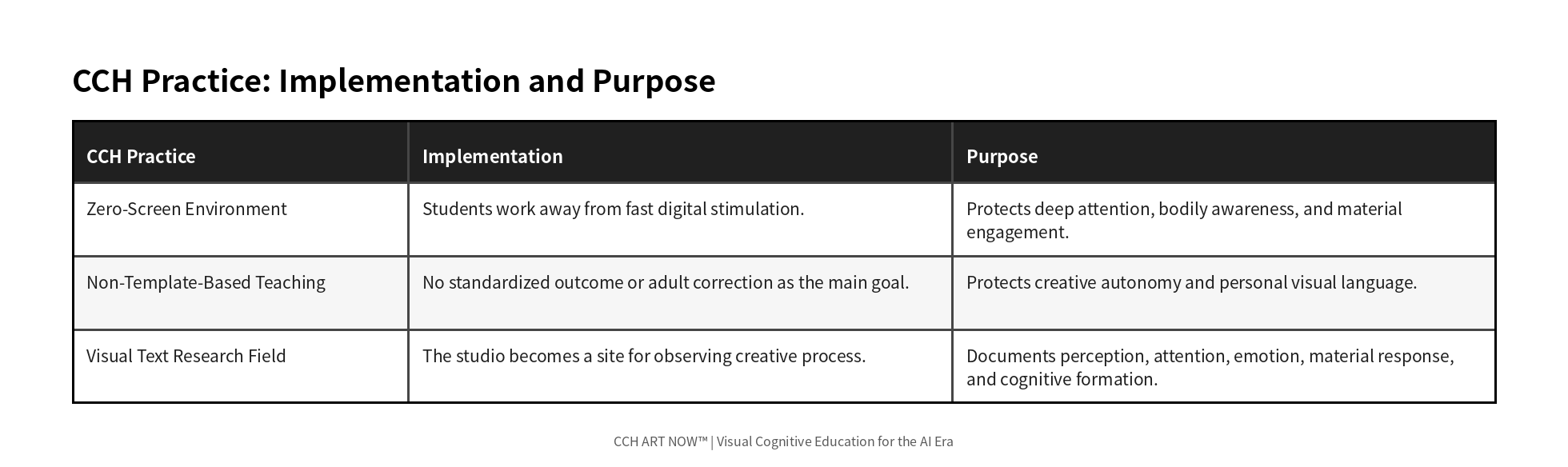
First, CCH establishes a zero-screen environment.
This is not an anti-technology position. It is a deliberate condition for protecting depth perception, bodily awareness, material resistance, and long-duration attention.
Second, CCH rejects template-based production.
Students are not trained to reproduce identical outcomes. They are supported in forming personal visual language through observation, material exploration, decision-making, and reflection.
Third, CCH positions the studio as a visual text research field.
Each creative process becomes an observation site for attention, perception, emotional rhythm, material response, visual organization, and cognitive development.
Through this structure, CCH brings VCAE into daily educational practice. It moves from how images are read to how the capacity to see is formed.
CCH does not propose a standardized art-making method. Instead, it can be understood within the academic lineage of Visual Culture Art Education (VCAE). VCAE is significant because it moves art education beyond traditional technical training and positions it within the educational field of images, culture, social meaning, and critical inquiry.
Zero-Screen Practice as Protection of Deep Perception
In the age of AI and digital media, a zero-screen environment may be misunderstood as a rejection of technology. In CCH, zero-screen practice is not anti-technology. It is a pedagogical design that protects the conditions required for deep perception.
Screens accelerate visual consumption. They encourage rapid switching, instant stimulation, external comparison, and algorithmic capture of attention. Children and adults alike become accustomed to immediate response and fast visual reward.
Material-based creation works differently.
Paper does not respond automatically.
Color must be layered.
Marks cannot always be undone.
Materials resist control.
Mistakes must be handled.
A visual structure takes time to form.
These conditions are not inefficient. They are educationally valuable.
Through material-based creation, students learn to stay with uncertainty, tolerate ambiguity, handle resistance, revise decisions, regulate impulses, and build order over time. These capacities are not only artistic capacities. They are forms of cognitive resilience.
CCH’s zero-screen practice protects the human abilities most easily weakened by accelerated digital environments: sustained attention, bodily awareness, material judgment, reality feedback, and self-regulation.
In practical transformation, CCH can be understood as a studio-based educational system that translates VCAE theory into daily creative practice. It includes three concrete levels of execution:
The following conceptual chart visualizes how CCH understands sustained attention and multi-material control across a two-hour studio session. It does not claim to be a clinical measurement. Instead, it compares general developmental attention benchmarks with CCH’s case-based observational model, showing how attention may deepen when children are supported by a zero-screen, material-rich, and decision-based studio environment.
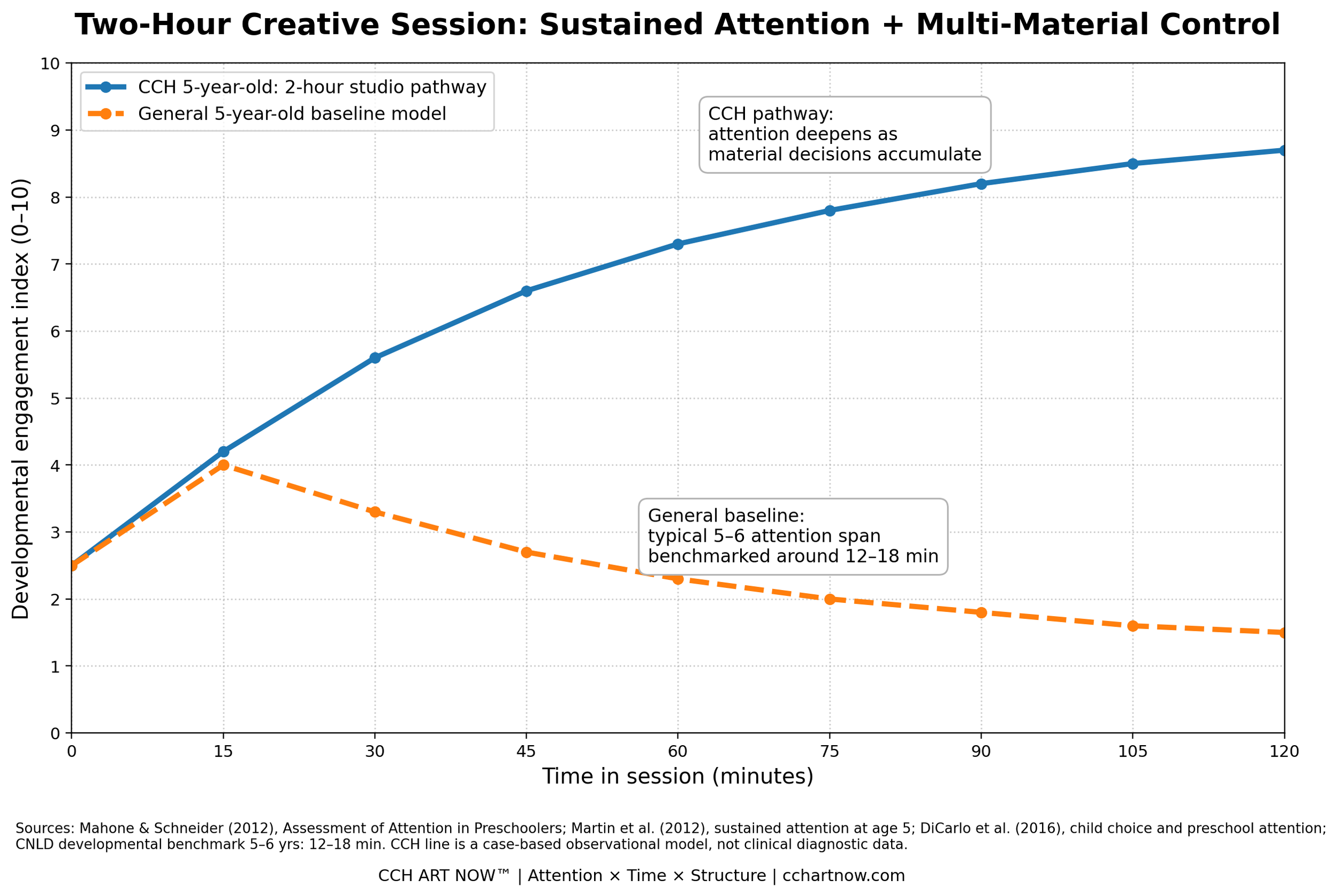
This chart uses developmental attention benchmarks as a general reference.
The CCH pathway represents a case-based observational model, not clinical diagnostic data.
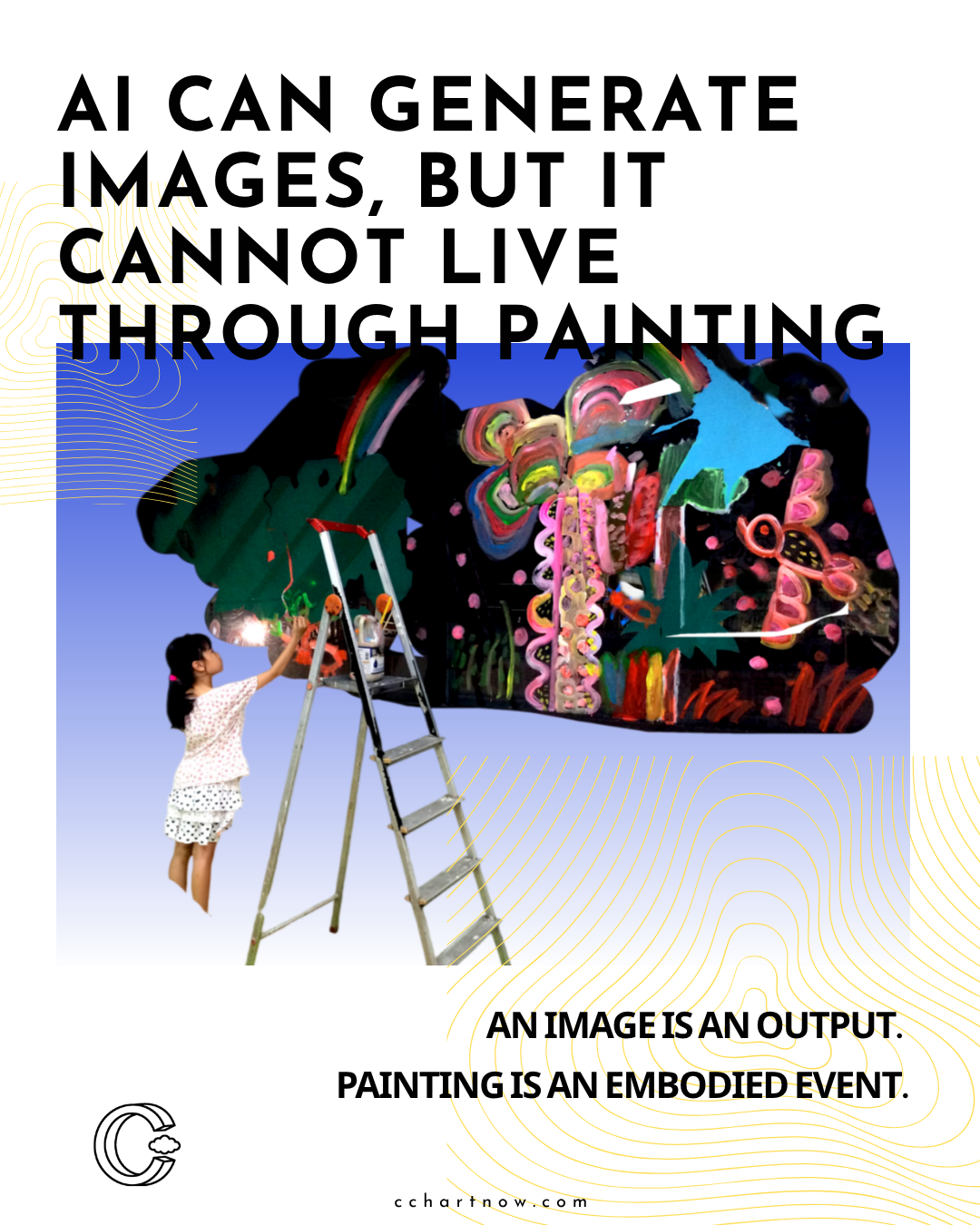
AI Can Generate Images, But It Cannot Live Through Painting
AI is transforming image production. Machines can generate polished images, imitate styles, extend visual compositions, and simulate historical or contemporary aesthetics. Technical visual representation is becoming increasingly automated.
This does not make painting irrelevant. It makes the human act of painting more important.
AI can generate an image, but it cannot live through the act of painting on behalf of a human being.
Painting is not only image production. It is a bodily event. It involves the hand, pressure, speed, hesitation, error, material resistance, attention, memory, emotion, and decision. The final image is not merely an output. It is evidence of an embodied process.
AI can produce an image.
Human painting produces an event.
This distinction is central to CCH.
In the age of AI, the most valuable human capacities are not merely technical representation or visual polish. What becomes increasingly important is the capacity to observe, choose, stay with uncertainty, respond to material resistance, and form meaning through lived experience.
The more easily images can be generated, the more important it becomes to protect the human capacities that cannot be generated instantly:
attention, perception, bodily awareness, material sensitivity, judgment, emotional regulation, and personal visual language.
Drawing as a Basic Human Right of Expression
CCH further argues that drawing should not belong only to artists, designers, art students, or technically skilled individuals. Drawing should be understood as a basic human right of expression.
Just as speech does not belong only to public speakers, writing does not belong only to authors, and movement does not belong only to dancers, drawing should not belong only to those who are considered “good at art.”
Every person should have access to color, line, material, gesture, and visual expression without immediate judgment.
This does not mean that every drawing must be considered a professional artwork. Rather, it means that every person deserves access to a form of expression that does not have to begin with language, performance, explanation, or external approval.
For children, drawing builds perception, attention, emotional expression, and self-confidence.
For adults, drawing can reconnect them with inner states that have been hidden beneath social roles, professional identities, family expectations, and performance pressure.
In this sense, drawing is not an escape from reality. It is a return to reality through body and material.
It allows a person to feel:
I am here.
I can choose.
I can leave a trace.
I can see what I am becoming.
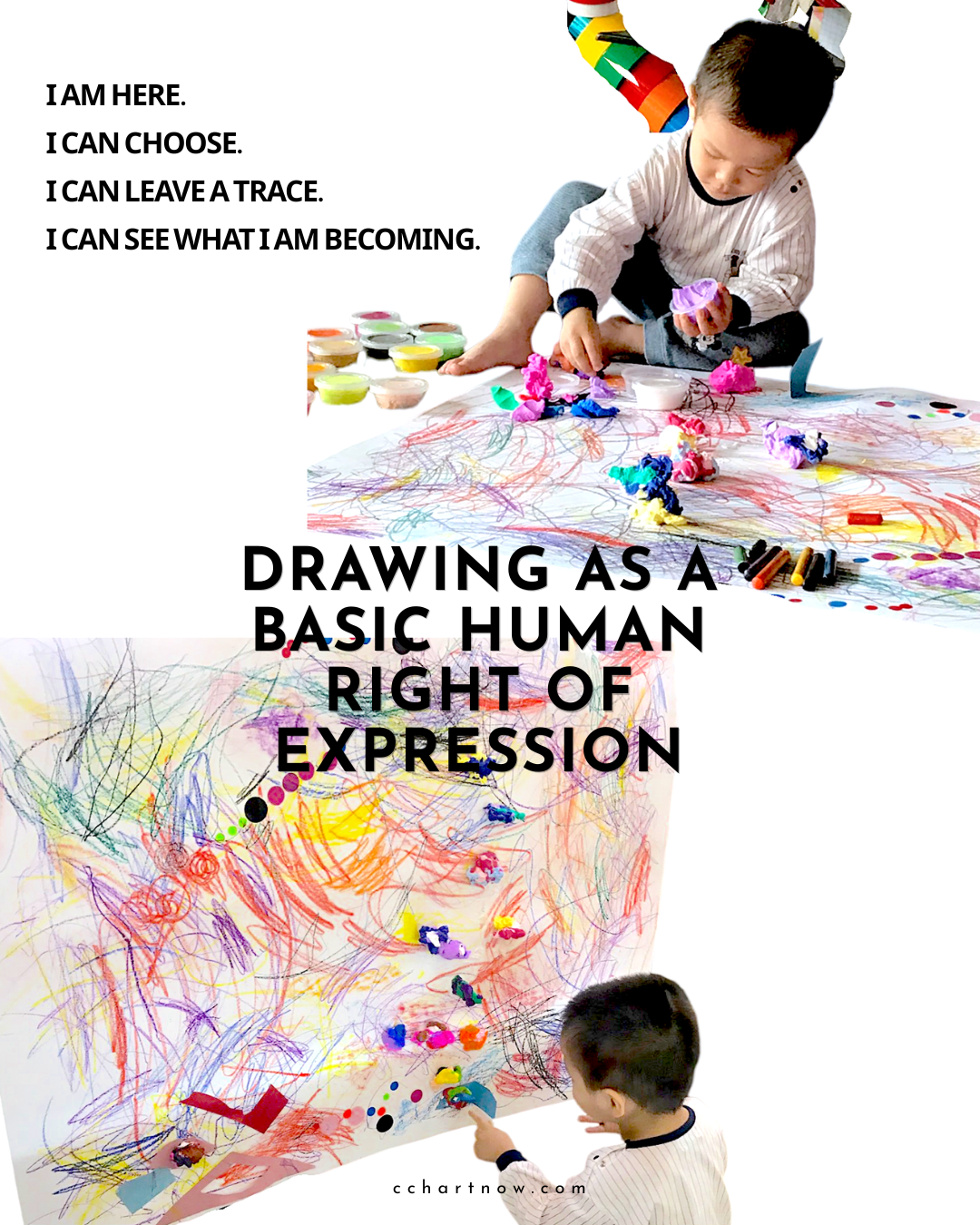
CCH further argues that drawing should not belong only to artists, designers, art students, or technically skilled individuals. Drawing should be understood as a basic human right of expression.
Photographs Record External Life; Drawing Records Internal States
Over the past two decades, human beings have used photographs to record themselves. Photography once served as a way to preserve memory, share joy, and document relationships. In the age of social media, however, self-recording has increasingly become performance, comparison, exposure, and image management.
People now worry about being judged, screenshotted, misunderstood, consumed, or socially evaluated. What once felt like memory can easily become pressure. What once felt like sharing can become exposure.
CCH proposes another possibility:
Photographs record external life. Drawing records internal states.
Photographs allow the world to see us. Drawing allows us to see ourselves first.
Drawing can preserve color, gesture, emotion, bodily rhythm, material choice, and cognitive movement without exposing one’s face, location, relationships, class position, or private life. It can become a safer and deeper form of self-recording in the age of AI and social media.
The goal is not to produce content for others to consume.
The goal is to preserve a record of how one is forming, feeling, choosing, and becoming.
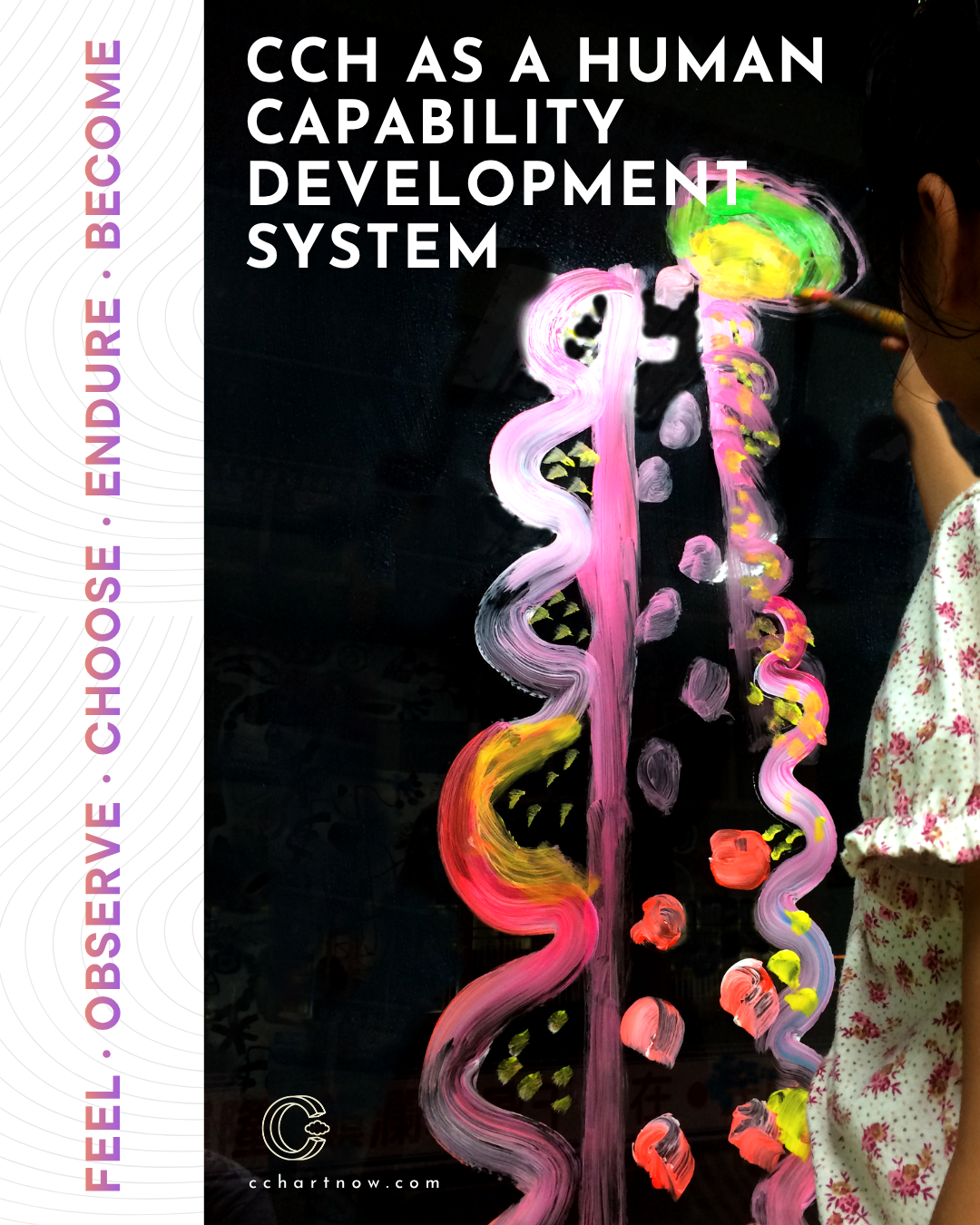
CCH as a Human Capability Development System
CCH is not a traditional art class. It is not simply a free creative activity. It is a human capability development system that uses artistic practice as its medium.
CCH brings together:
visual culture education and critical image awareness;
material-based practice and embodied cognition;
long-duration creation and attention training;
zero-screen environments and cognitive resilience;
AI-era questions of human agency, expression, privacy, and self-recording.
The goal of CCH is not to make every person an artist.
The goal is to protect the human capacity to perceive, attend, express, reflect, regulate, judge, and form a self over time.
In the future, as images become easier to generate, identities easier to package, and lives easier to compare, CCH protects what remains deeply human:
to feel oneself,
to observe the world,
to face material,
to endure time,
to form judgment,
to express truth,
and to become oneself through creative practice.
References
Barthes, R. (1977). Image, Music, Text. Translated by Stephen Heath. New York: Hill and Wang.
Duncum, P. (2002). “Visual Culture Art Education: Why, What and How.” International Journal of Art & Design Education.
Duncum, P. (2004). “Visual Culture Isn’t Just Visual: Multiliteracy, Multimodality and Meaning.” Studies in Art Education, 45(3), 252–264.
Efland, A. D. (1990). A History of Art Education: Intellectual and Social Currents in Teaching the Visual Arts. New York: Teachers College Press.
Geahigan, G. (1998). “Critical Inquiry: Understanding the Concept and Applying it in the Classroom.” Art Education, 51(5), 10–16.
Geahigan, G. (1998). “Implementing Critical Inquiry in the Classroom.” Studies in Art Education, 39(4), 309–322.
Kristeva, J. (1986). “Word, Dialogue and Novel.” In The Kristeva Reader, edited by Toril Moi. New York: Columbia University Press.