How an eighteen-year-old student transformed an encyclopedia into a visual inquiry into survival, civilization, and value
A cockroach rarely receives our sustained attention. We notice it, react, and move away.
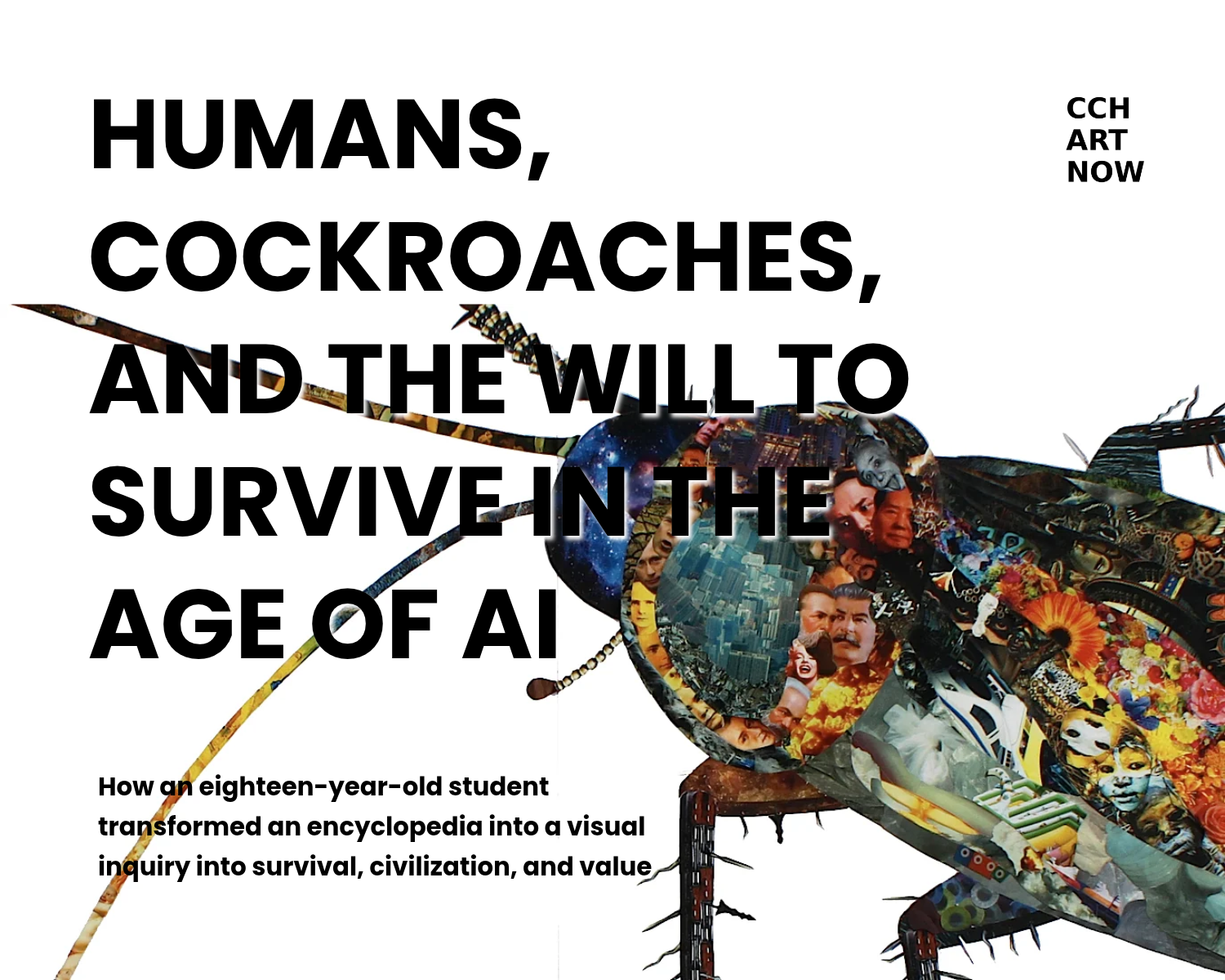
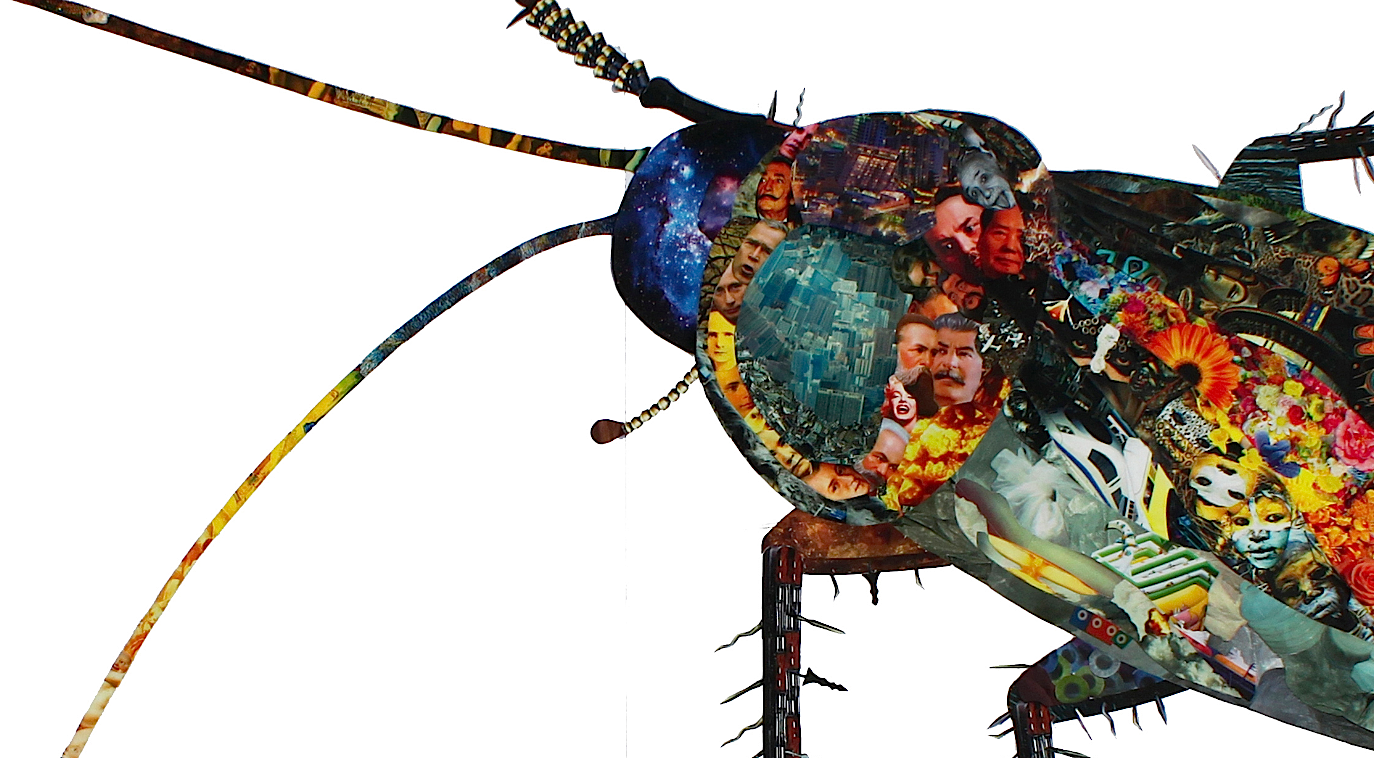
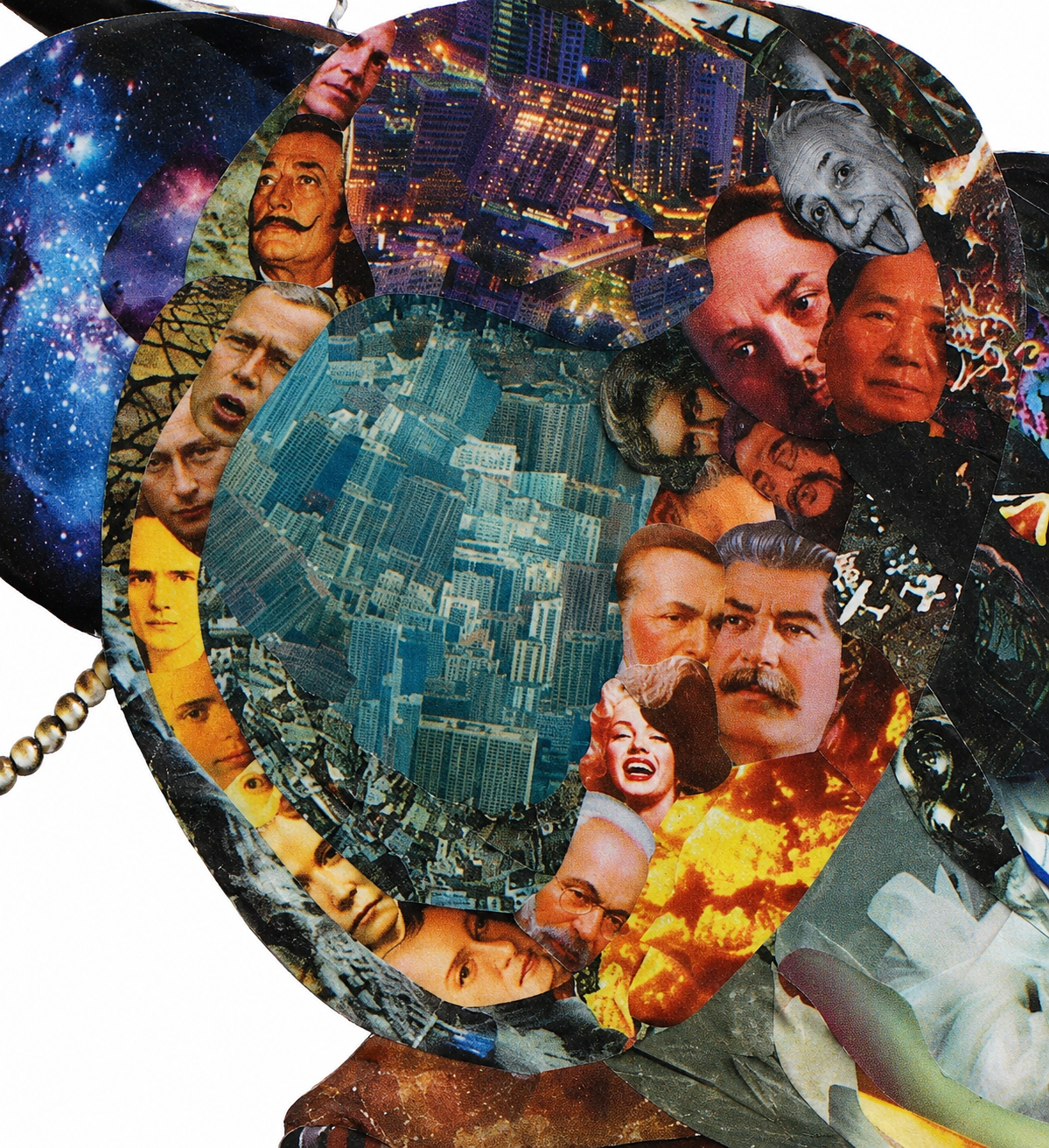
In this student collage, the encounter changes. Enlarged across a full sheet of art paper, the insect invites close inspection. Its body contains cities, faces, industrial objects, flowers, cultural imagery, and the universe. Its surface appears almost alive, as though its shell were reflecting the color and complexity of the world around it.
The student was approximately eighteen and preparing an application portfolio for Emily Carr University of Art + Design. As recalled from that preparation process, collage was among the required components. The teaching challenge was to help a portfolio exercise develop into a meaningful relationship between concept, material, and visual form.
The student chose a cockroach as the subject and an encyclopedia as the source material.
Together, they opened a question: What happens when the world humanity considers worth recording is carried by a creature it often wishes to eliminate?
Waste and life competing for space
The student imagined the cockroach as a witness to successive generations of human development. Its perceived tenacity became the starting point for an artistic proposition: while civilizations change, this unwanted observer continues to survive.
The idea of a “sole witness” belongs to the artwork’s imaginative framework rather than to biological history. It gives the insect a position from which to look back at humanity.
The theme, Waste and Life, emerges from this reversal. Human beings construct environments, consume resources, and discard what they no longer value. Other organisms occupy the spaces that remain. The cockroach becomes a way to consider who belongs in these environments and who gets to decide.
The work also unsettles a hierarchy of worth. A creature commonly treated as lowly receives elaborate visual attention, while its capacity to survive becomes a source of fascination. Here, “lowly” describes a human judgment, not a biological rank.
The large scale makes that judgment harder to maintain without examination. Something ordinarily dismissed now asks to be studied.
An encyclopedia becomes a living body
For the student, the encyclopedia represented a record of the world: the people, objects, environments, and developments that humanity had chosen to preserve in print.
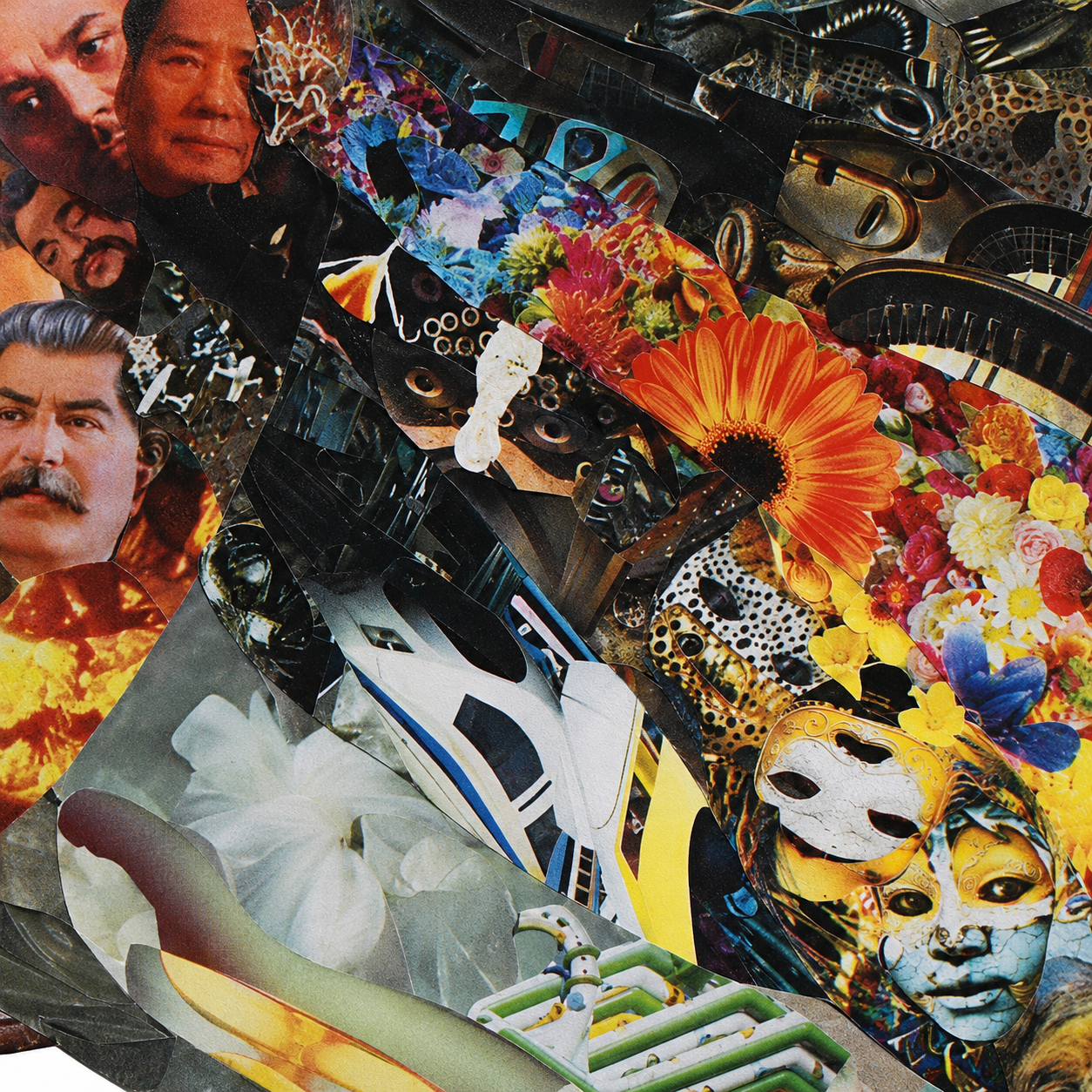
Its pages supplied the collage with a wide range of imagery. Cosmic space meets urban density. Industrial forms sit beside flowers and organic shapes. Human faces appear within a body assembled from the traces of human knowledge.
The source material matters because an encyclopedia organizes information into categories. Collage allows those categories to be rearranged.
Once removed from their original pages, images acquire new neighbors and new functions. A fragment may contribute color, suggest a texture, establish a cultural reference, or help describe the insect’s anatomy. Its role depends on its relationship to the surrounding composition.
Metallic and organic qualities create a particularly strong contrast. Hard, manufactured forms meet softer natural imagery. Together, they give the cockroach’s surface a shifting richness, suggesting a shell that reflects the world it inhabits.
When language becomes anatomy
The conceptual work extends into small details.
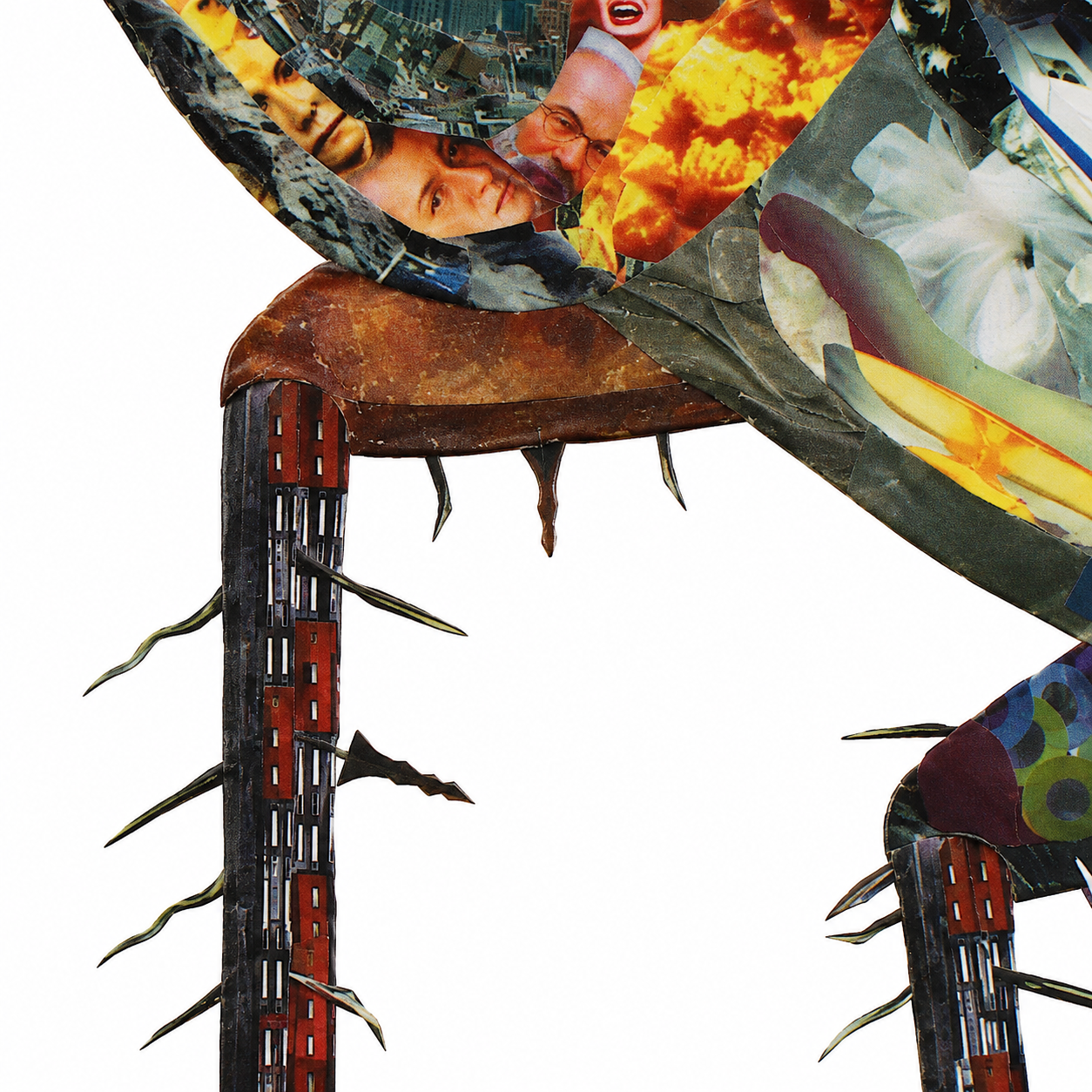
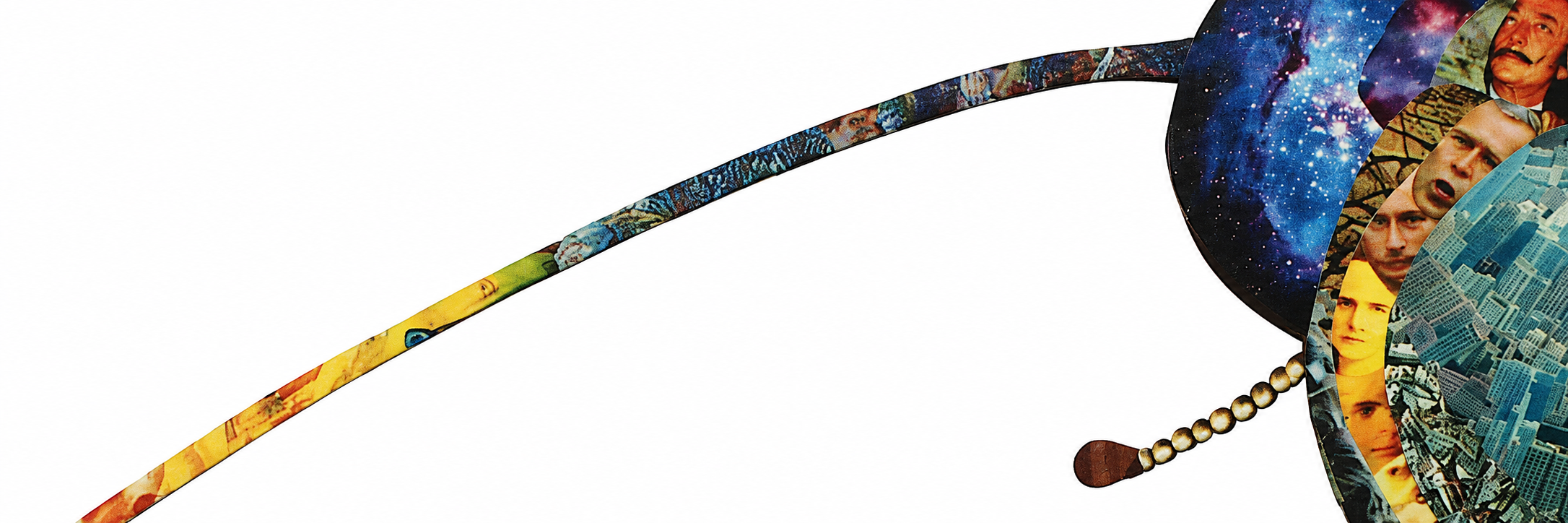
The student used the Mandarin homophones 毛 (máo, hair) and 矛 (máo, spear) to transform the hairs on the cockroach’s legs into spear-like forms. A linguistic association becomes a visual decision.
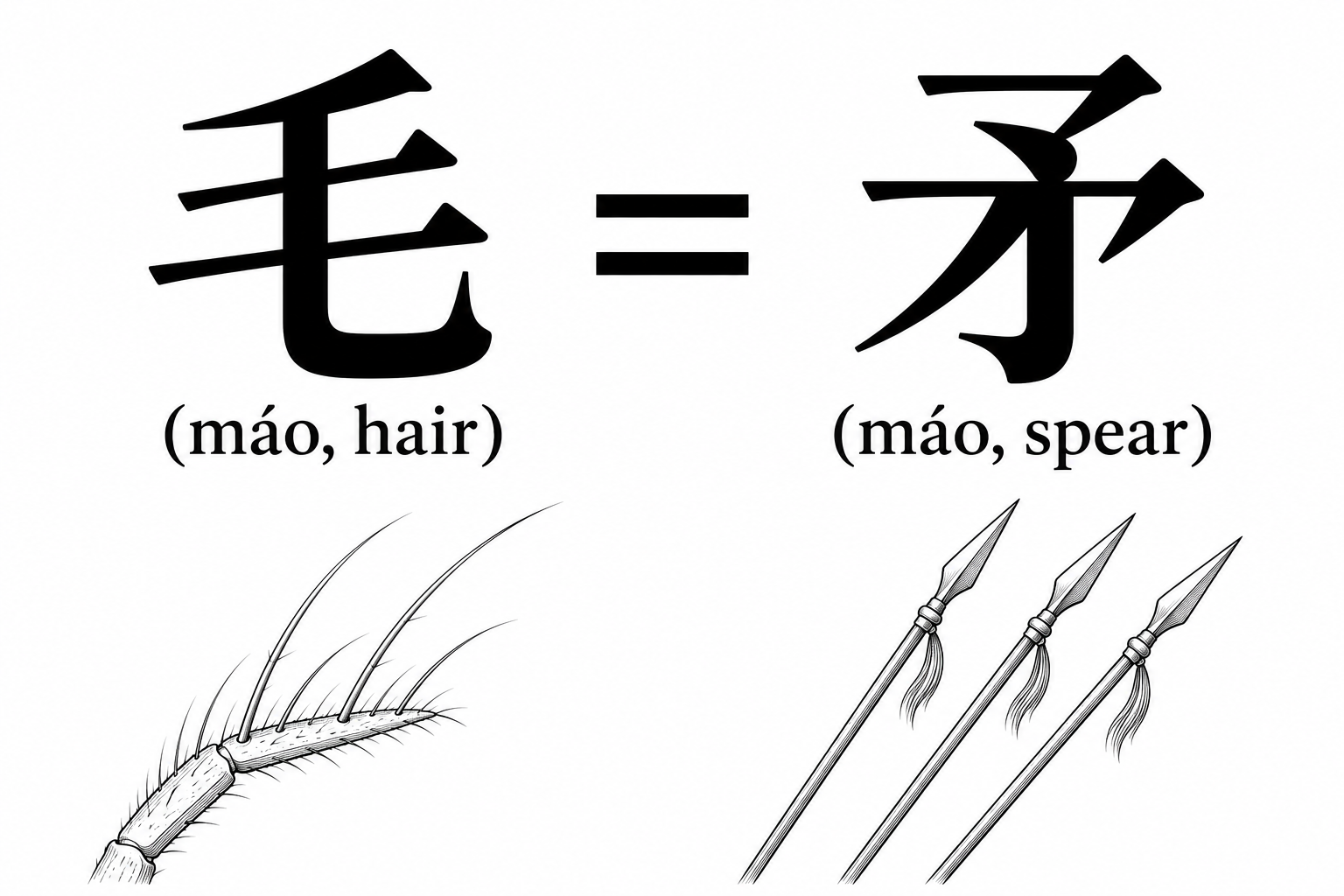
From a distance, these elements belong to the insect’s anatomy. Up close, they introduce the image of a human weapon. Within the theme of survival, they also invite interpretations involving defense and conflict.
The antennae incorporate faces the educator identifies as representing African peoples. Their placement brings human cultural imagery into an unexpected anatomical location. A further inquiry could return to the encyclopedia to identify the specific communities and original captions, preserving the differences among the people represented.
These details give the enlarged format a purpose. Scale creates room for ideas to remain discoverable within a coherent whole.
Learning by constructing a public idea
Seymour Papert and Idit Harel’s constructionism offers one useful lens for this work. Their account connects the building of knowledge with the learner’s creation of an external, shareable artifact. An idea can be encountered, discussed, and reconsidered through something the learner has made.
In this case, the student’s proposition becomes available for others to inspect. The encyclopedia, insect silhouette, weapon imagery, and contrasts of texture give viewers concrete features to interpret.
Read through constructionism, the collage offers an opportunity to develop understanding through decisions about representation. What belongs inside this body? How can a fragment retain its original meaning while serving a new purpose? How much complexity can the composition hold?
These are questions that arise through making. The physical work gives them a form that can be revisited.
Studio Thinking and the relationship between detail and meaning
The Studio Thinking framework identifies habits of mind taught through visual arts practice, including Observe, Envision, Express, Reflect, and Stretch & Explore. These habits interact rather than forming a fixed sequence.
Several provide useful ways to discuss this artwork:
Studio habitConnection to the collageObserveAttend to the insect’s anatomy and the visual qualities of source images.EnvisionImagine how separate fragments could form a recognizable body.ExpressConnect material choices to ideas about civilization and survival.Stretch & ExploreTransform the máo wordplay into an anatomical detail.ReflectExplain how particular choices support the work’s meaning.
This is a retrospective interpretation of the artwork and the educator’s account. A fuller account of how these habits developed would require process photographs, student explanations, and records of revision.
Reading the work through CCH
For CCH ART NOW, the case raises a central educational question: How can a learner sustain ownership of an idea while giving it material form?
Viewed through the current CCH framework, four interrelated areas of practice become relevant:
CCH dimensionTeaching applicationConcentrateKeep the central inquiry in view while attending to individual fragments.InitiateMake choices about subject, source material, symbolism, and scale.CultivateDevelop relationships among images and test whether details support the whole.HarvestArticulate what the work communicates and what remains open to interpretation.
These dimensions can recur throughout a project. A new fragment may prompt another decision; a completed section may lead the learner back to the original question.
Printed material also introduces constraints. Images arrive with existing colors, proportions, meanings, and boundaries. Selecting and cutting them requires choices about what to retain and what to change. This makes collage a useful setting for CCH’s emphasis on judgment within material practice.
The completed work provides a rich basis for discussing those choices. It does not, by itself, establish gains in attention or cognitive resilience.
Teacher attention that protects student authorship
A relevant CCH teaching principle is High Observational Sensitivity, Low Intrusive Intervention.
Applied to a project like this today, it means noticing the learner’s decisions closely and choosing interventions that help the learner examine them. A teacher might ask:
What makes this image belong here?
How does this detail connect to your central idea?
What changes when you view the work from across the room?
Which part needs clarification, and which part can remain ambiguous?
These are suggested prompts for current practice, rather than a transcript of the original lessons.
The teacher’s task includes distinguishing observation from interpretation. A pause might involve comparison, uncertainty, fatigue, or something else entirely. Understanding it requires attention and, when appropriate, a question.
Project Zero’s Making Learning Visible research provides a complementary approach: purposeful documentation can support reflection on how ideas develop and help educators revisit the relationship between their intentions and what occurred.
For CCH, useful records would include the student’s own explanation, alternative arrangements, revision decisions, and the teacher’s responses. Together, these could show how the learner maintained or changed the work’s direction.
A world reflected in an unwanted life
The collage gives a familiar creature an unfamiliar presence. Its surface holds the complexity of an encyclopedia while retaining the shape of a single organism.
The viewer moves between scales: insect and civilization, anatomical detail and cultural image, individual fragment and whole composition.
That movement is also the educational significance of the work. A portfolio requirement became an opportunity to organize knowledge, construct meaning, and make choices that others could encounter.
Through CCH’s present-day lens, the lasting question is how teaching can support this kind of authorship: a learner staying with an idea, examining its possibilities, and accepting responsibility for the form it takes.
On the back of a cockroach, the student assembled a world—and offered a perspective from which to see it again.
Case note: This article draws on the educator’s recollection and the supplied artwork image. The theoretical and CCH connections are retrospective interpretations. The reference to portfolio requirements describes this student’s historical preparation context.
References
Papert, S., & Harel, I. (1991). Situating Constructionism. In Constructionism.
Harvard Project Zero. Eight Habits of Mind.
Studio Thinking. The Framework.
Harvard Project Zero. Making Learning Visible.