

Autonomy, responsive scaffolding, and material practice in the AI age
Chia-Chen Hsu | Founder, CCH ART NOW
Research-informed practice article · Classroom session: 8 November 2026
Abstract
How should a teacher respond when a child chooses a familiar activity over a planned challenge, then repeatedly asks whether freer mark-making is allowed? This article examines one approximately two-hour CCH ART NOW studio session through research on motivation, scaffolding, and exploratory learning. The analysis draws on a retrospective teacher account and four classroom photographs. It distinguishes observed actions from interpretations of the child's emotional state and from claims about learning outcomes. Published research provides a rationale for supporting choice while adjusting guidance to the learner's responses. The case generates a practical question for teacher development: how can educators offer sufficient support for the next action while preserving the child's authority over the work? A proposed observation framework translates this question into behaviors that can be tracked across sessions. The article offers a basis for further inquiry into learner agency in the AI age.
Keywords: learner agency; autonomy support; contingent scaffolding; guided play; material-based learning; teacher observation
1. A child chooses the starting point
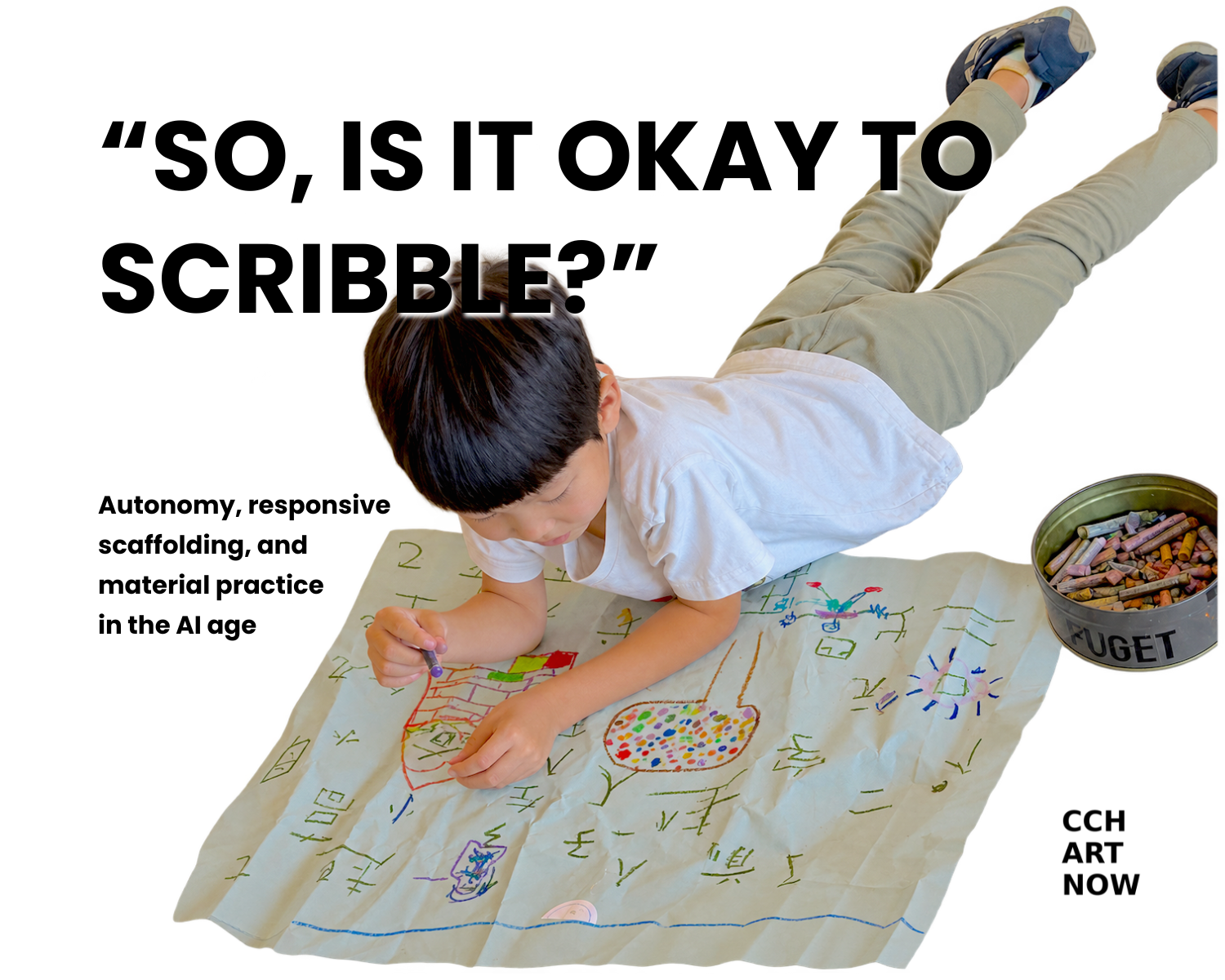
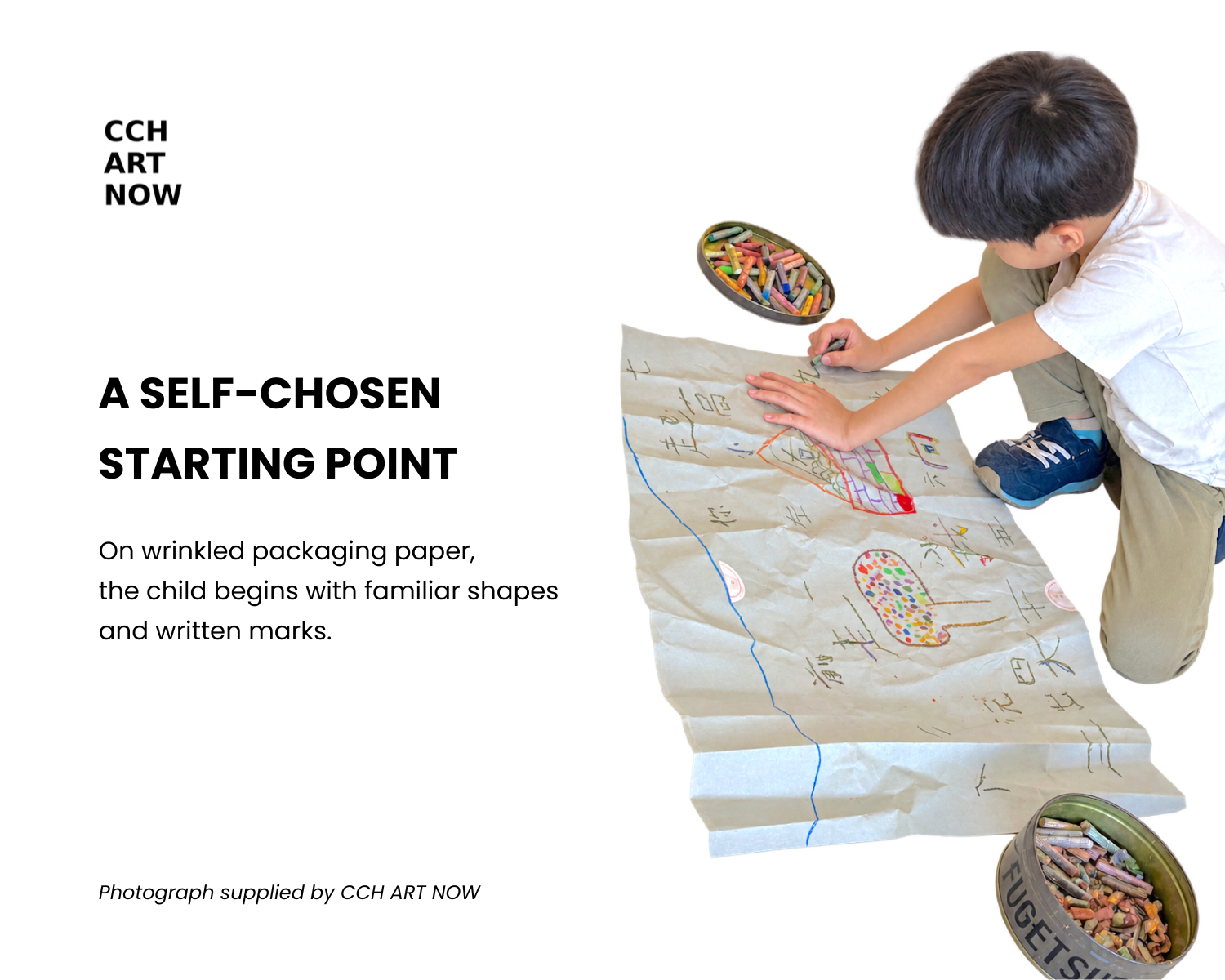
The session began with materials prepared for three-dimensional assembly. The child selected a wrinkled sheet of packaging paper, spread it across the floor, and began drawing with crayons. The teacher accepted this change of direction and allowed the drawing to develop.
The early drawing included bounded shapes, grid-like divisions, and a recognizable tree. According to the teacher, the tree resembled a form encountered at school. Color use was varied, while many marks remained within established outlines.
At approximately forty minutes, the teacher noticed the child arranging long crayons inside a round container. This was a shift in activity. It may have involved spatial exploration, although the available account does not establish what the child was investigating.
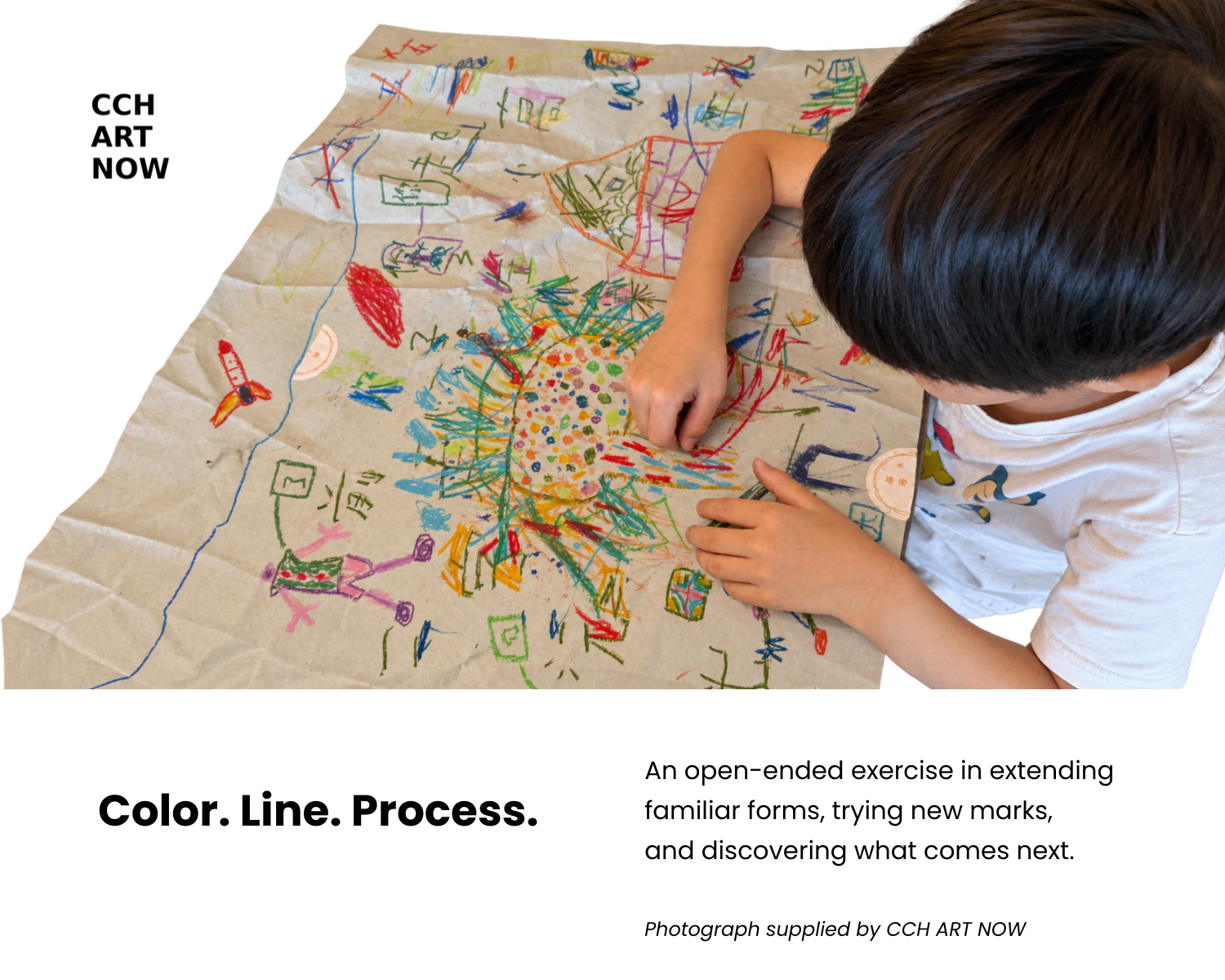
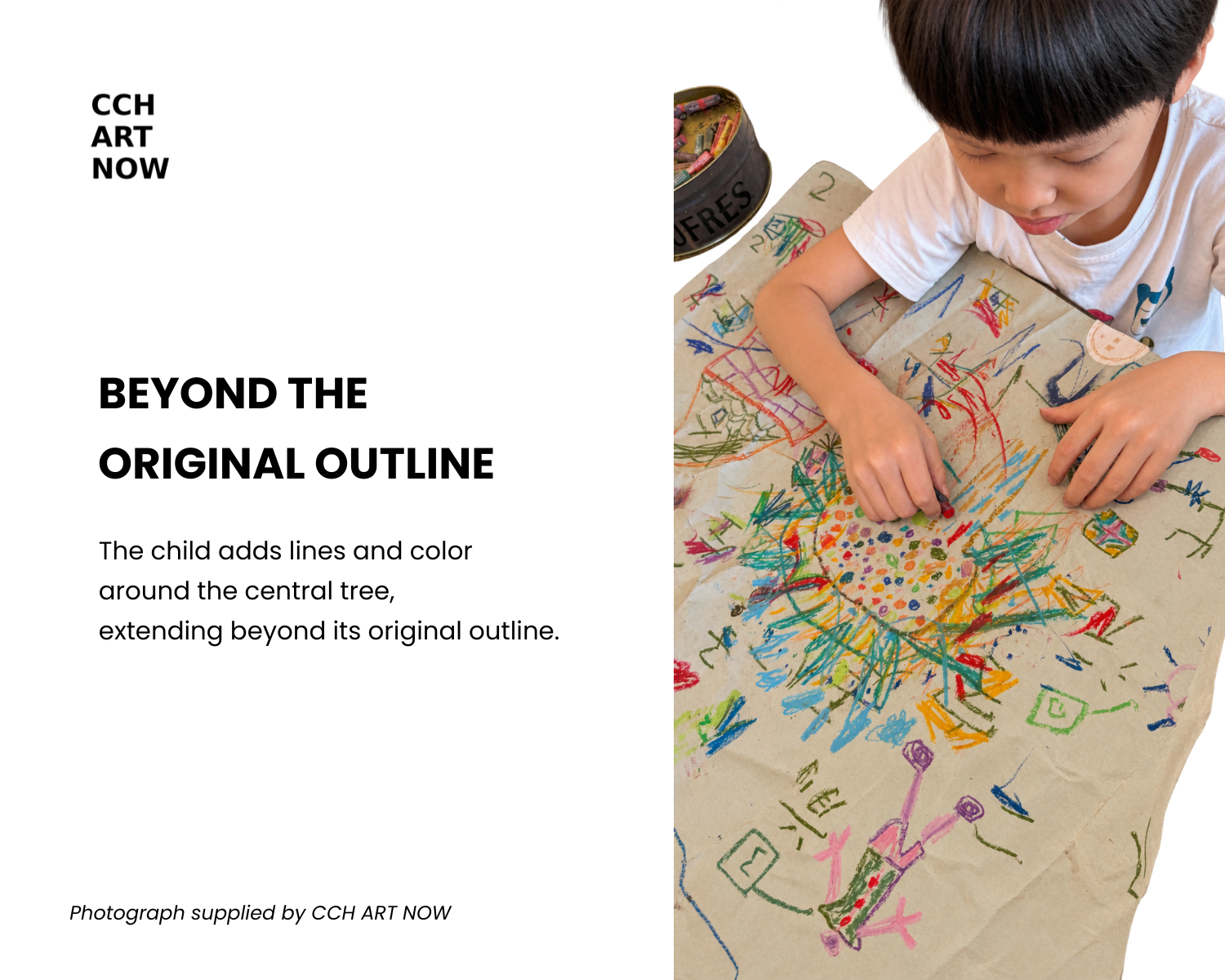
The teacher then asked about recently learned Chinese writing. The child began writing familiar characters and, in the teacher's account, worked with evident interest. The teacher invited changes in color and extensions of the written forms. Later, attention returned to the tree, where additional lines and colors extended around and beyond its earlier contour.
During the invitations to explore, the teacher recalled repeated questions, translated from Mandarin as: “So, is it okay to scribble?” The question is reported from recollection, rather than an audio transcript. It makes visible a distinction worth investigating: a child can initiate an activity while still seeking adult confirmation about how it may proceed.
Scope of the case
This is a practice-informed interpretation of one session. The available materials are the teacher's retrospective narrative and four supplied photographs, of which two are reproduced here. They provide neither continuous observation nor independent coding. The approximate forty-minute point comes from the teacher's account. Permission requests were not counted, and engagement duration was not systematically sampled. The two-hour session length therefore describes the lesson, rather than a measured span of uninterrupted attention.
2. Psychological accounts of choice, support, and exploration
Autonomy includes ownership and a workable next step
Self-determination theory identifies autonomy, competence, and relatedness as important psychological needs. Autonomy concerns experiencing ownership of one's action; competence concerns feeling capable of meeting a challenge; relatedness concerns connection and care. Learning environments can support all three through meaningful choice, appropriately structured challenges, and respectful interaction (Ryan & Deci, 2020).
The child's choice of paper offers a plausible instance of behavioral initiative. The teacher's move from familiar writing toward visual variation may have provided an accessible next step. These are interpretations of the teaching interaction; they do not establish the child's subjective experience of autonomy or competence.
Relevant experimental evidence comes from Waterschoot et al. (2019). In a study of 126 pupils, with a mean age of 10.8 years, children who could undertake a preferred painting activity reported greater intrinsic motivation and vitality than children whose earlier choice was withdrawn. The study supports attention to meaningful preferences. Its age group, comparison condition, and immediate self-report outcomes limit direct generalization to this case.
For CCH practice, the implication is to preserve choice while making participation manageable. A child who hesitates might benefit from two concrete possibilities, a brief demonstration of a technique, or an invitation to begin with one small mark. Which support is appropriate remains an observational question.
Scaffolding changes as the child responds
In their review of teacher–student interaction, van de Pol et al. (2010) identify three defining features of scaffolding: support contingent on the learner's performance, gradual withdrawal of support, and transfer of responsibility to the learner. Questions and demonstrations qualify as scaffolding through their responsiveness and eventual withdrawal, rather than their form alone.
This framework gives a precise research connection to the CCH principle of High Observational Sensitivity, Low Intrusive Intervention. The teacher attends closely to action, offers support proportionate to the difficulty, and checks whether the child can continue with increasing responsibility.
The session documents a change after adult invitations. The next question is whether the child can initiate a related variation when prompts are reduced. Such evidence would strengthen an account of growing independence. It also helps define low intrusion positively: assistance sufficient to enable progress, with consequential choices remaining available to the learner.
Teaching cues shape the field of exploration
Bonawitz et al. (2011) found that preschoolers shown one function of a novel toy in a pedagogical demonstration explored fewer additional possibilities than children in comparison conditions. The finding concerns a specific exploratory task, but demonstrates that children use the manner of adult instruction as information about what is worth investigating.
Applied cautiously to studio practice, this suggests a reason to allow some encounters with materials before presenting a finished example. Direct instruction remains useful when the learning goal requires a particular technique. When the goal is discovery, teachers can consider how their examples may influence the possibilities children pursue.
3. What published quantitative evidence contributes
Skene et al. (2022) reviewed 39 guided-play studies; 17 entered outcome meta-analyses. Benefits over direct instruction were identified for early mathematics, shape knowledge, and task switching. Other comparisons were inconclusive. Implementation varied, and many studies had substantial risk of bias. Figure 2 presents all twelve pooled comparisons from Table 2.
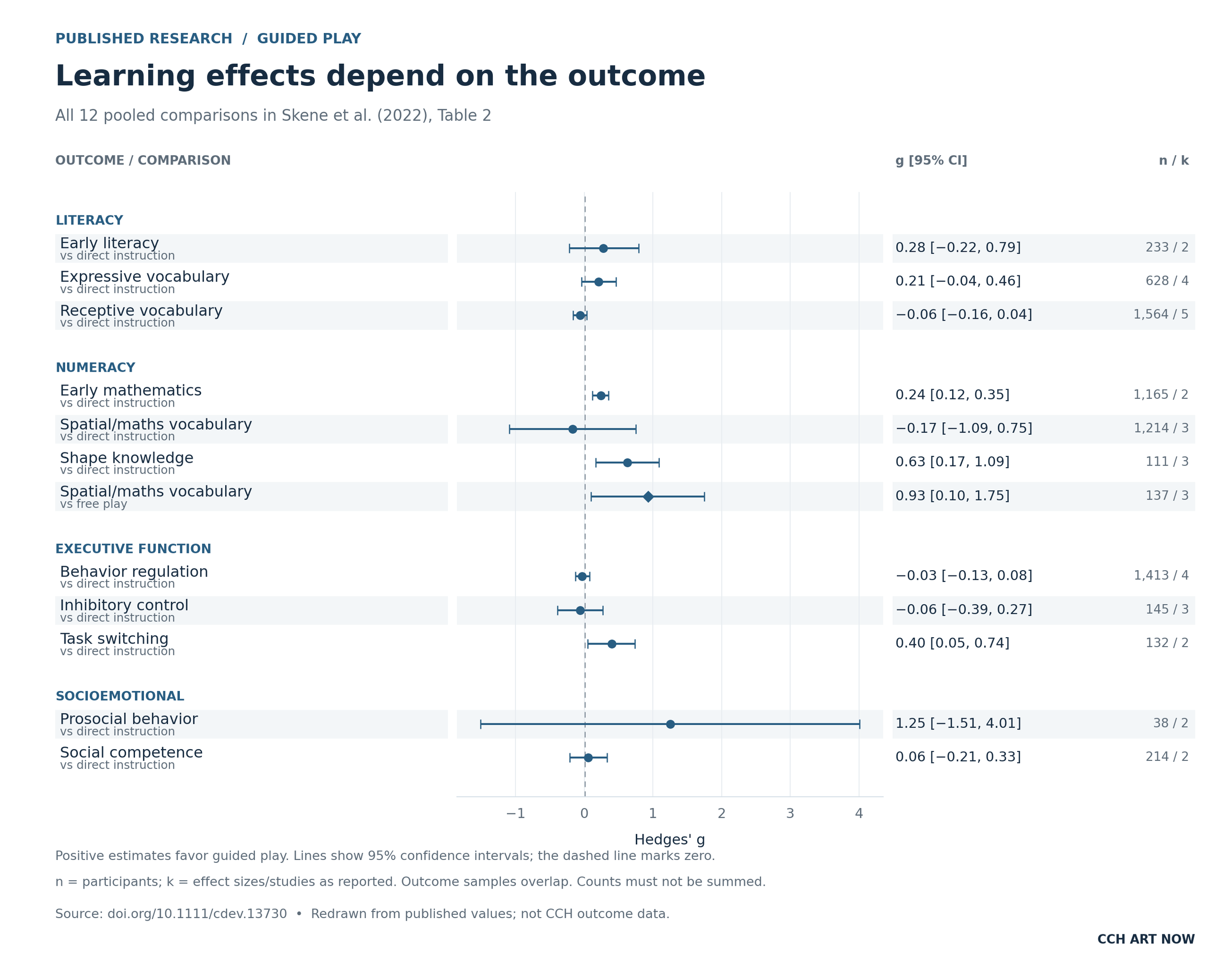
Here, g is a standardized effect size. Positive values favor guided play. Intervals crossing zero leave the direction uncertain. Participant counts overlap across outcomes and should not be summed.
This evidence offers a useful comparison for designing CCH inquiry. The present case involves open-ended art activity, a particular teacher–child relationship, and decisions about materials and marks. Any claim that this combination improves executive function requires direct assessment of that claim. A visually expanded drawing alone cannot demonstrate a change in cognitive flexibility.
4. Interpreting the child with care
Familiar forms can support personally meaningful action
The teacher wondered whether the return to bounded shapes reflected school-related pressure. That is a plausible hypothesis to explore alongside alternatives: enjoyment of familiar symbols, preference for a recognizable image, or the particular demands of the selected surface. The photographs do not distinguish among these explanations.
Thomas and Jolley (1998) emphasize that children's drawings are influenced by multiple processes and are unreliable as sole indicators of emotional experience. Diamond's (2013) review also situates executive performance within broader emotional, social, and physical conditions. Together, these perspectives encourage contextual inquiry while leaving the cause of this child's behavior open.
An account grounded in the available evidence would read: The child used familiar forms, repeatedly sought confirmation about permissible marks, and later added variations following teacher invitations. This statement can guide further observation without assigning a psychological cause to a drawing style.
Agency belongs to the decision process
The pedagogical value of a boundary depends partly on what the child is doing with it. A child may deliberately preserve an outline, revise it, or extend beyond it. Each can express agency when it reflects a meaningful choice. Conversely, a visually unconventional result may follow close compliance with a teacher's preference.
For this article, learner agency is treated operationally as opportunities to initiate, choose, revise, seek assistance, and influence the course of activity. This is a proposed working definition for observation. It is not a validated measure of a stable personal trait.
The repeated permission question is therefore useful as an interactional event. It invites inquiry into what the child understands about the task, what kind of confirmation the teacher supplies, and what the child does afterward. Its meaning should be assessed through the surrounding exchange.
5. Making sensitive teaching observable
For teacher development, sensitivity becomes more teachable when an observation is separated from its interpretation and from the response chosen. Figure 3 proposes a CCH framework for making these decisions discussable. Its arrows describe a cycle of inquiry, rather than an established causal mechanism.
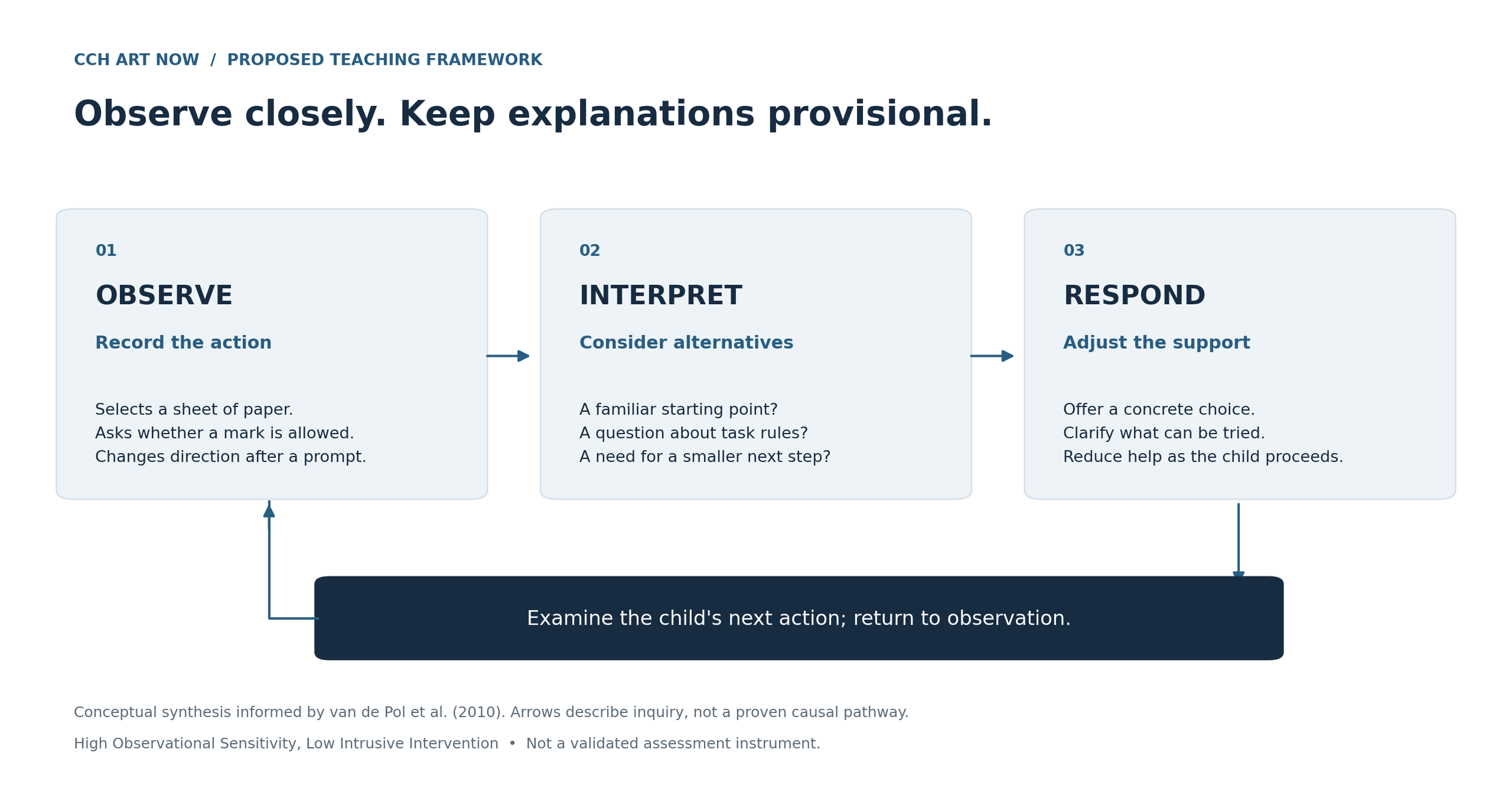
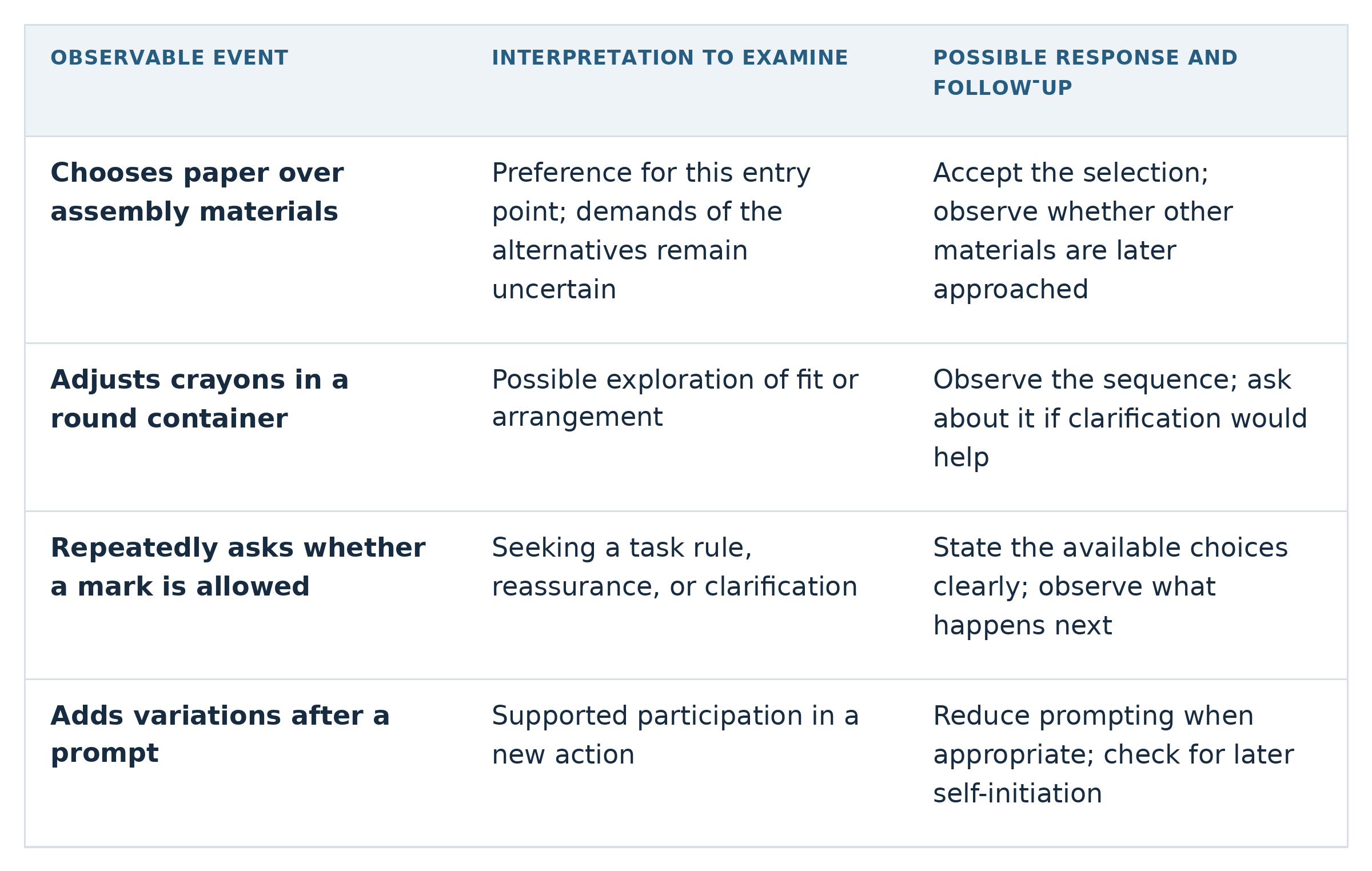
These responses are options for professional judgment. A teacher might say, “You can keep this shape or change it. Which would you like to try?” A child struggling to begin may need a more concrete invitation. Subsequent action provides information for the next adjustment.
This places responsibility on the teacher to examine the effects of intervention. Waiting, questioning, and demonstrating each become choices to evaluate against the learner's response.
6. Following the development of independence
The question of internalization requires repeated observation. Kassai et al. (2019), in a meta-analysis of children's executive-function training, found improvement in trained components but no convincing transfer to other untrained executive-function components. That review did not evaluate CCH or art-based teaching. It offers a methodological reason to assess each proposed form of transfer directly.
A feasible next step is to track comparable opportunities across
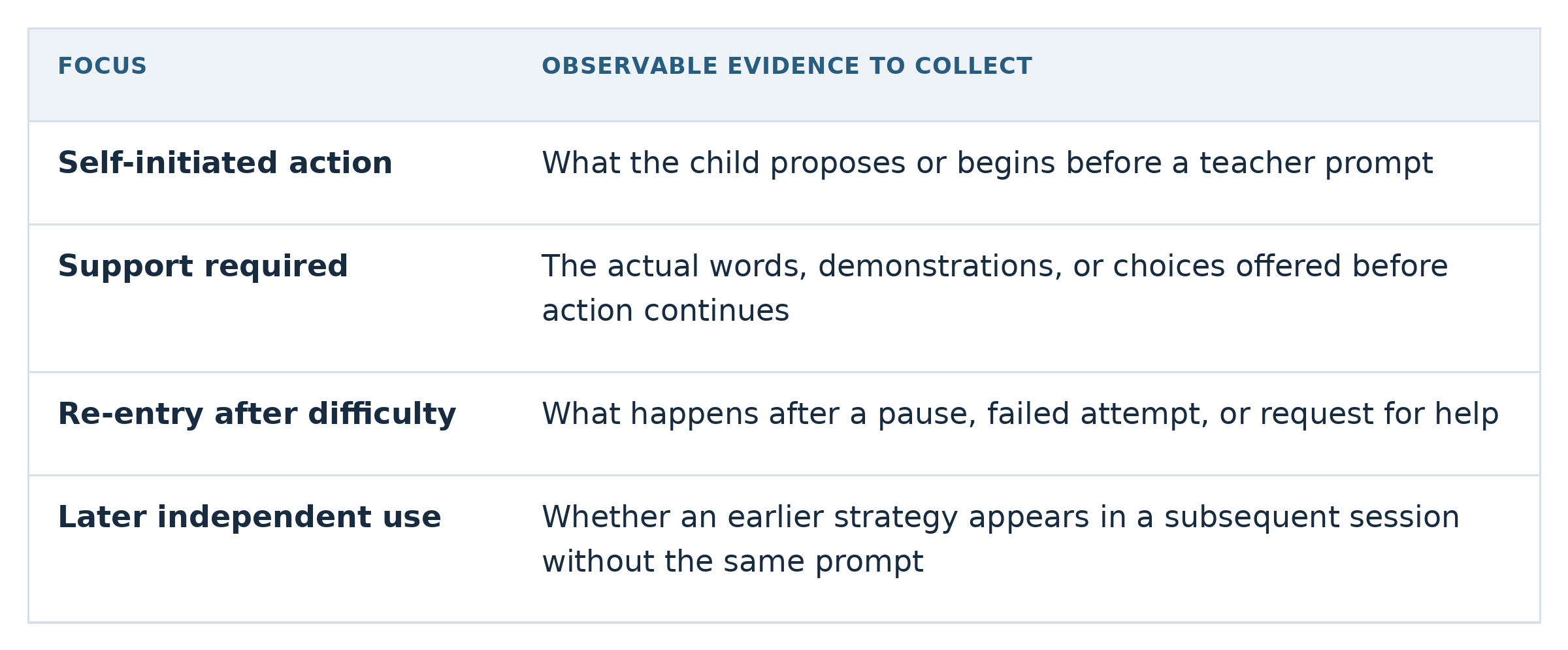
These are proposed documentation categories, rather than standardized psychological scores. Lesson duration, observed engagement, and returning after interruption should be recorded separately. Notes about task novelty and teacher prompting would help interpret change. Independent coding of selected recordings, with appropriate permission, could strengthen consistency. Claims of effectiveness would require a design addressing alternative explanations, including maturation, familiarity, and the teacher–child relationship.
Conclusion: preserving room for human judgment
For education in the AI age, this case directs attention toward the conditions under which a learner makes a next move. The child selected a surface, used familiar resources, asked about the scope of permission, and participated in variation with adult support. Those actions offer concrete starting points for examining agency.
CCH ART NOW's proposed contribution is to make the relationship between material action and teacher response visible: observing closely, keeping interpretations provisional, and adjusting assistance while preserving meaningful decisions for the child. Further documentation can test whether these opportunities develop into increasingly independent strategies. The educational aspiration is a learner who can choose a starting point, seek useful support, and return to an uncertain task with an action of their own.
References
Bonawitz, E., Shafto, P., Gweon, H., Goodman, N. D., Spelke, E., & Schulz, L. (2011). The double-edged sword of pedagogy: Instruction limits spontaneous exploration and discovery. Cognition, 120(3), 322–330. https://doi.org/10.1016/j.cognition.2010.10.001
Diamond, A. (2013). Executive functions. Annual Review of Psychology, 64, 135–168. https://doi.org/10.1146/annurev-psych-113011-143750
Kassai, R., Futo, J., Demetrovics, Z., & Takacs, Z. K. (2019). A meta-analysis of the experimental evidence on the near- and far-transfer effects among children's executive function skills. Psychological Bulletin, 145(2), 165–188. https://doi.org/10.1037/bul0000180
Ryan, R. M., & Deci, E. L. (2020). Intrinsic and extrinsic motivation from a self-determination theory perspective: Definitions, theory, practices, and future directions. Contemporary Educational Psychology, 61, 101860. https://doi.org/10.1016/j.cedpsych.2020.101860
Skene, K., O'Farrelly, C. M., Byrne, E. M., Kirby, N., Stevens, E. C., & Ramchandani, P. G. (2022). Can guidance during play enhance children's learning and development in educational contexts? A systematic review and meta-analysis. Child Development, 93(4), 1162–1180. https://doi.org/10.1111/cdev.13730
Thomas, G. V., & Jolley, R. P. (1998). Drawing conclusions: A re-examination of empirical and conceptual bases for psychological evaluation of children from their drawings. British Journal of Clinical Psychology, 37(2), 127–139. https://doi.org/10.1111/j.2044-8260.1998.tb01289.x
van de Pol, J., Volman, M., & Beishuizen, J. (2010). Scaffolding in teacher–student interaction: A decade of research. Educational Psychology Review, 22, 271–296. https://doi.org/10.1007/s10648-010-9127-6
Waterschoot, J., Vansteenkiste, M., & Soenens, B. (2019). The effects of experimentally induced choice on elementary school children's intrinsic motivation: The moderating role of indecisiveness and teacher–student relatedness. Journal of Experimental Child Psychology, 188, 104692. https://doi.org/10.1016/j.jecp.2019.104692
Author perspective: Written from the perspective of the CCH ART NOW founder and teacher. The analysis concerns the author's own educational practice. Published research and the classroom account are identified separately throughout.