
CASE RECORD + RESEARCH RATIONALE
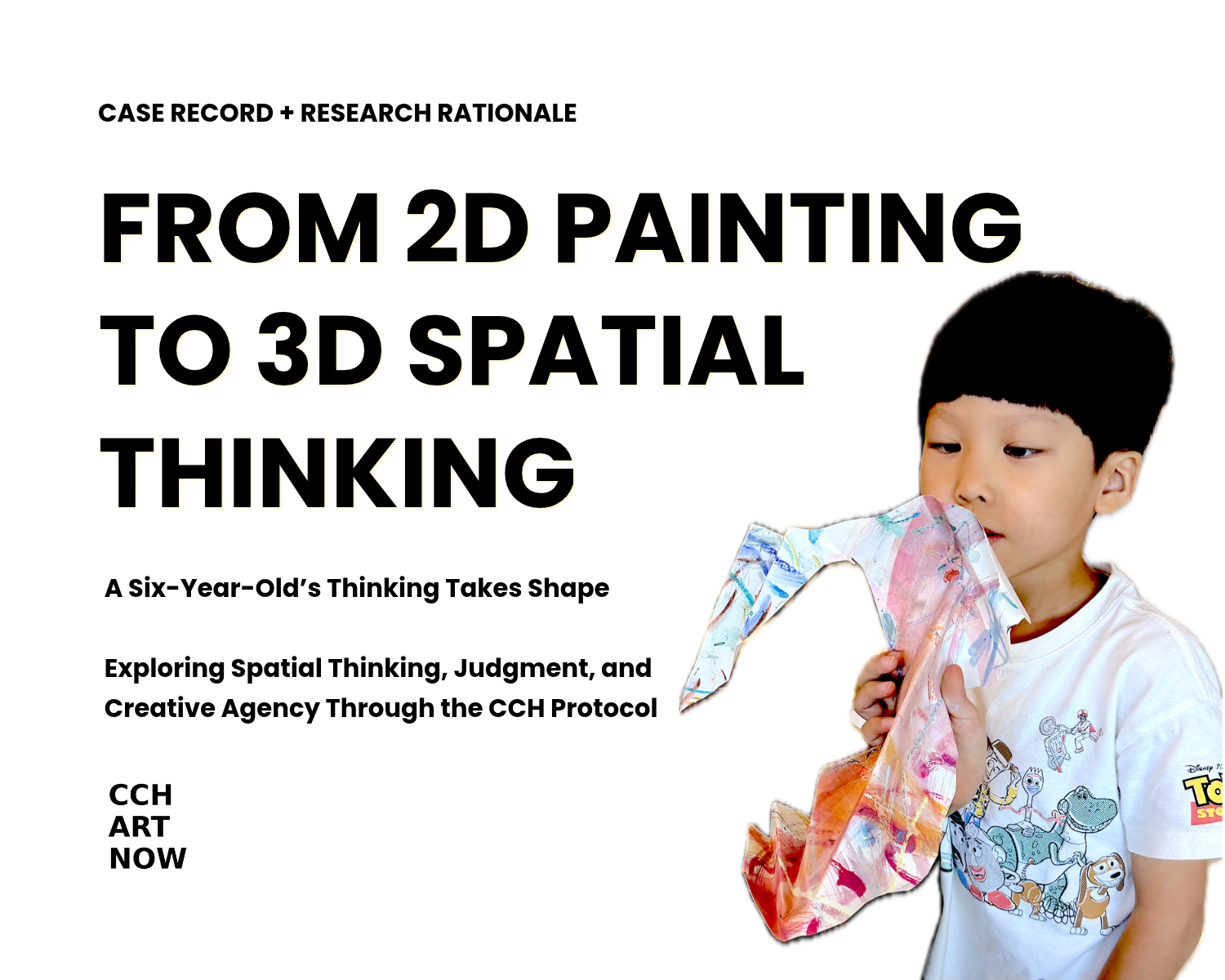
A Six-Year-Old’s Thinking Takes Shape
Exploring Spatial Thinking, Judgment, and Creative Agency Through the CCH Protocol
Central assessment | This case illustrates a research-informed teaching design: preserving the child’s choices, using concrete demonstrations to make a task accessible, and extending thinking through material action, feedback and reorganization. It offers promising practice-based evidence. CCH’s overall effectiveness and comparative advantages require continued measurement and comparison.
Three observations worth preserving
1. A change in task approach: from rectangular cutouts toward cutting along marks, colors and contours.
2. Material judgment: considering the orientation of colored and white surfaces and suggesting glass as a mounting surface.
3. Expanded expression: shaping flat elements into objects, rearranging them and extending the squirrels’ story.
How to read the evidence
Observation refers to events reported by the teacher. Interpretation refers to possible meanings analyzed through theory. External research refers to findings about related teaching mechanisms from other studies. These categories are kept distinct. All numerical findings have sources; no case scores or improvement percentages have been invented.
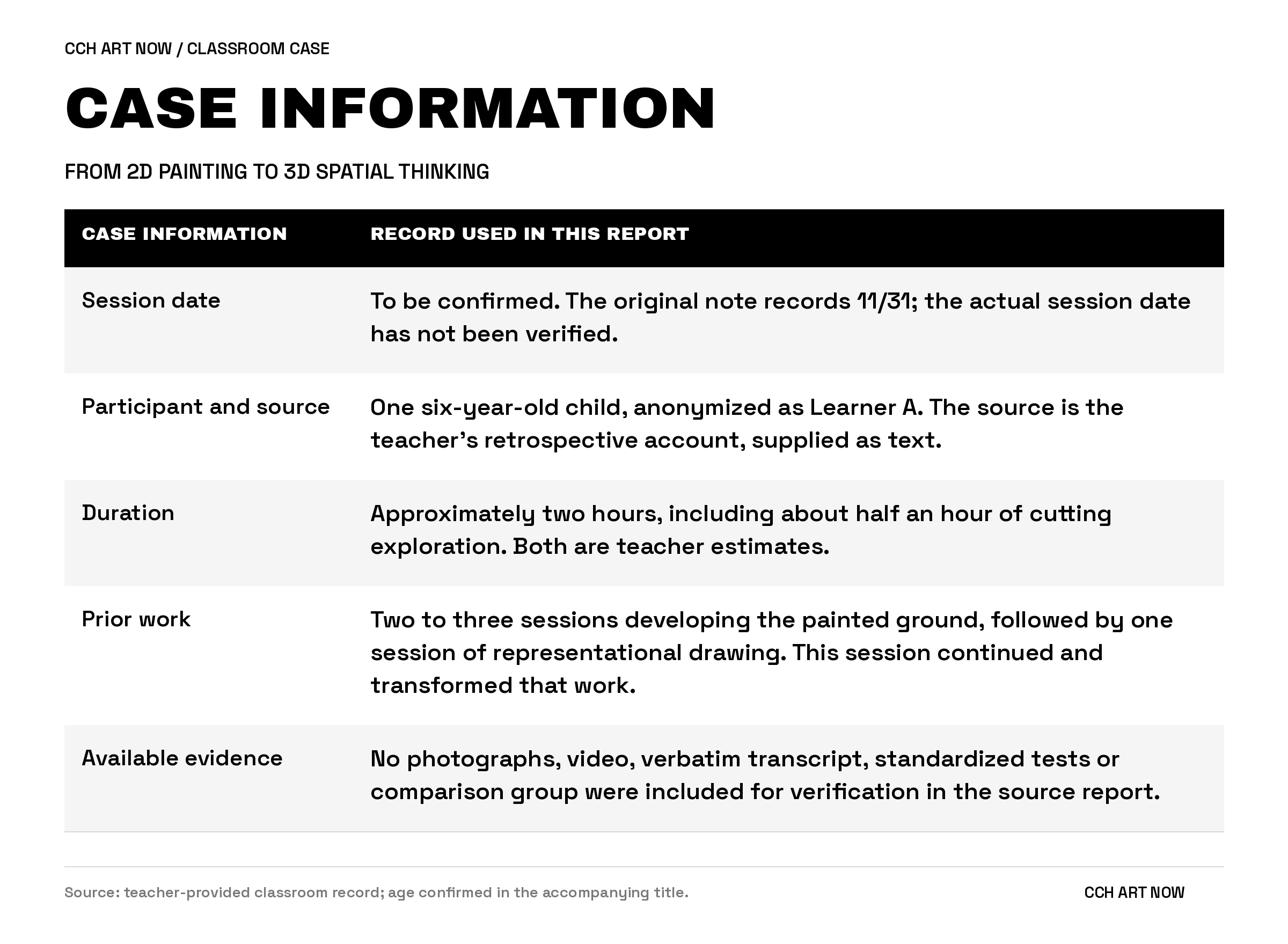
Teaching account and method: Chia-Chen Hsu / CCH ART NOW. Literature verification and report preparation: November 3, 2026. This is a practice analysis, not a peer-reviewed CCH intervention study.
01 / CLASSROOM RECORD
Classroom sequence and guidance
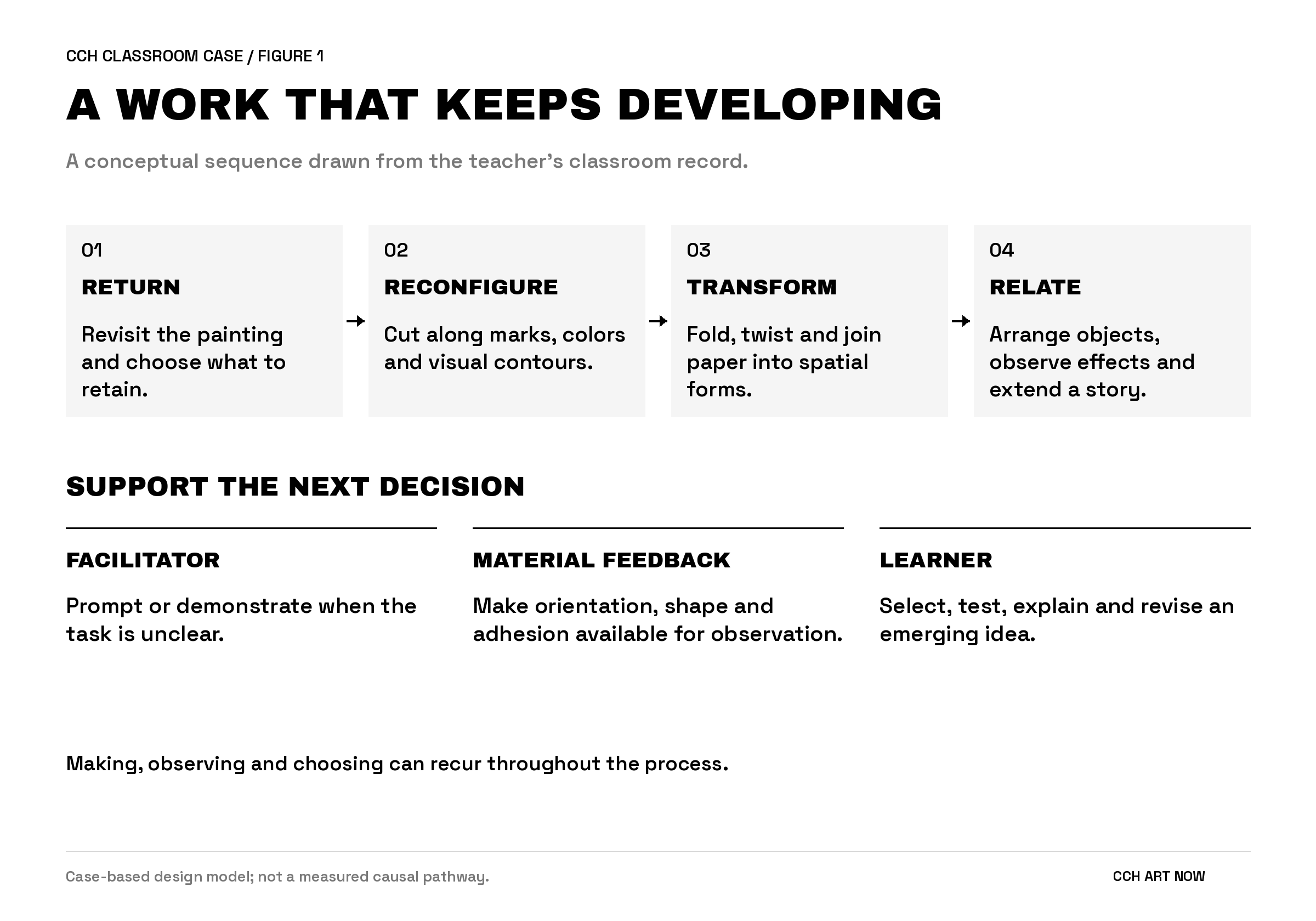
Retaining familiar elements and exploring a new way to cut
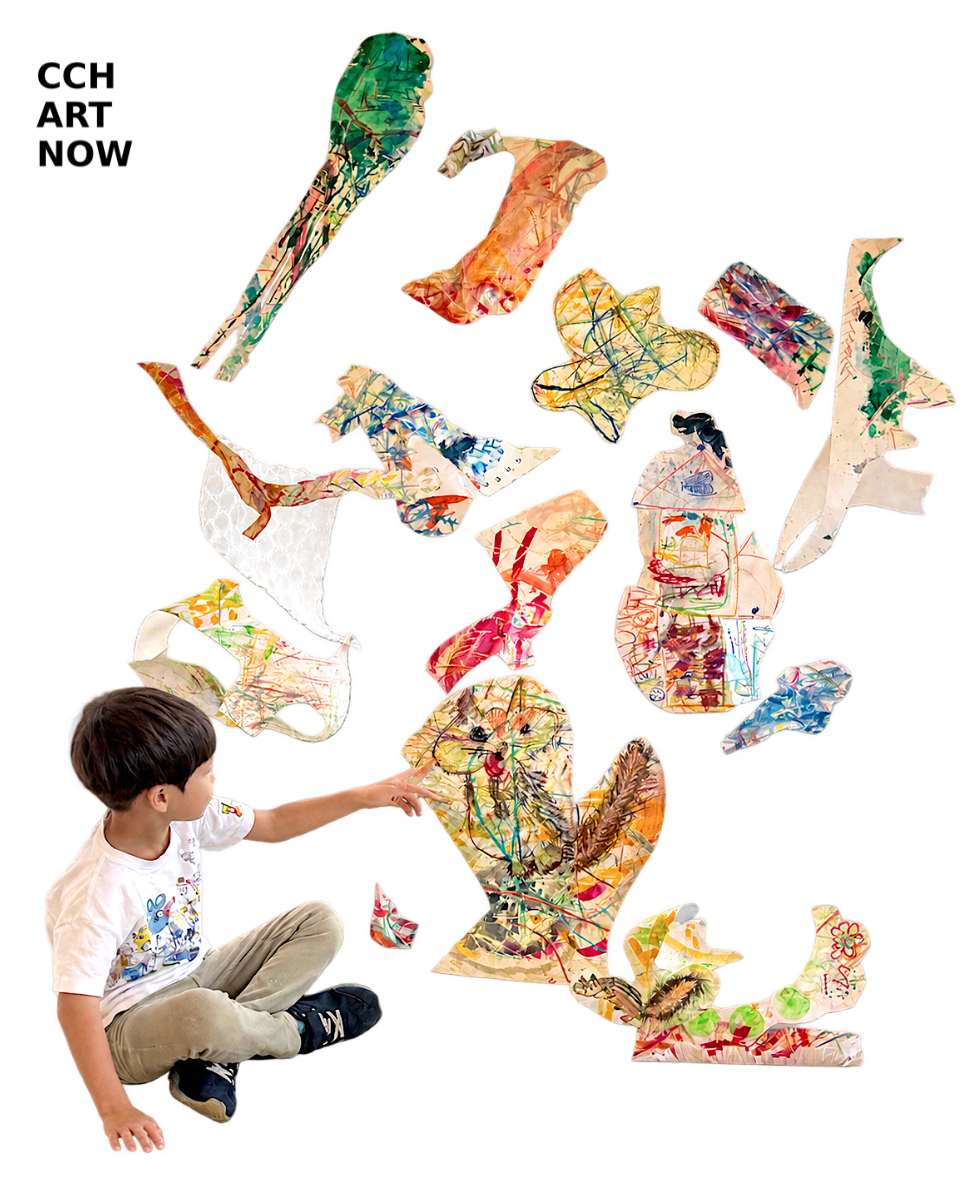
The session continued work accumulated over earlier lessons, cutting and reassembling the painting. Initially, the child was unsure what to cut. We began by identifying the two squirrels he wanted to retain and cutting out these representational elements. The teacher then invited him to examine watercolor marks and areas of color as shapes that could be redesigned.
Demonstrating a possibility and returning space for exploration
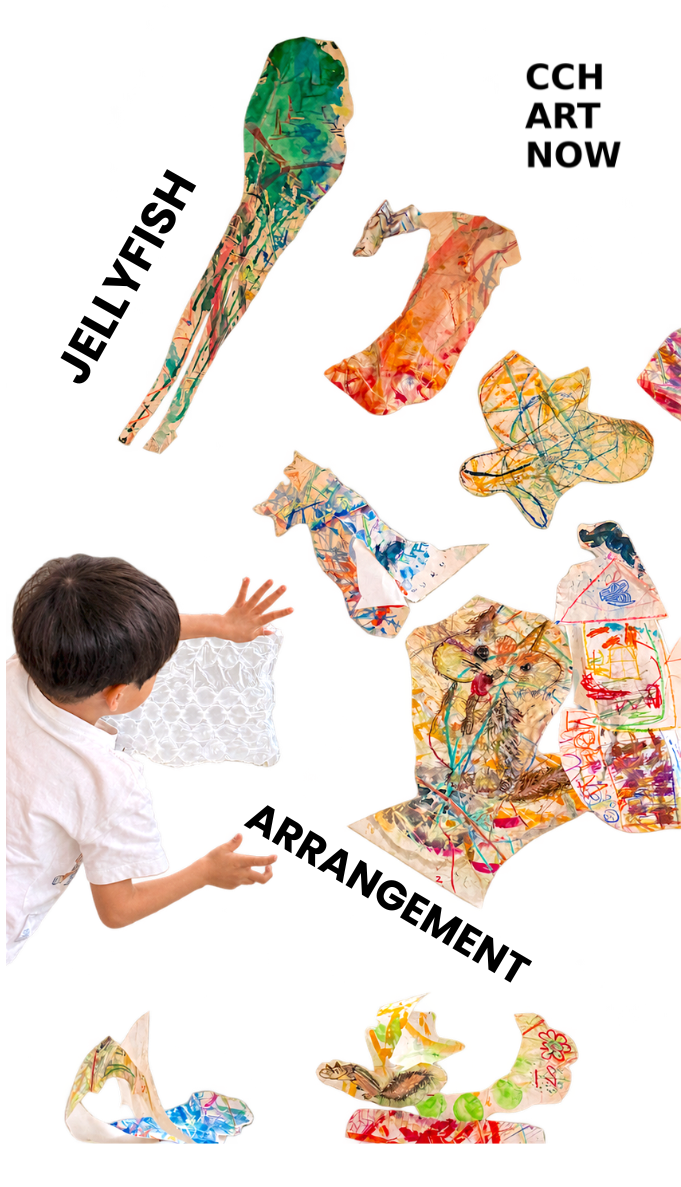
The child initially tended to cut rectangular sections. The teacher demonstrated following a flowing green area and suggested a large jellyfish-like form. She also invited him to follow the colored contours of grain stalks and the explosion-like crayon marks. After indicating understanding, he continued exploring and independently cut decorative fringes. The teacher encouraged viewing from a distance to consider whether small details remained visible. This phase lasted approximately half an hour, estimated retrospectively.
Creating spatial forms through folding and twisting
The child had previously explored cutting and reorganizing cardboard. This session extended related operations to his painting. The teacher demonstrated staircase-like and accordion folds, alongside freer twisting, so flat paper could develop height, direction and dramatic effects. The child generated associations and began noticing which colored surfaces faced outward and how white reverse sides affected presentation. Some structures were secured with glue.
Connecting a practical difficulty to the working surface
When temporarily mounting objects on the wall, the child noticed that the surface was not smooth and that attachment was difficult. He suggested that glass might hold the objects more easily. This was an independently proposed alternative in the teacher’s account; it is not treated here as a completed experimental comparison of adhesion.
Developing relationships and a story between objects
Once the elements became separate objects, the teacher used questions to support arrangement: how could their positions make the scene more interesting, and how could the squirrels’ story develop? She reduced intervention in the arrangement, preserving the child’s compositional choices. The work was finally presented on a window. Its pieces could be taken home and rearranged into new scenes. The teacher described the child as enjoying the exploration and the final composition as rich and engaging.
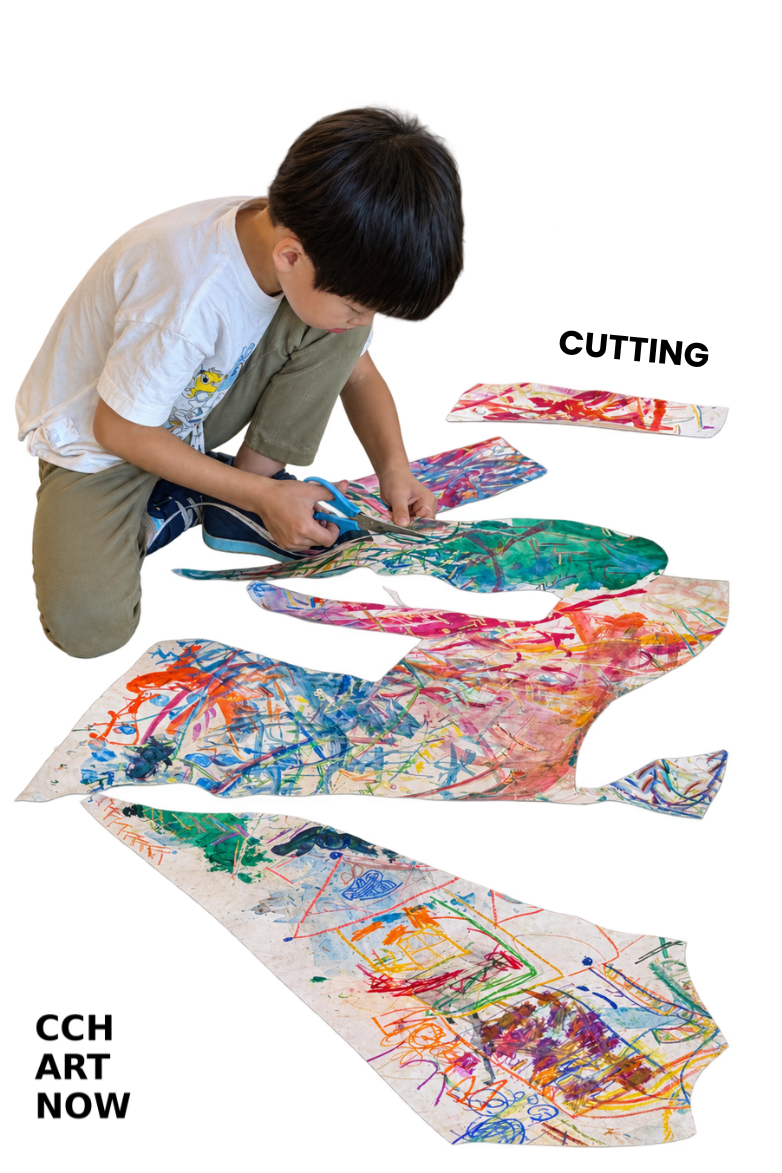
Precision in documentation | Rectangular cutting can be understood as a strategy for interpreting the task at that point. It does not, on its own, establish rigid thinking. Likewise, a two-hour lesson is not equivalent to 120 minutes of uninterrupted attention.
02 / LEARNING PROCESS
From material feedback to the next choice
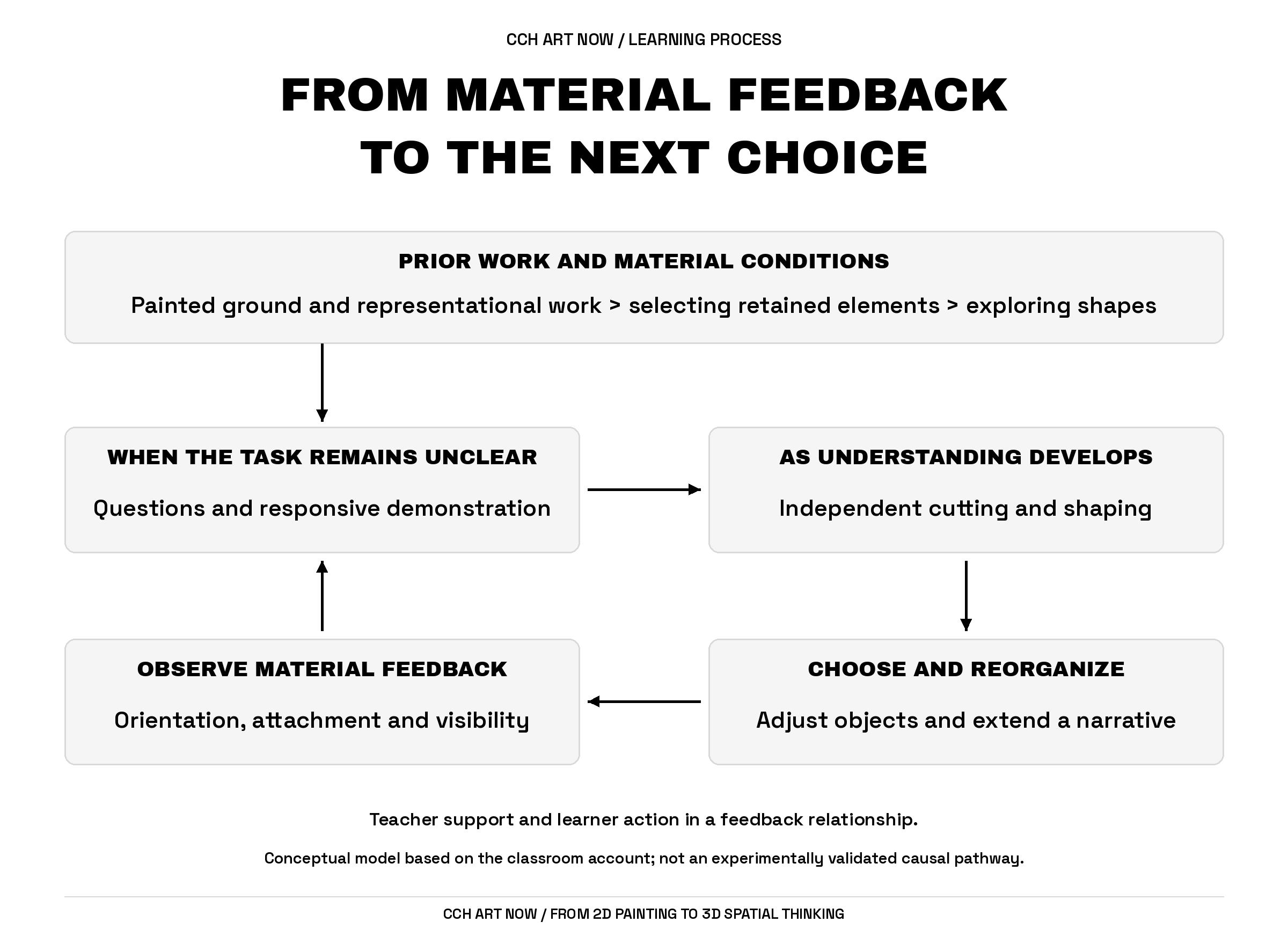
Helping the child cross an immediate threshold of understanding
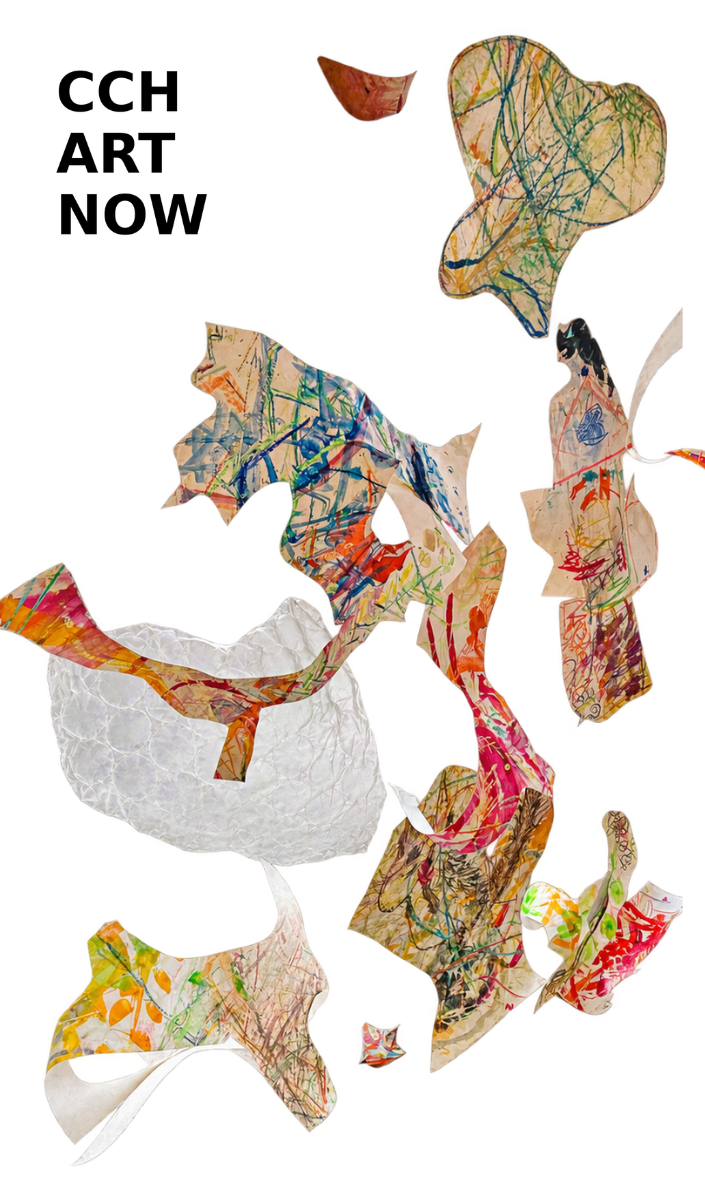
When verbal instructions were insufficient, demonstration provided a visible operational cue. After the child indicated understanding, the teacher returned cutting, shaping and arrangement to him. This is consistent with scaffolding that adjusts support in response to the learner (Wood et al., 1976) [3]. Independent performance after support withdrawal was not tested in this case.
The jellyfish suggestion can provide an entry point while also concentrating associations around the teacher’s example. To preserve scope, a follow-up could ask what else the shape suggests, or invite making a form before deciding its story. This is a teaching recommendation arising from the case.
Bonawitz et al. (2011) found that certain pedagogical demonstrations narrowed preschool children’s subsequent exploration of a toy [6]. This encourages attention to the scope of examples. It does not establish that all demonstration is harmful, and the study did not examine this cutting activity.
03 / THEORETICAL CONNECTIONS
Teaching mechanisms and academic theory
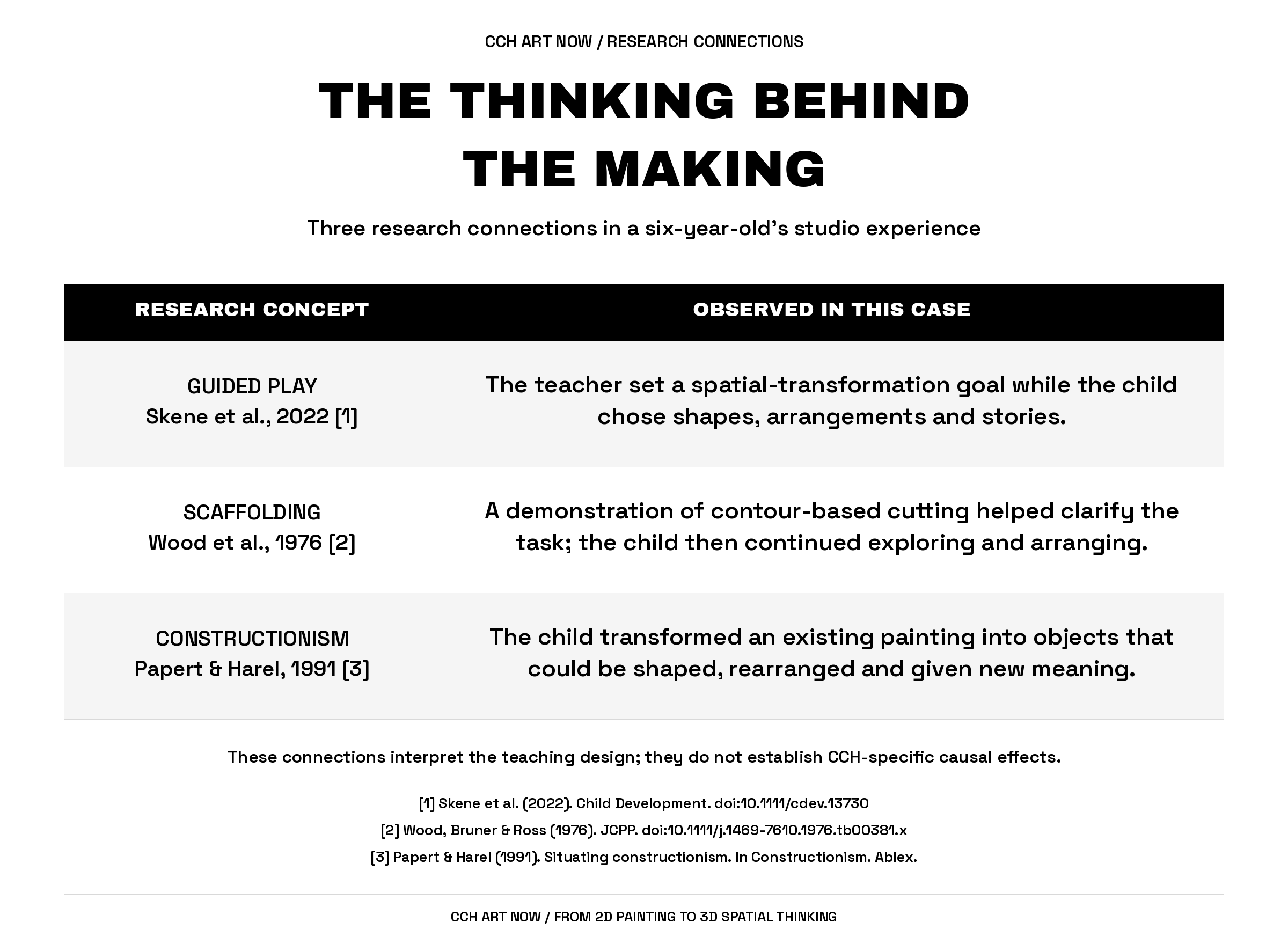
The strongest combination in this case
The teacher offers enough support to enable progress; the child gains information through action and retains the next choice. This allows guidance and autonomy to operate within the same learning process. This is an analytical judgment about the design.
04 / QUANTITATIVE RESEARCH
External research findings and effect sizes
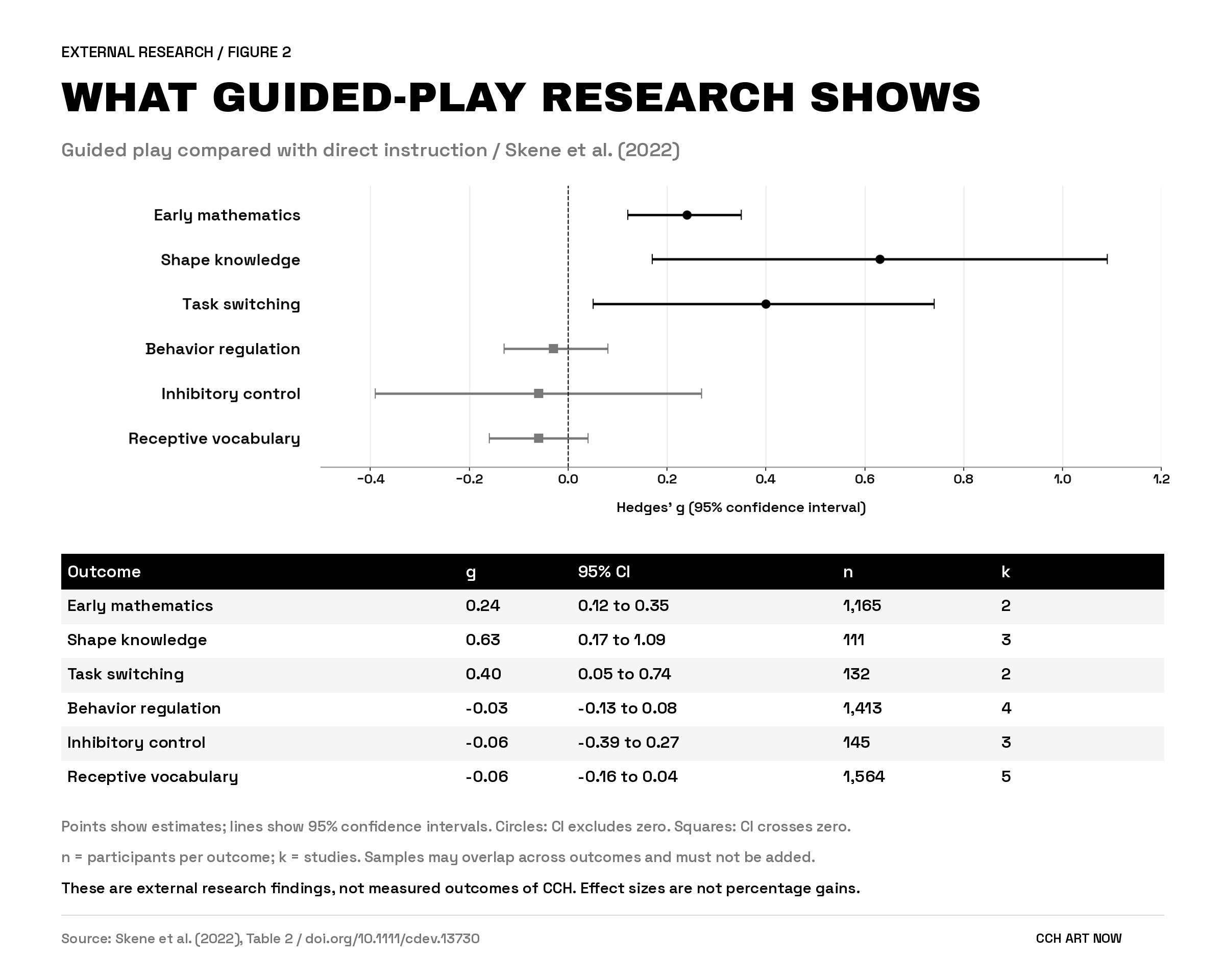
Source: Skene et al. (2022), Table 2. n is the combined sample for each outcome; k is the number of studies. Samples may overlap across rows and must not be added. Hedges’ g is a standardized effect size: 0.63 does not mean a 63% improvement.
Figure 2. Guided play relative to direct instruction. Points indicate g; lines indicate 95% confidence intervals. Black circles have intervals excluding zero; gray squares have intervals crossing zero. Values are redrawn from the original paper.
Meaning for CCH | Positive findings for some specific abilities offer a design reference. Behavior regulation, inhibitory control and receptive vocabulary showed no significant differences in this comparison. These findings do not establish that CCH improves general attention. All numerical results on this page come from external research.
05 / SPATIAL LEARNING
Research implications of moving from flat to spatial forms
217 studies | Hedges’ g = 0.47 | SE = 0.04
Meta-analysis of spatial-skills training: Uttal et al. (2013) [2].
Uttal et al. (2013) analyzed 217 studies. After excluding outliers, the average training effect relative to control was Hedges’ g = 0.47 (SE = 0.04) [2]. The research spans ages and training approaches, supporting the malleability of spatial skills. This is not the child’s test result or an effect specific to paper-based lessons.
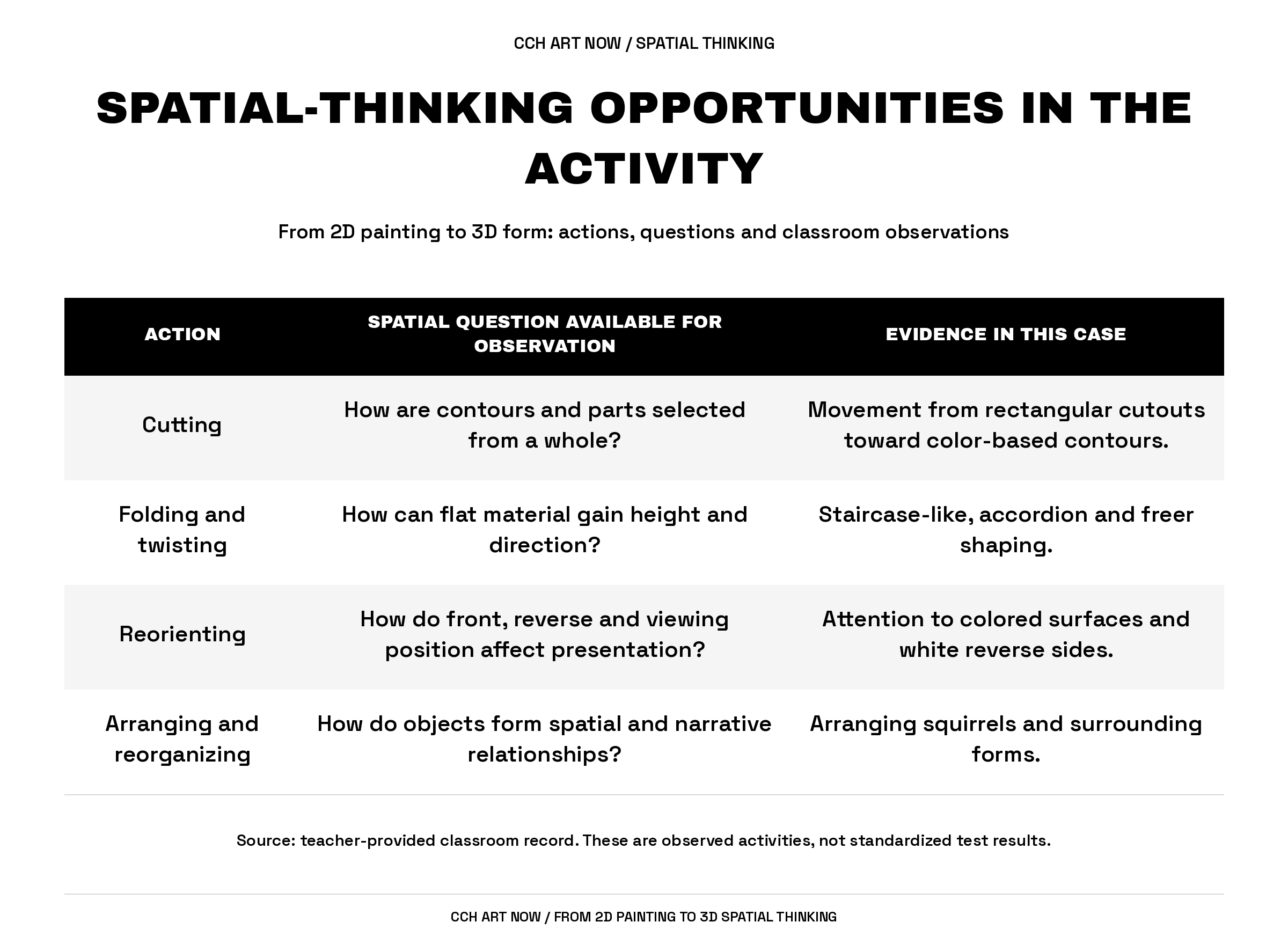
A supportable claim
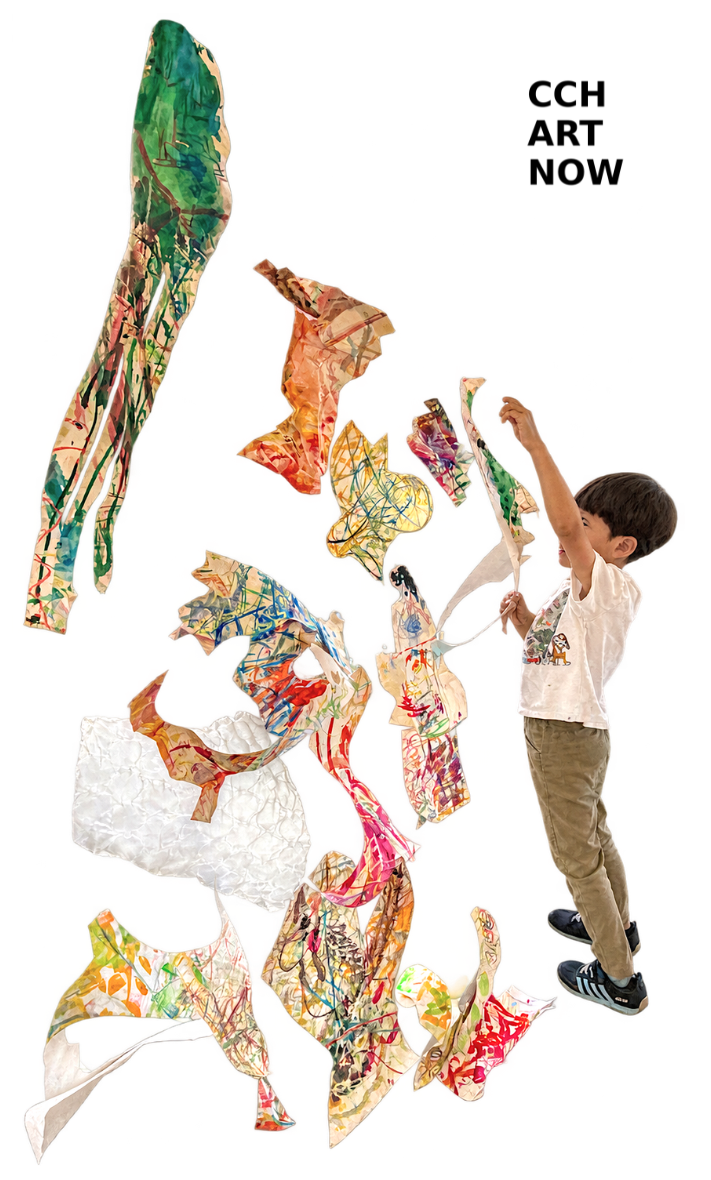
The lesson provided practice in contour recognition, shape transformation and spatial arrangement. Together with spatial-training research, these activities merit intentional design and observation. Improvement on standardized spatial measures would require pre/post assessment.
Precision about age and duration
Rectangular cutting may reflect prior task experience, interpretation of instructions or habitual cutting strategies. The appropriate description is that this child was developing an understanding of this particular flat-to-spatial task. It does not justify assuming that all five- or six-year-olds think only in two dimensions.
Continuity across sessions preserves relationships among the work and earlier decisions. This case illustrates how such a design operates. Whether two hours is optimal, or more sessions produce better outcomes, requires separate study. Lesson duration cannot substitute for a measure of uninterrupted attention.
06 / DISTINCTIVE POSITIONING
CCH features and fair comparison
This comparison concerns instructional designs and public frameworks. It is neither a market survey nor an effectiveness ranking. Demonstration-led and free-exploration formats are analytical types; institutions may combine multiple approaches.
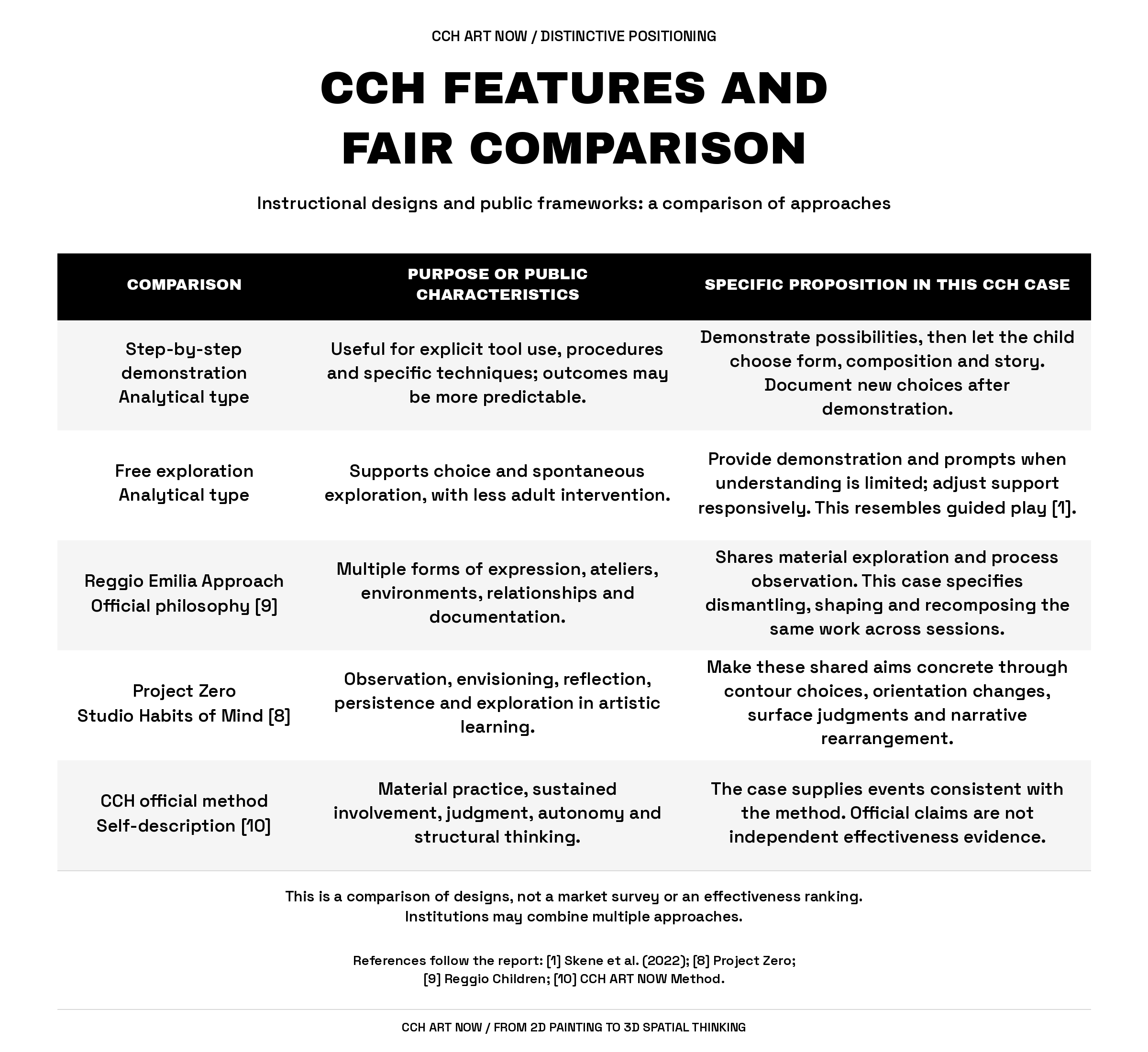
A recognizable combination of design choices
Continue one work across sessions; use previous outcomes as the next material; place choices within physical constraints such as cutting and mounting; provide responsive demonstrations while preserving arrangement decisions; and document learning events alongside the finished work.
Suggested positioning | CCH uses evolving artworks to organize material transformation, feedback and autonomous decision-making. This feature combination is supported by the case. Claims of global uniqueness, superiority over all institutions or proven optimal effectiveness exceed the available evidence.
07 / ARTICLE
Practicing judgment throughan evolving artwork
CCH ART NOW case article | A learning design that moves from painting to spatial composition
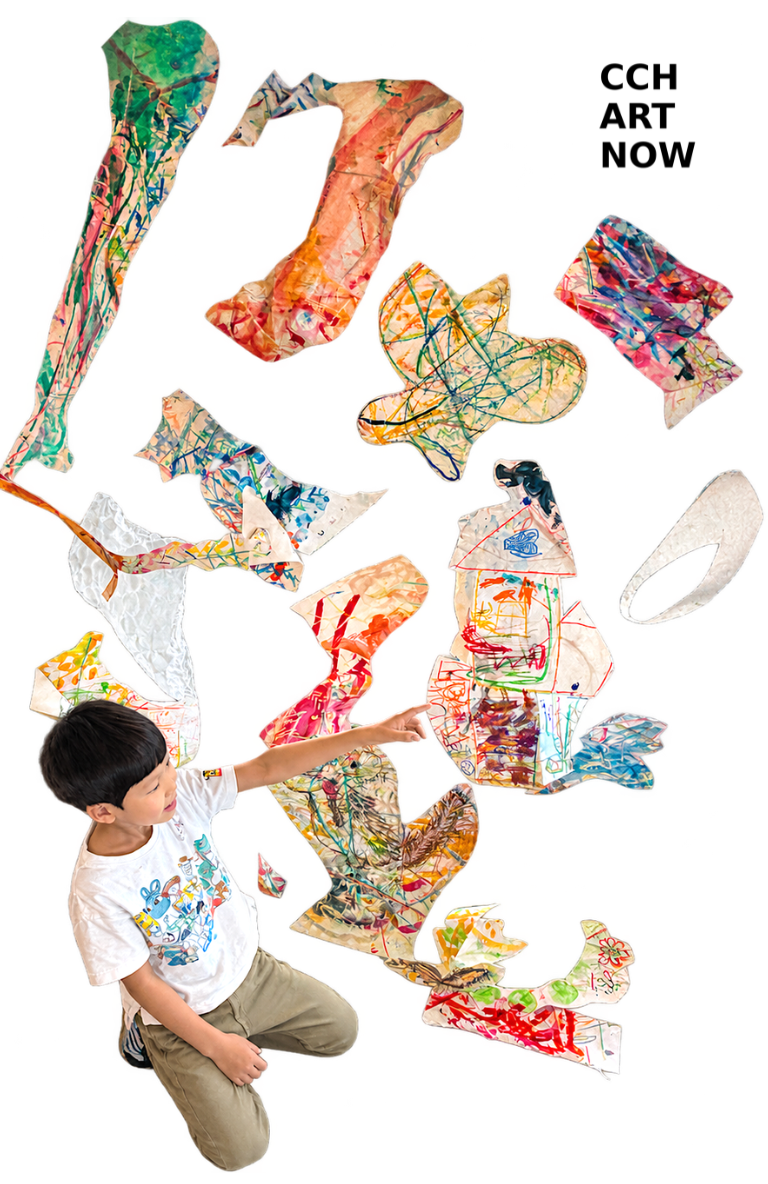
Two squirrels cut from an earlier painting became the starting point for the session. The next challenge was to see its marks, colors and lines anew: what shapes could they become? What would folding change? How might a different position change the story?
Several sessions of developing the ground and representational drawing preceded this approximately two-hour transformation. Continuity allowed the child to revisit choices, retain selected elements and reorganize others. This resonates with constructionism’s account of external constructions as vehicles for thinking (Papert & Harel, 1991) [4]. A finished work also became material for further exploration.
A key teaching decision concerned demonstration. When the child initially cut rectangular sections, the teacher modeled following colored contours. After indicating understanding, he resumed exploration, cutting and arrangement. Adjusting support to the learner’s response can be understood through scaffolding (Wood et al., 1976) [3]. The learning goal can be clear while creative outcomes remain open.
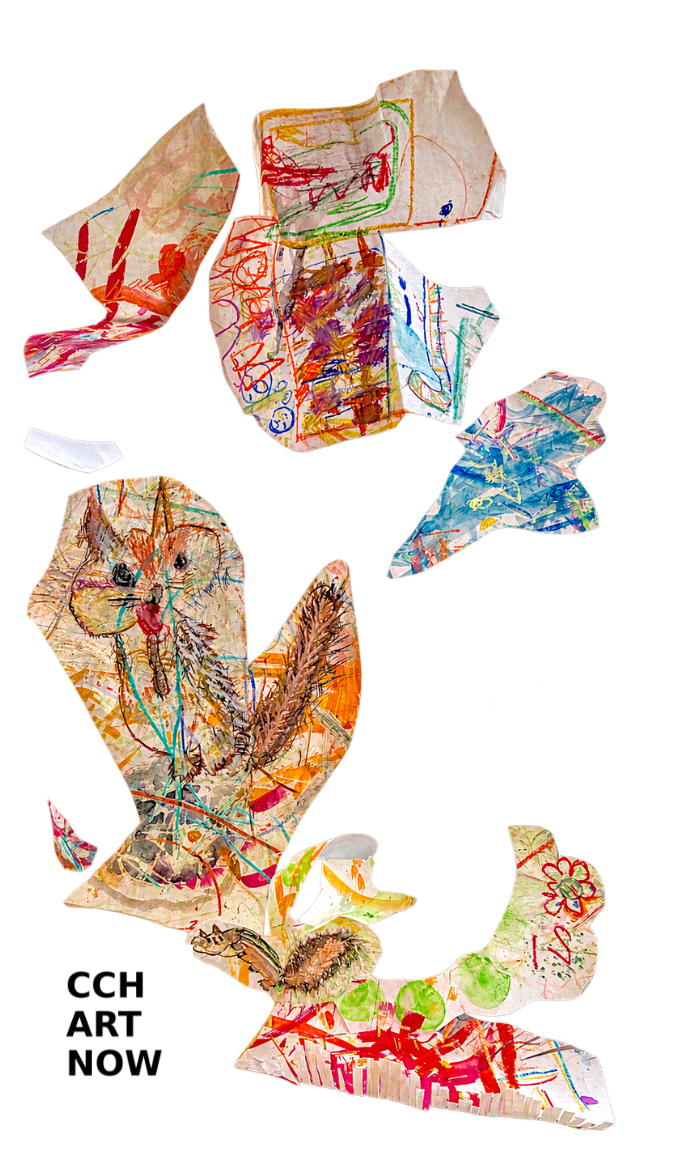
Twisting paper, reorienting colored surfaces and trying mounting surfaces made information available through action. Kirsh and Maglio’s (1994) concept of epistemic action describes how some actions help clarify a problem [7]. Extending that idea to paper construction is a theoretical interpretation: making can reveal possibilities that were not fully anticipated.
The child retained decision-making responsibility. He selected the squirrels, explored decorative cuts, considered arrangement and suggested glass for mounting. Self-determination theory emphasizes autonomy, competence and relatedness (Ryan & Deci, 2000) [5]. It offers a reason to design clear support together with opportunities for learner initiative.
Art education has established traditions of material exploration and thinking through practice. Reggio Emilia emphasizes ateliers, environments and documentation [9]; Project Zero describes habits including observation, reflection and exploration [8]. CCH’s proposition in this case lies in organizing continuity, transformation of previous work, material feedback and autonomous choices into a traceable process.
The value of the session includes the final spatial scene and the child’s progression into action, discovery and choice. These events provide practice-based illustrations of the teaching design.
Continued observation of independent strategy use in new tasks would strengthen the evidence for the method.
Evidence note: This article analyzes one teacher’s retrospective record. Theory is used to interpret mechanisms. It does not claim that CCH has passed a comparative trial or demonstrated gains in general cognitive ability.
08 / EVALUATION PLAN
Making CCH outcomes progressively testable
The following plan is proposed, not administered or validated as a scale. Only described events can be entered for this case; other fields remain unmeasured. The six dimensions align with CCH’s public observation areas [10]; operational definitions are recommendations developed for this report.
Three valuable additions for the next cycle
1. New task: offer different images and papers before repeating a demonstration. Record independent cutting and shaping, then provide support as needed.
2. Delayed observation: assess retention after a predetermined interval, for example one to two weeks. This is a suggested design, not an established optimal interval.
3. Fair comparison: match time, materials and adult-to-child ratio as closely as possible; specify outcomes in advance and use assessors unaware of assignment.
Data quality | Obtain guardian consent and age-appropriate child assent for anonymized records. Have two raters trial-code the same material, examine agreement and refine definitions. Formal cognitive claims require suitable validated measures and appropriate permissions. Custom observation scores should not be presented as clinical diagnoses.
09 / REFERENCES
Academic references
Author-year citations and reference numbers are used together. Sources below are original papers or an original author chapter. Framework and brand webpages are listed separately. The quantitative figure is redrawn from published values; no publisher figure has been reproduced.
[1] Skene, K., O’Farrelly, C. M., Byrne, E. M., Kirby, N., Stevens, E. C., & Ramchandani, P. G. (2022). Can
guidance during play enhance children’s learning and development in educational contexts? A systematic review and meta-analysis. Child Development, 93(4), 1162-1180.
https://doi.org/10.1111/cdev.13730
Systematic review and meta-analysis. Guided-play definition and all effect sizes on page 5.
[2] Uttal, D. H., Meadow, N. G., Tipton, E., Hand, L. L., Alden, A. R., Warren, C., & Newcombe, N. S. (2013). The malleability of spatial skills: A meta-analysis of training studies. Psychological Bulletin, 139(2), 352-402.
https://doi.org/10.1037/a0028446
Meta-analysis. Spatial malleability; 217 studies, g = 0.47, SE = 0.04. Checked against the author-provided full text.
[3] Wood, D., Bruner, J. S., & Ross, G. (1976). The role of tutoring in problem solving. Journal of Child Psychology and Psychiatry, 17(2), 89-100.
https://doi.org/10.1111/j.1469-7610.1976.tb00381.x
Child-adult tutoring study. Scaffolding and responsive support.
[4] Papert, S., & Harel, I. (1991). Situating constructionism. In I. Harel & S. Papert (Eds.), Constructionism. Ablex Publishing.
https://web.eecs.umich.edu/~mjguz/csl/home.cc.gatech.edu/allison/uploads/4/papert91.html
Original theoretical chapter. Making external constructions and building knowledge; not an intervention effect study.
[5] Ryan, R. M., & Deci, E. L. (2000). Self-determination theory and the facilitation of intrinsic motivation, social development, and well-being. American Psychologist, 55(1), 68-78.
https://doi.org/10.1037/0003-066X.55.1.68
Theory and research review. Support for autonomy, competence and relatedness.
[6] Bonawitz, E., Shafto, P., Gweon, H., Goodman, N. D., Spelke, E., & Schulz, L. (2011). The double-edged sword of pedagogy: Instruction limits spontaneous exploration and discovery. Cognition, 120(3), 322-330.
https://doi.org/10.1016/j.cognition.2010.10.001
Preschool exploration experiments. Trade-offs between particular demonstrations and scope of exploration.
Additional sources and scope of use
[7] Kirsh, D., & Maglio, P. (1994). On distinguishing epistemic from pragmatic action. Cognitive Science, 18(4), 513-549.
https://doi.org/10.1207/s15516709cog1804_1
Cognitive study of Tetris actions. Information-seeking action; application to this case is analogical.
[8] Project Zero. (2003). Eight habits of mind. Harvard Graduate School of Education.
https://www.pz.harvard.edu/resources/eight-habits-of-mind
Official research-team framework. Studio Habits of Mind and fair comparison; webpage dated 2003.
[9] Reggio Children. (n.d.). Reggio Emilia Approach.
https://www.reggiochildren.it/en/reggio-emilia-approach/
Official educational philosophy. Ateliers, environments and documentation; not a CCH comparative trial.
[10] CCH ART NOW. (n.d.). CCH method.
https://www.cchartnow.com/method
Brand self-description. Current positioning and six observation dimensions; not independent third-party evidence.
Reading and use
Webpages were consulted on November 3, 2026. Sources were selected for their relevance to this case’s mechanisms. This report is not a systematic review of all art-education literature. External meta-analyses support design rationales and hypotheses; CCH-specific causal claims require CCH-specific data.
The case can support parent communication, teacher discussion and institutional explanations. When sharing it, retain the distinction between single-session observation and external evidence for related mechanisms. Confirm the actual session date and the child’s age.
Suggested claim | This CCH session used an evolving artwork to provide practice in material transformation, spatial arrangement and autonomous choice. The design can be discussed alongside guided play, scaffolding and spatial-learning research. Continued observation of independent application and transfer will build CCH’s own evidence.