

Case 5|Visual Culture Literacy & Metacognitive Development
From Popular Media Analysis to Critical Cultural Awareness
CCH ART NOW™
Adult & Young Adult Contexts
Focus area: visual culture literacy, metacognition, media analysis, cultural awareness, gender representation, and critical thinking
Overview
Visual culture literacy is not only the ability to recognize images. It is the ability to understand how images, sound, symbols, bodies, fashion, editing, and cultural references work together to produce meaning.
In contemporary media environments, students are constantly surrounded by visual systems. Music videos, social media, film, fashion, advertising, celebrity imagery, and digital platforms shape how people understand gender, identity, emotion, race, power, beauty, success, and belonging. Yet constant exposure does not automatically become critical literacy. A student may consume visual culture every day without being able to explain how that culture organizes perception.
This case documents an international university cohort with non-art backgrounds who participated in visual culture analysis sessions. The course did not ask students to become artists. Instead, it asked them to become more conscious interpreters of visual culture.
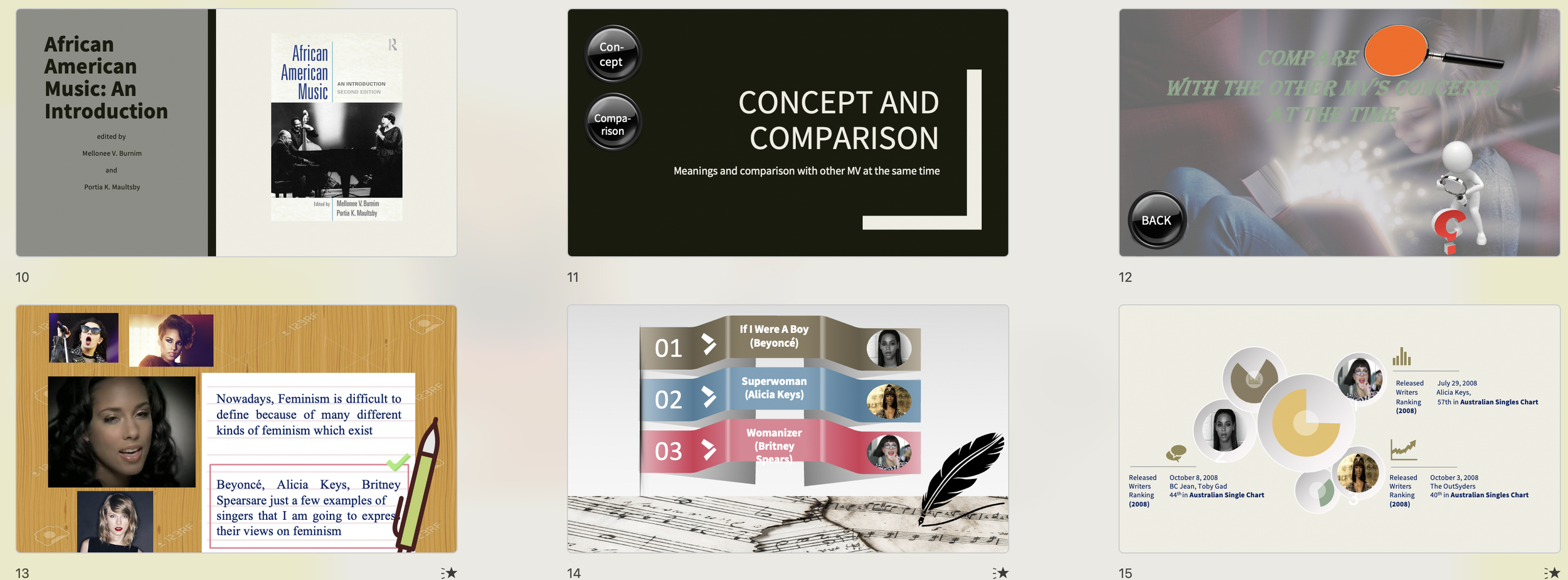
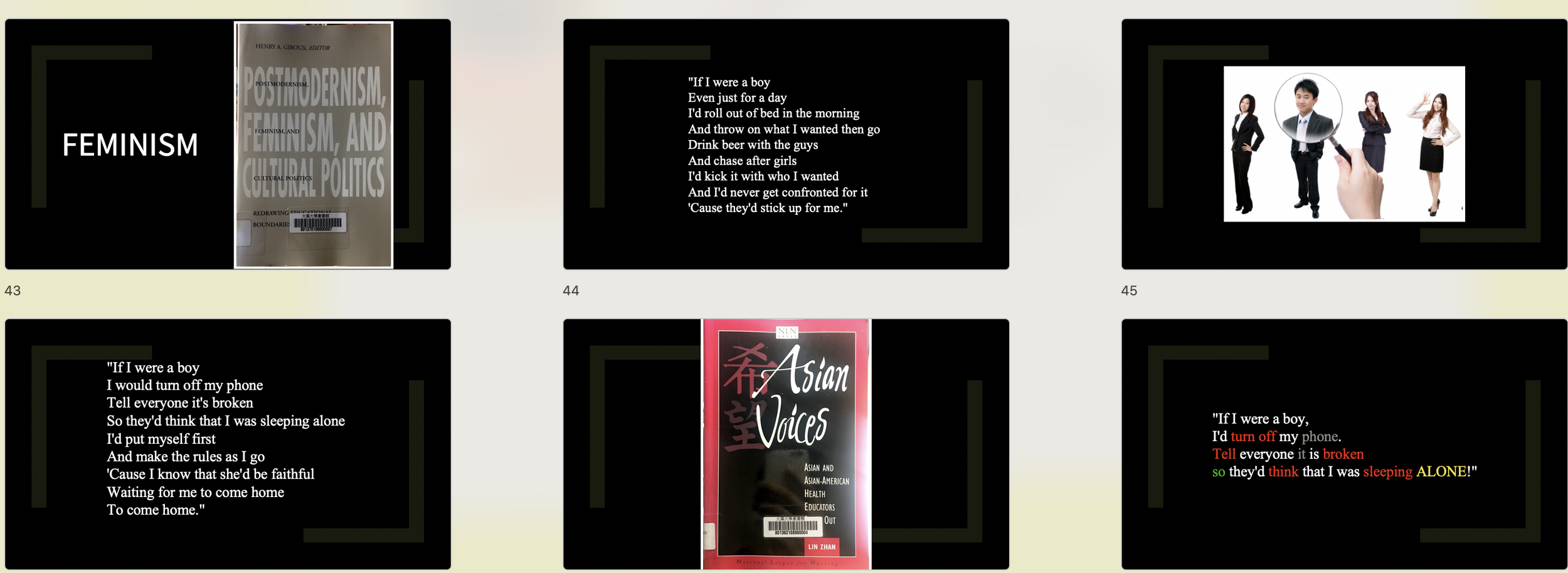
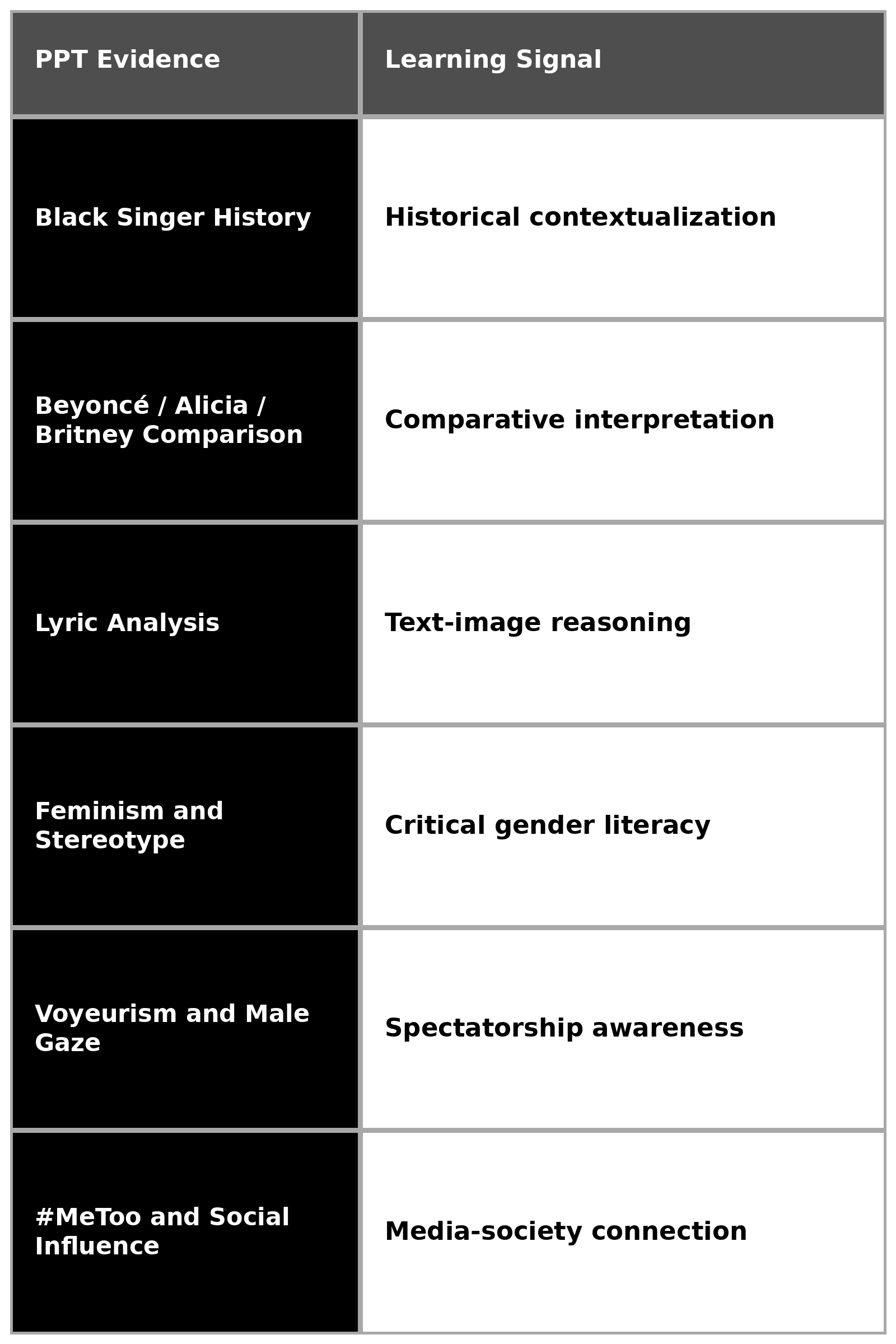
One student group developed a detailed presentation analyzing Beyoncé’s If I Were a Boy music video. Their work moved beyond entertainment commentary and entered historical, social, gender-based, and visual-cultural analysis. The presentation connected African American music history, feminist discourse, gender role reversal, voyeurism, objectification, male gaze theory, stereotypes, discrimination, and contemporary movements such as #MeToo. It also compared Beyoncé’s video with Alicia Keys’s Superwoman and Britney Spears’s Womanizer, showing how different female artists presented feminism and gender power through distinct visual and musical strategies.
From a CCH perspective, this case shows that visual culture analysis can become a powerful site of metacognitive development. Students were not only learning to analyze media. They were learning to observe how they themselves interpret media.
The core CCH insight is that visual awareness precedes critical interpretation.
The most important learning outcome was not only media knowledge, but the student’s increasing ability to observe their own interpretive process.
Background
The participants were international university students from non-art backgrounds. Their academic training was not primarily in fine art, design, film, or visual studies. However, they were deeply immersed in global media culture. Like many contemporary students, they encountered music videos, fashion imagery, digital entertainment, celebrity culture, and social media aesthetics as part of everyday life.
This made the course context important. The goal was not to introduce students to visual culture as something distant or elite. The goal was to help them recognize that the images they already consumed were structured systems of meaning.
In the Beyoncé case, students selected a familiar popular media object and treated it as a cultural text. Instead of analyzing the video only as music promotion, they investigated how the video constructs gender roles, visualizes emotional conflict, reverses masculine and feminine positions, and activates broader social questions about sexism, inequality, and representation.
This is where the educational value becomes visible. When students begin with popular media that feels familiar, they can gradually move from recognition to analysis. They begin with what they know, but they do not remain at the level of preference. They learn to ask what the image is doing, how meaning is constructed, and how social assumptions become visible through aesthetic form.
From Media Consumption to Visual Culture Literacy
Before structured analysis, students may describe media through immediate reactions. They may say something is beautiful, emotional, cool, powerful, sad, stylish, romantic, or dramatic. These reactions are not wrong, but they are not yet analysis.
Visual culture literacy begins when students move from reaction to interpretation. They begin asking how an image creates the feeling it produces. They notice camera angle, costume, color, setting, editing, sound, body language, symbolic reversal, narrative structure, and cultural reference. They learn that emotion in media is not accidental. It is constructed.
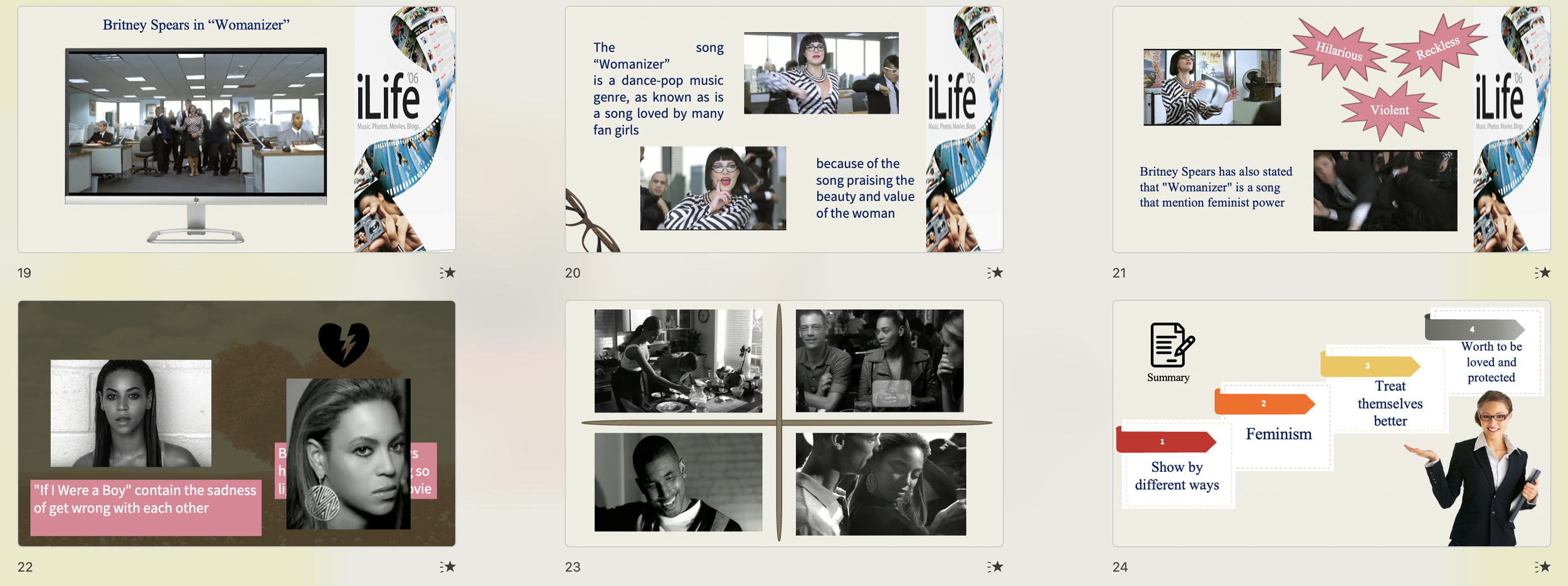
The Beyoncé presentation showed this shift clearly. Students identified that If I Were a Boy uses gender role reversal as a central concept. Beyoncé performs behaviors culturally associated with masculine privilege, while the male partner is placed in a more emotionally vulnerable position. The group interpreted this reversal as a way to expose unequal expectations within heterosexual relationships and to make gendered double standards visible.
This is not simply music video appreciation. It is visual-cultural reading. Students were learning to understand media as a system that uses image, role, gesture, editing, and narrative reversal to make social meaning visible.
Historical and Cultural Context
One of the strongest parts of the student presentation was that it did not treat Beyoncé as an isolated celebrity figure. The group placed the analysis within a broader history of African American music. Their presentation included a historical timeline moving from African musical traditions and slavery, through spirituals, blues, jazz, gospel, R&B, soul, funk, disco, hip-hop, and contemporary Black music.
This matters educationally because it shows students moving from isolated media consumption toward cultural contextualization.
A music video is not only an individual artwork. It emerges from histories of race, gender, performance, popular music, commercial media, and social struggle. By connecting Beyoncé to Black singer history and African American music traditions, students began to understand that contemporary media carries historical memory, even when it appears in the form of entertainment.
This is an important part of visual culture literacy. Students learn that images and sounds are not neutral. They come from histories. They circulate through power. They are shaped by cultural memory and social conflict.
For international students, this kind of analysis is especially valuable because it requires them to interpret cultural material outside their own immediate background. They must learn to avoid superficial reading and instead ask how race, gender, history, and media industry structures shape meaning.
These visual tables are included as part of the case documentation. They show how the student presentation moved from popular media observation toward cultural analysis, social theory, and metacognitive reflection.
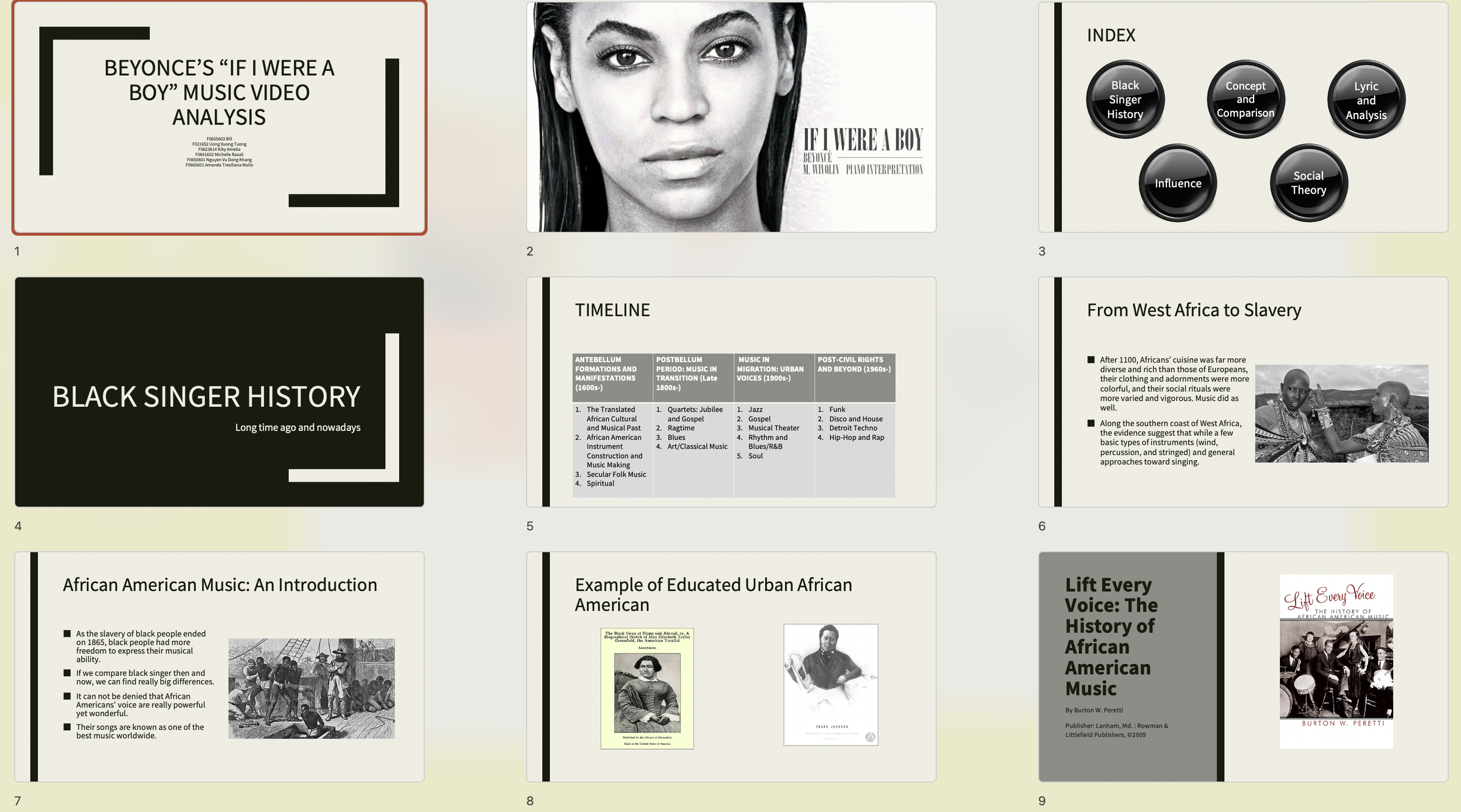
PPT Evidence
Comparative Analysis Across Female Pop Artists
The presentation also compared Beyoncé’s If I Were a Boy with Alicia Keys’s Superwoman and Britney Spears’s Womanizer. This comparison is educationally important because it shows students moving from single-object analysis to comparative cultural interpretation.
Alicia Keys’s Superwoman was interpreted through images of women across different social roles, including motherhood, professional life, and aspiration. Britney Spears’s Womanizer was discussed through pop performance, female sexuality, and claims of feminist power. Beyoncé’s If I Were a Boy was analyzed through sadness, relationship reversal, gender inequality, and emotional recognition.
This comparison helped students see that feminism in popular media is not expressed in only one way. It may appear through empowerment, endurance, irony, sexuality, role reversal, emotional testimony, or critique of male behavior. Each artist uses a different visual and sonic strategy.
This matters because students often begin with broad labels such as feminism or empowerment. Through comparison, they learn to distinguish different forms of representation. They begin to ask not only whether a work is feminist, but how it constructs feminist meaning, what kind of womanhood it presents, what visual strategies it uses, and what contradictions remain.
That kind of comparative thinking is a major step in metacognitive development. Students are not merely learning content. They are learning how to refine their own categories of interpretation.
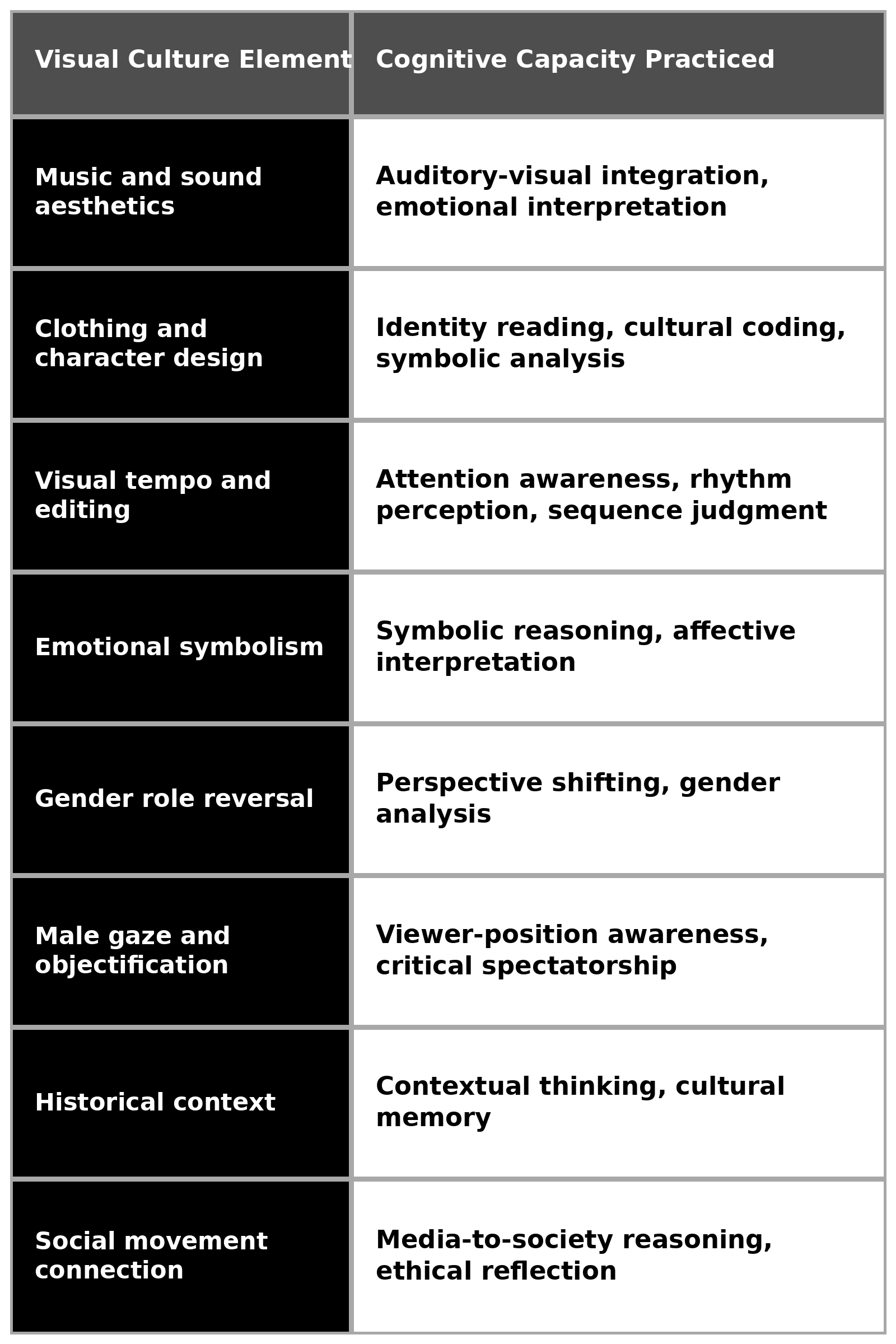
Visual Culture Element
Gender Representation and Role Reversal
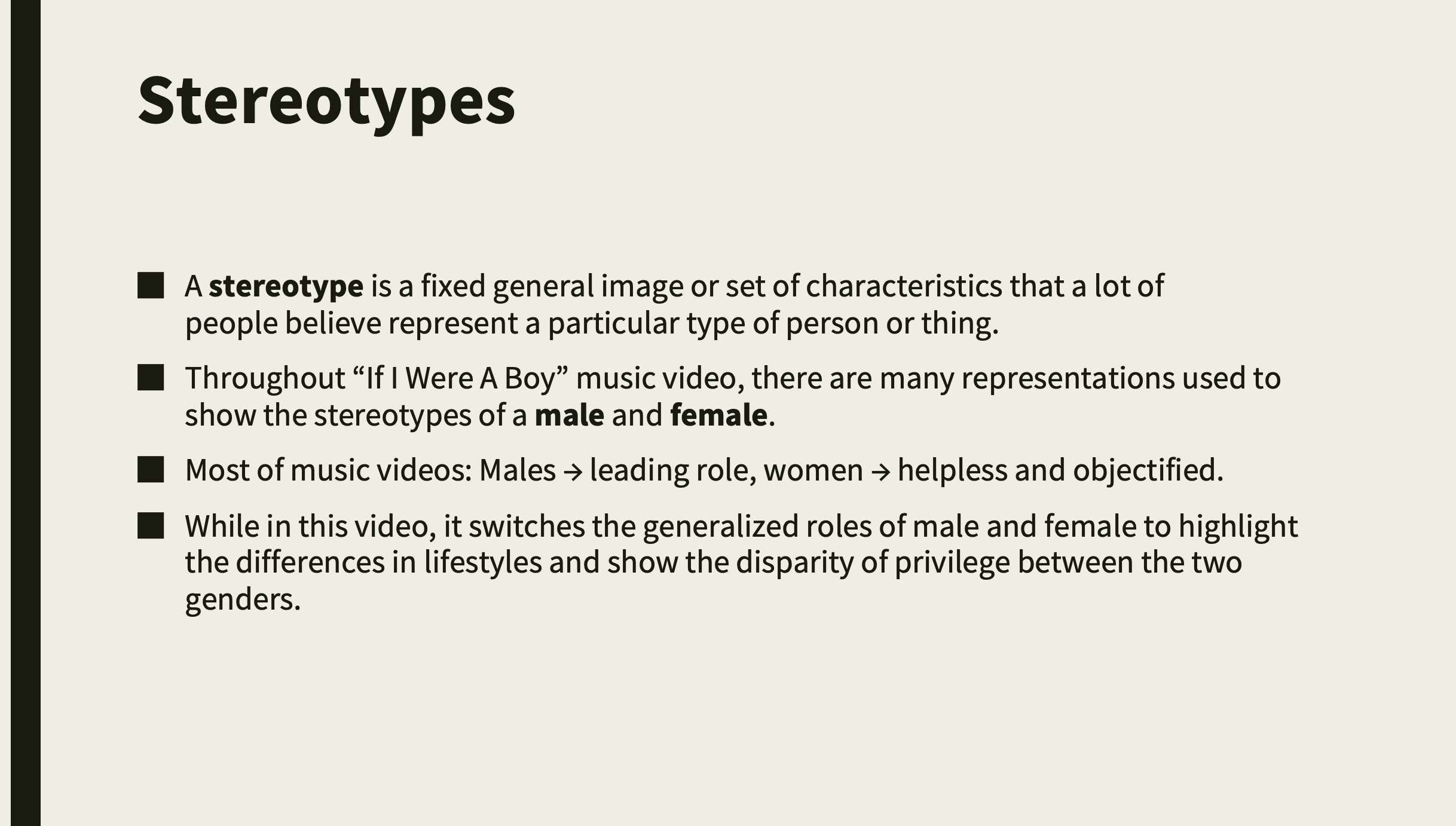
The Beyoncé video gave students a strong entry point into gender representation because it dramatizes role reversal. The female protagonist performs the behaviors typically excused in men, while the male partner experiences emotional neglect. At the end, the reversal is revealed as a way to expose the original gender imbalance.
Students identified that the video contrasts how male and female behavior can be judged differently within relationships. They connected this to feminism and to the social expectation that women often carry emotional loyalty while men are granted more freedom or forgiveness.
This kind of analysis is valuable because students are not only identifying a theme. They are learning how narrative structure produces critique. The video does not simply state that gender inequality exists. It lets the viewer experience the discomfort of reversed positions, then reveals the asymmetry.
In educational terms, this becomes a strong example of how visual storytelling can produce ethical recognition. Students learn that media can make social structures visible through role, embodiment, pacing, and reversal.
Male Gaze, Voyeurism, and Objectification
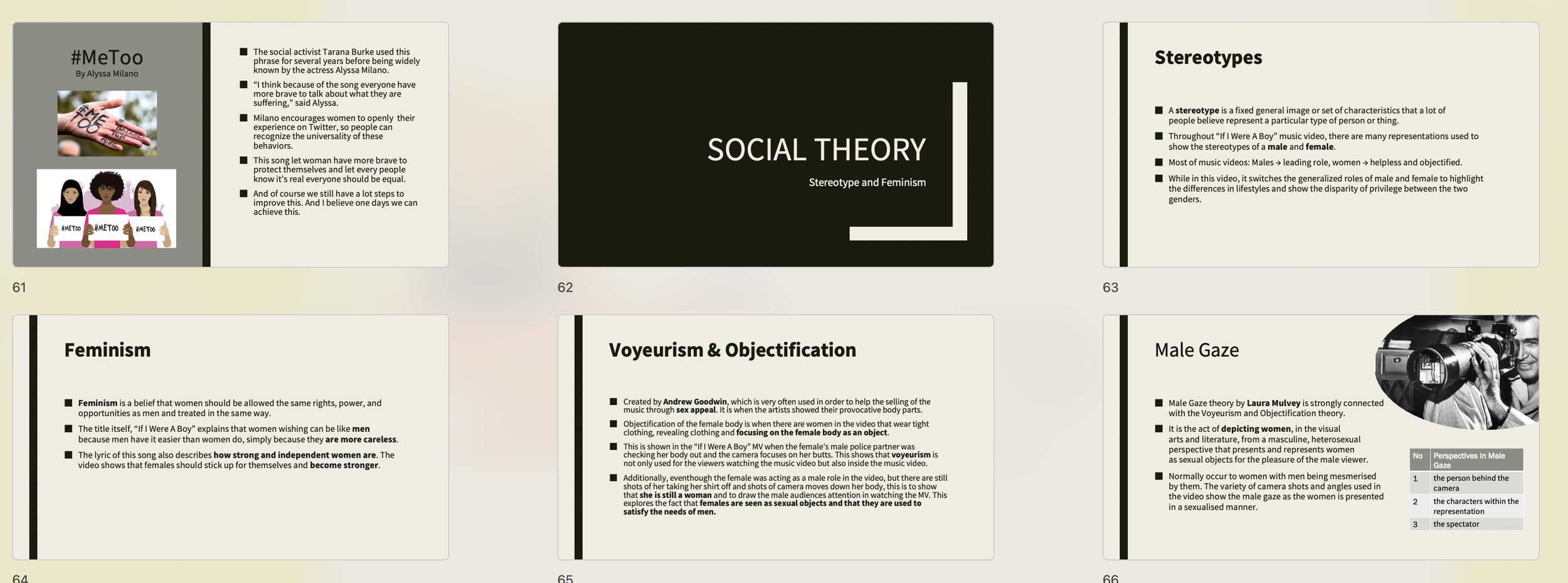
The student presentation also engaged with male gaze, voyeurism, and objectification. It referenced the idea that music videos often use sexualized imagery to attract the viewer’s attention, and it connected this to the camera’s treatment of the female body. The group also discussed Laura Mulvey’s male gaze theory and the way visual media can present women from a masculine, heterosexual viewing position.
This part of the presentation is significant because students were no longer only asking what the story means. They were asking how the camera positions the viewer.
That is a more advanced level of visual analysis.
To analyze male gaze, students must understand that meaning does not only come from plot. It also comes from perspective. Who is looking? Who is being looked at? How does the camera frame the body? Which body is made available for visual pleasure? Which subject is active, and which is displayed?
These questions train students to think about spectatorship. They begin to understand that visual culture is not simply content. It is a structure of looking.
This is highly relevant to CCH because it develops reflective perception. Students become aware not only of the image, but of their own position as viewers.
This indicates that students were not only identifying visual content, but beginning to analyze spectatorship: how a viewer is positioned, how a body becomes visible, and how camera structure shapes interpretation.
Social Theory and Media Interpretation
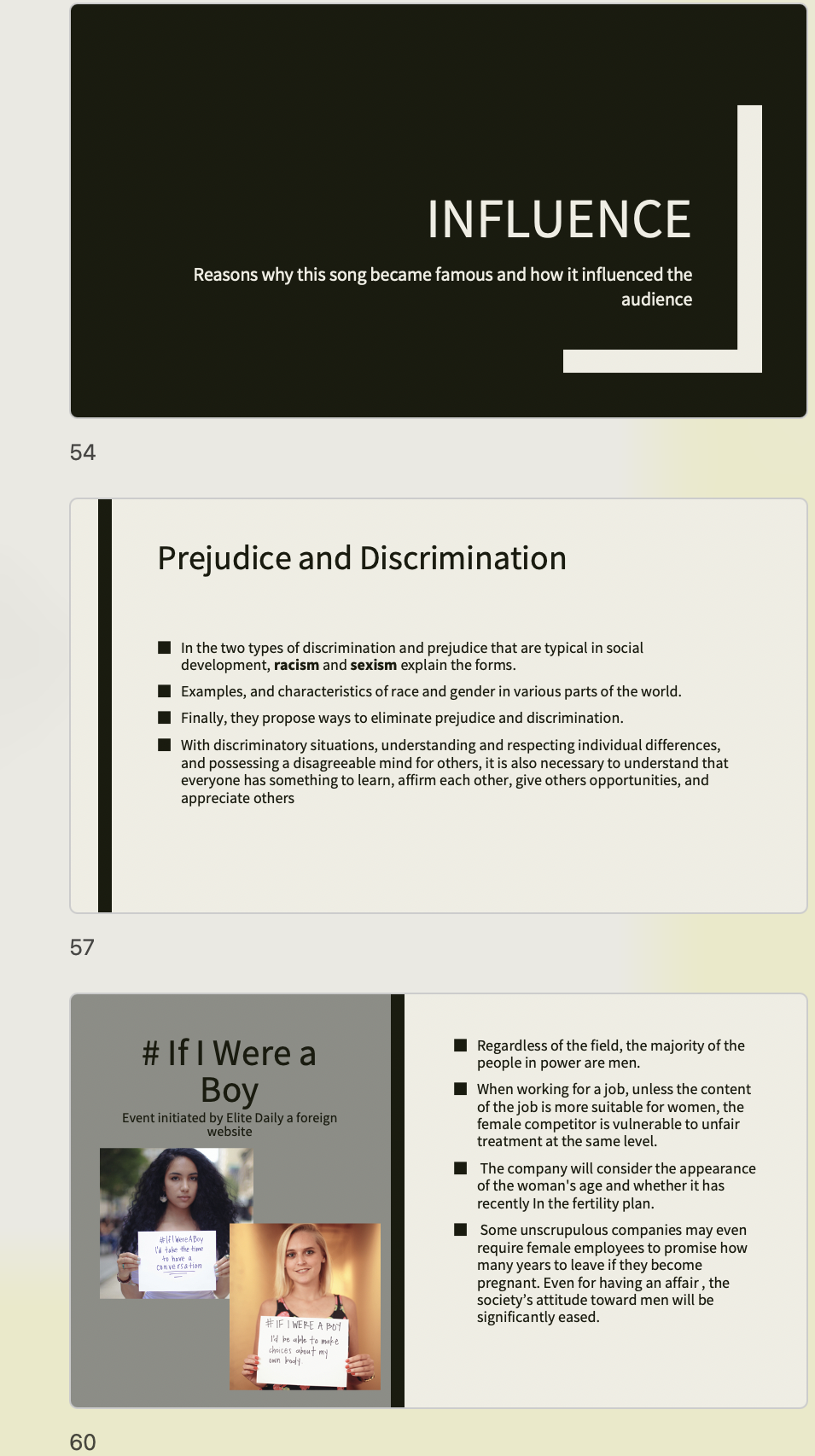
The presentation also connected the music video to stereotype, feminism, prejudice, and discrimination. Students discussed how stereotypes create fixed images of groups and how media can either reproduce or challenge those images. They interpreted If I Were a Boy as a work that exposes gender inequality and challenges the normalization of male privilege.
This is where visual culture literacy expands into social theory.
Students are no longer only analyzing aesthetics. They are asking how aesthetics participates in social understanding. They are learning that popular media can encode assumptions about gender, race, power, sexuality, respectability, vulnerability, and agency.
The group also connected the song’s influence to women’s rights and #MeToo. Even if some of the historical connections would need more precise academic refinement, the educational value is clear: students were attempting to connect media representation with broader social movements and public discourse.
That attempt itself is important. It shows that students were beginning to see media not as entertainment isolated from society, but as a site where social meanings are produced, circulated, contested, and emotionally intensified.
Metacognitive Development
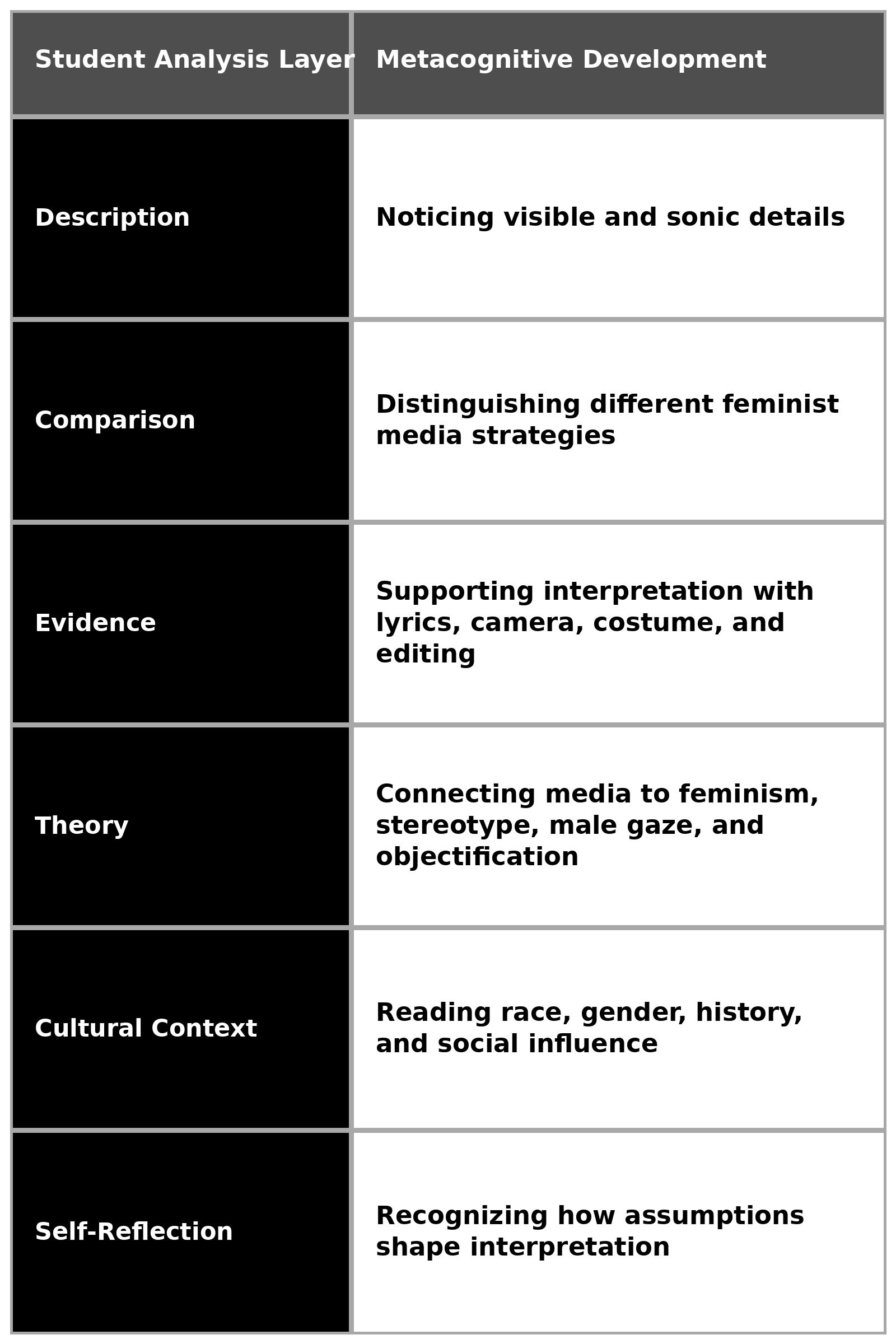
Student Analysis Layer
The deepest learning outcome in this case was not only that students learned more about Beyoncé, feminism, or music video analysis.
The deeper outcome was that students became more aware of their own thinking.
When students analyze popular media critically, they must slow down their automatic reactions. They must ask why they interpreted an image in a certain way. They must examine whether their cultural background, gender assumptions, media habits, or prior beliefs shaped their reading. They must support interpretation with evidence from the image.
This is metacognitive development.
Metacognition means becoming aware of one’s own thinking process. In this case, students were learning to observe how they interpret culture. They were learning to ask why certain images feel powerful, why certain roles feel natural, why certain camera angles create desire, why certain songs feel empowering, and how social assumptions become embedded in media form.
The Beyoncé presentation demonstrated this development because students did not remain at the level of opinion. They organized historical context, compared different artists, analyzed lyrics and visuals, introduced social theory, and connected media to public issues.
That is a significant cognitive shift for non-art-background students. They moved from media consumption toward reflective interpretation.
CCH Interpretation
From a CCH perspective, this case shows how visual culture analysis can operate as cognitive training.
The students were not producing artworks. They were producing interpretation. Yet the learning process still aligned strongly with CCH because it required attention, perception, comparison, evidence-based reasoning, cultural awareness, and reflective judgment.
The classroom became a space where students could slow down visual consumption and turn it into structured inquiry. Popular media became the material. The analytical process became the studio.
This is why CCH does not limit creative education to making objects. Creative education also includes learning how to see, interpret, compare, question, and reflect.
In this case, Beyoncé’s music video functioned as a complex visual-cultural object. Through it, students entered discussions of Black music history, feminism, role reversal, camera perspective, gendered spectatorship, social stereotypes, and media influence.
The core CCH insight is that visual awareness precedes critical interpretation.
Before students can think critically about media, they must first learn to notice how media organizes attention, emotion, identity, and social meaning.
Educational Significance
This case shows that visual culture literacy is not only for art students.
In a world shaped by social media, entertainment platforms, branding, AI-generated imagery, celebrity culture, algorithmic feeds, and global visual circulation, all students need stronger interpretive tools. They need to understand how images persuade, how aesthetics produce emotion, how identities are designed, how cultural symbols travel, and how viewers are positioned.
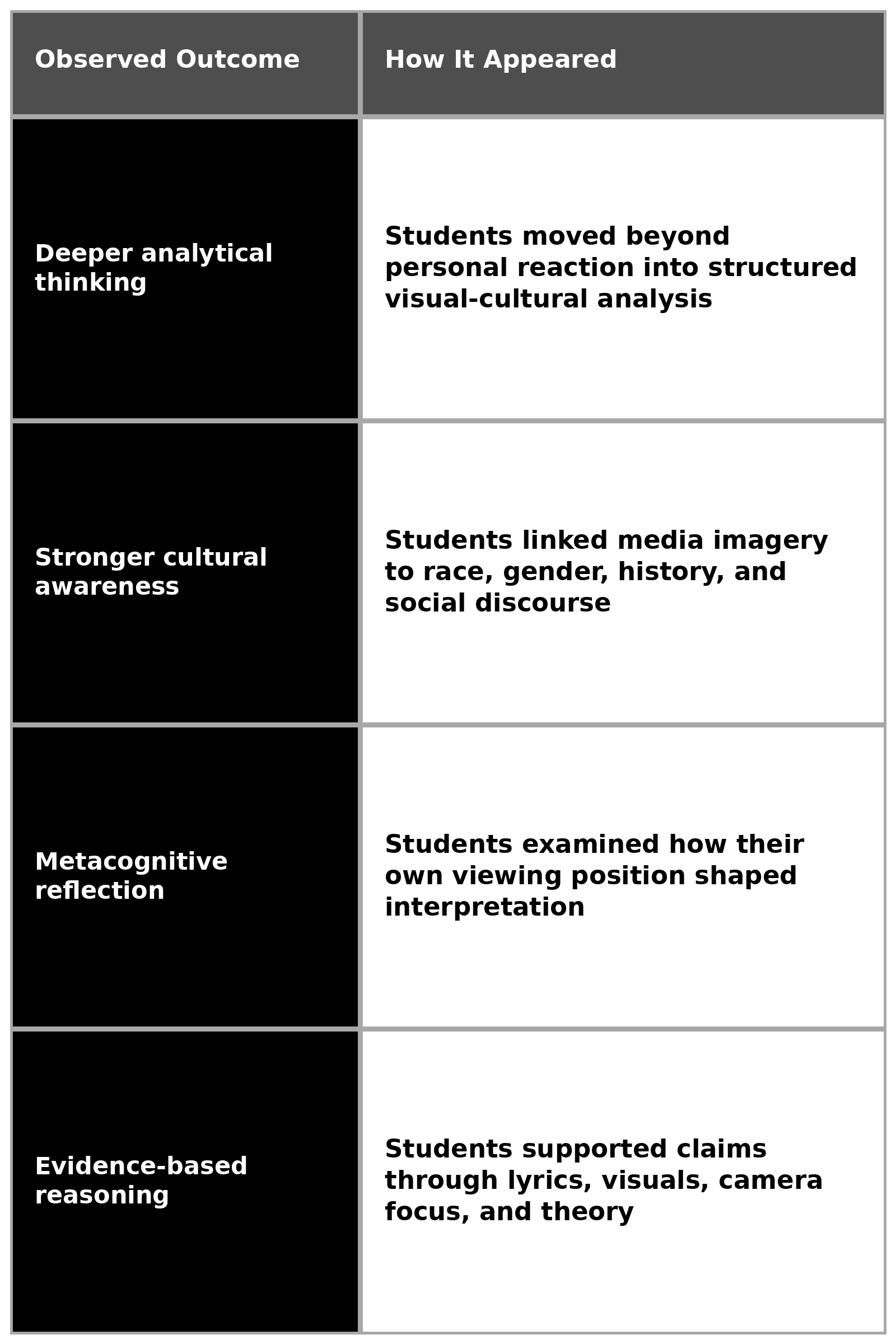
Observed Outcome
For international university students, this work is especially important because they often move across cultural systems. They must learn that visual meaning is not universal. A symbol, fashion choice, body gesture, camera angle, or sound aesthetic can carry different meanings across cultural contexts.
Visual culture analysis therefore supports more than media literacy. It supports cultural awareness, self-awareness, and interpretive responsibility.
The Beyoncé presentation demonstrates that non-art-background students can engage deeply with complex visual-cultural material when given a structured analytical framework. Their work became a site of critical thinking and metacognitive development rather than a simple class report.
This is the value of CCH in adult and young adult learning contexts. It helps learners move from passive exposure to active interpretation.
Case Summary
Case 5|Visual Culture Literacy & Metacognitive Development
An international university cohort with non-art backgrounds participated in visual culture analysis sessions. Through the analysis of Beyoncé’s If I Were a Boy music video, students examined African American music history, feminist representation, gender role reversal, stereotypes, voyeurism, objectification, male gaze, discrimination, and the social influence of popular media.
The learning process included comparison with Alicia Keys’s Superwoman and Britney Spears’s Womanizer, allowing students to examine different forms of feminist expression in popular music culture. The group connected media imagery to broader social concerns, including women’s rights, prejudice, discrimination, and #MeToo.
Observed outcomes included deeper analytical thinking, stronger cultural awareness, more precise visual interpretation, and improved metacognitive reflection.
This case demonstrates how structured visual culture analysis can help non-art-background students develop critical thinking skills within media-saturated environments.
Evidence Boundary
This case is presented as a qualitative educational observation within the CCH ART NOW™ framework. It is not a clinical assessment, psychological diagnosis, therapeutic claim, or completed third-party evaluation.
The student presentation is used here as supporting evidence of learning process and interpretive development. The observed outcomes should not be interpreted as universal or guaranteed results. The case illustrates how structured visual culture analysis may support interpretive depth, cultural awareness, and metacognitive reflection among university students from non-art backgrounds.
Further structured documentation, student reflection records, discussion transcripts, rubric-based assessment, and external review would strengthen the evidence base over time.
References
Freedman, K. (2003). Teaching Visual Culture: Curriculum, Aesthetics, and the Social Life of Art.
Mirzoeff, N. (1999). An Introduction to Visual Culture.
Mulvey, L. (1975). Visual Pleasure and Narrative Cinema.
Flavell, J. H. (1979). Metacognition and cognitive monitoring: A new area of cognitive-developmental inquiry.
Hobbs, R. (2010). Digital and Media Literacy: A Plan of Action.
Yenawine, P. (2013). Visual Thinking Strategies: Using Art to Deepen Learning Across School Disciplines.
Beyoncé’s If I Were a Boy Music Video Analysis. Student group presentation, international university cohort. CCH teaching archive.