
Mid-Program Parent Observation
Parent-Reported Developmental Shifts in Attention, Autonomy, and Creative Thinking
Studio Observations|Children
CCH ART NOW™
Evidence type: Parent observation
Participants: Anonymized child cases, ages 5–6
Observation stage: Mid-program documentation
Overview
This article documents two anonymized mid-program parent observations from CCH ART NOW™. The purpose is not to present parent feedback as promotional praise, but to examine how families describe visible changes in children’s attention, confidence, emotional regulation, creative autonomy, and material-based thinking after sustained participation in a studio-based learning environment.
Within the CCH documentation framework, parent observation is treated as one layer of qualitative evidence. It does not replace classroom observation, process photography, sustained attention records, or independent evaluation. Instead, it helps determine whether learning signals observed inside the studio correspond to broader patterns in the child’s daily life.
The two cases presented here differ in duration. Case X reflects an early developmental shift after five sessions. Case Y reflects a longer developmental arc after more than twenty sessions. Together, they show how parent-reported evidence can help track changes in attention stability, self-directed decision-making, sensory regulation, and creative thinking over time.
Why Parent Observation Matters
Studio observation captures what happens during the learning process. Parent observation adds another layer: whether the child’s behavior, confidence, decision-making, or creative initiative appears to change beyond the studio.
This distinction is important. In early childhood education, the visible product often becomes the easiest thing to evaluate. However, the developmental value of CCH is not limited to what a child produces. It concerns how the child attends, chooses, revises, persists, self-regulates, and authors meaning through material practice.
Executive function research emphasizes capacities such as staying focused, thinking before acting, meeting new challenges, and managing information in purposeful ways. Diamond describes executive functions as skills that support focused attention, flexible thinking, and goal-directed behavior. The Center on the Developing Child at Harvard University similarly explains executive function and self-regulation as capacities that help children manage information, make decisions, and plan ahead. (PubMed)
From this perspective, parent observation becomes meaningful when it identifies not only enjoyment or talent, but changes in attention, regulation, agency, and self-authored action.
Case Evidence X
Early Indicators After Five Sessions
Participant: Age 5
Observation period: 5 sessions
Focus area: Early indicators of attention stability, independent decision-making, and creative autonomy within a studio-based cognitive development environment.
A Visible Developmental Shift After Five Sessions
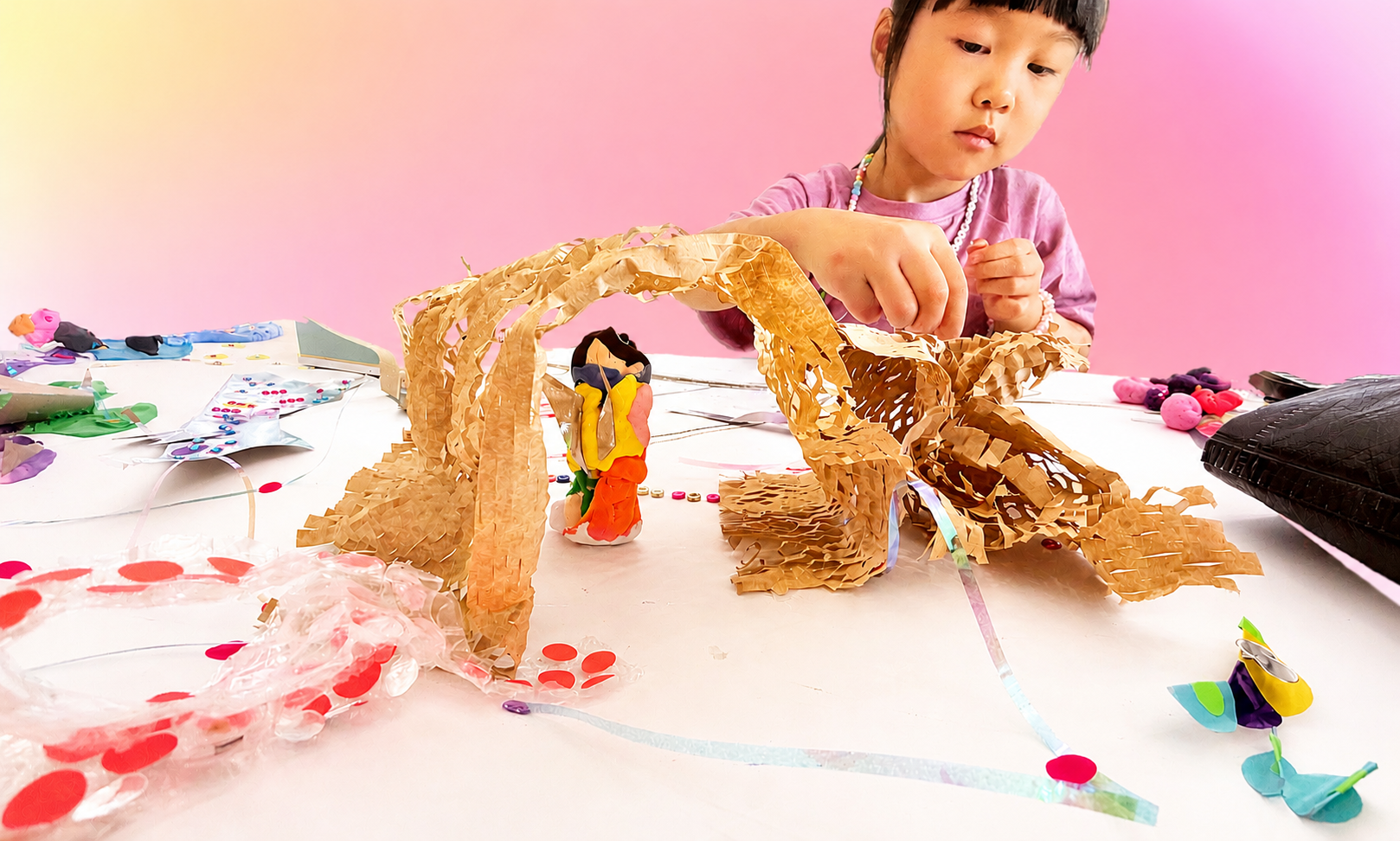
This anonymous parent observation documents a five-year-old child’s developmental shift after only five CCH sessions.
The parent reported visible changes in the child’s confidence, attention, emotional regulation, and creative autonomy. Compared with conventional talent classes, the parent identified the most important difference as “thinking”: the child was not simply imitating or completing a task, but actively searching for materials, making decisions, and creating something of her own.
The feedback is especially meaningful because it was given mid-program, before the full learning cycle was completed. In CCH, parent feedback is not treated as promotional praise. It is read as one layer of developmental evidence, especially when it identifies changes in behavior, attention, confidence, decision-making, and self-authored creative action.
CCH Interpretation
Case X suggests that early participation in a structured studio ecology may support visible shifts in confidence and self-directed action. The parent’s emphasis on “thinking” is important because it moves the evaluation away from surface-level product completion and toward the child’s internal process of choosing, testing, and creating.
Within the CCH framework, this indicates an early movement from external task completion toward self-authored creative agency.
This also aligns with the OECD Learning Compass framework, which places student agency at the center of future education and describes learners as active participants in shaping their own learning pathways. (OECD)
Case Evidence Y
Longitudinal Indicators After 20+ Sessions
Participant: Age 6
Observation period: 20+ sessions
Focus area: Longitudinal indicators of attention regulation, sensory integration, material-based thinking, and self-directed creative development within a studio-based cognitive development environment.
From Sensory Distraction to Integrative Creative Thinking
This anonymous parent observation documents a six-year-old child’s developmental progress after more than twenty CCH sessions.
The parent described the child as highly curious, sensitive to sensory input, and easily affected by surrounding sounds, movement, visual stimuli, and environmental changes. Within the CCH studio-based environment, the child gradually developed stronger attention regulation, clearer creative intention, and a more integrated way of working with materials, ideas, and structure.
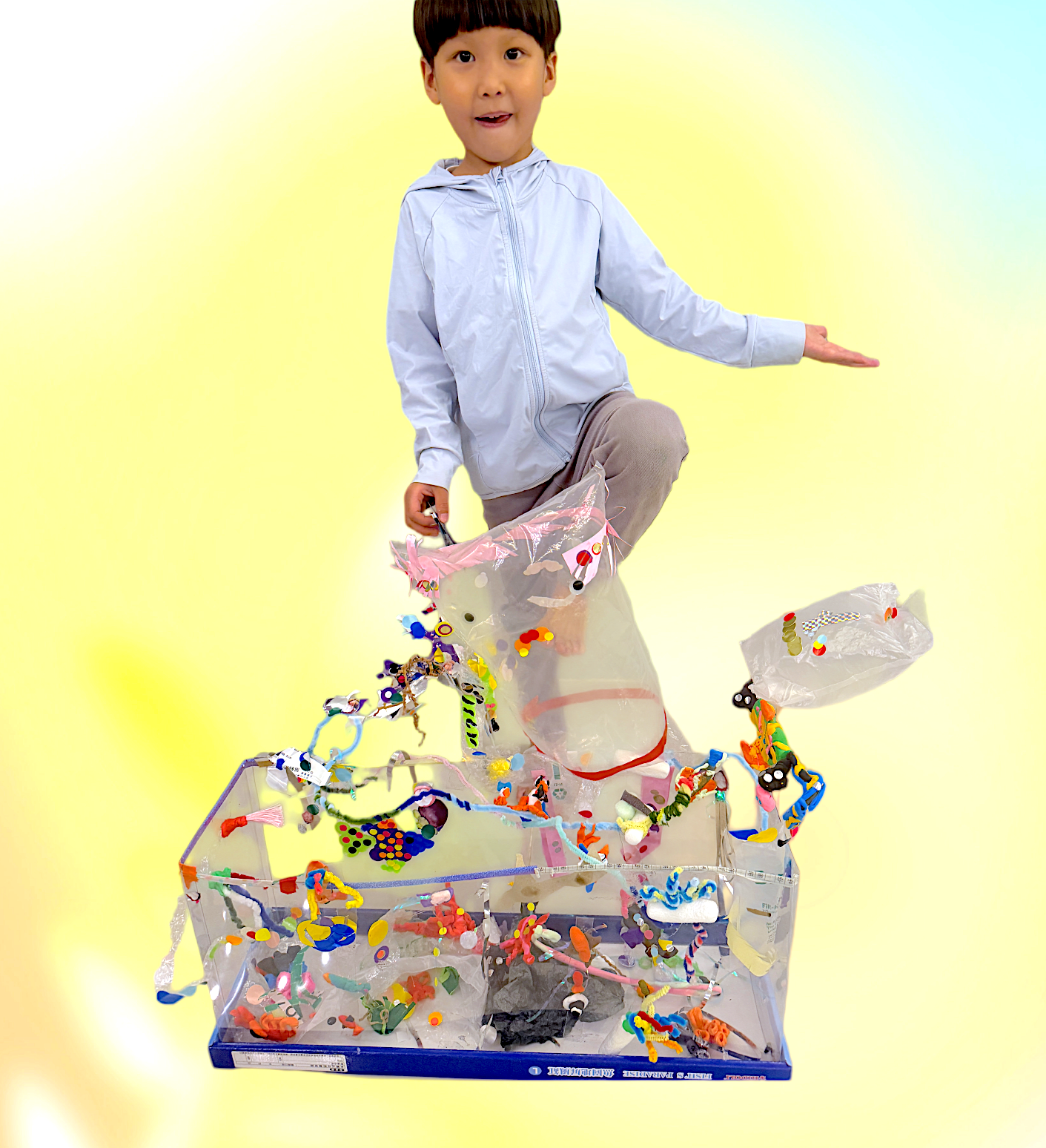
The parent observed that the child became more able to combine materials, organize visual and tactile information, and bring creative learning into everyday play and school contexts. His work was no longer limited to making isolated objects. Instead, he began to connect different materials, stories, toys, and sensory impressions into new creative systems of his own.
Compared with conventional classes, the most significant difference was the expansion of thinking. The child was not working toward a fixed model or predetermined result. He was learning to perceive, select, combine, revise, and present his own creative process with increasing confidence.
This case is meaningful because it reflects a longer developmental arc. After more than twenty sessions, the parent was able to observe changes beyond short-term class engagement, including improved integration ability, stronger expressive confidence, better post-class regulation, and a growing capacity to transform rich sensory input into self-directed creative structure.
In CCH, parent feedback is read as one layer of developmental evidence, especially when it identifies changes in attention, sensory regulation, material integration, conceptual clarity, and self-authored creative action.
CCH Interpretation
Case Y suggests that long-term participation may support a shift from sensory distraction toward integrated creative organization. The child’s sensitivity to environmental stimuli was not treated as a deficit to suppress. Instead, the studio environment provided repeated opportunities to transform sensory richness into material selection, narrative structure, and self-directed creative systems.
This is significant because attention regulation is not only a matter of quiet behavior. In a material-based studio setting, regulation may appear as the capacity to organize sensory input into purposeful action.
The CCH interpretation is that creative development does not emerge from free expression alone. It emerges from repeated encounters with material resistance, spatial choice, sensory complexity, and opportunities for self-authored decision-making.
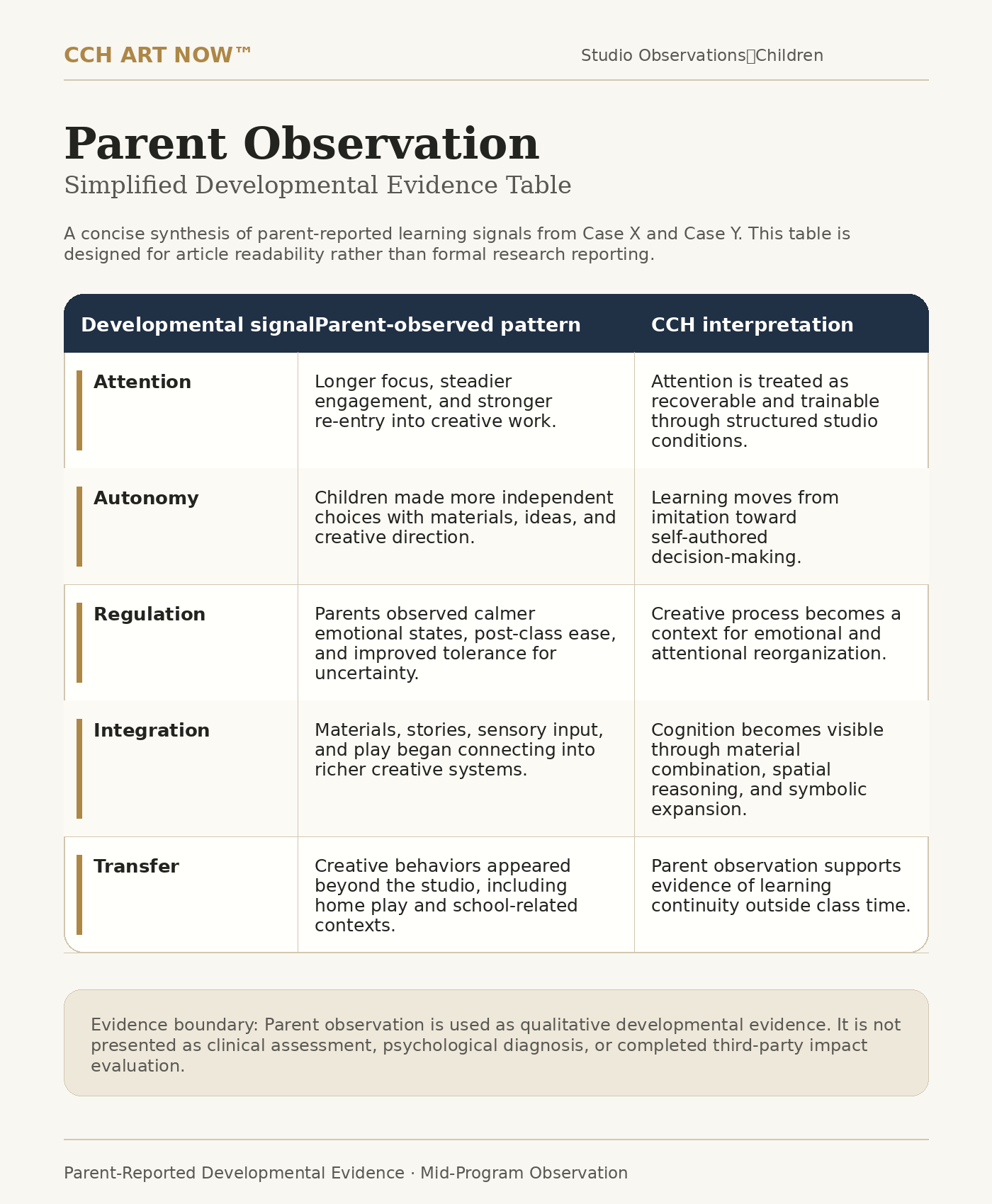
Simplified developmental evidence table based on anonymized parent observations from Case X and Case Y.
Cross-Case Analysis
Although Case X and Case Y differ in duration, both parent observations point to a shared developmental pattern.
Case X shows an early shift toward confidence, decision-making, and creative autonomy after five sessions. Case Y shows a longer developmental arc involving attention regulation, sensory integration, material-based thinking, and transfer into everyday contexts.
Together, the two observations suggest that CCH’s studio-based environment may support:
attention stability
independent decision-making
emotional regulation
sensory integration
material-based thinking
creative autonomy
self-authored learning
transfer beyond the studio
The two cases also show why parent observation matters. A child may appear engaged in class, but parent feedback can reveal whether that engagement is becoming more visible in everyday behavior, play, school-related contexts, or family observation.
Parent Observation as Qualitative Evidence
Parent feedback is not treated as a standalone proof of impact. It is subjective, relational, and context-dependent. However, when parent reports are anonymized, translated carefully, and compared with studio observations, they become a useful layer of qualitative evidence.
In CCH documentation, parent observation is most valuable when it identifies specific behavioral changes rather than general satisfaction. Examples include:
greater willingness to try
stronger confidence in making choices
improved attention after class
more self-directed use of materials
clearer organization of ideas
transfer of creative thinking into daily life
increased ability to continue a process without immediate external validation
This approach is consistent with the evidence boundary established in the CCH WISE Evidence Brief, which frames the current evidence base as early qualitative documentation combining parent testimony, teacher observation, process photography, sustained attention records, and learning-risk analysis.
Evidence Boundary
This article presents anonymized parent observations as qualitative developmental evidence. It is not a clinical assessment, psychological diagnosis, therapeutic claim, or completed third-party impact evaluation.
The observations should be read as parent-reported learning signals within the CCH ART NOW™ documentation framework. Further structured observation, external review, and longitudinal documentation would strengthen the evidence base over time.
References
Center on the Developing Child at Harvard University. (n.d.). A Guide to Executive Function.
Diamond, A. (2013). Executive functions. Annual Review of Psychology, 64, 135–168.
OECD. (n.d.). Student Agency for 2030.
OECD. (n.d.). Future of Education and Skills 2030/2040.
CCH ART NOW™. (2026). Learning Through Material Risk: WISE Evidence Brief. Parent feedback, studio observations, sustained attention records, and CCH-LFMA.
Educational Significance
The educational significance of these parent observations lies in the shift from output-based evaluation to process-based developmental evidence.
In conventional children’s art classes, parents often evaluate the finished product: whether the artwork looks complete, beautiful, recognizable, or worth displaying. CCH asks a different question:
What kind of attention, judgment, regulation, and autonomy became visible through the child’s process?
This reframing is especially important in the age of AI. As AI systems accelerate output generation, human learning environments must protect the slower developmental conditions through which attention, agency, and judgment are formed.
CCH does not position children’s studio practice as decoration or entertainment. It positions studio practice as a structured environment where human capacities can be observed, cultivated, and documented over time.